
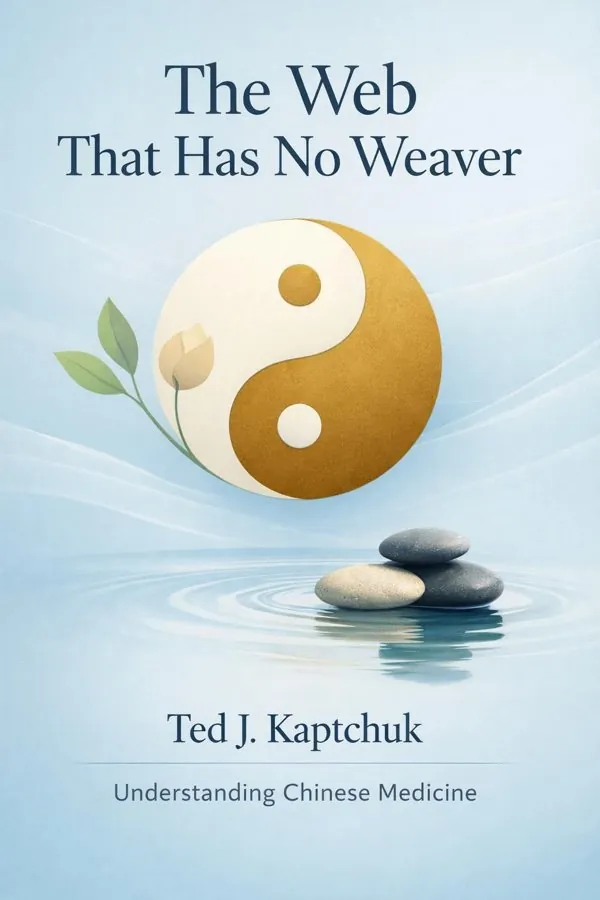
The Web That Has No Weaver: Understanding Chinese Medicine: Summary & Key Insights
 10 min6 chaptersAudio available
What Is The Web That Has No Weaver: Understanding Chinese Medicine About?
The Web That Has No Weaver: Understanding Chinese Medicine by Ted J. Kaptchuk is a health_med book spanning 6 pages. This book offers a comprehensive introduction to traditional Chinese medicine (TCM) for Western readers. It explains the philosophical foundations, diagnostic methods, and treatment principles of TCM, emphasizing the holistic view of health and the interconnection between body, mind, and environment. The author bridges Eastern and Western medical perspectives, making complex concepts accessible to those unfamiliar with Chinese medical theory.
This FizzRead summary covers all 6 key chapters of The Web That Has No Weaver: Understanding Chinese Medicine in approximately 10 minutes, distilling the most important ideas, arguments, and takeaways from Ted J. Kaptchuk's work. Also available as an audio summary and Key Quotes Podcast.
The Web That Has No Weaver: Understanding Chinese Medicine
This book offers a comprehensive introduction to traditional Chinese medicine (TCM) for Western readers. It explains the philosophical foundations, diagnostic methods, and treatment principles of TCM, emphasizing the holistic view of health and the interconnection between body, mind, and environment. The author bridges Eastern and Western medical perspectives, making complex concepts accessible to those unfamiliar with Chinese medical theory.
Who Should Read The Web That Has No Weaver: Understanding Chinese Medicine?
This book is perfect for anyone interested in health_med and looking to gain actionable insights in a short read. Whether you're a student, professional, or lifelong learner, the key ideas from The Web That Has No Weaver: Understanding Chinese Medicine by Ted J. Kaptchuk will help you think differently.
- ✓Readers who enjoy health_med and want practical takeaways
- ✓Professionals looking to apply new ideas to their work and life
- ✓Anyone who wants the core insights of The Web That Has No Weaver: Understanding Chinese Medicine in just 10 minutes
Want the full summary?
Get instant access to this book summary and 100K+ more with Fizz Moment.
Get Free SummaryAvailable on App Store • Free to download
Key Chapters
When Westerners first encounter Chinese medicine, they often ask questions rooted in their own framework: What disease does acupuncture treat? What chemical compound in herbs makes them effective? These are reasonable, but they miss the point. Chinese medicine doesn’t begin by naming diseases in the Western sense. Instead, it starts from patterns—relationships of imbalance among the forces that animate life. You could say that Western medicine is a medicine of things, while Chinese medicine is a medicine of relationships.
In Western medical thinking, disease is a tangible fault, a breakdown in physical components. In Chinese medical thought, that breakdown is only the surface symptom of a deeper disharmony. Health, in this view, is not the absence of disease but the presence of dynamic equilibrium—a balanced flow of Qi, harmonious interaction of Yin and Yang, and cooperation among the body’s organ networks.
This difference leads to profound variations in how diagnosis and treatment are conceived. A Western physician isolates, categorizes, and treats specific dysfunctions—an infection, a tumor, or an organ failure. A Chinese physician perceives patterns in the whole person—perhaps a deficiency of Yin, stagnation of Qi, or disharmony among the Liver and Spleen. These patterns reveal themselves through pulse, complexion, mood, and the rhythms of your environment. To truly grasp Chinese medicine, you must begin to see through these patterns, understanding that health is not something you possess, but something you participate in.
The philosophical roots of Chinese medicine are ancient and profoundly intertwined with the worldview of Taoism. Taoism sees life as a flowing process rather than a static state. The Tao—the Way—is not a doctrine but the underlying rhythm of existence. In Chinese medicine, this philosophy of flow becomes the foundation for how health is understood. Harmony means moving with the Tao; pathology means resistance to that flow.
Yin and Yang describe the dual yet complementary forces that shape all phenomena. Every function in the body can be interpreted through their dynamic interplay: activity and rest, heat and cold, substance and energy. Yin is the material foundation—the blood, the tissues, the fluids. Yang is the force that animates and transforms—movement, warmth, and function. Neither can exist without the other; they continually transform into one another as day turns to night and summer turns to winter. Health depends on their continuous, balanced interaction.
The Five Phases, or Wu Xing—Wood, Fire, Earth, Metal, and Water—extend this dynamic understanding into a system of relationships. Each phase corresponds to specific organs, emotions, and environmental qualities. The liver resonates with Wood, expressing growth and expansion; the heart aligns with Fire, expressing joy and enthusiasm; the spleen embodies Earth, centering and nourishing; the lungs reflect Metal, contraction and clarity; and the kidneys mirror Water, deep vitality and storage. These relationships are not metaphors but diagnostic realities. When a person’s Wood is overactive, for instance, the resulting Liver Qi stagnation may manifest as irritability or muscle tension. In Chinese medicine, the body mirrors the cosmos—it is the microcosm through which the patterns of Heaven and Earth unfold.
+ 4 more chapters — available in the FizzRead app
All Chapters in The Web That Has No Weaver: Understanding Chinese Medicine
About the Author
Ted J. Kaptchuk is an American scholar and practitioner of traditional Chinese medicine. He is a professor of medicine at Harvard Medical School and director of the Program in Placebo Studies and the Therapeutic Encounter. His work focuses on the intersection of traditional healing systems and modern medical research.
Get This Summary in Your Preferred Format
Read or listen to the The Web That Has No Weaver: Understanding Chinese Medicine summary by Ted J. Kaptchuk anytime, anywhere. FizzRead offers multiple formats so you can learn on your terms — all free.
Available formats: App · Audio · PDF · EPUB — All included free with FizzRead
Download The Web That Has No Weaver: Understanding Chinese Medicine PDF and EPUB Summary
Key Quotes from The Web That Has No Weaver: Understanding Chinese Medicine
“When Westerners first encounter Chinese medicine, they often ask questions rooted in their own framework: What disease does acupuncture treat?”
“The philosophical roots of Chinese medicine are ancient and profoundly intertwined with the worldview of Taoism.”
Frequently Asked Questions about The Web That Has No Weaver: Understanding Chinese Medicine
The Web That Has No Weaver: Understanding Chinese Medicine by Ted J. Kaptchuk is a health_med book that explores key ideas across 6 chapters. This book offers a comprehensive introduction to traditional Chinese medicine (TCM) for Western readers. It explains the philosophical foundations, diagnostic methods, and treatment principles of TCM, emphasizing the holistic view of health and the interconnection between body, mind, and environment. The author bridges Eastern and Western medical perspectives, making complex concepts accessible to those unfamiliar with Chinese medical theory.
You Might Also Like
On Immunity
Eula Biss
10 min
The Three-Body Problem
Liu Cixin
10 min
Community Health Volunteer Toolkit: Training and Practical Activities
World Health Organization
10 min
Healing Back Pain: The Mind-Body Connection
John E. Sarno
10 min
Health Literacy for All: Practical Guides to Communicate Health Information (Compilations)
World Health Organization
10 min
The Complete Guide to Sports Supplements: An Evidence-Based Review
Anita Bean
10 minBrowse by Category
Ready to read The Web That Has No Weaver: Understanding Chinese Medicine?
Get the full summary and 100K+ more books with Fizz Moment.