
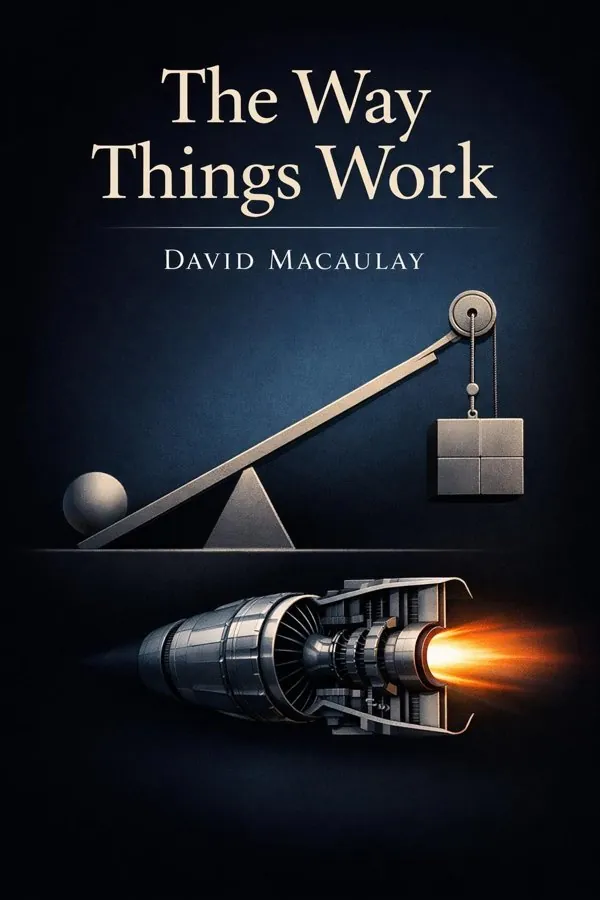
The Way Things Work: Summary & Key Insights
 10 min8 chaptersAudio available
What Is The Way Things Work About?
The Way Things Work by David Macaulay is a popular_sci book spanning 8 pages. This illustrated reference book explains the workings of hundreds of machines and devices, from simple levers and pulleys to complex technologies like jet engines and computers. Through detailed drawings and clear explanations, it reveals the scientific principles behind everyday mechanisms, making physics and engineering accessible and engaging for readers of all ages.
This FizzRead summary covers all 8 key chapters of The Way Things Work in approximately 10 minutes, distilling the most important ideas, arguments, and takeaways from David Macaulay's work. Also available as an audio summary and Key Quotes Podcast.
The Way Things Work
This illustrated reference book explains the workings of hundreds of machines and devices, from simple levers and pulleys to complex technologies like jet engines and computers. Through detailed drawings and clear explanations, it reveals the scientific principles behind everyday mechanisms, making physics and engineering accessible and engaging for readers of all ages.
Who Should Read The Way Things Work?
This book is perfect for anyone interested in popular_sci and looking to gain actionable insights in a short read. Whether you're a student, professional, or lifelong learner, the key ideas from The Way Things Work by David Macaulay will help you think differently.
- ✓Readers who enjoy popular_sci and want practical takeaways
- ✓Professionals looking to apply new ideas to their work and life
- ✓Anyone who wants the core insights of The Way Things Work in just 10 minutes
Want the full summary?
Get instant access to this book summary and 100K+ more with Fizz Moment.
Get Free SummaryAvailable on App Store • Free to download
Key Chapters
Every complex invention starts with something simple. When I began drawing *The Way Things Work*, I realized that true understanding must begin with six timeless machines: the lever, wheel and axle, pulley, inclined plane, wedge, and screw. These are the roots of mechanical creativity — not fancy devices, but extensions of human hands and thought.
A lever teaches us how a small force can lift a great weight. From a playground seesaw to a crowbar prying open a crate, the principle remains beautifully consistent: pivot, effort, and load. In the drawings, I showed mammoths using sticks to move boulders, because their clumsy strength mirrors the idea behind leverage — making nature’s force usable through geometry.
Then there’s the wheel and axle. This idea transformed motion itself by reducing friction. Imagine rolling a heavy log instead of dragging it. That insight marked humanity’s first triumph over resistance. The pulley took it further, allowing us to lift vertically with ease, trading distance for effort through rope and wheel.
The inclined plane and wedge are kin — turning horizontal movement into vertical progress. When a ramp lets a mammoth push a burden upward gently, or a wedge splits wood, you see the magic of distributed effort. The screw extends that genius in a spiral, turning rotation into lift or pressure. Each of these machines contains a miniature story of struggle — how humans learned to manipulate direction and magnitude of forces.
The joy of understanding these devices lies in realizing they aren’t obsolete. They live in every hinge, door handle, zipper, and helicopter rotor. They remain the vocabulary of mechanics — an alphabet from which all machines speak. By grasping them, you join a long conversation between curiosity and creation.
Machines obey universal laws, not human ones. The moment we ask how a lever lifts a rock or why a motor spins, we enter the world of physics. Force, work, and energy are the three measures that govern everything mechanical. In this part of my book, I wanted readers to see these not as abstractions, but as characters that shape the story of every motion.
Force is the push or pull that sets things in motion. Work happens when that force causes movement over a distance. Energy is what enables the force to exist in the first place. Behind every crank, every piston, there’s an exchange of these quantities. When the mammoths push an object up a ramp, they convert muscle energy into mechanical work. The ramp’s slope demands more distance but less force — an exquisite bargain in nature’s economy.
Machines are born to manipulate these exchanges. They’re physical negotiations that make the impossible achievable. A car engine turns explosive chemical energy into rotary motion; a bow stores potential energy to launch an arrow. The laws of conservation remind us that nothing is gained or lost — only transformed. Through gears, pulleys, and springs, machines reshape energy to fit our needs.
There’s wonder in this invisible architecture. Every time you flick a switch and something whirrs alive, you witness centuries of accumulated insight distilled into action. Recognizing force, work, and energy in all technologies reveals their kinship. No matter how advanced our tools become, they still depend on these ancient, elegant exchanges.
+ 6 more chapters — available in the FizzRead app
All Chapters in The Way Things Work
About the Author
David Macaulay is a British-born American author and illustrator known for his richly detailed books that explore architecture, engineering, and design. His works, including Cathedral, Castle, and The Way Things Work, have received numerous awards for their educational and artistic excellence.
Get This Summary in Your Preferred Format
Read or listen to the The Way Things Work summary by David Macaulay anytime, anywhere. FizzRead offers multiple formats so you can learn on your terms — all free.
Available formats: App · Audio · PDF · EPUB — All included free with FizzRead
Download The Way Things Work PDF and EPUB Summary
Key Quotes from The Way Things Work
“Every complex invention starts with something simple.”
“Machines obey universal laws, not human ones.”
Frequently Asked Questions about The Way Things Work
The Way Things Work by David Macaulay is a popular_sci book that explores key ideas across 8 chapters. This illustrated reference book explains the workings of hundreds of machines and devices, from simple levers and pulleys to complex technologies like jet engines and computers. Through detailed drawings and clear explanations, it reveals the scientific principles behind everyday mechanisms, making physics and engineering accessible and engaging for readers of all ages.
You Might Also Like

Structures: Or Why Things Don"t Fall Down
J.E. Gordon
10 min
The Road to Wigan Pier
George Orwell
10 min
Bonk: The Curious Coupling of Science and Sex
Mary Roach
10 min
First Bite: How We Learn to Eat
Bee Wilson
10 min
In Pursuit Of The Unknown: 17 Equations That Changed The World
Ian Stewart
10 min
Napoleon's Buttons: 17 Molecules That Changed History
Penny Le Couteur and Jay Burreson
10 minBrowse by Category
Ready to read The Way Things Work?
Get the full summary and 100K+ more books with Fizz Moment.