
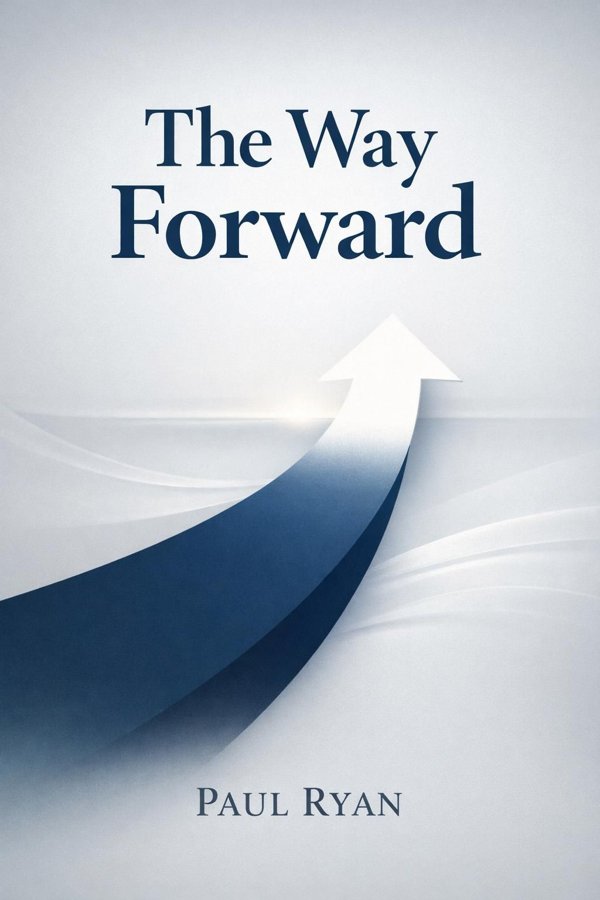
The Way Forward: Summary & Key Insights
by Paul Ryan
 10 min9 chaptersAudio available
Key Takeaways from The Way Forward
Political identity is often less a lightning strike than a long apprenticeship.
Every budget is a moral document in numerical form.
National campaigns reveal whether political ideals can survive the pressures of spectacle.
A healthy economy does not emerge from rhetoric alone; it depends on incentives that encourage work, investment, entrepreneurship, and mobility.
One of Ryan’s sharpest critiques is that Washington has developed habits that confuse political activity with actual achievement.
What Is The Way Forward About?
The Way Forward by Paul Ryan is a politics book spanning 9 pages. The Way Forward is Paul Ryan’s attempt to explain not just what went wrong in American politics, but what a serious governing agenda should look like when institutions are strained, partisanship is intense, and public trust is fading. Part memoir, part policy manifesto, and part argument for conservative reform, the book traces Ryan’s rise from a budget-focused congressman from Wisconsin to Speaker of the House, while laying out his ideas on debt, healthcare, economic growth, poverty, national security, and the future of the Republican Party. What makes the book matter is that Ryan writes from inside the machinery of power. He is not speculating from the sidelines; he is reflecting as someone who helped shape budget fights, tax debates, entitlement reform proposals, and high-stakes negotiations at the center of Washington. Even readers who disagree with his politics will find a revealing portrait of modern American governance and the tensions between principle and compromise. At its core, The Way Forward argues that political renewal requires seriousness: leaders must move beyond slogans, reconnect policy to moral purpose, and rebuild public life through disciplined, pragmatic, principle-based government.
This FizzRead summary covers all 9 key chapters of The Way Forward in approximately 10 minutes, distilling the most important ideas, arguments, and takeaways from Paul Ryan's work. Also available as an audio summary and Key Quotes Podcast.
The Way Forward
The Way Forward is Paul Ryan’s attempt to explain not just what went wrong in American politics, but what a serious governing agenda should look like when institutions are strained, partisanship is intense, and public trust is fading. Part memoir, part policy manifesto, and part argument for conservative reform, the book traces Ryan’s rise from a budget-focused congressman from Wisconsin to Speaker of the House, while laying out his ideas on debt, healthcare, economic growth, poverty, national security, and the future of the Republican Party. What makes the book matter is that Ryan writes from inside the machinery of power. He is not speculating from the sidelines; he is reflecting as someone who helped shape budget fights, tax debates, entitlement reform proposals, and high-stakes negotiations at the center of Washington. Even readers who disagree with his politics will find a revealing portrait of modern American governance and the tensions between principle and compromise. At its core, The Way Forward argues that political renewal requires seriousness: leaders must move beyond slogans, reconnect policy to moral purpose, and rebuild public life through disciplined, pragmatic, principle-based government.
Who Should Read The Way Forward?
This book is perfect for anyone interested in politics and looking to gain actionable insights in a short read. Whether you're a student, professional, or lifelong learner, the key ideas from The Way Forward by Paul Ryan will help you think differently.
- ✓Readers who enjoy politics and want practical takeaways
- ✓Professionals looking to apply new ideas to their work and life
- ✓Anyone who wants the core insights of The Way Forward in just 10 minutes
Want the full summary?
Get instant access to this book summary and 100K+ more with Fizz Moment.
Get Free SummaryAvailable on App Store • Free to download
Key Chapters
Political identity is often less a lightning strike than a long apprenticeship. Ryan presents his early career as proof that public service can begin not with fame or charisma, but with curiosity, discipline, and a fascination with how ideas become laws. His path into politics grew from an interest in economics, public policy, and the practical consequences of government decisions on families and communities. That background shaped him into a legislator who saw politics not primarily as theater, but as a mechanism for solving problems.
He emphasizes that his worldview was rooted in Janesville, Wisconsin, where family, church, local institutions, and hard work formed a civic ethic. Personal loss, especially the early death of his father, deepened his sense of responsibility and independence. Those experiences reinforced his belief that policy debates are never abstract. Tax rates, welfare programs, and debt levels eventually touch real households trying to build stable lives.
Ryan’s early years working in policy and congressional offices also taught him that durable political influence usually comes from mastering substance. Instead of chasing visibility, he developed expertise in budgets and entitlement policy, areas many politicians avoid because they are complicated and politically dangerous. That choice helped define his public career.
For readers, the larger lesson is that meaningful leadership is often built quietly. Expertise, patience, and consistency can matter more than instant recognition. Whether in politics, business, or civic life, a strong foundation usually comes from understanding systems before trying to control them.
Actionable takeaway: If you want to lead, begin by mastering one difficult, overlooked problem area and build credibility through substance before seeking prominence.
Every budget is a moral document in numerical form. Ryan argues that federal budgeting is not just accounting; it is a public statement about what government values, what it is willing to sustain, and what burdens it is shifting onto future generations. His long focus on fiscal policy comes from the conviction that runaway debt is not merely inefficient but unjust, because it allows current leaders to postpone hard choices while younger citizens inherit the consequences.
In the book, Ryan describes budget reform as one of Washington’s least glamorous but most essential tasks. He contends that both parties often avoid honesty on spending because voters reward immediate benefits more than long-term restraint. Yet entitlement growth, chronic deficits, and interest payments can crowd out national priorities and reduce flexibility during crises. From his perspective, reform does not mean austerity for its own sake. It means aligning promises with reality, modernizing programs, and preserving a safety net by making it sustainable.
A practical way to understand his point is through household and organizational planning. Families, schools, nonprofits, and businesses all know that recurring obligations eventually define what is possible. When fixed costs rise unchecked, choice disappears. Ryan believes the federal government faces the same logic, only at a much larger scale.
Even readers skeptical of his preferred policy solutions can appreciate the underlying discipline: governments should state clearly what they can fund, what they must reform, and why delay has costs. Budgeting, in this sense, is a test of seriousness.
Actionable takeaway: Examine any institution you care about by asking a simple question: do its spending choices reflect its stated values, or are short-term incentives undermining long-term goals?
National campaigns reveal whether political ideals can survive the pressures of spectacle. Ryan’s discussion of the 2012 vice-presidential campaign with Mitt Romney highlights the gap between policy seriousness and modern electoral politics. Running on a national ticket placed him inside a relentless cycle of media framing, message discipline, opposition attacks, and symbolic expectations that often leave little room for nuanced argument.
Ryan portrays the campaign as both an honor and a lesson. It showed him how difficult it is to persuade voters on complex matters like debt, Medicare, and tax reform when public attention is fragmented and political branding dominates substance. A candidate can spend years developing detailed proposals, only to watch those proposals reduced to a slogan, a caricature, or a viral clip. Yet he does not conclude that policy should be abandoned. Instead, he suggests that serious reformers must learn to communicate plainly without surrendering intellectual honesty.
The experience also sharpened his awareness of team dynamics and decision-making under pressure. Campaigns demand clarity about priorities: what to defend, what to explain, and when to stay disciplined instead of reactive. Those lessons extend beyond politics. In any high-stakes environment, whether a corporate launch or a public leadership role, the challenge is to preserve mission under scrutiny.
Ryan’s account implies that character matters most when external incentives reward simplification, aggression, or opportunism. The public may not always see the internal deliberations, but they shape what kind of leader emerges after the campaign ends.
Actionable takeaway: In moments of public pressure, decide in advance which principles are nonnegotiable so you can communicate simply without losing the substance that defines your purpose.
A healthy economy does not emerge from rhetoric alone; it depends on incentives that encourage work, investment, entrepreneurship, and mobility. Ryan’s policy vision is anchored in the belief that government should create conditions for broad-based prosperity rather than manage economic life from above. He argues for lower barriers to growth, a simpler tax code, regulatory restraint, and welfare policies that help people move toward independence rather than permanent dependency.
His broader point is that economic policy is inseparable from human dignity. In his view, work is not only a source of income but also a source of purpose, social connection, and self-respect. That is why he repeatedly links pro-growth policies with upward mobility. A dynamic economy, he believes, gives more citizens the chance to form families, save money, build businesses, and participate meaningfully in their communities.
Ryan’s examples often connect national policy to ordinary life: a small business owner deciding whether to hire, a worker considering training, or a family weighing whether a changing tax and benefits structure makes advancement worthwhile. He criticizes systems that unintentionally punish effort by withdrawing support too abruptly as earnings rise. To him, reform should smooth these transitions and make work pay.
Whether one agrees with his conservative framework or not, the central insight remains useful: policy should be evaluated not only by intention, but by the incentives it creates over time. Good goals can fail if the structure discourages initiative or traps people in complexity.
Actionable takeaway: When assessing any policy or program, ask how it shapes behavior over the long run and whether it expands or narrows people’s path to productive independence.
One of Ryan’s sharpest critiques is that Washington has developed habits that confuse political activity with actual achievement. Press conferences, partisan positioning, and endless tactical maneuvering can create the appearance of action while postponing the hard work of governing. He argues that this culture discourages candor. Politicians are rewarded for attacking opponents and protecting short-term narratives, even when the country would benefit more from compromise, transparency, and realistic expectations.
Ryan’s frustration is especially directed at institutional incentives. Legislators face pressure from media cycles, donor expectations, activist bases, and primary threats. These forces make it easier to reject imperfect solutions than to defend serious but politically costly reforms. The result is drift: obvious structural problems remain unresolved because too many actors benefit from symbolic conflict.
This diagnosis helps explain why long-term issues such as entitlement reform, debt, and immigration persist despite widespread acknowledgment that the status quo is unsustainable. In Ryan’s telling, the problem is not merely ideological disagreement; it is a system that prizes confrontation over stewardship.
The insight applies beyond government. Many organizations substitute visible busyness for genuine progress. Teams hold meetings, issue statements, and circulate plans, but avoid the decisions that would actually improve performance. Ryan’s complaint about Washington is really a warning about institutions in general: incentives shape behavior, and bad incentives corrode mission.
Actionable takeaway: In your own workplace or civic setting, distinguish between activities that generate attention and actions that solve problems, then reward the latter even when they are less visible or immediately popular.
Principles matter most when they can be translated into workable policy. Ryan does not present conservatism as a collection of slogans about small government; he frames it as a governing philosophy centered on constitutional limits, free enterprise, personal responsibility, civil society, and respect for local institutions. The challenge, as he sees it, is not merely defending these values rhetorically but applying them to concrete issues in a way that improves lives.
He argues that conservatives weaken themselves when they become defined only by opposition. Saying no to government expansion may sometimes be necessary, but it is not sufficient. A credible political movement must also answer practical questions: How should healthcare function? How should anti-poverty programs encourage mobility? How should tax policy foster growth without sacrificing fairness? Ryan wants a conservatism that is reform-minded rather than nostalgic.
A key part of this approach is subsidiarity, the idea that decisions should be made as close to people and communities as possible. Families, churches, neighborhoods, and local organizations often understand needs better than distant bureaucracies. Yet Ryan also acknowledges that federal policy shapes the environment in which these institutions operate. That means principles must guide design, not excuse inaction.
For readers, this section offers a broader lesson about ideology and execution. Values gain credibility when they solve real problems. Any belief system, political or otherwise, becomes hollow when it cannot move from abstract commitments to operational choices.
Actionable takeaway: Take one principle you claim to value, such as freedom, fairness, or responsibility, and ask how it should concretely shape decisions, budgets, and incentives rather than remaining only a statement of identity.
A society can grow wealthier while becoming less cohesive. Ryan argues that policy debates too often ignore the social and cultural foundations that make self-government possible. Economic growth matters, but it cannot by itself repair loneliness, family breakdown, civic disengagement, or the weakening of local institutions. In his view, a flourishing nation depends on moral and cultural habits that government cannot manufacture but can either support or undermine.
This is where the book broadens beyond budgets and tax policy. Ryan stresses the importance of family stability, community responsibility, religious life, and voluntary associations. These institutions teach restraint, obligation, trust, and mutual aid. Without them, citizens may become more isolated and more dependent on centralized systems to provide meaning and order. He worries that when civil society weakens, politics becomes overburdened, because people begin asking government to solve problems that are fundamentally relational or cultural.
A practical application of this idea can be seen in neighborhoods where schools, faith communities, local charities, and mentoring groups create networks of support that no national program can replicate. Public policy can help by avoiding designs that penalize marriage, discourage work, or crowd out community initiative. But Ryan’s larger point is that renewal must also come from below.
Even readers who are not socially conservative can engage the central question: what non-government institutions are essential to a stable democracy, and how can they be strengthened? The answer matters because citizenship is learned in everyday life, not only at the ballot box.
Actionable takeaway: Invest time or resources in at least one local institution, such as a school, charity, congregation, or mentoring group, because strong communities are built through participation, not commentary.
Foreign policy may seem distant from domestic concerns until instability abroad begins shaping daily life. Ryan’s national security outlook is rooted in the belief that American leadership remains necessary in a dangerous world. He argues that adversaries exploit hesitation, allies depend on credible commitments, and national defense is a core constitutional responsibility that cannot be treated as secondary to domestic politics.
In the book, Ryan links military readiness, alliances, and strategic clarity to broader national confidence. A country burdened by internal division can still protect itself, but only if it remains serious about threats from hostile states, terrorism, cyberattacks, and geopolitical power shifts. He is skeptical of both naivete and fatigue: the idea that threats will resolve themselves, or that withdrawal from global responsibilities will automatically produce peace.
His perspective is also institutional. Just as fiscal disorder can weaken national resilience, so can inconsistent foreign policy. Defense planning requires long horizons, credible funding, and clear objectives. Businesses and households understand the value of preparing before a crisis; Ryan argues that nations must do the same. You do not wait for a fire to decide whether firefighters matter.
For general readers, the enduring lesson is that security policy should be judged by preparedness, deterrence, and realism rather than wishful thinking. A stable international order may be imperfect, but the vacuum left by retreat is often filled by more dangerous actors.
Actionable takeaway: Evaluate national security debates by asking three questions: what are the actual threats, what capacities are needed to deter them, and what are the costs of pretending the problem can be ignored?
Political parties decline when they become more interested in emotion than in governing. Ryan’s vision for the future of the Republican Party is not simply to win elections, but to recover a reputation for seriousness, reform, and responsible leadership. He argues that the party must pair conservative principles with constructive policies that address modern problems, including healthcare costs, economic dislocation, institutional distrust, and cultural fragmentation.
A major theme is that populist energy, while politically potent, is not enough to sustain a governing coalition. Anger can mobilize voters, but it cannot substitute for an agenda. Ryan wants the party to resist defining itself solely through grievance, personality, or tactical opposition. Instead, he advocates a politics of persuasion rooted in ideas, optimism, and competence.
This argument also reflects his broader concern about the erosion of democratic norms and institutional trust. Parties shape public expectations. If they reward performative conflict over reform, they teach citizens to expect less from government and more from spectacle. Ryan believes Republicans should present themselves as a party of upward mobility, constitutionalism, and practical problem-solving.
The lesson extends beyond partisan politics. Any organization can lose its purpose when short-term excitement overwhelms mission. Renewal requires leaders willing to tell supporters what they need to hear, not only what they want to hear. That is often risky, but necessary.
Actionable takeaway: Judge political movements not only by whom they oppose, but by whether they offer a coherent governing program that could improve institutions over time.
All Chapters in The Way Forward
About the Author
Paul Ryan is an American politician, policy advocate, and former congressional leader who served as the 54th Speaker of the United States House of Representatives from 2015 to 2019. A Republican from Wisconsin, he represented Wisconsin’s 1st congressional district in the House from 1999 to 2019 and became one of his party’s most prominent voices on budgeting, tax reform, and entitlement policy. Ryan chaired both the House Budget Committee and the House Ways and Means Committee, roles that helped establish his reputation as a detail-oriented policy thinker. In 2012, he was the Republican nominee for vice president alongside Mitt Romney. Throughout his public career, Ryan became closely associated with fiscal conservatism, government reform, and the effort to connect conservative principles with practical governance.
Get This Summary in Your Preferred Format
Read or listen to the The Way Forward summary by Paul Ryan anytime, anywhere. FizzRead offers multiple formats so you can learn on your terms — all free.
Available formats: App · Audio · PDF · EPUB — All included free with FizzRead
Download The Way Forward PDF and EPUB Summary
Key Quotes from The Way Forward
“Political identity is often less a lightning strike than a long apprenticeship.”
“Every budget is a moral document in numerical form.”
“National campaigns reveal whether political ideals can survive the pressures of spectacle.”
“A healthy economy does not emerge from rhetoric alone; it depends on incentives that encourage work, investment, entrepreneurship, and mobility.”
“One of Ryan’s sharpest critiques is that Washington has developed habits that confuse political activity with actual achievement.”
Frequently Asked Questions about The Way Forward
The Way Forward by Paul Ryan is a politics book that explores key ideas across 9 chapters. The Way Forward is Paul Ryan’s attempt to explain not just what went wrong in American politics, but what a serious governing agenda should look like when institutions are strained, partisanship is intense, and public trust is fading. Part memoir, part policy manifesto, and part argument for conservative reform, the book traces Ryan’s rise from a budget-focused congressman from Wisconsin to Speaker of the House, while laying out his ideas on debt, healthcare, economic growth, poverty, national security, and the future of the Republican Party. What makes the book matter is that Ryan writes from inside the machinery of power. He is not speculating from the sidelines; he is reflecting as someone who helped shape budget fights, tax debates, entitlement reform proposals, and high-stakes negotiations at the center of Washington. Even readers who disagree with his politics will find a revealing portrait of modern American governance and the tensions between principle and compromise. At its core, The Way Forward argues that political renewal requires seriousness: leaders must move beyond slogans, reconnect policy to moral purpose, and rebuild public life through disciplined, pragmatic, principle-based government.
You Might Also Like
Antifa: The Anti-Fascist Handbook
Mark Bray
10 min
Attack from Within: How Disinformation Is Sabotaging America
Barbara McQuade
10 min
Coercion, Capital, and European States, AD 990–1992
Charles Tilly
10 min
Digital Democracy: Concepts, Methodologies, Tools, and Applications
Various Authors
10 min
Fascism
Stanley G. Payne
10 min
Fire And Fury: Inside The Trump White House
Michael Wolff
10 minBrowse by Category
Ready to read The Way Forward?
Get the full summary and 100K+ more books with Fizz Moment.