
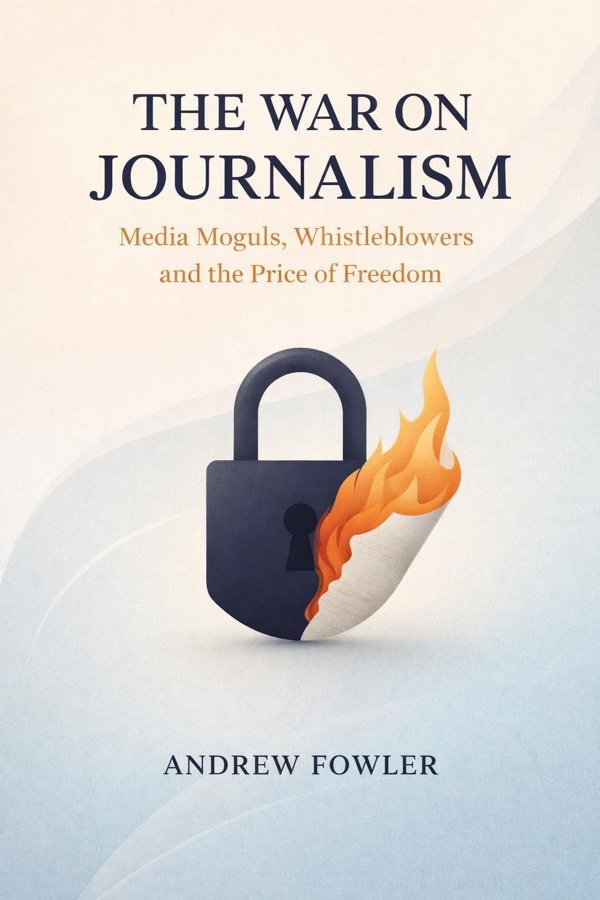
The War on Journalism: Media Moguls, Whistleblowers and the Price of Freedom: Summary & Key Insights
 10 min5 chaptersAudio available
What Is The War on Journalism: Media Moguls, Whistleblowers and the Price of Freedom About?
The War on Journalism: Media Moguls, Whistleblowers and the Price of Freedom by Andrew Fowler is a politics book spanning 5 pages. An investigative work examining the global assault on independent journalism, focusing on the relationships between governments, corporations, and the media. Fowler explores how whistleblowers and journalists face increasing threats, censorship, and legal challenges in the pursuit of truth.
This FizzRead summary covers all 5 key chapters of The War on Journalism: Media Moguls, Whistleblowers and the Price of Freedom in approximately 10 minutes, distilling the most important ideas, arguments, and takeaways from Andrew Fowler's work. Also available as an audio summary and Key Quotes Podcast.
The War on Journalism: Media Moguls, Whistleblowers and the Price of Freedom
An investigative work examining the global assault on independent journalism, focusing on the relationships between governments, corporations, and the media. Fowler explores how whistleblowers and journalists face increasing threats, censorship, and legal challenges in the pursuit of truth.
Who Should Read The War on Journalism: Media Moguls, Whistleblowers and the Price of Freedom?
This book is perfect for anyone interested in politics and looking to gain actionable insights in a short read. Whether you're a student, professional, or lifelong learner, the key ideas from The War on Journalism: Media Moguls, Whistleblowers and the Price of Freedom by Andrew Fowler will help you think differently.
- ✓Readers who enjoy politics and want practical takeaways
- ✓Professionals looking to apply new ideas to their work and life
- ✓Anyone who wants the core insights of The War on Journalism: Media Moguls, Whistleblowers and the Price of Freedom in just 10 minutes
Want the full summary?
Get instant access to this book summary and 100K+ more with Fizz Moment.
Get Free SummaryAvailable on App Store • Free to download
Key Chapters
The press has long claimed the mantle of the 'fourth estate'—an independent watchdog holding power to account. But that heritage, hard-won through centuries of struggle, is now under siege. In tracing the lineage of press freedom, I examine its symbiotic relationship with democracy. Early journalism thrived on adversarial questioning, but as political institutions professionalized and corporations swallowed once-independent newsrooms, the watchdog role deteriorated into a spectator sport.
During the twentieth century, Western democracies enshrined the ideal of a free press, but this freedom came tethered to capital. As television networks expanded and advertising dependence deepened, the values of journalism—verification, fairness, and courage—found themselves subordinated to ratings and quarterly profit margins. The old adage that news should comfort the afflicted and afflict the comfortable gradually inverted. Investigations into powerful interests grew fewer, and self-censorship became routine.
This historical context matters because the failures of today’s media are not sudden collapses; they are the culmination of decades of compromise. What began as subtle editorial pressure soon hardened into systemic submission. When governments discovered they could shape the narrative by managing access, and when corporations learned that controversy could be costly, journalism began its retreat. This is where the war truly began—not with bullets or bans, but with budget cuts and boardroom edicts.
As a reporter, I have seen the transformation firsthand. The editorial independence that once defined newsrooms has been eroded by layers of managerial oversight, legal vetting, and public relations gatekeeping. The result is a culture of compliance that masquerades as balance. And so, the modern journalist often walks a tightrope between truth and career survival. What was once a profession defined by fearless inquiry has, too often, become an industry driven by fear itself.
When examining modern journalism, one cannot ignore the towering influence of the moguls—those who own not just outlets, but entire ecosystems of narrative control. Rupert Murdoch, whose empire stretches from Sydney to New York to London, epitomizes the concentration of power that has turned journalism into an instrument of ideology. In this section, I unpack how ownership shapes truth—and why editorial freedom is impossible when tied to shareholder interests.
Media consolidation erodes pluralism. With fewer owners controlling more channels, dissenting opinions become liabilities, not assets. Consider how the same story—a leak about government wrongdoing, for instance—receives radically different treatment depending on the publisher’s corporate alliances. News, in this context, becomes not an account of fact but a battleground of vested interests. The greater the concentration, the narrower the discourse.
I have witnessed newspapers pull stories at the last moment because advertisers threatened withdrawal, and investigative projects shelved because they might "damage relationships" with political power. Such patterns illustrate not isolated lapses but the natural outcome of a business model where truth competes with profit. What emerges is a form of information feudalism: moguls act as lords, journalists their subjects, and the public the serfs, fed a carefully measured portion of reality.
Still, the problem transcends individuals. The corporate newsroom’s dependence on capital mimics broader capitalist dynamics. Ownership determines agenda, and agenda determines the limits of permissible thought. In some cases, investigative journalism survives—not because of these systems, but in spite of them. The independent outlets that continue probing power are exceptions that prove the rule: that freedom, when commodified, inevitably contracts.
In narrating these developments, I argue that the struggle against media consolidation is not merely about market fairness—it is about democratic survival. For democracy cannot flourish if the gatekeepers of truth operate from boardrooms rather than newsrooms.
+ 3 more chapters — available in the FizzRead app
All Chapters in The War on Journalism: Media Moguls, Whistleblowers and the Price of Freedom
About the Author
Andrew Fowler is an Australian investigative journalist and author, known for his work with the ABC’s Four Corners program. His reporting has covered international politics, intelligence, and media freedom.
Get This Summary in Your Preferred Format
Read or listen to the The War on Journalism: Media Moguls, Whistleblowers and the Price of Freedom summary by Andrew Fowler anytime, anywhere. FizzRead offers multiple formats so you can learn on your terms — all free.
Available formats: App · Audio · PDF · EPUB — All included free with FizzRead
Download The War on Journalism: Media Moguls, Whistleblowers and the Price of Freedom PDF and EPUB Summary
Key Quotes from The War on Journalism: Media Moguls, Whistleblowers and the Price of Freedom
“The press has long claimed the mantle of the 'fourth estate'—an independent watchdog holding power to account.”
“When examining modern journalism, one cannot ignore the towering influence of the moguls—those who own not just outlets, but entire ecosystems of narrative control.”
Frequently Asked Questions about The War on Journalism: Media Moguls, Whistleblowers and the Price of Freedom
The War on Journalism: Media Moguls, Whistleblowers and the Price of Freedom by Andrew Fowler is a politics book that explores key ideas across 5 chapters. An investigative work examining the global assault on independent journalism, focusing on the relationships between governments, corporations, and the media. Fowler explores how whistleblowers and journalists face increasing threats, censorship, and legal challenges in the pursuit of truth.
You Might Also Like
Antifa: The Anti-Fascist Handbook
Mark Bray
10 min
Attack from Within: How Disinformation Is Sabotaging America
Barbara McQuade
10 min
Coercion, Capital, and European States, AD 990–1992
Charles Tilly
10 min
Digital Democracy: Concepts, Methodologies, Tools, and Applications
Various Authors
10 min
Fascism
Stanley G. Payne
10 min
Fire And Fury: Inside The Trump White House
Michael Wolff
10 minBrowse by Category
Ready to read The War on Journalism: Media Moguls, Whistleblowers and the Price of Freedom?
Get the full summary and 100K+ more books with Fizz Moment.