
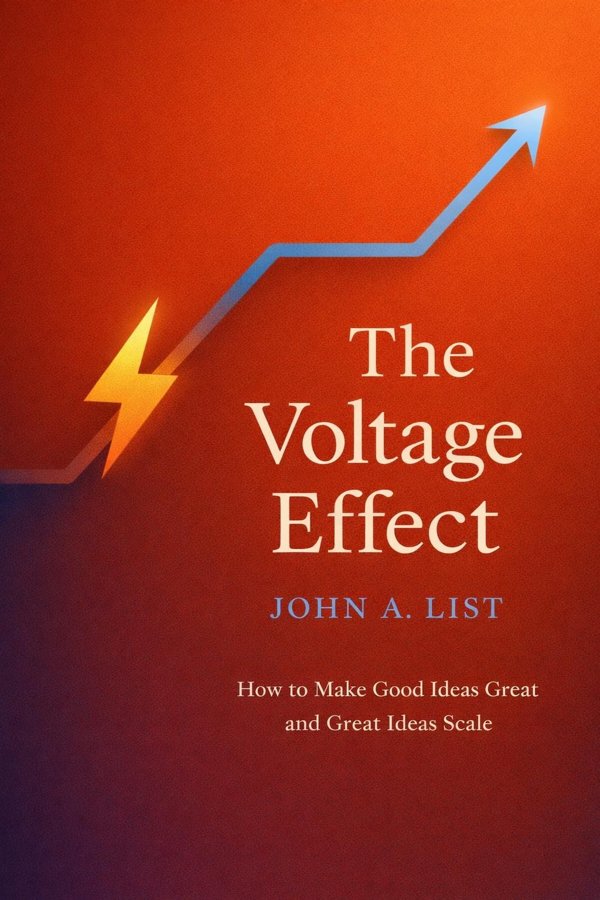
The Voltage Effect: How to Make Good Ideas Great and Great Ideas Scale: Summary & Key Insights
by John A. List
 10 min4 chaptersAudio available
What Is The Voltage Effect: How to Make Good Ideas Great and Great Ideas Scale About?
The Voltage Effect: How to Make Good Ideas Great and Great Ideas Scale by John A. List is a economics book spanning 4 pages. In The Voltage Effect, economist John A. List explores why some ideas and innovations succeed on a large scale while others fail to take off. Drawing on decades of behavioral economics research and real-world experiments, List identifies the key factors that determine whether an idea can 'scale' effectively. He provides insights into decision-making, incentives, and organizational design, offering practical lessons for entrepreneurs, policymakers, and leaders seeking to turn promising concepts into impactful realities.
This FizzRead summary covers all 4 key chapters of The Voltage Effect: How to Make Good Ideas Great and Great Ideas Scale in approximately 10 minutes, distilling the most important ideas, arguments, and takeaways from John A. List's work. Also available as an audio summary and Key Quotes Podcast.
The Voltage Effect: How to Make Good Ideas Great and Great Ideas Scale
In The Voltage Effect, economist John A. List explores why some ideas and innovations succeed on a large scale while others fail to take off. Drawing on decades of behavioral economics research and real-world experiments, List identifies the key factors that determine whether an idea can 'scale' effectively. He provides insights into decision-making, incentives, and organizational design, offering practical lessons for entrepreneurs, policymakers, and leaders seeking to turn promising concepts into impactful realities.
Who Should Read The Voltage Effect: How to Make Good Ideas Great and Great Ideas Scale?
This book is perfect for anyone interested in economics and looking to gain actionable insights in a short read. Whether you're a student, professional, or lifelong learner, the key ideas from The Voltage Effect: How to Make Good Ideas Great and Great Ideas Scale by John A. List will help you think differently.
- ✓Readers who enjoy economics and want practical takeaways
- ✓Professionals looking to apply new ideas to their work and life
- ✓Anyone who wants the core insights of The Voltage Effect: How to Make Good Ideas Great and Great Ideas Scale in just 10 minutes
Want the full summary?
Get instant access to this book summary and 100K+ more with Fizz Moment.
Get Free SummaryAvailable on App Store • Free to download
Key Chapters
When I talk about scalability, I’m not merely describing growth. Growth can occur for many reasons—luck, marketing, momentum—but scalability refers to something deeper: the ability of an idea to maintain its effectiveness as it expands. It’s the capacity to preserve the original magic across scale.
A scalable idea delivers consistent results regardless of context, while an unscalable one performs only under narrow conditions. To me, scalability is both a truth test and a design principle. When you run a small experiment, you’re uncovering how humans react to a set of circumstances. But conditions change as you scale. Populations diversify, motivations shift, systems become more complex. Unless your idea’s core mechanism survives that turbulence, you’ll lose voltage quickly.
In behavioral economics, we often carry lessons from controlled trials into policy—but if those lessons were drawn from an unrepresentative sample, the resulting programs falter. Similarly, a company that finds success among early adopters might see its appeal fade when reaching mainstream consumers. Scalability demands humility; it asks you to validate not just that something works once, but that it can keep working under pressure.
Understanding scalability requires focusing on two dimensions: fidelity and efficiency. Fidelity asks, does the idea retain its essence when replicated? Efficiency asks, can it do so without exponential cost? The intersection of these two defines the scalable boundary. To get there, you have to recognize that every system resists scaling in its own way—people change, incentives distort, externalities multiply. The discipline lies in predicting those changes before they happen.
Throughout my work—from pricing policies to charitable donations to education initiatives—I’ve learned that the most dangerous assumption is that early success automatically forecasts widespread success. Scaling is rewriting the equation, not copying the result. It’s less about taking what worked yesterday and more about uncovering why it worked, so you can reengineer that mechanism for broader reach.
In this sense, scalability isn’t a destination; it’s a diagnostic mindset. When you internalize it, you begin seeing every idea as an evolving system of inputs and feedbacks. You learn to ask not just, ‘Did it work?’ but ‘Why did it work, and will those reasons survive when the world changes?’ That’s when the path to genuine scaling begins.
Standing before an idea that shines in early trials, I always ask myself: does it exhibit the five vital signs of scalability? Over years of experiments and entrepreneurship, I’ve found these signs to be remarkably predictive: false positives, representativeness, false negatives, incentives, and spillovers. Think of them as your idea’s health indicators—ignore them, and the voltage drops before you even flip the switch.
False positives are the seductive mirages. They occur when early data suggests success that isn’t real. Often, enthusiasm, sampling quirks, or chance drive results upward, fooling us into overconfidence. At Uber, when we tested certain pricing incentives, initial figures looked spectacular—but when scaled citywide, those effects vanished. We’d been measuring excitement, not sustainable behavior. Recognizing false positives requires skepticism and replication. Every new success should invite a second question: ‘If I changed the setting, would this outcome persist?’ Without that question, we mistake local magic for universal truth.
Representativeness ties closely to this. If your test environment doesn’t reflect the broader population, your results lie to you. In education programs, I learned this firsthand. Teaching interventions that succeed in motivated classrooms sometimes falter in under-resourced ones. Policymakers must ask whether their pilot samples mirror the diversity of real-world users. Representativeness is not about scale alone—it’s about inclusion, about giving your idea the variety of contexts it will eventually face.
False negatives work in the opposite direction. Sometimes we discard ideas too early because conditions sabotaged their performance. A great idea can appear weak when tested under tight constraints or poor data strategy. In charitable giving, for example, experiments have shown that slight changes in framing can shift donor behavior dramatically. If your test failed to capture the right framing, you might be rejecting gold as garbage. The art is knowing when to push past a disappointing first signal to revisit the underlying mechanism.
Incentives are the dynamic fuel of scalability. Every person involved—employees, users, partners—responds to incentives, and those incentives evolve with scale. What motivates a small team of founders may not motivate thousands of workers. At Lyft and Uber, we saw performance surge or sag depending on whether incentives aligned with long-term goals rather than short-term gains. Designing scalable incentives means anticipating behavioral drift—building systems that encourage continued excellence even as distance from leadership grows.
Finally, spillovers capture the unseen ripple effects. When ideas scale, they don’t merely multiply—they change the environment around them. A successful carbon tax, for instance, might influence consumer behavior, political sentiment, and innovation far beyond its original economic targets. Spillovers can be positive or negative, amplifying voltage or draining it. The solution isn’t avoidance but awareness: measure and manage those side currents so they strengthen rather than undermine your purpose.
To me, these five vital signs form the diagnostic map for every idea’s journey. They remind us that scaling is not an act of repetition but of adaptation. You’re building a bigger organism now—one with metabolism, feedback, and consequence. Treat each sign as a pulse check before accelerating, and you’ll find your idea retains its voltage where others flicker out.
+ 2 more chapters — available in the FizzRead app
All Chapters in The Voltage Effect: How to Make Good Ideas Great and Great Ideas Scale
About the Author
John A. List is an American economist known for his pioneering work in field experiments and behavioral economics. He is the Kenneth C. Griffin Distinguished Service Professor in Economics at the University of Chicago and has served as Chief Economist for Uber and Lyft. His research focuses on understanding human behavior in real-world settings and applying economic principles to solve practical problems.
Get This Summary in Your Preferred Format
Read or listen to the The Voltage Effect: How to Make Good Ideas Great and Great Ideas Scale summary by John A. List anytime, anywhere. FizzRead offers multiple formats so you can learn on your terms — all free.
Available formats: App · Audio · PDF · EPUB — All included free with FizzRead
Download The Voltage Effect: How to Make Good Ideas Great and Great Ideas Scale PDF and EPUB Summary
Key Quotes from The Voltage Effect: How to Make Good Ideas Great and Great Ideas Scale
“When I talk about scalability, I’m not merely describing growth.”
“Standing before an idea that shines in early trials, I always ask myself: does it exhibit the five vital signs of scalability?”
Frequently Asked Questions about The Voltage Effect: How to Make Good Ideas Great and Great Ideas Scale
The Voltage Effect: How to Make Good Ideas Great and Great Ideas Scale by John A. List is a economics book that explores key ideas across 4 chapters. In The Voltage Effect, economist John A. List explores why some ideas and innovations succeed on a large scale while others fail to take off. Drawing on decades of behavioral economics research and real-world experiments, List identifies the key factors that determine whether an idea can 'scale' effectively. He provides insights into decision-making, incentives, and organizational design, offering practical lessons for entrepreneurs, policymakers, and leaders seeking to turn promising concepts into impactful realities.
You Might Also Like

Business Adventures
John Brooks
10 min
Nudge
Richard H. Thaler, Cass R. Sunstein
10 min
The Hitchhiker"s Guide to the Galaxy
Douglas Adams
10 minThe Muqaddimah
Ibn Khaldun
10 minThe Outsiders
William N. Thorndike
10 min
A Little History of Economics
Niall Kishtainy
10 minBrowse by Category
Ready to read The Voltage Effect: How to Make Good Ideas Great and Great Ideas Scale?
Get the full summary and 100K+ more books with Fizz Moment.