
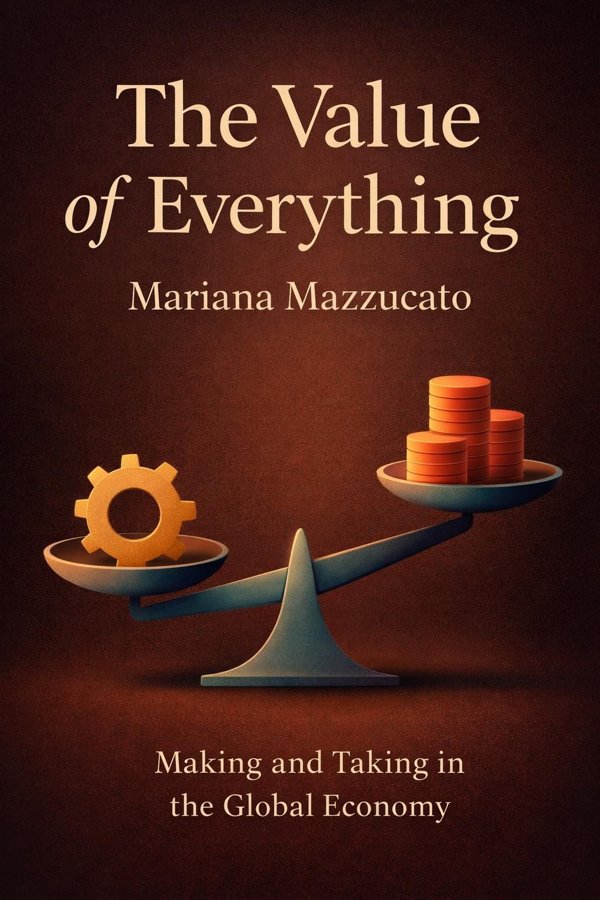
The Value of Everything: Making and Taking in the Global Economy: Summary & Key Insights
 10 min10 chaptersAudio available
What Is The Value of Everything: Making and Taking in the Global Economy About?
The Value of Everything: Making and Taking in the Global Economy by Mariana Mazzucato is a economics book spanning 10 pages. In this influential work, economist Mariana Mazzucato examines how modern economies define and measure value. She argues that the distinction between value creation and value extraction has been blurred, allowing financial and rent-seeking activities to be rewarded as if they were productive. Through historical and contemporary analysis, Mazzucato calls for a rethinking of capitalism to ensure that value is created collectively and distributed fairly.
This FizzRead summary covers all 10 key chapters of The Value of Everything: Making and Taking in the Global Economy in approximately 10 minutes, distilling the most important ideas, arguments, and takeaways from Mariana Mazzucato's work. Also available as an audio summary and Key Quotes Podcast.
The Value of Everything: Making and Taking in the Global Economy
In this influential work, economist Mariana Mazzucato examines how modern economies define and measure value. She argues that the distinction between value creation and value extraction has been blurred, allowing financial and rent-seeking activities to be rewarded as if they were productive. Through historical and contemporary analysis, Mazzucato calls for a rethinking of capitalism to ensure that value is created collectively and distributed fairly.
Who Should Read The Value of Everything: Making and Taking in the Global Economy?
This book is perfect for anyone interested in economics and looking to gain actionable insights in a short read. Whether you're a student, professional, or lifelong learner, the key ideas from The Value of Everything: Making and Taking in the Global Economy by Mariana Mazzucato will help you think differently.
- ✓Readers who enjoy economics and want practical takeaways
- ✓Professionals looking to apply new ideas to their work and life
- ✓Anyone who wants the core insights of The Value of Everything: Making and Taking in the Global Economy in just 10 minutes
Want the full summary?
Get instant access to this book summary and 100K+ more with Fizz Moment.
Get Free SummaryAvailable on App Store • Free to download
Key Chapters
To begin this exploration, I step back to the classical economists—Adam Smith, David Ricardo, and Karl Marx—because they understood that value was rooted in production. For Smith, value derived from labor that produced goods for exchange; for Ricardo, comparative advantage and productive labor structured how nations prospered; and Marx expanded these insights to highlight exploitation and surplus value as the dynamics underpinning capitalist growth.
What united these thinkers was a concern with the real economy—the tangible processes of making and doing. Unproductive labor, Smith noted, may yield pleasure or power but not the goods that sustain society. Ricardo examined how rents distorted value by allowing landowners to profit without contributing production. Marx’s critique went further, exposing how capital accumulation could conceal exploitation by treating labor’s contribution as a mere cost.
These historical foundations matter because they gave economics a moral and productive center. Value was not simply about what people were willing to pay; it was about what actually contributed to material growth. In classical theory, the economy was anchored in production, and money was a reflection of that production. Today, that anchor has drifted. Understanding this shift requires seeing how the definition of value was reengineered.
The key rupture came with the rise of neoclassical economics in the late nineteenth century. The classical focus on labor and production was replaced by the notion of subjective utility—the idea that value resided not in production but in the pleasure or satisfaction derived by consumers. This shift was subtle yet revolutionary. In making value subjective, economics detached it from the material processes of creating goods and services.
This redefinition brought individual choice to the center of economic thought. Markets became arenas of preference expression, not social production. Prices were assumed to reflect value perfectly, and thus, market outcomes were taken as objective truths. Once that assumption was accepted, anything that earned a profit appeared to be value-creating by definition.
The implications are profound. If price equals value, then there is no meaningful distinction between productive and unproductive activity. Speculative trading, monopolistic rents, and leveraged buyouts all seem as valid as investment in manufacturing or education. The economy becomes a hall of mirrors, where creation and extraction look the same. By tracing this intellectual history, I expose how a conceptual shift changed policy, measurement, and morality itself—the way we justify wealth and inequality.
+ 8 more chapters — available in the FizzRead app
All Chapters in The Value of Everything: Making and Taking in the Global Economy
About the Author
Mariana Mazzucato is an Italian-American economist and professor at University College London. She is known for her research on innovation, public value, and the role of the state in economic growth. Her work has influenced global economic policy debates and she has advised governments and international organizations.
Get This Summary in Your Preferred Format
Read or listen to the The Value of Everything: Making and Taking in the Global Economy summary by Mariana Mazzucato anytime, anywhere. FizzRead offers multiple formats so you can learn on your terms — all free.
Available formats: App · Audio · PDF · EPUB — All included free with FizzRead
Download The Value of Everything: Making and Taking in the Global Economy PDF and EPUB Summary
Key Quotes from The Value of Everything: Making and Taking in the Global Economy
“To begin this exploration, I step back to the classical economists—Adam Smith, David Ricardo, and Karl Marx—because they understood that value was rooted in production.”
“The key rupture came with the rise of neoclassical economics in the late nineteenth century.”
Frequently Asked Questions about The Value of Everything: Making and Taking in the Global Economy
The Value of Everything: Making and Taking in the Global Economy by Mariana Mazzucato is a economics book that explores key ideas across 10 chapters. In this influential work, economist Mariana Mazzucato examines how modern economies define and measure value. She argues that the distinction between value creation and value extraction has been blurred, allowing financial and rent-seeking activities to be rewarded as if they were productive. Through historical and contemporary analysis, Mazzucato calls for a rethinking of capitalism to ensure that value is created collectively and distributed fairly.
More by Mariana Mazzucato
You Might Also Like

Business Adventures
John Brooks
10 min
Nudge
Richard H. Thaler, Cass R. Sunstein
10 min
The Hitchhiker"s Guide to the Galaxy
Douglas Adams
10 minThe Muqaddimah
Ibn Khaldun
10 minThe Outsiders
William N. Thorndike
10 min
A Little History of Economics
Niall Kishtainy
10 minBrowse by Category
Ready to read The Value of Everything: Making and Taking in the Global Economy?
Get the full summary and 100K+ more books with Fizz Moment.