
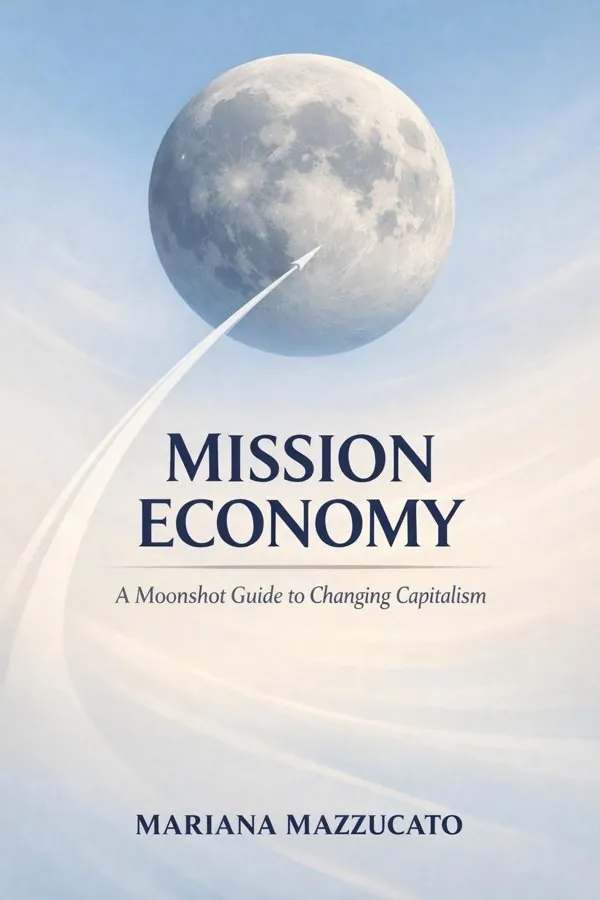
Mission Economy: A Moonshot Guide to Changing Capitalism: Summary & Key Insights
 10 min10 chaptersAudio available
Key Takeaways from Mission Economy: A Moonshot Guide to Changing Capitalism
One of the most unsettling ideas in the book is that capitalism’s biggest failure today is not simply inequality or instability, but a deeper loss of collective purpose.
A powerful myth in modern economics is that the private sector innovates while the public sector merely regulates, subsidizes, or repairs the damage.
The moon landing was not just a technological triumph; it was a lesson in organized ambition.
A mission is not the same as a slogan, a spending program, or a vague national priority.
Mazzucato argues that public-private collaboration often fails not because collaboration itself is flawed, but because the terms are poorly designed.
What Is Mission Economy: A Moonshot Guide to Changing Capitalism About?
Mission Economy: A Moonshot Guide to Changing Capitalism by Mariana Mazzucato is a economics book spanning 10 pages. In Mission Economy, Mariana Mazzucato makes a bold claim: the biggest problems of our time cannot be solved by markets alone, nor by governments acting as passive regulators that merely fix failures after they appear. Instead, she argues that societies need ambitious, mission-driven public action capable of shaping markets toward shared goals. Drawing inspiration from the Apollo moon landing, Mazzucato shows how clear collective missions can mobilize innovation, coordinate public and private actors, and direct investment toward solving complex challenges such as climate change, public health threats, inequality, and digital transformation. What makes this book especially important is that it pushes beyond familiar debates about “big government” versus “free markets.” Mazzucato reframes the issue entirely: the real question is how to build institutions that are confident enough to set direction, creative enough to experiment, and accountable enough to serve the public good. As a leading economist, founder of University College London’s Institute for Innovation and Public Purpose, and advisor to governments around the world, she brings both scholarly depth and policy experience. Mission Economy is a practical manifesto for redesigning capitalism around purpose, capability, and collective problem-solving.
This FizzRead summary covers all 10 key chapters of Mission Economy: A Moonshot Guide to Changing Capitalism in approximately 10 minutes, distilling the most important ideas, arguments, and takeaways from Mariana Mazzucato's work. Also available as an audio summary and Key Quotes Podcast.
Mission Economy: A Moonshot Guide to Changing Capitalism
In Mission Economy, Mariana Mazzucato makes a bold claim: the biggest problems of our time cannot be solved by markets alone, nor by governments acting as passive regulators that merely fix failures after they appear. Instead, she argues that societies need ambitious, mission-driven public action capable of shaping markets toward shared goals. Drawing inspiration from the Apollo moon landing, Mazzucato shows how clear collective missions can mobilize innovation, coordinate public and private actors, and direct investment toward solving complex challenges such as climate change, public health threats, inequality, and digital transformation.
What makes this book especially important is that it pushes beyond familiar debates about “big government” versus “free markets.” Mazzucato reframes the issue entirely: the real question is how to build institutions that are confident enough to set direction, creative enough to experiment, and accountable enough to serve the public good. As a leading economist, founder of University College London’s Institute for Innovation and Public Purpose, and advisor to governments around the world, she brings both scholarly depth and policy experience. Mission Economy is a practical manifesto for redesigning capitalism around purpose, capability, and collective problem-solving.
Who Should Read Mission Economy: A Moonshot Guide to Changing Capitalism?
This book is perfect for anyone interested in economics and looking to gain actionable insights in a short read. Whether you're a student, professional, or lifelong learner, the key ideas from Mission Economy: A Moonshot Guide to Changing Capitalism by Mariana Mazzucato will help you think differently.
- ✓Readers who enjoy economics and want practical takeaways
- ✓Professionals looking to apply new ideas to their work and life
- ✓Anyone who wants the core insights of Mission Economy: A Moonshot Guide to Changing Capitalism in just 10 minutes
Want the full summary?
Get instant access to this book summary and 100K+ more with Fizz Moment.
Get Free SummaryAvailable on App Store • Free to download
Key Chapters
One of the most unsettling ideas in the book is that capitalism’s biggest failure today is not simply inequality or instability, but a deeper loss of collective purpose. Mazzucato argues that many advanced economies have become dominated by short-termism. Financial markets reward quarterly earnings over long-term investment, corporations prioritize shareholder value over productive innovation, and governments often limit themselves to correcting market failures rather than actively shaping better outcomes.
This shift matters because societies cannot solve large-scale problems with institutions designed only to react. When profit maximization becomes the main organizing principle, investment flows toward what is easiest to monetize, not necessarily what is most socially valuable. That is why we see underinvestment in public health preparedness, green infrastructure, and breakthrough technologies whose benefits are broad but whose returns are uncertain or delayed.
Mazzucato does not reject markets. She argues that markets are outcomes of rules, institutions, and public choices. If those choices reward extraction instead of creation, capitalism becomes narrower, more fragile, and less innovative. A healthier form of capitalism would focus on value creation, productive capacity, and shared long-term goals.
You can see this in practice when a company cuts research budgets to boost stock prices, or when venture capital floods into quick-growth apps while clean energy storage remains underfunded. The problem is not lack of money; it is lack of direction.
Actionable takeaway: Judge economic success not only by growth or profits, but by whether institutions are building long-term capabilities and solving real public problems.
A powerful myth in modern economics is that the private sector innovates while the public sector merely regulates, subsidizes, or repairs the damage. Mazzucato challenges this story head-on. She shows that governments have often been central drivers of major innovations, especially when uncertainty was too high and time horizons too long for private investors to move first.
From the internet and GPS to biotechnology and clean energy research, public institutions have repeatedly funded early-stage experimentation, built key infrastructure, and created the conditions that allowed private firms to scale new technologies. In that sense, the state is not just a referee standing outside the game. At its best, it is a strategic actor willing to take risks, coordinate efforts, and invest where markets hesitate.
This matters because how we understand the state shapes what we ask of it. If government is seen only as a bureaucratic fixer of failures, then public ambition shrinks. But if it is seen as a co-creator of value, we can design agencies, budgets, and partnerships to support discovery and transformation.
A practical example is vaccine development. Public funding often supports basic science, clinical research, and procurement guarantees long before a product reaches the market. The private sector plays a crucial role, but it often builds on public groundwork that reduced uncertainty.
Actionable takeaway: When evaluating policy, ask not only whether government is efficient, but whether it has the capacity and confidence to lead innovation in areas where society needs bold progress.
The moon landing was not just a technological triumph; it was a lesson in organized ambition. Mazzucato uses the Apollo program as a model because it transformed a seemingly impossible goal into a coordinated national effort. It aligned procurement, research, industry, engineering, public agencies, and political will around a clearly defined mission: land a man on the moon and return him safely to Earth.
What made Apollo powerful was not only its scale, but its structure. The mission was concrete enough to inspire action, broad enough to stimulate innovation across many sectors, and urgent enough to justify experimentation. It generated spillovers in computing, materials science, aerospace, and systems engineering. In other words, a mission aimed at one clear objective ended up expanding capabilities across the wider economy.
Mazzucato is careful not to romanticize Apollo. It had exclusions, costs, and a top-down quality that should not simply be copied. But its core lesson remains relevant: when governments define bold goals and build institutions around them, they can catalyze innovation far beyond what fragmented market signals alone would achieve.
Today’s equivalents might include carbon-neutral cities, zero-waste manufacturing, or pandemic-ready health systems. These are not single inventions; they are complex challenges requiring cross-sector coordination, experimentation, and public legitimacy.
Actionable takeaway: Frame big societal problems as missions with clear goals, measurable outcomes, and broad room for innovation, rather than as isolated policy issues handled by disconnected departments.
A mission is not the same as a slogan, a spending program, or a vague national priority. Mazzucato defines mission-oriented policy as a way of setting bold, specific, societally relevant goals that can direct innovation across sectors. Good missions are inspirational but also practical: they identify a challenge, invite multiple solutions, and require collaboration among public agencies, private firms, researchers, and communities.
This approach differs from traditional industrial policy, which often supports particular sectors, and from market-failure policy, which tends to intervene only after problems appear. Mission-oriented policy is proactive. It starts by asking what kind of future we want to build and then organizes institutions, financing, and incentives accordingly.
For example, “decarbonize the economy” is too broad to mobilize action by itself. But “create 100 carbon-neutral cities by 2035” is a mission. It can engage transport planners, construction firms, energy utilities, software developers, universities, and local governments. It creates direction without dictating a single method.
Mazzucato stresses that missions should be bold yet measurable, targeted yet flexible, and designed to crowd in innovation rather than replace it. They should also be democratically debated, so that public priorities are not decided only by technocrats or incumbent firms.
Actionable takeaway: When designing strategy in government, business, or civil society, translate broad aspirations into mission statements that are concrete enough to coordinate action and open enough to invite creative solutions.
Mazzucato argues that public-private collaboration often fails not because collaboration itself is flawed, but because the terms are poorly designed. Too often, governments socialize risk while private actors privatize rewards. The public sector funds research, absorbs uncertainty, guarantees demand, or rescues failing industries, yet the upside is captured narrowly through patents, monopoly pricing, or shareholder payouts.
A mission economy requires a different model of partnership. If public institutions are taking significant risks and helping create new markets, then the gains should also be shared more fairly. This does not mean punishing business success. It means structuring contracts, equity stakes, intellectual property terms, pricing agreements, and reinvestment rules so that public value is recognized and protected.
Consider pharmaceutical innovation. Public funding may support early science, university labs, and procurement agreements, while a private firm commercializes the product. If the resulting medicine is priced beyond public reach, the partnership has failed the public purpose that helped make it possible. Similar issues arise in green technology, digital infrastructure, and defense contracting.
Mazzucato calls for symbiotic partnerships, not parasitic ones. The public sector should be confident in negotiating terms, setting expectations, and demanding outcomes aligned with mission goals. Collaboration should be based on co-creation, transparency, and shared reward.
Actionable takeaway: In any public-private project, ask who bears the risk, who captures the reward, and how contracts can ensure that innovation serves broad social goals rather than narrow extraction.
Money alone does not create transformation; patient and purposeful finance does. Mazzucato shows that mission-driven change requires funding systems that can tolerate uncertainty, support experimentation, and sustain investment over long time horizons. Conventional finance often struggles to do this because it rewards liquidity, rapid returns, and low-risk predictability. But the most important innovations, especially those tied to public missions, are rarely neat or immediate.
That is why public investment banks, mission funds, procurement programs, and strategic budgeting matter. They can channel capital toward areas that are socially urgent but commercially uncertain, such as decarbonization technologies, resilient public health systems, or advanced manufacturing. Public finance can also crowd in private investment by reducing risk and signaling long-term commitment.
Mazzucato’s point is not that government should replace private capital. It is that financial systems need to be aligned with productive outcomes rather than speculative gains. An economy overloaded with asset trading and short-term extraction will struggle to finance missions that require years of investment before results become visible.
A useful example is renewable energy deployment. Public guarantees, feed-in tariffs, or green development banks can create the confidence needed for private investors to scale technologies that once looked too risky. Over time, those interventions can help create entirely new markets.
Actionable takeaway: Support financing structures that reward long-term value creation, and evaluate investment not only by immediate returns but by its contribution to capability-building and mission success.
Ambition without capability quickly turns into disappointment. Mazzucato emphasizes that mission-oriented policy depends on governance: the quality of institutions, the competence of public agencies, and the systems used to coordinate learning, accountability, and adaptation. Governments cannot simply announce a mission and expect results. They need dynamic organizations able to experiment, collaborate, and revise strategy as conditions change.
This means moving beyond rigid, siloed bureaucracies. Missions usually cut across housing, energy, transport, health, education, and digital systems. They require agencies that can share information, align metrics, and solve problems jointly. They also require procurement systems that reward innovation rather than defaulting to the lowest short-term bidder.
Accountability is equally important. Mazzucato is not calling for blank checks or technocratic control. Public missions must be transparent, democratically grounded, and open to scrutiny. Success should be measured not just by money spent but by outcomes achieved, capabilities built, and public value created.
For example, a mission to improve urban air quality should include clear metrics, citizen engagement, cross-agency coordination, and regular review. If one approach fails, institutions should learn and adjust rather than hide failure. In complex missions, intelligent experimentation matters more than the illusion of perfect planning.
Actionable takeaway: Build institutions that are cross-functional, learning-oriented, and accountable, because the success of a mission depends as much on governance quality as on the boldness of the goal.
A society gets more of what it chooses to value. One of Mazzucato’s most important arguments is that economics often treats value as whatever the market is willing to pay for. She rejects this narrow view. Price and value are not the same thing. Many activities that are essential to social well-being, such as caregiving, public health preparedness, and environmental stewardship, are undervalued by markets, while some highly paid activities may extract wealth without creating much real value.
This distinction matters because policy follows measurement. If productivity, innovation, and success are defined too narrowly, public institutions will underinvest in capabilities that sustain human flourishing. Mazzucato wants us to recover a richer idea of value creation—one that includes public goods, resilience, inclusion, and long-term capacity.
Take care work as an example. It is foundational to economic life, yet it is often poorly paid and treated as secondary because its benefits are diffuse and hard to monetize. Likewise, preventive health systems may look expensive in annual budgets but create enormous social value by avoiding future crises. A mission economy requires metrics that capture these broader contributions.
Reimagining value also changes how we assess innovation. An app that keeps users scrolling may be profitable, but that does not automatically make it more valuable than a public transit system that reduces emissions and improves mobility.
Actionable takeaway: When making decisions, distinguish between activities that merely generate revenue and those that create lasting social value, and support the latter through policy, investment, and institutional design.
Mazzucato is ambitious, but she is not naive about the obstacles. Mission-oriented policy can fail through bureaucratic inertia, political capture, poor design, weak coordination, or lack of public trust. Missions can become empty branding exercises, vague wish lists, or vehicles for corporate lobbying if institutions are not capable and accountable. That is why implementation is one of the book’s most practical concerns.
A common challenge is path dependence. Existing agencies, budgets, and incentives were often built for incremental administration, not cross-sector transformation. Another challenge is political time: elected leaders think in short cycles, while missions may take a decade or more to produce visible results. There is also the danger of elite planning detached from citizen needs, which can undermine legitimacy even when goals are worthy.
Mazzucato’s answer is not to lower ambition. It is to invest in public capability, participatory governance, and iterative learning. Missions should be designed with intermediate milestones, diverse coalitions, transparent metrics, and room to adapt. They should mobilize citizens, not just experts, because broad participation strengthens both problem-solving and democratic support.
A city-level climate mission, for example, works best when residents, businesses, utilities, planners, and researchers all have roles in shaping and testing solutions. Implementation becomes more durable when people see themselves in the mission.
Actionable takeaway: Start bold, but build missions with realistic milestones, citizen involvement, and institutional learning, because durable transformation depends on execution as much as vision.
All Chapters in Mission Economy: A Moonshot Guide to Changing Capitalism
About the Author
Mariana Mazzucato is an Italian-American economist, professor, and leading voice on innovation policy and the role of the state in shaping markets. She is Professor in the Economics of Innovation and Public Value at University College London, where she founded and directs the Institute for Innovation and Public Purpose. Her work challenges conventional economic thinking by showing how governments have often played a central role in driving technological breakthroughs and creating new markets. Mazzucato has advised governments, international institutions, and policymakers on industrial strategy, green growth, public investment, and inclusive innovation. She is widely known for developing the concept of the entrepreneurial state and for arguing that public policy should focus on creating value, not merely correcting market failures. Her writing combines academic depth with practical policy relevance.
Get This Summary in Your Preferred Format
Read or listen to the Mission Economy: A Moonshot Guide to Changing Capitalism summary by Mariana Mazzucato anytime, anywhere. FizzRead offers multiple formats so you can learn on your terms — all free.
Available formats: App · Audio · PDF · EPUB — All included free with FizzRead
Download Mission Economy: A Moonshot Guide to Changing Capitalism PDF and EPUB Summary
Key Quotes from Mission Economy: A Moonshot Guide to Changing Capitalism
“One of the most unsettling ideas in the book is that capitalism’s biggest failure today is not simply inequality or instability, but a deeper loss of collective purpose.”
“A powerful myth in modern economics is that the private sector innovates while the public sector merely regulates, subsidizes, or repairs the damage.”
“The moon landing was not just a technological triumph; it was a lesson in organized ambition.”
“A mission is not the same as a slogan, a spending program, or a vague national priority.”
“Mazzucato argues that public-private collaboration often fails not because collaboration itself is flawed, but because the terms are poorly designed.”
Frequently Asked Questions about Mission Economy: A Moonshot Guide to Changing Capitalism
Mission Economy: A Moonshot Guide to Changing Capitalism by Mariana Mazzucato is a economics book that explores key ideas across 10 chapters. In Mission Economy, Mariana Mazzucato makes a bold claim: the biggest problems of our time cannot be solved by markets alone, nor by governments acting as passive regulators that merely fix failures after they appear. Instead, she argues that societies need ambitious, mission-driven public action capable of shaping markets toward shared goals. Drawing inspiration from the Apollo moon landing, Mazzucato shows how clear collective missions can mobilize innovation, coordinate public and private actors, and direct investment toward solving complex challenges such as climate change, public health threats, inequality, and digital transformation. What makes this book especially important is that it pushes beyond familiar debates about “big government” versus “free markets.” Mazzucato reframes the issue entirely: the real question is how to build institutions that are confident enough to set direction, creative enough to experiment, and accountable enough to serve the public good. As a leading economist, founder of University College London’s Institute for Innovation and Public Purpose, and advisor to governments around the world, she brings both scholarly depth and policy experience. Mission Economy is a practical manifesto for redesigning capitalism around purpose, capability, and collective problem-solving.
More by Mariana Mazzucato

You Might Also Like

Business Adventures
John Brooks
10 min
Nudge
Richard H. Thaler, Cass R. Sunstein
10 min
The Hitchhiker"s Guide to the Galaxy
Douglas Adams
10 minThe Muqaddimah
Ibn Khaldun
10 minThe Outsiders
William N. Thorndike
10 min
A Little History of Economics
Niall Kishtainy
10 minBrowse by Category
Ready to read Mission Economy: A Moonshot Guide to Changing Capitalism?
Get the full summary and 100K+ more books with Fizz Moment.