
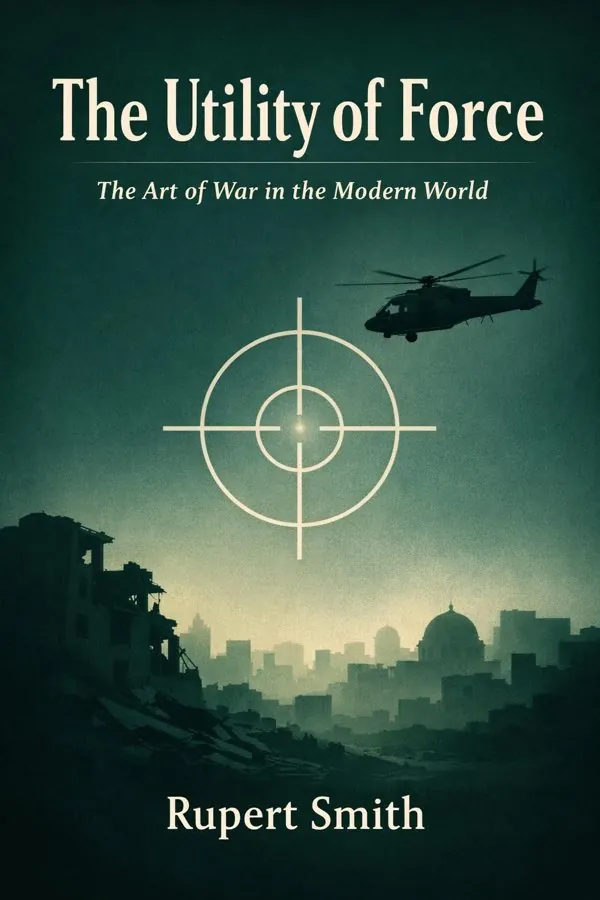
The Utility of Force: The Art of War in the Modern World: Summary & Key Insights
by Rupert Smith
 10 min10 chaptersAudio available
What Is The Utility of Force: The Art of War in the Modern World About?
The Utility of Force: The Art of War in the Modern World by Rupert Smith is a war_military book spanning 10 pages. In this influential work, General Sir Rupert Smith argues that modern warfare has shifted from industrial wars between states to 'wars amongst the people.' Drawing on his extensive military experience, he explores how political, social, and media factors have transformed the nature of conflict, making traditional military strategies increasingly ineffective. The book examines the challenges of applying force in complex environments such as peacekeeping, counterinsurgency, and humanitarian interventions.
This FizzRead summary covers all 10 key chapters of The Utility of Force: The Art of War in the Modern World in approximately 10 minutes, distilling the most important ideas, arguments, and takeaways from Rupert Smith's work. Also available as an audio summary and Key Quotes Podcast.
The Utility of Force: The Art of War in the Modern World
In this influential work, General Sir Rupert Smith argues that modern warfare has shifted from industrial wars between states to 'wars amongst the people.' Drawing on his extensive military experience, he explores how political, social, and media factors have transformed the nature of conflict, making traditional military strategies increasingly ineffective. The book examines the challenges of applying force in complex environments such as peacekeeping, counterinsurgency, and humanitarian interventions.
Who Should Read The Utility of Force: The Art of War in the Modern World?
This book is perfect for anyone interested in war_military and looking to gain actionable insights in a short read. Whether you're a student, professional, or lifelong learner, the key ideas from The Utility of Force: The Art of War in the Modern World by Rupert Smith will help you think differently.
- ✓Readers who enjoy war_military and want practical takeaways
- ✓Professionals looking to apply new ideas to their work and life
- ✓Anyone who wants the core insights of The Utility of Force: The Art of War in the Modern World in just 10 minutes
Want the full summary?
Get instant access to this book summary and 100K+ more with Fizz Moment.
Get Free SummaryAvailable on App Store • Free to download
Key Chapters
When I look back at the industrial age of warfare, what strikes me most is its predictability. Wars between nation-states were waged by organized armies with clear hierarchies, identifiable front lines, and definite beginnings and endings. In the nineteenth century and the first half of the twentieth, war reflected the logic of industry itself: resources were mobilized nationally, manpower assembled en masse, objectives defined territorially. The industrial war was a system—each part serving the machinery of state and strategy.
In this era, success was measurable. Victory meant destroying the enemy’s capability to resist. Whether in the Napoleonic wars, the Franco-Prussian conflict, or the two world wars, the principle was consistent: win through overwhelming material force, capture territory, destroy armies, impose peace. The state’s monopoly on violence was unchallenged, and military professionalism operated within that framework.
Yet that very organization of war mirrored the age’s assumptions—that nations were distinct actors pursuing tangible interests and that citizens, as part of those nations, accepted collective sacrifice. Political will and military operations were aligned through national identity. The battlefield was physical, the objectives finite, and the means—industrial production, manpower, logistics—was the decisive variable. It was a world in which Clausewitz’s dictum, that war is the continuation of politics by other means, found its most perfect expression.
With the advent of nuclear weapons, the coherence of industrial warfare collapsed. The logic of total war met its own fatal limit—no state could risk complete destruction. After 1945, deterrence replaced combat as the central mechanism of confrontation. The Cold War was not fought on traditional battlefields, but through proxy wars, ideological competition, and the constant shadow of annihilation.
Nuclear deterrence created a paradox: the most powerful weapons ever built could never be used, thereby invalidating the concept of victory through military destruction. Meanwhile, the process of decolonization liberated numerous societies from imperial control, fragmenting the global order into states of varied stability and strength. Conflicts multiplied not between empires but within states and communities. The nature of war turned inward.
Industrial war thus faded—not because war itself ceased, but because the structure that sustained it became obsolete. The end of the Cold War only confirmed this shift. No grand power confrontation promised clarity; instead, smaller, asymmetrical conflicts emerged where communication, legitimacy, and social narrative were decisive. In this new world, force could no longer promise political order by sheer scale. It had to persuade, influence, and coexist with civil society. Military organizations trained to destroy enemy armies now faced adversaries that dissolved into populations, fought through ideology, and survived by complicating military initiatives.
The decline of industrial war was not merely a technological event but a philosophical transformation—it reduced the utility of traditional military power and demanded we reimagine the purpose of force itself.
+ 8 more chapters — available in the FizzRead app
All Chapters in The Utility of Force: The Art of War in the Modern World
About the Author
General Sir Rupert Smith is a retired British Army officer who served in various command and staff positions, including Deputy Supreme Allied Commander Europe. He is recognized for his strategic insights into modern warfare and conflict resolution, combining academic analysis with practical military experience.
Get This Summary in Your Preferred Format
Read or listen to the The Utility of Force: The Art of War in the Modern World summary by Rupert Smith anytime, anywhere. FizzRead offers multiple formats so you can learn on your terms — all free.
Available formats: App · Audio · PDF · EPUB — All included free with FizzRead
Download The Utility of Force: The Art of War in the Modern World PDF and EPUB Summary
Key Quotes from The Utility of Force: The Art of War in the Modern World
“When I look back at the industrial age of warfare, what strikes me most is its predictability.”
“With the advent of nuclear weapons, the coherence of industrial warfare collapsed.”
Frequently Asked Questions about The Utility of Force: The Art of War in the Modern World
The Utility of Force: The Art of War in the Modern World by Rupert Smith is a war_military book that explores key ideas across 10 chapters. In this influential work, General Sir Rupert Smith argues that modern warfare has shifted from industrial wars between states to 'wars amongst the people.' Drawing on his extensive military experience, he explores how political, social, and media factors have transformed the nature of conflict, making traditional military strategies increasingly ineffective. The book examines the challenges of applying force in complex environments such as peacekeeping, counterinsurgency, and humanitarian interventions.
You Might Also Like
Patriot
Andrew Britton
10 min
War
John Hersey
10 min
An Army at Dawn: The War in North Africa, 1942–1943
Rick Atkinson
10 min
Brave New War: The Next Stage of Terrorism and the End of Globalization
John Robb
10 min
Catch-22
Joseph Heller
10 min
Command and Control: Nuclear Weapons, the Damascus Accident, and the Illusion of Safety
Eric Schlosser
10 minBrowse by Category
Ready to read The Utility of Force: The Art of War in the Modern World?
Get the full summary and 100K+ more books with Fizz Moment.