
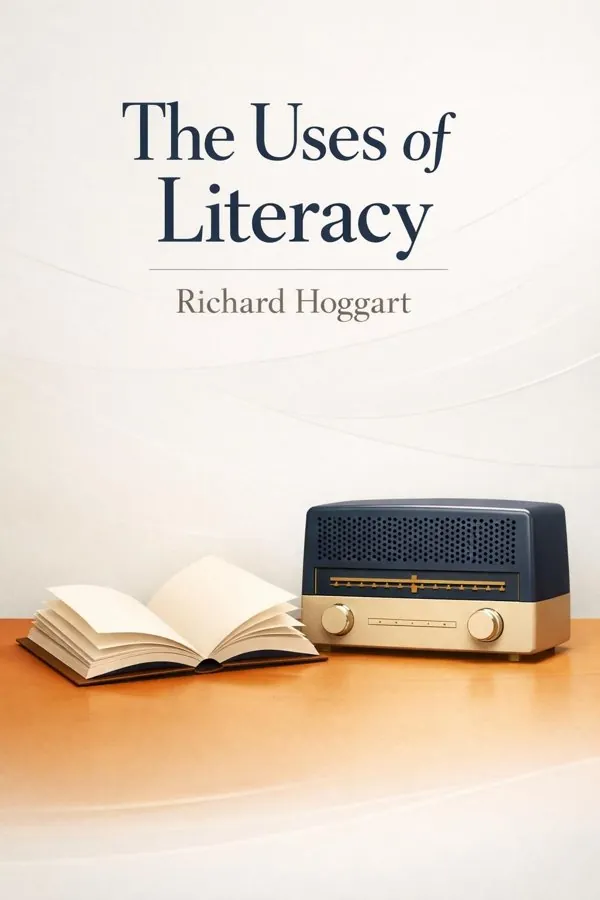
The Uses of Literacy: Aspects of Working-Class Life with Special Reference to Publications and Entertainments: Summary & Key Insights
 10 min2 chaptersAudio available
What Is The Uses of Literacy: Aspects of Working-Class Life with Special Reference to Publications and Entertainments About?
The Uses of Literacy: Aspects of Working-Class Life with Special Reference to Publications and Entertainments by Richard Hoggart is a sociology book spanning 2 pages. A landmark study of British working-class culture, Richard Hoggart’s *The Uses of Literacy* (1957) examines how mass media and popular culture transformed the everyday lives, values, and reading habits of the working class in postwar Britain. Combining literary criticism, sociology, and cultural observation, Hoggart contrasts the traditional, community-based culture of the working class with the emerging commercialized mass culture, offering one of the earliest and most influential analyses of cultural change in modern society.
This FizzRead summary covers all 2 key chapters of The Uses of Literacy: Aspects of Working-Class Life with Special Reference to Publications and Entertainments in approximately 10 minutes, distilling the most important ideas, arguments, and takeaways from Richard Hoggart's work. Also available as an audio summary and Key Quotes Podcast.
The Uses of Literacy: Aspects of Working-Class Life with Special Reference to Publications and Entertainments
A landmark study of British working-class culture, Richard Hoggart’s *The Uses of Literacy* (1957) examines how mass media and popular culture transformed the everyday lives, values, and reading habits of the working class in postwar Britain. Combining literary criticism, sociology, and cultural observation, Hoggart contrasts the traditional, community-based culture of the working class with the emerging commercialized mass culture, offering one of the earliest and most influential analyses of cultural change in modern society.
Who Should Read The Uses of Literacy: Aspects of Working-Class Life with Special Reference to Publications and Entertainments?
This book is perfect for anyone interested in sociology and looking to gain actionable insights in a short read. Whether you're a student, professional, or lifelong learner, the key ideas from The Uses of Literacy: Aspects of Working-Class Life with Special Reference to Publications and Entertainments by Richard Hoggart will help you think differently.
- ✓Readers who enjoy sociology and want practical takeaways
- ✓Professionals looking to apply new ideas to their work and life
- ✓Anyone who wants the core insights of The Uses of Literacy: Aspects of Working-Class Life with Special Reference to Publications and Entertainments in just 10 minutes
Want the full summary?
Get instant access to this book summary and 100K+ more with Fizz Moment.
Get Free SummaryAvailable on App Store • Free to download
Key Chapters
In the first part of my book, I wanted to recall the substance and dignity of the older working-class life—the moral and emotional fabric of the communities I knew. This was a world that valued decency, respectability, and neighborliness above all. The terraced streets and shared backyards were not merely physical spaces but social institutions, where gossip kept moral standards alive and where people had an unspoken code of mutual help. There was pride in living within one’s means, in being ‘respectable’ despite poverty, and in maintaining a sense of fairness and fellow feeling.
Family life formed the foundation of this culture. The home was small, often overcrowded, yet it was filled with rituals of care and duty. The mother’s authority and the father’s hard work were the twin symbols of moral order. Life was rarely easy, but it was grounded in a sense of honesty and restraint—a belief that one earned one’s pleasures and did not live beyond one’s place. Such moral seriousness was not prudishness; it was a structure of meaning in an uncertain world.
Education, in this context, held a nearly sacred place. Many working-class people saw reading not simply as a pastime but as a moral act—a way to rise, to learn, and to broaden one’s understanding. In the mechanics’ institutes and adult education classes, in the lending libraries and cheap editions of the classics, there was a hunger for self-improvement. People read with purpose: they wanted knowledge that would ennoble their lives. This is why I have always resisted the idea that working people were culturally deprived. They possessed their own standards of taste and intelligence, and above all, a seriousness about words and ideas.
The popular literature of the early twentieth century—pamphlets, serial stories, magazines—reflected these values. The sentimental tales often reinforced virtues of decency and sympathy, while magazines like *The People’s Friend* or *Woman’s Own* served as moral touchstones. Even the recreation was communal: street songs, club concerts, the Saturday night dance—all were opportunities for people to affirm their identity within the group. The world I describe here was not idyllic, but it was cohesive; it was a working moral culture, not yet reduced to an audience of consumers.
When I turned to the second part of the book, I had to confront what was already overtaking that older way of life—the growing presence of mass culture in every home. The radio, the cinema, the magazines now written for mass appeal—all carried with them new tones, new desires. Advertising spoke a seductive language of ease and glamour, whispering that happiness could be bought. The imagery of the glossy weeklies, the hit songs, the booming film industry: all combined to produce a world less grounded in locality and more in fantasy.
The danger, as I saw it, was not that people were entertained, but that entertainment began to replace thought. The new mass culture appealed constantly to sentimentality and to the quick thrill of consumption. It simplified experience, distilling complex realities into slogans or stereotypes—the faithful housewife, the dashing young man, the happy consumer family. The older values of restraint and responsibility began to appear dour, even repressive. What was once an ethic of community began to give way to the language of personal success and private pleasure.
One of the most striking changes was linguistic. The working-class idiom—rich, ironic, and grounded in the realities of life—began to be diluted by the easy emotionalism of mass-market talk. Popular expression became standardized; people were encouraged to feel rather than to think. The local humor and moral wit that once defined the neighborhoods were replaced by the artificial cheerfulness of jingles and advertisements.
In this part of the book, I tried to argue that mass culture created a form of cultural alienation. People no longer recognized their genuine experiences reflected in what they read or saw. The working classes, who had once made sense of their world through shared stories and moral conversation, were now spoken to as a market segment. To be educated or thoughtful was to risk isolation; to be merely receptive and eager to buy was to be modern. This was the shift I feared most—not the loss of tradition itself, but the loss of our capacity for independent moral judgment.
Yet I was not calling for withdrawal or reaction. I believed that cultural change, though painful, could be met with renewal—if education could train people not only to read words, but to read the world. Critical literacy, I insisted, is the true defense against manipulation. The task was not to retreat into nostalgia but to build forms of learning and community that could resist the more corrosive powers of mass persuasion.
All Chapters in The Uses of Literacy: Aspects of Working-Class Life with Special Reference to Publications and Entertainments
About the Author
Richard Hoggart (1918–2014) was a British cultural critic, academic, and founder of the Centre for Contemporary Cultural Studies at the University of Birmingham. His work laid the foundation for the field of cultural studies, and he was known for his deep concern with education, media, and the moral life of working-class communities.
Get This Summary in Your Preferred Format
Read or listen to the The Uses of Literacy: Aspects of Working-Class Life with Special Reference to Publications and Entertainments summary by Richard Hoggart anytime, anywhere. FizzRead offers multiple formats so you can learn on your terms — all free.
Available formats: App · Audio · PDF · EPUB — All included free with FizzRead
Download The Uses of Literacy: Aspects of Working-Class Life with Special Reference to Publications and Entertainments PDF and EPUB Summary
Key Quotes from The Uses of Literacy: Aspects of Working-Class Life with Special Reference to Publications and Entertainments
“In the first part of my book, I wanted to recall the substance and dignity of the older working-class life—the moral and emotional fabric of the communities I knew.”
“When I turned to the second part of the book, I had to confront what was already overtaking that older way of life—the growing presence of mass culture in every home.”
Frequently Asked Questions about The Uses of Literacy: Aspects of Working-Class Life with Special Reference to Publications and Entertainments
The Uses of Literacy: Aspects of Working-Class Life with Special Reference to Publications and Entertainments by Richard Hoggart is a sociology book that explores key ideas across 2 chapters. A landmark study of British working-class culture, Richard Hoggart’s *The Uses of Literacy* (1957) examines how mass media and popular culture transformed the everyday lives, values, and reading habits of the working class in postwar Britain. Combining literary criticism, sociology, and cultural observation, Hoggart contrasts the traditional, community-based culture of the working class with the emerging commercialized mass culture, offering one of the earliest and most influential analyses of cultural change in modern society.
You Might Also Like
Between the World and Me
Ta-Nehisi Coates
10 min
Half the Sky
Nicholas D. Kristof, Sheryl WuDunn
10 min
Men Explain Things To Me
Rebecca Solnit
10 min
Rational Ritual
Michael Suk-Young Chwe
10 min
The New Jim Crow
Michelle Alexander
10 min
Beyond Culture
Edward T. Hall
10 minBrowse by Category
Ready to read The Uses of Literacy: Aspects of Working-Class Life with Special Reference to Publications and Entertainments?
Get the full summary and 100K+ more books with Fizz Moment.