
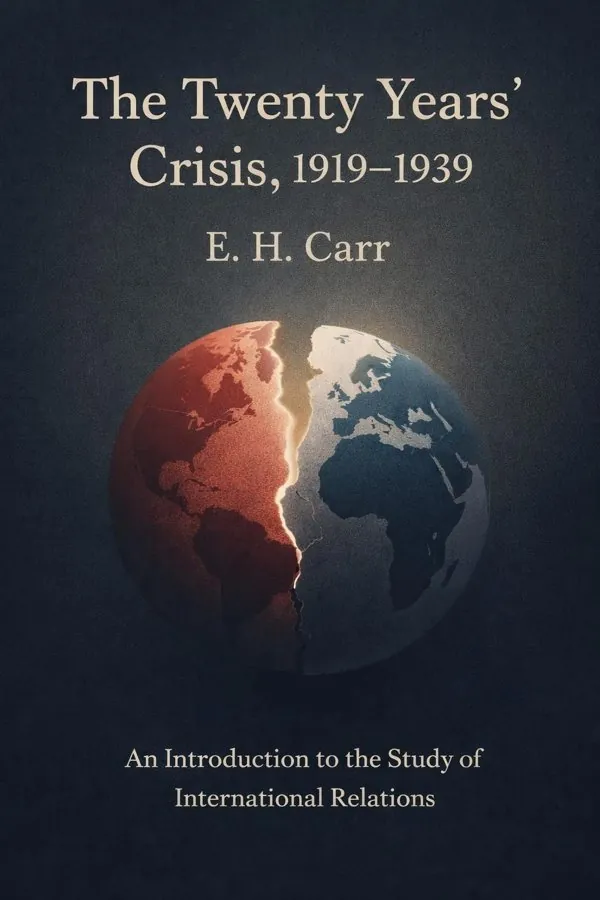
The Twenty Years' Crisis, 1919–1939: An Introduction to the Study of International Relations: Summary & Key Insights
by E. H. Carr
 10 min9 chaptersAudio available
What Is The Twenty Years' Crisis, 1919–1939: An Introduction to the Study of International Relations About?
The Twenty Years' Crisis, 1919–1939: An Introduction to the Study of International Relations by E. H. Carr is a politics book spanning 9 pages. Originally published in 1939, this seminal work by British historian and diplomat Edward Hallett Carr examines the interwar period and the failure of idealism in international politics. Carr critiques utopian approaches to international relations and lays the foundation for realist theory, arguing that power and interest are central to understanding global affairs. The book remains a cornerstone of political realism and a key text in the study of international relations.
This FizzRead summary covers all 9 key chapters of The Twenty Years' Crisis, 1919–1939: An Introduction to the Study of International Relations in approximately 10 minutes, distilling the most important ideas, arguments, and takeaways from E. H. Carr's work. Also available as an audio summary and Key Quotes Podcast.
The Twenty Years' Crisis, 1919–1939: An Introduction to the Study of International Relations
Originally published in 1939, this seminal work by British historian and diplomat Edward Hallett Carr examines the interwar period and the failure of idealism in international politics. Carr critiques utopian approaches to international relations and lays the foundation for realist theory, arguing that power and interest are central to understanding global affairs. The book remains a cornerstone of political realism and a key text in the study of international relations.
Who Should Read The Twenty Years' Crisis, 1919–1939: An Introduction to the Study of International Relations?
This book is perfect for anyone interested in politics and looking to gain actionable insights in a short read. Whether you're a student, professional, or lifelong learner, the key ideas from The Twenty Years' Crisis, 1919–1939: An Introduction to the Study of International Relations by E. H. Carr will help you think differently.
- ✓Readers who enjoy politics and want practical takeaways
- ✓Professionals looking to apply new ideas to their work and life
- ✓Anyone who wants the core insights of The Twenty Years' Crisis, 1919–1939: An Introduction to the Study of International Relations in just 10 minutes
Want the full summary?
Get instant access to this book summary and 100K+ more with Fizz Moment.
Get Free SummaryAvailable on App Store • Free to download
Key Chapters
The immediate aftermath of the First World War witnessed what I call the utopian moment in international thought. The devastation of 1914–1918 seemed to cry out for a new world order founded on reason, law, and moral will. From Woodrow Wilson’s Fourteen Points to the Covenant of the League of Nations, there spread the conviction that humanity had learned enough from its suffering to abolish war itself. The intellectual climate was dominated by idealist assumptions: that progress was inevitable, that collective security could replace the balance of power, and that moral consensus could serve as the foundation of an international system.
These utopian thinkers regarded states as rational actors united by shared humanity. They believed international relations could be governed by the same ethical norms as personal conduct. The establishment of the League was seen as the institutional embodiment of moral progress, a mechanism that would allow legal and moral reasoning to replace the crude instrument of war. But beneath this optimism lay untested assumptions about human nature and state behavior. The League’s machinery was only as strong as the political will of its members, and that will remained, stubbornly, a function of national interest.
For many, the utopian spirit represented the moral awakening of mankind. Yet I saw it as dangerously unmoored from reality. The architects of the postwar order mistook the temporary exhaustion of Europe for genuine moral conversion. They imagined that rules and institutions could override the ever-present dynamics of power. The result was a fragile structure sustained by rhetorical belief rather than material balance. Utopianism, for all its noble ideals, ignored that international politics is conducted not by saints but by statesmen, whose primary concern is survival.
In critically examining utopianism, my foremost concern was the blindness it fostered toward the permanent elements of politics: conflict, power, and interest. The utopian mind, I wrote, sees only ends and ignores means. It assumes that good intentions can generate good outcomes, that moral truth can be imposed upon the chaos of human relations without accounting for coercion or self-interest. Such thinking is psychologically comforting but politically ruinous.
The utopians, armed with moral language, declared that international law could replace diplomacy, that public opinion would restrain aggression, that free trade would pacify rivalries. They mistook symptoms for causes, believing that if statesmen talked about peace long enough, peace itself would emerge. Yet words and institutions, unaided by power, have no life of their own. The League could condemn aggression but not compel compliance. The high priests of morality failed to see that law and justice in international life depend, as they always have, on the support of power.
I do not reject morality. Rather, I argue that moral claims in politics are never abstract — they are expressions of power relationships. When a state appeals to universal principles, it often universalizes its own interest. The victors of 1919 preached self-determination but denied it to their colonies. They declared equality of nations yet insisted on a permanent seat at the League Council. Behind the rhetoric of justice lay the reality of privilege. The utopian illusion arises precisely when moral ideals are treated as if they floated above the world of force and interest, instead of being born within it.
+ 7 more chapters — available in the FizzRead app
All Chapters in The Twenty Years' Crisis, 1919–1939: An Introduction to the Study of International Relations
About the Author
Edward Hallett Carr (1892–1982) was a British historian, diplomat, journalist, and international relations theorist. He served in the British Foreign Office and later became a professor of international politics at the University of Wales, Aberystwyth. Carr is best known for his works on Soviet history and international relations, particularly 'The Twenty Years' Crisis' and his multi-volume 'History of Soviet Russia'.
Get This Summary in Your Preferred Format
Read or listen to the The Twenty Years' Crisis, 1919–1939: An Introduction to the Study of International Relations summary by E. H. Carr anytime, anywhere. FizzRead offers multiple formats so you can learn on your terms — all free.
Available formats: App · Audio · PDF · EPUB — All included free with FizzRead
Download The Twenty Years' Crisis, 1919–1939: An Introduction to the Study of International Relations PDF and EPUB Summary
Key Quotes from The Twenty Years' Crisis, 1919–1939: An Introduction to the Study of International Relations
“The immediate aftermath of the First World War witnessed what I call the utopian moment in international thought.”
“In critically examining utopianism, my foremost concern was the blindness it fostered toward the permanent elements of politics: conflict, power, and interest.”
Frequently Asked Questions about The Twenty Years' Crisis, 1919–1939: An Introduction to the Study of International Relations
The Twenty Years' Crisis, 1919–1939: An Introduction to the Study of International Relations by E. H. Carr is a politics book that explores key ideas across 9 chapters. Originally published in 1939, this seminal work by British historian and diplomat Edward Hallett Carr examines the interwar period and the failure of idealism in international politics. Carr critiques utopian approaches to international relations and lays the foundation for realist theory, arguing that power and interest are central to understanding global affairs. The book remains a cornerstone of political realism and a key text in the study of international relations.
You Might Also Like
Antifa: The Anti-Fascist Handbook
Mark Bray
10 min
Attack from Within: How Disinformation Is Sabotaging America
Barbara McQuade
10 min
Coercion, Capital, and European States, AD 990–1992
Charles Tilly
10 min
Digital Democracy: Concepts, Methodologies, Tools, and Applications
Various Authors
10 min
Fascism
Stanley G. Payne
10 min
Fire And Fury: Inside The Trump White House
Michael Wolff
10 minBrowse by Category
Ready to read The Twenty Years' Crisis, 1919–1939: An Introduction to the Study of International Relations?
Get the full summary and 100K+ more books with Fizz Moment.