
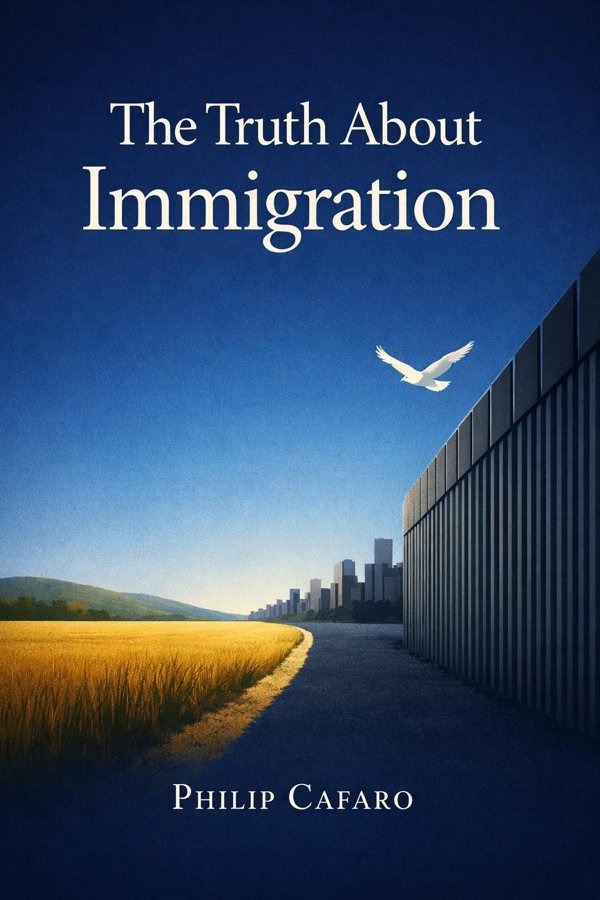
The Truth About Immigration: Summary & Key Insights
 10 min8 chaptersAudio available
What Is The Truth About Immigration About?
The Truth About Immigration by Philip Cafaro is a politics book spanning 8 pages. In this book, environmental philosopher Philip Cafaro examines the complex moral, economic, and ecological dimensions of immigration policy in the United States. He argues for a balanced approach that considers the well-being of both current citizens and future generations, emphasizing sustainability, fairness, and the preservation of democratic values.
This FizzRead summary covers all 8 key chapters of The Truth About Immigration in approximately 10 minutes, distilling the most important ideas, arguments, and takeaways from Philip Cafaro's work. Also available as an audio summary and Key Quotes Podcast.
The Truth About Immigration
In this book, environmental philosopher Philip Cafaro examines the complex moral, economic, and ecological dimensions of immigration policy in the United States. He argues for a balanced approach that considers the well-being of both current citizens and future generations, emphasizing sustainability, fairness, and the preservation of democratic values.
Who Should Read The Truth About Immigration?
This book is perfect for anyone interested in politics and looking to gain actionable insights in a short read. Whether you're a student, professional, or lifelong learner, the key ideas from The Truth About Immigration by Philip Cafaro will help you think differently.
- ✓Readers who enjoy politics and want practical takeaways
- ✓Professionals looking to apply new ideas to their work and life
- ✓Anyone who wants the core insights of The Truth About Immigration in just 10 minutes
Want the full summary?
Get instant access to this book summary and 100K+ more with Fizz Moment.
Get Free SummaryAvailable on App Store • Free to download
Key Chapters
To understand where we stand today, we must retrace how U.S. immigration policy evolved. For much of the nineteenth century, America’s borders were essentially open. Immigration fueled industrial growth, urbanization, and vast demographic expansion. By the early twentieth century, however, leaders began to recognize that growth at all costs carried serious social strains—crowded cities, economic inequality, and cultural fragmentation. The 1924 Immigration Act established quotas, marking the first serious national attempt to regulate who could enter and at what scale.
The mid-twentieth century brought waves of reform. The 1965 Immigration and Nationality Act replaced old quotas with a global system emphasizing family reunification and skills. This change, rooted in ideals of fairness and openness, drastically reshaped America’s demographic trajectory. Immigration rose substantially, particularly from Latin America and Asia. The population boom that followed had environmental and social effects rarely debated at the time: rising urban pressures, increasing carbon emissions, and continued habitat loss.
From the late twentieth century onward, discussion of immigration turned sharply polarized. Business groups promoted high immigration to meet labor demands, while environmentalists—myself included—warned that population growth exacerbates resource depletion and climate change. Yet politicians largely avoided linking immigration policy to sustainability. That historical omission is precisely what this book seeks to correct. By reviewing how immigration policy has reflected shifting cultural and economic priorities, I argue that we must now ask a deeper question: How can we adapt our policy to protect both human dignity and the ecological foundation of our civilization?
At the heart of immigration policy lie moral choices. Fairness and justice are not abstract ideals; they determine whose hopes are fulfilled and whose lives are changed. Many advocates frame immigration as purely an issue of compassion for outsiders. Compassion matters—but morality also demands we weigh duties to citizens who already belong to a nation and to generations who will come after us.
Ethical reasoning reveals that every right carries reciprocal responsibilities. A society cannot care for strangers if it fails to sustain itself. If unchecked immigration undermines economic security or environmental stability, then the moral costs spread widely. In my analysis, justice requires treating all people—citizens and noncitizens—with dignity while recognizing that a national community is entitled to protect its capacity for mutual care.
I draw upon philosophical traditions from Aristotle to John Rawls, emphasizing that justice functions within limits. Citizenship creates specific obligations: shared participation, taxes, and adherence to democratic norms. Overextension of these obligations, whether through unsustainable immigration or exclusionary policies, erodes fairness. Ethical immigration policy must combine moral universalism with practical prudence. It must acknowledge that though our compassion is limitless, our resources and institutions are not. Only honesty about limits can preserve true fairness.
+ 6 more chapters — available in the FizzRead app
All Chapters in The Truth About Immigration
About the Author
Philip Cafaro is a professor of philosophy at Colorado State University and a leading scholar in environmental ethics and population policy. His work explores the intersection of human flourishing, environmental sustainability, and moral responsibility.
Get This Summary in Your Preferred Format
Read or listen to the The Truth About Immigration summary by Philip Cafaro anytime, anywhere. FizzRead offers multiple formats so you can learn on your terms — all free.
Available formats: App · Audio · PDF · EPUB — All included free with FizzRead
Download The Truth About Immigration PDF and EPUB Summary
Key Quotes from The Truth About Immigration
“To understand where we stand today, we must retrace how U.”
“At the heart of immigration policy lie moral choices.”
Frequently Asked Questions about The Truth About Immigration
The Truth About Immigration by Philip Cafaro is a politics book that explores key ideas across 8 chapters. In this book, environmental philosopher Philip Cafaro examines the complex moral, economic, and ecological dimensions of immigration policy in the United States. He argues for a balanced approach that considers the well-being of both current citizens and future generations, emphasizing sustainability, fairness, and the preservation of democratic values.
You Might Also Like

Antifa: The Anti-Fascist Handbook
Mark Bray
10 min
Attack from Within: How Disinformation Is Sabotaging America
Barbara McQuade
10 min
Coercion, Capital, and European States, AD 990–1992
Charles Tilly
10 min
Digital Democracy: Concepts, Methodologies, Tools, and Applications
Various Authors
10 min
Fascism
Stanley G. Payne
10 min
Fire And Fury: Inside The Trump White House
Michael Wolff
10 minBrowse by Category
Ready to read The Truth About Immigration?
Get the full summary and 100K+ more books with Fizz Moment.