
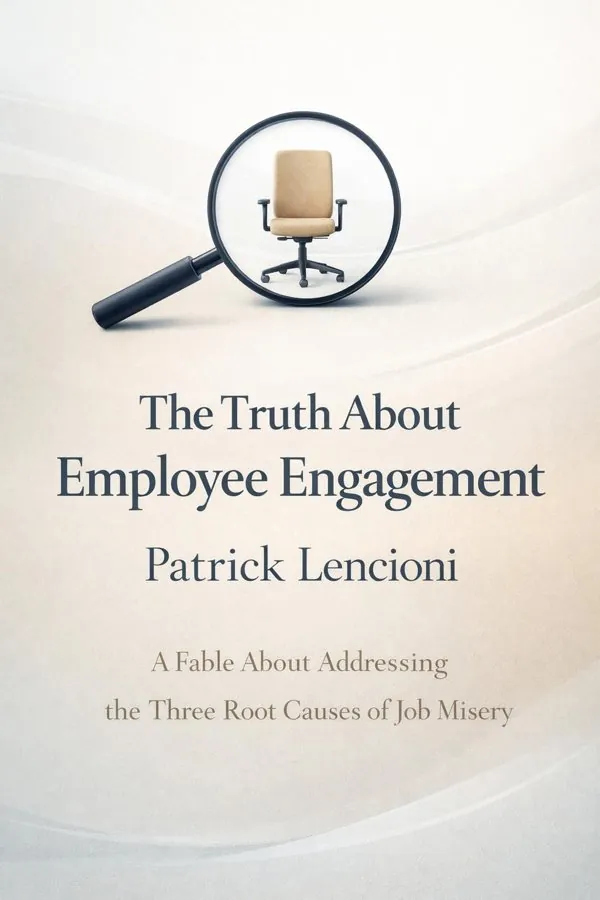
The Truth About Employee Engagement: A Fable About Addressing the Three Root Causes of Job Misery: Summary & Key Insights
 10 min5 chaptersAudio available
What Is The Truth About Employee Engagement: A Fable About Addressing the Three Root Causes of Job Misery About?
The Truth About Employee Engagement: A Fable About Addressing the Three Root Causes of Job Misery by Patrick Lencioni is a leadership book spanning 5 pages. In this business fable, Patrick Lencioni explores the underlying reasons why many employees feel disengaged and unfulfilled at work. Through a compelling story, he identifies three root causes of job misery—anonymity, irrelevance, and immeasurability—and offers practical strategies for managers to create more meaningful and motivating workplaces.
This FizzRead summary covers all 5 key chapters of The Truth About Employee Engagement: A Fable About Addressing the Three Root Causes of Job Misery in approximately 10 minutes, distilling the most important ideas, arguments, and takeaways from Patrick Lencioni's work. Also available as an audio summary and Key Quotes Podcast.
The Truth About Employee Engagement: A Fable About Addressing the Three Root Causes of Job Misery
In this business fable, Patrick Lencioni explores the underlying reasons why many employees feel disengaged and unfulfilled at work. Through a compelling story, he identifies three root causes of job misery—anonymity, irrelevance, and immeasurability—and offers practical strategies for managers to create more meaningful and motivating workplaces.
Who Should Read The Truth About Employee Engagement: A Fable About Addressing the Three Root Causes of Job Misery?
This book is perfect for anyone interested in leadership and looking to gain actionable insights in a short read. Whether you're a student, professional, or lifelong learner, the key ideas from The Truth About Employee Engagement: A Fable About Addressing the Three Root Causes of Job Misery by Patrick Lencioni will help you think differently.
- ✓Readers who enjoy leadership and want practical takeaways
- ✓Professionals looking to apply new ideas to their work and life
- ✓Anyone who wants the core insights of The Truth About Employee Engagement: A Fable About Addressing the Three Root Causes of Job Misery in just 10 minutes
Want the full summary?
Get instant access to this book summary and 100K+ more with Fizz Moment.
Get Free SummaryAvailable on App Store • Free to download
Key Chapters
Brian Bailey begins our story as a senior executive who has achieved the conventional markers of success: wealth, recognition, and advancement. Yet, beneath the surface, he feels an emptiness he can’t easily name. The high-stakes corporate game has lost its thrill. Boardrooms full of politics and profit charts no longer ignite his curiosity or commitment. What once felt like accomplishment now feels transactional. This disillusionment becomes unbearable when he realizes that his work no longer matters to him—or to the people around him.
So Brian does what few in his position would dare: he walks away. He sells his house, leaves his lucrative job, and moves to a small coastal town seeking something simpler and, hopefully, more authentic. There, almost by accident, he meets the owner of a struggling local business—a small sporting goods store—and is drawn into the challenge of helping it survive.
At first glance, managing a small, unremarkable retail outlet seems a massive step down from his executive career. Yet that’s precisely the humility he needs. Within weeks, he discovers that the store’s problem isn’t its product line or marketing—it’s the pervasive sense of hopelessness among employees. They aren’t lazy or incompetent; they’re detached. They seem to dread coming to work, to resent their customers, and to distrust management. Everything about their behavior signals a lack of engagement, and Brian, with his outsider’s perspective, wants to know why.
Through conversations and observations, Brian begins to see patterns: employees who feel invisible, unsure of how they’re performing, and disconnected from any meaningful purpose. He senses that the problem is not unique to this little store—it’s symptomatic of something much larger in the modern workplace. This realization sparks the central investigation of the book: what exactly makes a job miserable? And what can a leader do to turn misery into meaning?
The first revelation comes when Brian notices how little managers and employees actually know about one another. Most interactions in the store are purely task-oriented. People show up, do their shift, and leave without acknowledgment. Managers rarely use employees’ names, and personal details—birthdays, family, interests—are treated as irrelevant. There’s no malice behind it; it’s simply a culture where no one bothers to see the human being behind the job title. This is what I call *anonymity*.
Anonymity is poison to engagement because it denies people the most basic human need: to be known. When we believe that no one at work understands who we are or cares about us as individuals, our motivation shrivels. Brian recalls his own corporate career where executives were often addressed by numbers or titles rather than names, a dehumanizing habit disguised as professionalism. It dawns on him that this same dynamic is killing morale in the sporting goods store.
Brian begins his quiet revolution by doing something disarmingly simple—talking to people. He learns about their families, hobbies, and aspirations. He asks about their favorite sports teams, listens to their frustrations, and remembers what they say. He discovers that one stock clerk is caring for an elderly parent, another dreams of coaching youth baseball, another secretly sketches designs for better store layouts. These conversations transform the atmosphere. Employees who had been sullen start to smile. Absent any grand incentive program, the culture begins to thaw.
As I emphasize throughout the fable, the remedy for anonymity costs nothing but attention. True leadership begins when a manager genuinely knows and values the people who work with them. It’s not about blurring professionalism but about honoring humanity. When employees feel seen, loyalty blossoms, creativity surfaces, and the entire workplace begins to hum with energy.
+ 3 more chapters — available in the FizzRead app
All Chapters in The Truth About Employee Engagement: A Fable About Addressing the Three Root Causes of Job Misery
About the Author
Patrick Lencioni is an American author, consultant, and speaker known for his work on leadership, organizational health, and team management. He is the founder of The Table Group, a firm specializing in executive team development and organizational consulting.
Get This Summary in Your Preferred Format
Read or listen to the The Truth About Employee Engagement: A Fable About Addressing the Three Root Causes of Job Misery summary by Patrick Lencioni anytime, anywhere. FizzRead offers multiple formats so you can learn on your terms — all free.
Available formats: App · Audio · PDF · EPUB — All included free with FizzRead
Download The Truth About Employee Engagement: A Fable About Addressing the Three Root Causes of Job Misery PDF and EPUB Summary
Key Quotes from The Truth About Employee Engagement: A Fable About Addressing the Three Root Causes of Job Misery
“Brian Bailey begins our story as a senior executive who has achieved the conventional markers of success: wealth, recognition, and advancement.”
“The first revelation comes when Brian notices how little managers and employees actually know about one another.”
Frequently Asked Questions about The Truth About Employee Engagement: A Fable About Addressing the Three Root Causes of Job Misery
The Truth About Employee Engagement: A Fable About Addressing the Three Root Causes of Job Misery by Patrick Lencioni is a leadership book that explores key ideas across 5 chapters. In this business fable, Patrick Lencioni explores the underlying reasons why many employees feel disengaged and unfulfilled at work. Through a compelling story, he identifies three root causes of job misery—anonymity, irrelevance, and immeasurability—and offers practical strategies for managers to create more meaningful and motivating workplaces.
More by Patrick Lencioni
The Five Dysfunctions of a Team: A Leadership Fable
Patrick Lencioni
10 min
The Ideal Team Player: How to Recognize and Cultivate the Three Essential Virtues
Patrick Lencioni
10 min
The 6 Types of Working Genius
Patrick Lencioni
10 min
Death by Meeting: A Leadership Fable... About Solving the Most Painful Problem in Business
Patrick Lencioni
10 minYou Might Also Like

Extreme Ownership
Jocko Willink
10 min
Dare to Lead
Brene Brown
10 min
Leaders Eat Last
Simon Sinek
10 min
The 21 Irrefutable Laws of Leadership
John Maxwell
10 min
Start With Why
Simon Sinek
10 min
How to Lead When You're Not in Charge
Clay Scroggins
10 minBrowse by Category
Ready to read The Truth About Employee Engagement: A Fable About Addressing the Three Root Causes of Job Misery?
Get the full summary and 100K+ more books with Fizz Moment.