
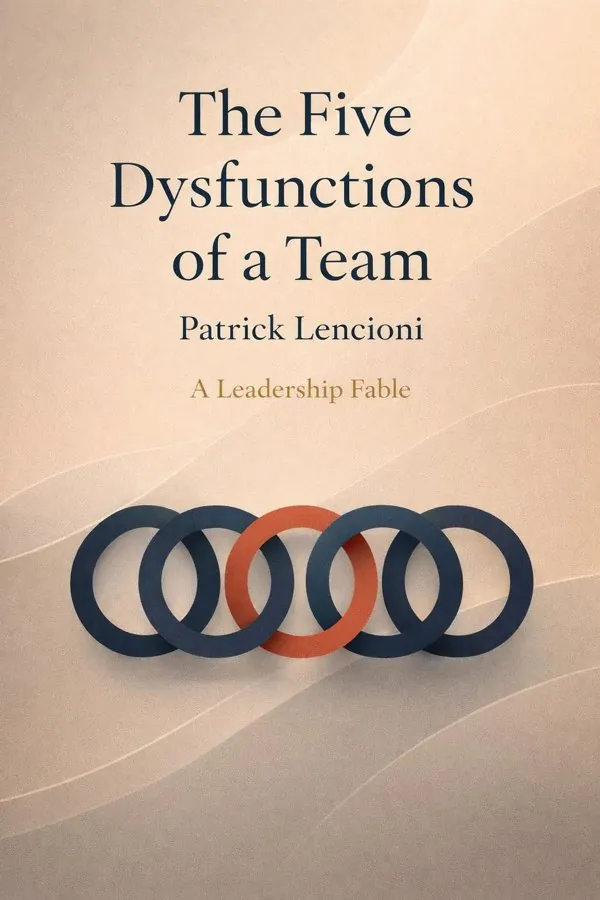
The Five Dysfunctions of a Team: A Leadership Fable: Summary & Key Insights
 10 min7 chaptersAudio available
What Is The Five Dysfunctions of a Team: A Leadership Fable About?
The Five Dysfunctions of a Team: A Leadership Fable by Patrick Lencioni is a leadership book spanning 7 pages. In this leadership fable, Patrick Lencioni explores the root causes of team failure and provides a model for building cohesive, effective teams. Through a fictional narrative about a struggling executive team, the book identifies five key dysfunctions—absence of trust, fear of conflict, lack of commitment, avoidance of accountability, and inattention to results—and offers practical strategies to overcome them.
This FizzRead summary covers all 7 key chapters of The Five Dysfunctions of a Team: A Leadership Fable in approximately 10 minutes, distilling the most important ideas, arguments, and takeaways from Patrick Lencioni's work. Also available as an audio summary and Key Quotes Podcast.
The Five Dysfunctions of a Team: A Leadership Fable
In this leadership fable, Patrick Lencioni explores the root causes of team failure and provides a model for building cohesive, effective teams. Through a fictional narrative about a struggling executive team, the book identifies five key dysfunctions—absence of trust, fear of conflict, lack of commitment, avoidance of accountability, and inattention to results—and offers practical strategies to overcome them.
Who Should Read The Five Dysfunctions of a Team: A Leadership Fable?
This book is perfect for anyone interested in leadership and looking to gain actionable insights in a short read. Whether you're a student, professional, or lifelong learner, the key ideas from The Five Dysfunctions of a Team: A Leadership Fable by Patrick Lencioni will help you think differently.
- ✓Readers who enjoy leadership and want practical takeaways
- ✓Professionals looking to apply new ideas to their work and life
- ✓Anyone who wants the core insights of The Five Dysfunctions of a Team: A Leadership Fable in just 10 minutes
Want the full summary?
Get instant access to this book summary and 100K+ more with Fizz Moment.
Get Free SummaryAvailable on App Store • Free to download
Key Chapters
DecisionTech was built to succeed—full of talented engineers and executives, backed by strong investors, and armed with an innovative product that should have revolutionized its market. Yet, it lagged dangerously behind competitors. The office felt polite but fragmented. Conversations were cautious, meetings predictable, and decisions postponed or undermined afterward. Into this haze walked Kathryn Petersen, the new CEO—experienced not in technology but in leadership.
Kathryn’s first weeks were quiet observation. She watched as her executives avoided real discussion, leaned on email instead of dialogue, and seemed more committed to personal silos than to the company’s mission. She sensed that their core problem had nothing to do with strategy—it was behavioral. They didn’t trust one another. Kathryn’s insight was simple yet profound: without trust, a team cannot function. But trust doesn’t mean mere reliability; it means vulnerability—the willingness to say, “I don’t know,” or “I made a mistake,” without fear of judgment.
As Kathryn began coaching her team, she urged them to open up, to share personal histories and work frustrations. It was uncomfortable, even awkward. But slowly, they began admitting insecurities, and for the first time, real connection emerged. Kathryn understood that to build trust, one must first expose imperfection. Only then can authentic dialogue begin. Her leadership journey reflected my belief that behavioral courage always precedes strategic success.
I’ve seen it in hundreds of organizations—the polite nods, the guarded glances, the hidden assumptions. The absence of trust is the foundation of every team’s struggle. When people refuse to be vulnerable, they build invisible walls. DecisionTech’s executives were polite but distant; they concealed their doubts and avoided asking for help. Kathryn’s breakthrough came when she realized that vulnerability must be modeled, not demanded. So she began to share her own stories of failure, inviting others to do the same.
Real trust isn’t built by team-building exercises or motivational slogans; it’s built through consistency and shared human truth. Kathryn led sessions where team members shared aspects of their backgrounds, their fears, and personal challenges. Gradually, faces softened, laughter returned, and, most importantly, they began admitting mistakes. This was a turning point. When one person said, “I dropped the ball,” and another responded, “That’s okay—how can we fix it together?” they shifted from self-protection to collaboration.
From this transformation arises the first rule of cohesive leadership: trust requires vulnerability. It’s not transactional; it’s emotional. Without it, everything that follows—conflict, commitment, accountability, results—remains defective.
+ 5 more chapters — available in the FizzRead app
All Chapters in The Five Dysfunctions of a Team: A Leadership Fable
About the Author
Patrick Lencioni is an American author, consultant, and speaker known for his work on business management, leadership, and organizational health. He is the founder of The Table Group, a firm specializing in executive team development and organizational consulting.
Get This Summary in Your Preferred Format
Read or listen to the The Five Dysfunctions of a Team: A Leadership Fable summary by Patrick Lencioni anytime, anywhere. FizzRead offers multiple formats so you can learn on your terms — all free.
Available formats: App · Audio · PDF · EPUB — All included free with FizzRead
Download The Five Dysfunctions of a Team: A Leadership Fable PDF and EPUB Summary
Key Quotes from The Five Dysfunctions of a Team: A Leadership Fable
“DecisionTech was built to succeed—full of talented engineers and executives, backed by strong investors, and armed with an innovative product that should have revolutionized its market.”
“I’ve seen it in hundreds of organizations—the polite nods, the guarded glances, the hidden assumptions.”
Frequently Asked Questions about The Five Dysfunctions of a Team: A Leadership Fable
The Five Dysfunctions of a Team: A Leadership Fable by Patrick Lencioni is a leadership book that explores key ideas across 7 chapters. In this leadership fable, Patrick Lencioni explores the root causes of team failure and provides a model for building cohesive, effective teams. Through a fictional narrative about a struggling executive team, the book identifies five key dysfunctions—absence of trust, fear of conflict, lack of commitment, avoidance of accountability, and inattention to results—and offers practical strategies to overcome them.
More by Patrick Lencioni

The Ideal Team Player: How to Recognize and Cultivate the Three Essential Virtues
Patrick Lencioni
10 min
The Truth About Employee Engagement: A Fable About Addressing the Three Root Causes of Job Misery
Patrick Lencioni
10 min
The 6 Types of Working Genius
Patrick Lencioni
10 min
Death by Meeting: A Leadership Fable... About Solving the Most Painful Problem in Business
Patrick Lencioni
10 minYou Might Also Like

Extreme Ownership
Jocko Willink
10 min
Dare to Lead
Brene Brown
10 min
Leaders Eat Last
Simon Sinek
10 min
The 21 Irrefutable Laws of Leadership
John Maxwell
10 min
Start With Why
Simon Sinek
10 min
How to Lead When You're Not in Charge
Clay Scroggins
10 minBrowse by Category
Ready to read The Five Dysfunctions of a Team: A Leadership Fable?
Get the full summary and 100K+ more books with Fizz Moment.