
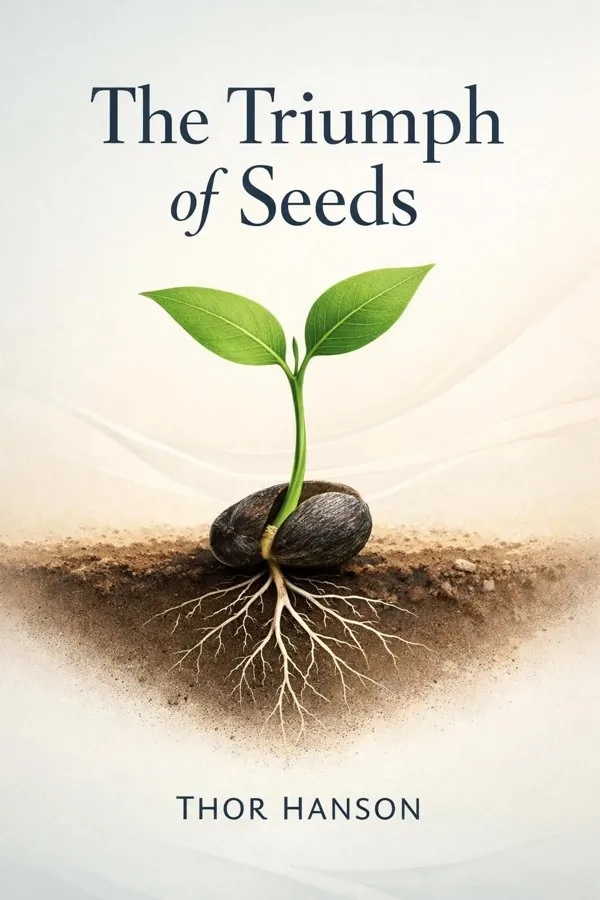
The Triumph of Seeds: How Grains, Nuts, Kernels, Pulses, and Pips Conquered the Plant Kingdom and Shaped Human History: Summary & Key Insights
by Thor Hanson
 10 min9 chaptersAudio available
Key Takeaways from The Triumph of Seeds: How Grains, Nuts, Kernels, Pulses, and Pips Conquered the Plant Kingdom and Shaped Human History
The rise of seeds was not a minor botanical improvement; it was a revolution that changed what plants could be and where they could live.
What seems lifeless in your hand is actually a highly organized survival machine.
One of the most astonishing things about seeds is that they can wait.
Plants may be rooted in place, but their offspring are not.
Many seeds do not just endure animals; they depend on them.
What Is The Triumph of Seeds: How Grains, Nuts, Kernels, Pulses, and Pips Conquered the Plant Kingdom and Shaped Human History About?
The Triumph of Seeds: How Grains, Nuts, Kernels, Pulses, and Pips Conquered the Plant Kingdom and Shaped Human History by Thor Hanson is a popular_sci book spanning 11 pages. Seeds are so familiar that it is easy to overlook how extraordinary they really are. They fill our bread baskets, stock our pantries, sprout in gardens, and travel across landscapes in ways both elegant and ingenious. In The Triumph of Seeds, conservation biologist Thor Hanson turns one of the most ordinary features of daily life into a source of wonder, showing how seeds became one of evolution’s most successful inventions and how they helped shape ecosystems, economies, and civilizations. Moving from deep evolutionary history to modern agriculture, Hanson explains how seeds protect plant embryos, survive drought and cold, recruit animals as partners, and spread across the globe. Just as importantly, he reveals how human life has become inseparable from them, from staple grains and spices to coffee, cotton, and the genetic future of crops. Hanson writes with the authority of a field scientist and the charm of a gifted storyteller, blending botany, ecology, history, and culture into an accessible narrative. The result is a popular science book that changes how readers see food, nature, and the hidden power packed inside the smallest kernels.
This FizzRead summary covers all 9 key chapters of The Triumph of Seeds: How Grains, Nuts, Kernels, Pulses, and Pips Conquered the Plant Kingdom and Shaped Human History in approximately 10 minutes, distilling the most important ideas, arguments, and takeaways from Thor Hanson's work. Also available as an audio summary and Key Quotes Podcast.
The Triumph of Seeds: How Grains, Nuts, Kernels, Pulses, and Pips Conquered the Plant Kingdom and Shaped Human History
Seeds are so familiar that it is easy to overlook how extraordinary they really are. They fill our bread baskets, stock our pantries, sprout in gardens, and travel across landscapes in ways both elegant and ingenious. In The Triumph of Seeds, conservation biologist Thor Hanson turns one of the most ordinary features of daily life into a source of wonder, showing how seeds became one of evolution’s most successful inventions and how they helped shape ecosystems, economies, and civilizations. Moving from deep evolutionary history to modern agriculture, Hanson explains how seeds protect plant embryos, survive drought and cold, recruit animals as partners, and spread across the globe. Just as importantly, he reveals how human life has become inseparable from them, from staple grains and spices to coffee, cotton, and the genetic future of crops. Hanson writes with the authority of a field scientist and the charm of a gifted storyteller, blending botany, ecology, history, and culture into an accessible narrative. The result is a popular science book that changes how readers see food, nature, and the hidden power packed inside the smallest kernels.
Who Should Read The Triumph of Seeds: How Grains, Nuts, Kernels, Pulses, and Pips Conquered the Plant Kingdom and Shaped Human History?
This book is perfect for anyone interested in popular_sci and looking to gain actionable insights in a short read. Whether you're a student, professional, or lifelong learner, the key ideas from The Triumph of Seeds: How Grains, Nuts, Kernels, Pulses, and Pips Conquered the Plant Kingdom and Shaped Human History by Thor Hanson will help you think differently.
- ✓Readers who enjoy popular_sci and want practical takeaways
- ✓Professionals looking to apply new ideas to their work and life
- ✓Anyone who wants the core insights of The Triumph of Seeds: How Grains, Nuts, Kernels, Pulses, and Pips Conquered the Plant Kingdom and Shaped Human History in just 10 minutes
Want the full summary?
Get instant access to this book summary and 100K+ more with Fizz Moment.
Get Free SummaryAvailable on App Store • Free to download
Key Chapters
The rise of seeds was not a minor botanical improvement; it was a revolution that changed what plants could be and where they could live. Before seeds evolved, most plants depended on spores and on wet conditions for reproduction. That strategy worked in damp environments, but it limited expansion. Reproduction remained exposed to chance, especially when water was scarce or conditions were unstable. Seeds solved that problem by packaging the next generation inside a durable, portable, nutrient-rich capsule.
Hanson shows that this innovation allowed plants to break free from the ecological constraints that had once kept them tied to moisture-bound worlds. A seed could wait. It could survive a harsh season, cross long distances, and germinate only when circumstances improved. In evolutionary terms, that flexibility was transformative. Seed plants spread into drier climates, colonized new habitats, and eventually came to dominate the land.
This long view matters because it reminds us that many of nature’s most powerful breakthroughs are not dramatic in appearance. A seed looks simple, even inert, yet its evolutionary advantage is enormous. We see the consequences everywhere today: forests, grasslands, deserts, farms, and orchards all depend on this compact life-support system.
A practical way to apply this idea is to look at modern landscapes through an evolutionary lens. Whether you are gardening, farming, teaching, or simply observing nature, notice which plants rely on seed persistence and seasonal timing. Actionable takeaway: pay closer attention to the ordinary seeds around you; they are living evidence of one of evolution’s most successful inventions.
What seems lifeless in your hand is actually a highly organized survival machine. Hanson explains that every seed contains three essential elements: an embryo, a food supply, and a protective coat. Together, these components create a self-contained package that can pause life without ending it. This ability to suspend development is one of the seed’s greatest strengths.
The embryo is the plant in miniature, already structured for future growth. The stored food, often in the cotyledons or endosperm, fuels its earliest development before leaves can gather energy from sunlight. The outer covering shields the whole system from injury, disease, drying, and sometimes even digestion. Some seed coats are thin and delicate; others are so tough that they require fire, freezing, abrasion, or passage through an animal gut before germination becomes possible.
Hanson’s descriptions help readers see why seeds are not passive objects but carefully tuned biological designs. A bean in a kitchen jar and an acorn under a tree represent different engineering solutions to the same challenge: how to protect fragile life long enough to give it a chance. This perspective also explains why seed quality matters so much in agriculture. A strong seed is not just a beginning; it is an investment in survival.
You can apply this insight by paying attention to seed condition in everyday life. Gardeners know that old or damaged seeds germinate poorly, and farmers rely on storage conditions that preserve viability. Actionable takeaway: if you grow plants, treat seeds as living systems, not dry commodities, and store them with care, cool temperatures, and low moisture.
One of the most astonishing things about seeds is that they can wait. Hanson emphasizes dormancy as a central reason for seed success: a seed can delay growth until the world outside becomes favorable. In effect, dormancy allows plants to separate reproduction from immediate environmental conditions. That is an extraordinary power in an unpredictable world.
A seed may remain dormant through winter, drought, fire, or years of poor conditions. Some seeds sprout only after temperature shifts, seasonal rains, smoke chemicals, or light cues signal that the moment is right. Others persist in soil seed banks for astonishing lengths of time, creating a hidden reserve of future life beneath our feet. This strategy spreads risk. If one season fails, the species is not finished.
Hanson uses examples from wild landscapes and agriculture alike to show how timing controls survival. Farmers depend on predictable germination, while ecologists study dormant seed banks to understand how grasslands, forests, and disturbed habitats recover. Even weeds owe much of their persistence to this ability to bide their time.
The broader lesson is that success often depends less on speed than on timing. Seeds do not rush into growth just because they can; they wait for a better opportunity. This principle applies beyond botany. In planning, investing, learning, and creative work, there are moments when preserving potential matters more than immediate action.
Actionable takeaway: think like a seed when conditions are poor. Instead of forcing progress at the wrong time, protect your resources, watch for the right cues, and move when the environment supports growth.
Plants may be rooted in place, but their offspring are not. Hanson shows that seeds succeed not only because they survive, but because they move. Dispersal is one of the great dramas of plant life, and seeds have evolved remarkable ways to escape the shadow of the parent plant. Without movement, young plants would compete with their own kin for light, water, and nutrients. With movement, they can colonize new ground.
Different species solve this challenge differently. Some rely on wind, producing winged or feathery seeds that drift like tiny gliders. Others use water, floating across streams, coastlines, or oceans. Many hitch rides on animals by clinging to fur or feathers with hooks and barbs. Still others package themselves inside sweet fruits, effectively paying animals to transport them and deposit them elsewhere.
Hanson makes clear that dispersal is not random chaos but adaptive strategy. The shape, weight, chemistry, and outer structure of a seed often reflect how it expects to travel. Maple samaras spin. Coconuts float. Burrs latch on. Berries entice. These designs reveal evolution working through opportunity and partnership.
This has practical relevance for gardeners, land managers, and anyone trying to restore habitats or control invasive species. Understanding how a seed moves can explain why certain plants spread rapidly and why others struggle to establish.
Actionable takeaway: when dealing with any plant, ask not only how it grows but how its seeds travel. That single question can improve gardening decisions, weed management, and your appreciation of how landscapes are formed.
Many seeds do not just endure animals; they depend on them. Hanson explores the deep coevolution between seed-bearing plants and the creatures that eat, carry, bury, or inadvertently plant them. This relationship is one of mutual influence. Plants shape animal behavior through nutrition, color, scent, and structure, while animals shape plant evolution by determining which seeds survive and where they end up.
Fruit is a classic example. The fleshy part is often less important to the plant than the seed inside, but it exists to attract an animal partner. Birds, mammals, and even fish consume the fruit and transport the seeds to new locations. In other cases, animals act as hoarders. Squirrels and jays bury nuts for later use, and forgotten caches become future trees. Some seeds even require scarification through digestion before they can germinate effectively.
Yet this partnership is not always harmonious. Seed predation is intense because seeds are concentrated packets of nutrition. Plants respond with toxins, hard shells, and timing strategies, while animals develop ways to crack, detoxify, or target them. Coevolution is therefore both cooperation and arms race.
Readers can apply this insight by thinking ecologically about gardens and food systems. Pollinators matter, but so do the seed dispersers and seed predators that shape plant communities after flowering ends. Protecting birds, mammals, and insects often means protecting plant regeneration too.
Actionable takeaway: support local biodiversity by planting native species and maintaining habitat for animals that disperse seeds. Healthy ecosystems are built not just on individual species, but on the relationships that connect them.
Civilization did not simply discover seeds; it was built on them. Hanson demonstrates that grains, legumes, nuts, and other seeds have fed populations, enabled settlement, and structured economies for thousands of years. Wheat, rice, maize, barley, beans, and lentils are not just foods. They are the biological foundation of cities, states, trade systems, and empires.
Seeds became central to agriculture because they store well, travel easily, and provide dense nutrition. Unlike many fruits or leafy plants, dry seeds can be harvested, preserved, transported, planted, and rationed. This made them ideal for early farming societies. Once people learned to save, select, and sow desirable seeds, they began directing evolution themselves. Domestication transformed wild grasses into crops with larger grains, more predictable growth, and traits suited to human use.
Hanson also highlights how seed-based crops shaped culture. Bread, beer, spices, coffee, chocolate, and pulses all carried social meaning as well as economic value. The exchange of seeds and seed products helped drive exploration, colonization, and global trade. In many ways, seed history is human history in concentrated form.
This idea changes how we see everyday meals. A bowl of rice or slice of bread is not merely food; it is the result of ancient evolutionary innovation and long human partnership with plants. Understanding this can inspire greater respect for agriculture and for the vulnerability of the systems that feed us.
Actionable takeaway: examine your weekly diet and identify the seeds at its center. This simple exercise reveals how deeply your own life still depends on the same biological strategy that built civilizations.
Some seeds nourish bodies, while others build fortunes. Hanson expands the story beyond staple crops to show how seeds became economic engines and cultural symbols. Coffee beans, cacao seeds, cottonseed, soybeans, sesame, mustard, nutmeg, and countless others have shaped labor systems, trade routes, cuisines, and global markets. The seed is both a biological unit and a commodity.
This dual role creates fascinating tensions. A seed is a living organism with ecological context, but in commerce it is often reduced to yield, price, patent, flavor, or strategic value. Entire regions have been transformed around the cultivation of seed crops, and industries have risen from their processing. Oils, flours, livestock feeds, beverages, textiles, and medicines all trace back to seeds. Even seemingly specialized products can have vast historical reach: a spice seed once altered geopolitics; a bean from the tropics became a global daily habit.
Hanson’s broader point is that seeds are woven into cultural identity as much as economics. Festivals, rituals, culinary traditions, and inheritance patterns often revolve around planting and harvest. Because seeds link nature, labor, and future provision, they acquire symbolic importance wherever people depend on them.
For modern readers, this perspective encourages more informed consumption. The products we buy carry hidden stories of cultivation, breeding, trade, and environmental cost. Whether choosing coffee, plant oils, nuts, or grains, consumers influence seed-driven industries.
Actionable takeaway: pick one seed-based product you use regularly and trace its supply chain. Understanding where it comes from and how it is grown can lead to better choices about sustainability, labor practices, and food quality.
Seeds are ancient, but our relationship with them is increasingly technological. Hanson explores how seed science now spans genetics, crop breeding, storage, restoration ecology, and global food security. If seeds once changed the world through natural evolution, they now stand at the center of deliberate human attempts to adapt to climate change, hunger, habitat loss, and environmental instability.
Modern science studies germination cues, disease resistance, drought tolerance, seed longevity, and genetic diversity. Plant breeders work to improve crops, while conservationists collect and preserve wild seeds in vaults and living collections. In degraded ecosystems, restoration often begins with the right seed mix. In agriculture, the future may depend on developing varieties resilient enough to withstand hotter temperatures, shifting rainfall, and emerging pests.
Hanson also points to the fragility beneath this progress. As farming becomes more uniform, genetic diversity can shrink. That makes crops more vulnerable to disease and changing conditions. Seed banks and research institutions are therefore not academic luxuries; they are insurance policies for humanity.
There is a useful lesson here for non-scientists. Innovation works best when it preserves diversity rather than replacing it with a single optimized solution. In seeds, as in systems more broadly, resilience comes from variation.
Actionable takeaway: support local seed libraries, native plant programs, or agricultural initiatives that preserve crop diversity. Protecting a wide range of seeds today increases our collective options for food, adaptation, and ecological recovery tomorrow.
A world rich in seeds is a world rich in futures. Hanson closes the argument by showing that seed diversity is under pressure from habitat destruction, monoculture, climate change, invasive species, and the erosion of traditional agricultural knowledge. When seed varieties disappear, we lose more than botanical curiosities. We lose traits that may be crucial for nutrition, resilience, adaptation, and cultural continuity.
Conservation can take many forms. Large-scale seed banks store genetic material from crops and wild plants. Botanical gardens and research centers maintain living collections. Farmers preserve heirloom varieties through cultivation. Indigenous communities and local growers sustain regionally adapted seeds that industrial systems often overlook. Each of these efforts protects not only plants but relationships between people, landscapes, and food traditions.
Hanson is especially effective at showing why this matters emotionally as well as scientifically. Seeds symbolize continuity, renewal, and trust in the future. To save a seed is to believe in a world that extends beyond the present moment. That idea gives conservation a human depth that statistics alone cannot provide.
Readers do not need to run a gene bank to participate. Small acts matter: growing heirloom vegetables, saving seeds from healthy plants, buying from diverse local growers, or learning which native species belong in a particular place. Conservation becomes real when it enters ordinary life.
Actionable takeaway: start with one species. Save, share, plant, or learn about one seed variety that matters in your region. Protecting biodiversity begins with attention, and attention begins with a single seed.
All Chapters in The Triumph of Seeds: How Grains, Nuts, Kernels, Pulses, and Pips Conquered the Plant Kingdom and Shaped Human History
About the Author
Thor Hanson is an American conservation biologist, speaker, and acclaimed author of natural history books that bring science to a wide audience. Trained as a field biologist, he has worked on conservation projects around the world and developed a reputation for explaining complex ecological ideas with clarity, warmth, and curiosity. Hanson is the author of several celebrated books, including Feathers, Buzz, Hurricane Lizards and Plastic Squid, and The Triumph of Seeds. His writing is distinguished by its combination of scientific depth, firsthand observation, and memorable storytelling. Rather than treating biology as abstract theory, he connects it to everyday objects and experiences, helping readers see the natural world with fresh attention. His work appeals to both science enthusiasts and general readers looking for engaging, intelligent nonfiction.
Get This Summary in Your Preferred Format
Read or listen to the The Triumph of Seeds: How Grains, Nuts, Kernels, Pulses, and Pips Conquered the Plant Kingdom and Shaped Human History summary by Thor Hanson anytime, anywhere. FizzRead offers multiple formats so you can learn on your terms — all free.
Available formats: App · Audio · PDF · EPUB — All included free with FizzRead
Download The Triumph of Seeds: How Grains, Nuts, Kernels, Pulses, and Pips Conquered the Plant Kingdom and Shaped Human History PDF and EPUB Summary
Key Quotes from The Triumph of Seeds: How Grains, Nuts, Kernels, Pulses, and Pips Conquered the Plant Kingdom and Shaped Human History
“The rise of seeds was not a minor botanical improvement; it was a revolution that changed what plants could be and where they could live.”
“What seems lifeless in your hand is actually a highly organized survival machine.”
“One of the most astonishing things about seeds is that they can wait.”
“Plants may be rooted in place, but their offspring are not.”
“Many seeds do not just endure animals; they depend on them.”
Frequently Asked Questions about The Triumph of Seeds: How Grains, Nuts, Kernels, Pulses, and Pips Conquered the Plant Kingdom and Shaped Human History
The Triumph of Seeds: How Grains, Nuts, Kernels, Pulses, and Pips Conquered the Plant Kingdom and Shaped Human History by Thor Hanson is a popular_sci book that explores key ideas across 9 chapters. Seeds are so familiar that it is easy to overlook how extraordinary they really are. They fill our bread baskets, stock our pantries, sprout in gardens, and travel across landscapes in ways both elegant and ingenious. In The Triumph of Seeds, conservation biologist Thor Hanson turns one of the most ordinary features of daily life into a source of wonder, showing how seeds became one of evolution’s most successful inventions and how they helped shape ecosystems, economies, and civilizations. Moving from deep evolutionary history to modern agriculture, Hanson explains how seeds protect plant embryos, survive drought and cold, recruit animals as partners, and spread across the globe. Just as importantly, he reveals how human life has become inseparable from them, from staple grains and spices to coffee, cotton, and the genetic future of crops. Hanson writes with the authority of a field scientist and the charm of a gifted storyteller, blending botany, ecology, history, and culture into an accessible narrative. The result is a popular science book that changes how readers see food, nature, and the hidden power packed inside the smallest kernels.
You Might Also Like

Structures: Or Why Things Don"t Fall Down
J.E. Gordon
10 min
The Road to Wigan Pier
George Orwell
10 min
Bonk: The Curious Coupling of Science and Sex
Mary Roach
10 min
First Bite: How We Learn to Eat
Bee Wilson
10 min
In Pursuit Of The Unknown: 17 Equations That Changed The World
Ian Stewart
10 min
Napoleon's Buttons: 17 Molecules That Changed History
Penny Le Couteur and Jay Burreson
10 minBrowse by Category
Ready to read The Triumph of Seeds: How Grains, Nuts, Kernels, Pulses, and Pips Conquered the Plant Kingdom and Shaped Human History?
Get the full summary and 100K+ more books with Fizz Moment.