
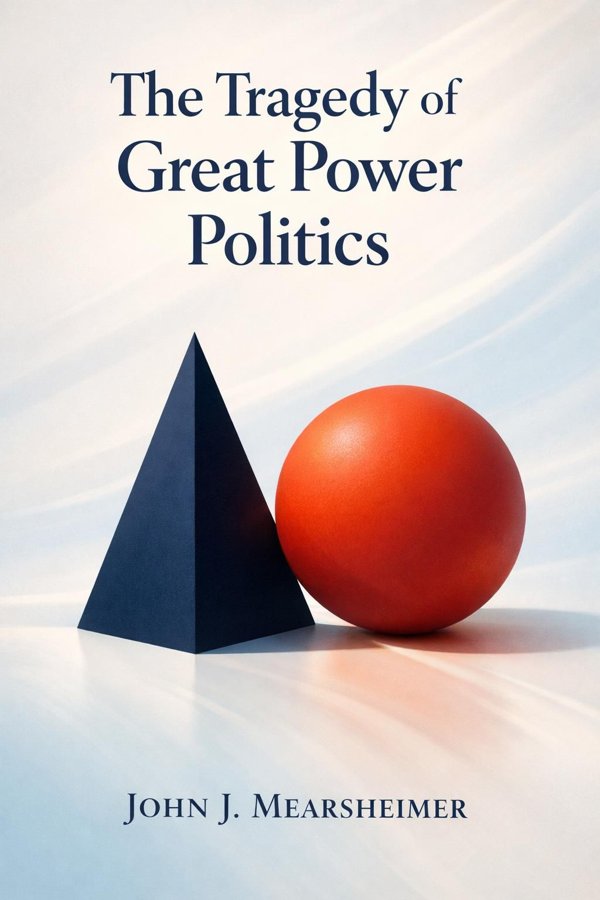
The Tragedy of Great Power Politics: Summary & Key Insights
 10 min10 chaptersAudio available
What Is The Tragedy of Great Power Politics About?
The Tragedy of Great Power Politics by John J. Mearsheimer is a politics book spanning 10 pages. This influential work of international relations theory argues that the structure of the international system compels great powers to seek dominance, making conflict inevitable. Mearsheimer develops the concept of 'offensive realism,' explaining how states act aggressively to ensure their survival in an anarchic world order.
This FizzRead summary covers all 10 key chapters of The Tragedy of Great Power Politics in approximately 10 minutes, distilling the most important ideas, arguments, and takeaways from John J. Mearsheimer's work. Also available as an audio summary and Key Quotes Podcast.
The Tragedy of Great Power Politics
This influential work of international relations theory argues that the structure of the international system compels great powers to seek dominance, making conflict inevitable. Mearsheimer develops the concept of 'offensive realism,' explaining how states act aggressively to ensure their survival in an anarchic world order.
Who Should Read The Tragedy of Great Power Politics?
This book is perfect for anyone interested in politics and looking to gain actionable insights in a short read. Whether you're a student, professional, or lifelong learner, the key ideas from The Tragedy of Great Power Politics by John J. Mearsheimer will help you think differently.
- ✓Readers who enjoy politics and want practical takeaways
- ✓Professionals looking to apply new ideas to their work and life
- ✓Anyone who wants the core insights of The Tragedy of Great Power Politics in just 10 minutes
Want the full summary?
Get instant access to this book summary and 100K+ more with Fizz Moment.
Get Free SummaryAvailable on App Store • Free to download
Key Chapters
To grasp the argument of offensive realism, we must first understand its roots. Realism, as a tradition in international relations theory, begins with a simple observation: power matters. Realists see states as rational actors operating in an anarchic system where survival is the primary goal. Within realism, however, there are variations that differ on how much power states seek.
Defensive realists, like Kenneth Waltz, assert that states aim for enough power to ensure their security but not more; they emphasize moderation. My view, offensive realism, takes a different stance. I contend that states invariably seek to maximize power, not merely preserve it. In an uncertain world, there is no such thing as safety in adequacy. If a state can increase its strength relative to others, logic and fear compel it to do so.
This framework depends on five key assumptions: the international system is anarchic; great powers possess military capability and can harm one another; no state can ever be certain of another’s intentions; survival is the ultimate goal; and states are rational actors. When these conditions interact, they produce an inexorable drive toward competition, expansion, and positional dominance.
That difference between offensive and defensive realism is crucial. Defensive realists believe balance constrains aggression; offensive realism recognizes that uncertainty sustains it. Since no authority exists to safeguard security, states must act as if others may someday threaten them. That anticipation makes restraint unrealistic and competition inevitable. From these theoretical foundations flows the tragic logic of power politics—the heart of this book.
Imagine a world without a supreme authority—no global government, no real enforcement mechanism. That is the condition of international politics, what we call anarchy. It doesn’t mean chaos; it means self-help. In such a world, every state must provide for its own security.
The logic of power stems from this constant self-help imperative. Power is the only reliable means to guarantee survival, and since no state can predict future threats, they strive to become as strong as possible today. Even if a state desires peace, it must prepare for war, because others may not share its intentions.
I explore this dynamic through historical illustrations, showing how Britain sought to prevent European hegemony, how the United States consolidated supremacy in the Americas, and how Germany, Japan, and Russia expanded in pursuit of security. The pattern is unchanging: insecurity breeds competition; competition breeds conflict.
When anarchy prevails, the desire for security produces a paradox known as the security dilemma. An increase in one state’s power inevitably makes others less secure, prompting them to respond with countermeasures—and thus spiraling tension ensues. This is not irrational behavior but a rational response within a structure that rewards vigilance and punishes weakness. The tragedy lies not in human evil but in structural necessity.
+ 8 more chapters — available in the FizzRead app
All Chapters in The Tragedy of Great Power Politics
About the Author
John J. Mearsheimer is an American political scientist and professor at the University of Chicago, known for his work on realist theory in international relations. His research focuses on the behavior of great powers and the causes of war.
Get This Summary in Your Preferred Format
Read or listen to the The Tragedy of Great Power Politics summary by John J. Mearsheimer anytime, anywhere. FizzRead offers multiple formats so you can learn on your terms — all free.
Available formats: App · Audio · PDF · EPUB — All included free with FizzRead
Download The Tragedy of Great Power Politics PDF and EPUB Summary
Key Quotes from The Tragedy of Great Power Politics
“To grasp the argument of offensive realism, we must first understand its roots.”
“Imagine a world without a supreme authority—no global government, no real enforcement mechanism.”
Frequently Asked Questions about The Tragedy of Great Power Politics
The Tragedy of Great Power Politics by John J. Mearsheimer is a politics book that explores key ideas across 10 chapters. This influential work of international relations theory argues that the structure of the international system compels great powers to seek dominance, making conflict inevitable. Mearsheimer develops the concept of 'offensive realism,' explaining how states act aggressively to ensure their survival in an anarchic world order.
You Might Also Like
Antifa: The Anti-Fascist Handbook
Mark Bray
10 min
Attack from Within: How Disinformation Is Sabotaging America
Barbara McQuade
10 min
Coercion, Capital, and European States, AD 990–1992
Charles Tilly
10 min
Digital Democracy: Concepts, Methodologies, Tools, and Applications
Various Authors
10 min
Fascism
Stanley G. Payne
10 min
Fire And Fury: Inside The Trump White House
Michael Wolff
10 minBrowse by Category
Ready to read The Tragedy of Great Power Politics?
Get the full summary and 100K+ more books with Fizz Moment.