
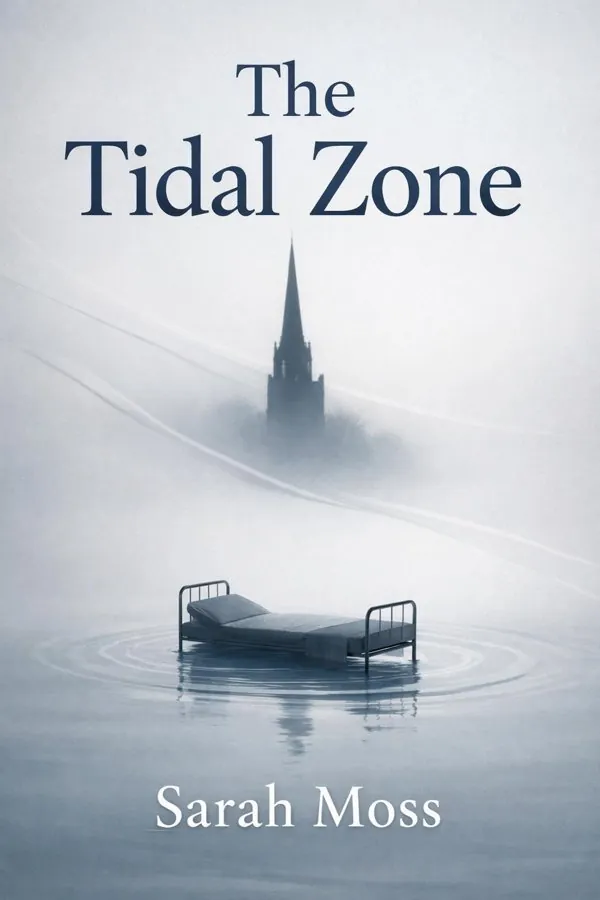
The Tidal Zone: Summary & Key Insights
by Sarah Moss
 10 min8 chaptersAudio available
Key Takeaways from The Tidal Zone
A damaged building can tell the truth about a damaged life more clearly than any confession.
A single phone call can divide life into before and after.
A crisis rarely destroys a family outright; more often, it rearranges the rooms inside it.
Survival does not end fear; sometimes it institutionalizes it.
When private suffering feels meaningless, people often reach toward history, art, or faith to ask larger questions.
What Is The Tidal Zone About?
The Tidal Zone by Sarah Moss is a bestsellers book spanning 7 pages. A family can feel permanent right up until the moment it doesn’t. In The Tidal Zone, Sarah Moss turns a sudden medical crisis into a deeply intelligent novel about love, fear, marriage, history, and the fragile routines that hold ordinary life together. The story centers on Adam, a stay-at-home father and academic researching Coventry Cathedral, a building whose destruction and rebuilding become a powerful parallel to his own family’s shaken world. When his fifteen-year-old daughter Miriam collapses at school and briefly stops breathing, Adam is pulled into a state of vigilance that transforms every meal, conversation, and silence into something charged with dread. What makes this novel matter is not just its plot, but Moss’s extraordinary attention to the emotional weather of family life. She captures the intimacy of care, the distortions of anxiety, and the way historical memory can illuminate private pain. A celebrated British novelist and scholar, Moss writes with intellectual precision and emotional warmth, weaving together domestic detail and cultural reflection. The Tidal Zone is compelling because it shows that catastrophe does not only shatter lives; it also exposes the unnoticed acts of tenderness and endurance that quietly sustain them.
This FizzRead summary covers all 8 key chapters of The Tidal Zone in approximately 10 minutes, distilling the most important ideas, arguments, and takeaways from Sarah Moss's work. Also available as an audio summary and Key Quotes Podcast.
The Tidal Zone
A family can feel permanent right up until the moment it doesn’t. In The Tidal Zone, Sarah Moss turns a sudden medical crisis into a deeply intelligent novel about love, fear, marriage, history, and the fragile routines that hold ordinary life together. The story centers on Adam, a stay-at-home father and academic researching Coventry Cathedral, a building whose destruction and rebuilding become a powerful parallel to his own family’s shaken world. When his fifteen-year-old daughter Miriam collapses at school and briefly stops breathing, Adam is pulled into a state of vigilance that transforms every meal, conversation, and silence into something charged with dread.
What makes this novel matter is not just its plot, but Moss’s extraordinary attention to the emotional weather of family life. She captures the intimacy of care, the distortions of anxiety, and the way historical memory can illuminate private pain. A celebrated British novelist and scholar, Moss writes with intellectual precision and emotional warmth, weaving together domestic detail and cultural reflection. The Tidal Zone is compelling because it shows that catastrophe does not only shatter lives; it also exposes the unnoticed acts of tenderness and endurance that quietly sustain them.
Who Should Read The Tidal Zone?
This book is perfect for anyone interested in bestsellers and looking to gain actionable insights in a short read. Whether you're a student, professional, or lifelong learner, the key ideas from The Tidal Zone by Sarah Moss will help you think differently.
- ✓Readers who enjoy bestsellers and want practical takeaways
- ✓Professionals looking to apply new ideas to their work and life
- ✓Anyone who wants the core insights of The Tidal Zone in just 10 minutes
Want the full summary?
Get instant access to this book summary and 100K+ more with Fizz Moment.
Get Free SummaryAvailable on App Store • Free to download
Key Chapters
A damaged building can tell the truth about a damaged life more clearly than any confession. At the start of The Tidal Zone, Adam introduces his research on Coventry Cathedral, a place destroyed by wartime bombing and later rebuilt in a way that refused simple restoration. This project is not a decorative backdrop to the novel; it is the intellectual and emotional framework through which Adam understands catastrophe, continuity, and survival. The old cathedral ruins remain beside the new one, making loss visible rather than hidden. That image becomes central to Adam’s experience as a father whose family life has been permanently altered by crisis.
Moss uses Adam’s academic work to show how people construct parallel worlds: the life before disaster and the life after it, the visible present and the invisible history underneath. Adam studies public trauma while slowly realizing that his own household has become a site of reconstruction. Just as Coventry did not erase the marks of destruction, Adam cannot return to a simpler version of family life after Miriam’s collapse. Knowledge, memory, and fear now coexist.
This idea applies beyond the novel. In real life, major events such as illness, bereavement, divorce, or financial upheaval often do not produce a clean break. Instead, old and new selves exist side by side. Healthy recovery may depend less on “getting back to normal” than on learning to live with visible traces of what happened.
Actionable takeaway: When facing upheaval, stop measuring healing by how quickly normality returns. Ask instead: what must be rebuilt, what must be remembered, and what can be carried forward without denial?
A single phone call can divide life into before and after. The novel’s central crisis arrives when fifteen-year-old Miriam collapses at school and stops breathing. Moss presents the event with devastating restraint, which makes it more frightening rather than less. There is no melodramatic excess, only the terrible precision of parental panic. For Adam, time immediately changes shape. The ordinary rhythm of the day is shattered, and every minute afterward becomes organized around uncertainty: what happened, whether it will happen again, and whether safety can ever be trusted.
Miriam’s collapse is more than a plot point. It reveals how quickly the stable assumptions of family life can disintegrate. Parents who once moved through routines without reflection must suddenly interpret every bodily symptom, every silence, every delay. Adam’s imagination becomes hyper-alert, searching for signs and patterns, while his emotional world narrows around the possibility of renewed disaster. Moss captures the brutal mismatch between public normality and private terror: the world continues, but for the family everything has changed.
The novel also shows how medical emergencies linger long after the immediate danger passes. Even when a child survives, the experience rewrites the family’s sense of time, making the future feel conditional. Many readers will recognize this dynamic from their own lives: after a diagnosis, accident, or near miss, ordinary events can acquire a disturbing edge.
Actionable takeaway: After any shock, acknowledge that your sense of time and safety may feel altered. Instead of forcing yourself to “move on” quickly, create small anchors—daily routines, clear information, and supportive conversations—that help rebuild trust in the present.
A crisis rarely destroys a family outright; more often, it rearranges the rooms inside it. After Miriam’s collapse, The Tidal Zone pays close attention to the subtle shifts in domestic life: who cooks, who watches, who worries aloud, who tries to keep the household functioning. Adam is already an unconventional figure in social terms, a stay-at-home father married to Emma, a high-powered professional. Moss uses this arrangement not for novelty, but to observe how care work actually operates under strain.
The home becomes an emotional architecture shaped by anxiety. Meals, conversations, school schedules, medical appointments, and work commitments no longer feel neutral. Each task carries symbolic weight. Adam’s vigilance intensifies, and his role as caretaker becomes both necessary and psychologically consuming. Emma, meanwhile, responds differently, and their marriage is tested not because love disappears but because fear expresses itself in uneven ways. One person may need information; another may need silence. One may seek control; another may cling to routine.
Moss is especially sharp about how families contain multiple realities at once. The younger daughter, Rose, remains part of the household’s energy and needs, reminding us that even in crisis, family life does not pause for a single narrative. Laundry still needs folding. People still eat dinner. Irritations still flare. That realism gives the novel its force: love is not abstract devotion, but the ongoing management of ordinary life under extraordinary pressure.
In practical terms, the novel suggests that households under stress benefit when invisible labor becomes visible. Naming tasks, fears, and limits can prevent resentment from hardening.
Actionable takeaway: In periods of family stress, do not assume everyone experiences the crisis the same way. Talk explicitly about practical responsibilities and emotional needs so the home can become a place of shared care rather than silent overload.
Survival does not end fear; sometimes it institutionalizes it. One of the most powerful insights in The Tidal Zone is that recovery is never as clean as outsiders imagine. Miriam lives, returns, and appears in many ways to resume her place in family life, but Adam cannot simply interpret this as closure. Instead, he enters the exhausting psychological territory of post-crisis existence, where improvement and dread coexist. Every sign of health is shadowed by the possibility of recurrence.
Moss shows how anxiety reshapes perception. Adam’s attention becomes trained on risk, and this vigilance is both understandable and damaging. It emerges from love, but it can also suffocate. The novel does not mock his fear or sentimentalize it. Rather, it presents anxiety as a rational response that can gradually become a governing condition. The problem is not that Adam cares too much; it is that love offers no formula for how much fear is enough.
This idea speaks to anyone who has lived through illness or uncertainty. People often expect gratitude after a near disaster—gratitude that the worst did not happen. But gratitude does not cancel trauma. A person can be thankful and still unable to relax. Families may look recovered from the outside while still living with internal aftershocks.
Practically, the novel suggests that recovery requires more than medical stabilization. Emotional processing, honest communication, and tolerance for uneven progress matter just as much. Healing may involve accepting uncertainty rather than conquering it.
Actionable takeaway: If you are caring for someone after a crisis, remember that fear can outlast the event itself. Support recovery by building realistic routines, seeking emotional support, and distinguishing between necessary care and endless catastrophic anticipation.
When private suffering feels meaningless, people often reach toward history, art, or faith to ask larger questions. Adam’s work on Coventry Cathedral gives The Tidal Zone much of its intellectual depth. The cathedral stands as a layered symbol: destruction without total erasure, memory without paralysis, rebuilding without denial. Moss uses it to explore whether human beings can create meaning after devastation, not by undoing loss but by living beside it.
The novel does not offer easy religious answers. Instead, it is interested in the cultural and emotional function of sacred spaces and inherited narratives. The cathedral represents a communal response to violence, a public form of endurance that contrasts with Adam’s intensely private fear. His academic reflections suggest that historical sites matter because they show how previous generations faced the impossible. Ruins are not only reminders of what ended; they are evidence that continuation is possible.
This tension between faith and uncertainty runs throughout the novel. Characters do not receive comforting revelations. Yet Moss shows that meaning can still emerge through attention, memory, ritual, and care. Even nonreligious readers can recognize the need for symbols that help us hold grief and resilience together. A place, story, or tradition can become a structure for surviving what reason alone cannot resolve.
In everyday life, people often seek similar anchors after trauma: revisiting family histories, turning to community rituals, or preserving visible reminders of what has happened. These acts may not solve suffering, but they can make it bearable.
Actionable takeaway: In times of uncertainty, look for forms of meaning that do not erase pain—history, art, ritual, community, or memory. They can provide a framework for endurance when clear answers are unavailable.
Under pressure, people often become more like their families than they realize. The Tidal Zone is not only about one medical emergency; it is also about inherited patterns of feeling, caregiving, and interpretation. Moss pays careful attention to intergenerational dynamics, showing how family histories shape present reactions. Adam’s observations move beyond immediate events into questions about parenting, partnership, and the legacies passed silently between generations.
This is important because crisis never arrives in an emotional vacuum. People respond according to old scripts as well as present realities. Some become practical, some retreat into analysis, some overfunction, some detach. Adam’s immersion in thought and research is partly temperamental, but it also reflects deeper habits of processing fear through intellect. Family members bring different models of resilience, avoidance, and tenderness, and these differences can either create conflict or reveal hidden forms of care.
Moss’s insight is that family life is made of repeated patterns, but repetition does not mean inevitability. The novel suggests that awareness creates the possibility of change. By noticing how one’s own habits are formed—by upbringing, gender expectations, or remembered wounds—a person may respond more freely in the present. This is especially relevant in parenting, where love can unconsciously reproduce the very anxieties or silences one hoped to escape.
Readers can apply this by asking simple but revealing questions: What did care look like in my family growing up? How was fear expressed? What was spoken openly, and what was hidden? Such reflection can improve communication and reduce blame during difficult periods.
Actionable takeaway: When stress exposes old family habits, pause before treating them as destiny. Identify the patterns you have inherited and choose, deliberately, which ones are worth repeating and which ones need to be interrupted.
Love is tested less by dramatic declarations than by the strain of ongoing uncertainty. One of the most compelling dimensions of The Tidal Zone is its portrait of marriage under pressure. Adam and Emma care deeply for one another, but Miriam’s collapse reveals the unevenness built into any long partnership. They inhabit different roles, rhythms, and emotional languages. Their marriage does not crack because affection is absent; it strains because crisis amplifies everything unresolved: work pressures, domestic labor, expectations, fatigue, and the difficult question of who gets to fall apart.
Moss avoids clichés about heroic unity. Instead, she shows that even good marriages contain asymmetries. Adam’s immersion in caregiving and anxiety contrasts with Emma’s demanding professional life, and their different responses can produce misunderstanding. Yet the novel’s strength lies in refusing simplistic judgment. Neither is simply right or wrong. Fear alters perception, and in family crises people often misread each other’s coping styles as indifference, control, or retreat.
This portrayal feels especially modern because it recognizes how partnerships are shaped by labor as much as feeling. Who carries the mental load? Who keeps functioning? Who absorbs the invisible emotional cost? These are not side issues but central facts of intimacy.
The practical lesson is that relationships need translation during hard times. Partners may need to explain not just what they feel, but how they operate under stress. “I need facts.” “I need reassurance.” “I need help with ordinary tasks.” Such clarity can reduce the loneliness of being misinterpreted.
Actionable takeaway: In periods of shared stress, do not assume your partner understands your coping style. Name your fears, define practical needs, and ask directly how they want support before resentment fills in the silence.
After disaster, making dinner can become an act of courage. The Tidal Zone understands that rebuilding rarely happens through grand transformation. More often, it happens through ordinary repetition: preparing food, walking to school, returning emails, making appointments, sharing jokes, tidying rooms, and staying present for one another. Moss treats daily life not as background material, but as the medium through which people endure. The family does not overcome crisis by discovering a neat lesson; they keep going by re-entering the ordinary, however tentatively.
This is where the novel’s title becomes especially resonant. A tidal zone is a place of instability, alternately submerged and exposed, shaped by forces beyond control. Family life after trauma resembles this space. Stability exists, but not permanently. Fear recedes and returns. Calm can be interrupted. Yet life continues in these shifting conditions. Moss suggests that resilience is not fixed strength but repeated adaptation.
What makes this idea valuable is its realism. Many narratives of survival focus on breakthroughs, but actual recovery is often incremental and unimpressive from the outside. A person laughs again. A family resumes old habits. A conversation becomes easier. These small movements matter because they signal not erasure of fear, but coexistence with it.
Readers can apply this insight by respecting mundane structure during difficult seasons. Routines are not trivial; they are containers for stability. Shared meals, regular sleep, walks, school runs, and household rituals help restore a sense of continuity when larger certainty is unavailable.
Actionable takeaway: When life feels destabilized, protect a few simple routines. Ordinary acts—done consistently and gently—can become the scaffolding that supports emotional repair.
All Chapters in The Tidal Zone
About the Author
Sarah Moss is a British novelist, memoirist, and academic celebrated for fiction that combines psychological insight, social observation, and historical awareness. Her work often explores family life, gender, isolation, belief, and the ways private experience intersects with wider cultural forces. Alongside her writing career, she has taught literature and creative writing at several universities, bringing a scholar’s intelligence and a novelist’s sensitivity to her work. Moss is the author of acclaimed books including Night Waking, Bodies of Light, Ghost Wall, and Summerwater. Her prose is known for its clarity, wit, and emotional precision. In The Tidal Zone, these qualities come together in a quietly powerful novel about parental fear, domestic life, and the difficult art of rebuilding after crisis.
Get This Summary in Your Preferred Format
Read or listen to the The Tidal Zone summary by Sarah Moss anytime, anywhere. FizzRead offers multiple formats so you can learn on your terms — all free.
Available formats: App · Audio · PDF · EPUB — All included free with FizzRead
Download The Tidal Zone PDF and EPUB Summary
Key Quotes from The Tidal Zone
“A damaged building can tell the truth about a damaged life more clearly than any confession.”
“A single phone call can divide life into before and after.”
“A crisis rarely destroys a family outright; more often, it rearranges the rooms inside it.”
“Survival does not end fear; sometimes it institutionalizes it.”
“When private suffering feels meaningless, people often reach toward history, art, or faith to ask larger questions.”
Frequently Asked Questions about The Tidal Zone
The Tidal Zone by Sarah Moss is a bestsellers book that explores key ideas across 8 chapters. A family can feel permanent right up until the moment it doesn’t. In The Tidal Zone, Sarah Moss turns a sudden medical crisis into a deeply intelligent novel about love, fear, marriage, history, and the fragile routines that hold ordinary life together. The story centers on Adam, a stay-at-home father and academic researching Coventry Cathedral, a building whose destruction and rebuilding become a powerful parallel to his own family’s shaken world. When his fifteen-year-old daughter Miriam collapses at school and briefly stops breathing, Adam is pulled into a state of vigilance that transforms every meal, conversation, and silence into something charged with dread. What makes this novel matter is not just its plot, but Moss’s extraordinary attention to the emotional weather of family life. She captures the intimacy of care, the distortions of anxiety, and the way historical memory can illuminate private pain. A celebrated British novelist and scholar, Moss writes with intellectual precision and emotional warmth, weaving together domestic detail and cultural reflection. The Tidal Zone is compelling because it shows that catastrophe does not only shatter lives; it also exposes the unnoticed acts of tenderness and endurance that quietly sustain them.
More by Sarah Moss


You Might Also Like

The Godfather
Mario Puzo
10 min
The Handmaid's Tale
Margaret Atwood
10 min
The Hunger Games
Suzanne Collins
10 min
The Nightingale
Kristin Hannah
10 min
The Seven Husbands of Evelyn Hugo
Taylor Jenkins Reid
10 min
Backwater Justice
Fern Michaels
10 minBrowse by Category
Ready to read The Tidal Zone?
Get the full summary and 100K+ more books with Fizz Moment.