
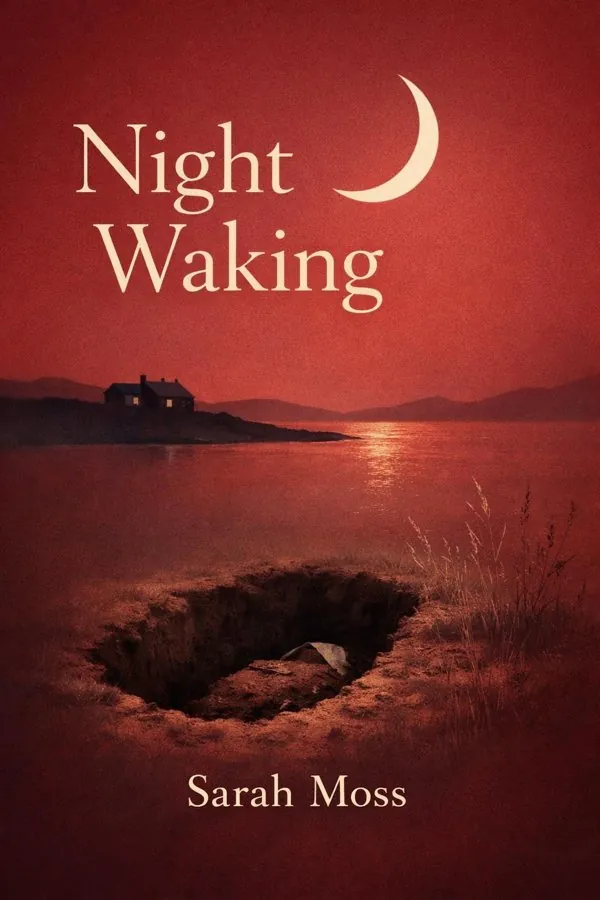
Night Waking: Summary & Key Insights
by Sarah Moss
 10 min8 chaptersAudio available
Key Takeaways from Night Waking
Isolation does not simply make people lonely; it can strip away the routines and social mirrors that help them recognize who they are.
Sometimes the most disturbing discoveries are not dramatic revelations but small, fragile traces that expose how much suffering has gone unrecorded.
One of the novel’s most piercing insights is that love and resentment can coexist without canceling each other out.
Healing does not always arrive as resolution; sometimes it begins when someone finds language for what has been endured.
Sleep deprivation is often treated as a private inconvenience, but Night Waking reveals it as a condition that reshapes thought, emotion, and power.
What Is Night Waking About?
Night Waking by Sarah Moss is a bestsellers book spanning 4 pages. Set on a wind-beaten Hebridean island, Night Waking is a novel about sleeplessness, strain, and the unsettling ways the past refuses to stay buried. Sarah Moss follows Anna Bennett, a historian and mother of two young children, who arrives on a remote island while her husband Giles pursues environmental research. Anna is exhausted, isolated, and increasingly fractured by the relentless demands of care. Then she discovers the tiny skeleton of a long-dead infant near their rented home, and the novel opens into something larger than domestic realism: a meditation on motherhood across centuries, on women’s erased lives, and on the uneasy relationship between intellectual ambition and family obligation. What makes the book so powerful is Moss’s ability to hold sharp wit, historical depth, and emotional honesty in the same frame. As both novelist and academic, she writes with unusual authority about scholarship, gender, and the stories institutions overlook. Night Waking matters because it treats ordinary maternal exhaustion not as a private weakness but as a social, historical, and moral question, turning one family’s difficult summer into a haunting inquiry about care, memory, and survival.
This FizzRead summary covers all 8 key chapters of Night Waking in approximately 10 minutes, distilling the most important ideas, arguments, and takeaways from Sarah Moss's work. Also available as an audio summary and Key Quotes Podcast.
Night Waking
Set on a wind-beaten Hebridean island, Night Waking is a novel about sleeplessness, strain, and the unsettling ways the past refuses to stay buried. Sarah Moss follows Anna Bennett, a historian and mother of two young children, who arrives on a remote island while her husband Giles pursues environmental research. Anna is exhausted, isolated, and increasingly fractured by the relentless demands of care. Then she discovers the tiny skeleton of a long-dead infant near their rented home, and the novel opens into something larger than domestic realism: a meditation on motherhood across centuries, on women’s erased lives, and on the uneasy relationship between intellectual ambition and family obligation. What makes the book so powerful is Moss’s ability to hold sharp wit, historical depth, and emotional honesty in the same frame. As both novelist and academic, she writes with unusual authority about scholarship, gender, and the stories institutions overlook. Night Waking matters because it treats ordinary maternal exhaustion not as a private weakness but as a social, historical, and moral question, turning one family’s difficult summer into a haunting inquiry about care, memory, and survival.
Who Should Read Night Waking?
This book is perfect for anyone interested in bestsellers and looking to gain actionable insights in a short read. Whether you're a student, professional, or lifelong learner, the key ideas from Night Waking by Sarah Moss will help you think differently.
- ✓Readers who enjoy bestsellers and want practical takeaways
- ✓Professionals looking to apply new ideas to their work and life
- ✓Anyone who wants the core insights of Night Waking in just 10 minutes
Want the full summary?
Get instant access to this book summary and 100K+ more with Fizz Moment.
Get Free SummaryAvailable on App Store • Free to download
Key Chapters
Isolation does not simply make people lonely; it can strip away the routines and social mirrors that help them recognize who they are. In Night Waking, Anna Bennett arrives on a remote Hebridean island already depleted by childcare, interrupted sleep, and the pressure of sustaining an academic identity while mothering two young children. The island intensifies everything. Its harsh weather, physical distance, and limited support leave Anna trapped in a space where every need is immediate and every intellectual desire must compete with nappies, meals, tantrums, and endless waking nights. Sarah Moss shows that this is not melodramatic collapse but a realistic account of what happens when a capable, educated woman is asked to do too much with too little rest, recognition, or help.
Anna’s isolation is emotional as much as geographical. Her husband Giles is physically present but professionally absorbed, protected by the cultural assumption that his work matters in a way Anna’s work can be postponed. This imbalance deepens her sense of erasure. The result is a mind that becomes sharper and more frayed at once: funny, perceptive, angry, distracted, guilty, and haunted. Moss captures how domestic overload can make a person feel both hyper-visible as a caregiver and invisible as a self.
In practical terms, the novel offers a language for modern burnout. Many readers will recognize Anna’s experience in forms that are less dramatic but equally real: remote parenting, career stagnation during caregiving years, or the emotional distortion created by chronic lack of sleep. The book invites us to ask not whether someone is “coping,” but what hidden costs coping imposes.
Actionable takeaway: when your sense of self begins to narrow under pressure, treat that not as a personal failure but as evidence that your conditions need to change.
Sometimes the most disturbing discoveries are not dramatic revelations but small, fragile traces that expose how much suffering has gone unrecorded. Anna’s discovery of an infant’s skeleton buried near the house is the turning point of Night Waking. What begins as a moment of shock becomes a moral and intellectual summons. The tiny bones connect Anna’s exhausted present to the island’s deeper history, especially to the lives of women and children whose stories were never fully preserved. The unearthed child is not merely a plot device; the grave embodies the novel’s central question: who gets remembered, and who disappears beneath the narratives of progress, scholarship, and family continuity?
Moss uses this discovery to braid archaeology, history, and intimate feeling. Anna’s response is shaped by professional curiosity, maternal identification, and personal distress. As she investigates the past, she is not escaping her life so much as seeing it refracted through history. The dead infant becomes a witness to recurring patterns of vulnerability: women burdened with care, children exposed to precarious conditions, and societies willing to let certain losses remain unspoken.
The novel suggests that historical inquiry is not cold detachment but a form of ethical attention. Anna’s obsession is understandable because the bones convert abstraction into encounter. Readers may recognize similar moments in their own lives: a family document, a photograph, or a local history that suddenly transforms “the past” into something immediate and human.
The practical application is broader than literary interpretation. We are often encouraged to value only visible achievements and official records, yet much of what shapes human life survives in fragments, omissions, and silences. Paying attention to those absences can change how we understand our communities and ourselves.
Actionable takeaway: when you encounter a forgotten story, resist the urge to move on quickly; ask what hidden system of neglect or silence made that forgetting possible.
One of the novel’s most piercing insights is that love and resentment can coexist without canceling each other out. Anna loves her children fiercely, yet she also longs to think, read, write, and pursue scholarly work without constant interruption. Night Waking refuses the sentimental myth that maternal devotion naturally dissolves all other ambitions. Instead, Sarah Moss portrays intellectual desire as a legitimate human need, not an indulgence, and shows how women are often made to feel selfish for protecting it.
Anna’s predicament is painfully recognizable. She is expected to remain emotionally available, physically responsive, and endlessly patient, while her own work becomes optional, fragmented, and postponed. Every task she completes is instantly replaced by another. Her mind must operate in snatches, and the very effort to preserve an inner life can seem like theft from her children. Moss is especially sharp in showing how this conflict is social, not merely psychological. The problem is not that Anna lacks gratitude or discipline. The problem is that caregiving labor is structured as invisible, and women’s thinking time is treated as negotiable.
This tension stretches beyond Anna’s household. By connecting her to women from the past, the novel suggests that generations of mothers have faced versions of the same struggle: how to sustain personhood within systems that define them primarily by service. The result is not a rejection of motherhood but a richer, more honest portrait of it.
Readers can apply this insight by challenging all-or-nothing thinking in their own lives. Creative work, study, reflection, and professional purpose do not oppose care; they help sustain the self that cares. Even small protections of time and attention matter. A parent who claims one uninterrupted hour to write, rest, or think is not abandoning family but preserving mental coherence.
Actionable takeaway: name your intellectual or creative needs clearly and treat them as essential, not as rewards to be earned after every other demand is met.
Healing does not always arrive as resolution; sometimes it begins when someone finds language for what has been endured. As Night Waking progresses, Anna’s investigation into the island’s buried history becomes a form of witness, allowing her to connect fragmented stories across time. This process does not erase exhaustion, grief, or unfairness. What it offers instead is a more grounded way of understanding them. By listening to voices neglected by official history, Anna gradually recovers parts of her own voice as well.
Sarah Moss suggests that reconciliation is less about neat closure than about honest recognition. Anna cannot control the conditions that have strained her marriage, interrupted her work, or depleted her body. Nor can she undo the suffering of those who lived on the island before her. But she can resist silence. She can investigate, narrate, and refuse the disappearance of vulnerable lives into oblivion. This act of witness changes her relationship to her own distress. It reframes private struggle as part of a longer and larger pattern of gendered labor, vulnerability, and endurance.
For readers, this idea has practical force. Many people carry experiences they cannot “solve”: burnout, caregiving fatigue, family tensions, or inherited grief. The novel implies that articulation matters. Writing, speaking, documenting, or even privately naming what happened can be an act of reordering experience. Story does not substitute for structural change, but it can create clarity, dignity, and connection.
Moss is also attentive to the ethical dimension of storytelling. To give voice is not to dominate another’s pain with your own interpretation. It is to approach the past humbly, acknowledging both empathy and limits. That balance gives the novel much of its moral intelligence.
Actionable takeaway: when life feels shapeless or silencing, start by giving your experience form—through words, records, or conversation—so that what hurts is no longer nameless.
Sleep deprivation is often treated as a private inconvenience, but Night Waking reveals it as a condition that reshapes thought, emotion, and power. Anna’s exhaustion is not background texture; it is the medium through which the novel’s tensions become legible. She is interrupted at night, depleted by day, and expected to function with competence, warmth, and composure. Moss captures the surreal quality of chronic sleeplessness: the jumpiness, the irrational spirals, the sharpened irritability, the dark comedy, and the sense that reality itself has become unstable.
What makes this portrayal so effective is that it resists both self-pity and trivialization. Anna’s sleeplessness is deeply embodied, but it is also social. Someone must absorb the cost of care, and in this household Anna absorbs more than her share. The novel quietly asks why women’s exhaustion is so often normalized, even romanticized, as evidence of devotion. Instead of praising maternal sacrifice in the abstract, Moss shows its concrete consequences on concentration, identity, and emotional equilibrium.
This idea is widely applicable. In workplaces, families, and institutions, we often assess performance without considering the hidden burdens shaping it. The parent who misses deadlines, the caregiver who seems distracted, or the colleague who appears less resilient may be functioning under conditions that make sustained attention nearly impossible. Recognizing sleep and rest as structural needs, not personal luxuries, changes how we assign responsibility and compassion.
On an individual level, the book encourages readers to take exhaustion seriously before it hardens into despair. That may mean renegotiating responsibilities, accepting imperfect standards, asking for help earlier, or refusing cultural scripts that glorify depletion. Rest is not merely recovery; it is protection for judgment, patience, and selfhood.
Actionable takeaway: stop treating chronic exhaustion as normal background noise and identify one practical change that protects your rest, even if it requires uncomfortable renegotiation.
Places do not just contain human drama; they shape how that drama is felt and understood. In Night Waking, the Hebridean island is more than scenery. Its wind, rain, remoteness, sea light, and rugged openness influence the novel’s mood and meaning at every turn. The landscape is beautiful but indifferent, expansive yet confining. For Anna, the island magnifies inner states. Its physical isolation echoes her emotional isolation, while its long historical memory reminds her that her own crisis is both intensely personal and part of something older.
Sarah Moss writes the natural world with precision, but she avoids easy romanticism. The island is not a healing retreat where modern anxieties dissolve in sublime nature. It is materially demanding. Weather complicates movement, domestic work remains relentless, and beauty offers no exemption from childcare or intellectual frustration. This realism matters because it challenges a common fantasy: that the right environment can solve problems rooted in unequal labor, strained relationships, or unacknowledged emotional needs.
At the same time, place does offer perspective. The island’s deep time and layered history destabilize Anna’s immediate sense of entrapment. It becomes possible to think across centuries, to sense continuity between past and present, and to experience the self as part of a larger ecology of memory and survival. Readers can apply this insight by paying attention to how environments affect thought. A home, workplace, city, or landscape can intensify stress or create space for reflection, but no place is neutral.
The practical lesson is not to search for a magical setting, but to become more conscious of environmental influence. Small changes in light, noise, access to nature, or privacy can alter mental experience significantly. Likewise, a place’s history can deepen our understanding of our own reactions within it.
Actionable takeaway: assess the spaces where you live and work, and change one environmental factor that is quietly amplifying your stress or diminishing your ability to think.
Inequality inside intimate relationships often survives not through open cruelty but through assumptions that seem ordinary. Night Waking examines marriage with unusual sharpness by showing how Anna and Giles inhabit the same household while living very different realities. Giles’s ecological research is treated as important, bounded, and intelligible. Anna’s labor is constant, diffuse, and easily overlooked because it takes the form of responsiveness: soothing children, managing routines, anticipating needs, repairing disruptions, and absorbing emotional spillover. The novel exposes how invisible work sustains visible achievement.
Moss does not reduce Giles to a villain. That would be too simple and far less true to life. Instead, she shows how decent, educated people can participate in unfair arrangements while imagining themselves egalitarian. This is one of the book’s most unsettling insights. In many modern partnerships, explicit beliefs about equality coexist with daily patterns that tell another story. The person whose work can be uninterrupted accumulates progress, while the person who is interruptible becomes the infrastructure of family life.
The novel encourages readers to look beyond stated intentions to actual distributions of time, rest, and concentration. Who gets to finish a thought? Who can leave the house unencumbered? Who is assumed to be on call? These questions are practical, not theoretical. They can reveal why resentment grows even in loving relationships.
Applied to real life, the book suggests the importance of auditing domestic labor in concrete rather than symbolic terms. Not “Do we both help?” but “Who carries mental load, nighttime interruptions, and default responsibility?” Honest answers may be uncomfortable, but they are necessary for fairness.
Actionable takeaway: replace vague assumptions of equality with a specific inventory of labor, attention, and interruption in your household, then rebalance based on reality rather than intention.
Official history often preserves power more faithfully than suffering. Night Waking insists that the past must be read not only through what was recorded but through what was neglected, minimized, or erased. Anna’s scholarly instincts draw her toward the island’s earlier inhabitants, especially women and children whose lives have left only fragmentary traces. In doing so, the novel becomes a critique of historical storytelling itself. What counts as an event? Whose labor is documented? Which deaths are mourned publicly, and which remain domestic, private, and therefore disposable in the archive?
This is where Sarah Moss’s academic intelligence gives the novel unusual depth. She understands that historical inquiry is shaped by selection, hierarchy, and institutional bias. Yet the book remains emotionally immediate because these questions are tied to Anna’s own condition. Her sense of marginalization in the present makes her more alert to marginalization in the past. She recognizes that what is omitted from records is often what mattered most in daily life: feeding children, enduring hunger, surviving weather, caring for the sick, and bearing losses that never entered formal narratives.
Readers can apply this lens beyond literature. Family histories, local monuments, school curricula, and public memory all reflect choices about visibility. Asking who is missing can transform understanding. A town’s economic history may ignore domestic labor. A family story may celebrate male achievement while overlooking the women who made it possible. Recovering such absences does not distort the past; it completes it.
The novel also offers a method: approach fragments with humility and imagination, but do not confuse silence with insignificance. Lack of evidence is often evidence of social disregard, not of an empty life. This is a powerful corrective to the way institutions define what matters.
Actionable takeaway: whenever you encounter a historical account, deliberately ask whose experiences are absent and what those omissions reveal about the values of the record.
All Chapters in Night Waking
About the Author
Sarah Moss is a British novelist and academic whose fiction is celebrated for its intelligence, atmospheric power, and psychological precision. She has written novels and nonfiction that often examine family life, gender, history, landscape, and the uneasy overlap between private experience and cultural expectation. Her academic background informs the depth of her historical and intellectual themes, while her prose remains vivid, humane, and sharply observant. Moss is especially admired for portraying women’s inner lives with unusual honesty, including the pressures of caregiving, ambition, and social constraint. In works such as Night Waking, she blends literary elegance with dark humor and moral seriousness, creating stories that feel both intimate and historically alert. She is widely regarded as one of the most thoughtful contemporary voices in British literary fiction.
Get This Summary in Your Preferred Format
Read or listen to the Night Waking summary by Sarah Moss anytime, anywhere. FizzRead offers multiple formats so you can learn on your terms — all free.
Available formats: App · Audio · PDF · EPUB — All included free with FizzRead
Download Night Waking PDF and EPUB Summary
Key Quotes from Night Waking
“Isolation does not simply make people lonely; it can strip away the routines and social mirrors that help them recognize who they are.”
“Sometimes the most disturbing discoveries are not dramatic revelations but small, fragile traces that expose how much suffering has gone unrecorded.”
“One of the novel’s most piercing insights is that love and resentment can coexist without canceling each other out.”
“Healing does not always arrive as resolution; sometimes it begins when someone finds language for what has been endured.”
“Sleep deprivation is often treated as a private inconvenience, but Night Waking reveals it as a condition that reshapes thought, emotion, and power.”
Frequently Asked Questions about Night Waking
Night Waking by Sarah Moss is a bestsellers book that explores key ideas across 8 chapters. Set on a wind-beaten Hebridean island, Night Waking is a novel about sleeplessness, strain, and the unsettling ways the past refuses to stay buried. Sarah Moss follows Anna Bennett, a historian and mother of two young children, who arrives on a remote island while her husband Giles pursues environmental research. Anna is exhausted, isolated, and increasingly fractured by the relentless demands of care. Then she discovers the tiny skeleton of a long-dead infant near their rented home, and the novel opens into something larger than domestic realism: a meditation on motherhood across centuries, on women’s erased lives, and on the uneasy relationship between intellectual ambition and family obligation. What makes the book so powerful is Moss’s ability to hold sharp wit, historical depth, and emotional honesty in the same frame. As both novelist and academic, she writes with unusual authority about scholarship, gender, and the stories institutions overlook. Night Waking matters because it treats ordinary maternal exhaustion not as a private weakness but as a social, historical, and moral question, turning one family’s difficult summer into a haunting inquiry about care, memory, and survival.
More by Sarah Moss

You Might Also Like

The Godfather
Mario Puzo
10 min
The Handmaid's Tale
Margaret Atwood
10 min
The Hunger Games
Suzanne Collins
10 min
The Nightingale
Kristin Hannah
10 min
The Seven Husbands of Evelyn Hugo
Taylor Jenkins Reid
10 min
Backwater Justice
Fern Michaels
10 minBrowse by Category
Ready to read Night Waking?
Get the full summary and 100K+ more books with Fizz Moment.