
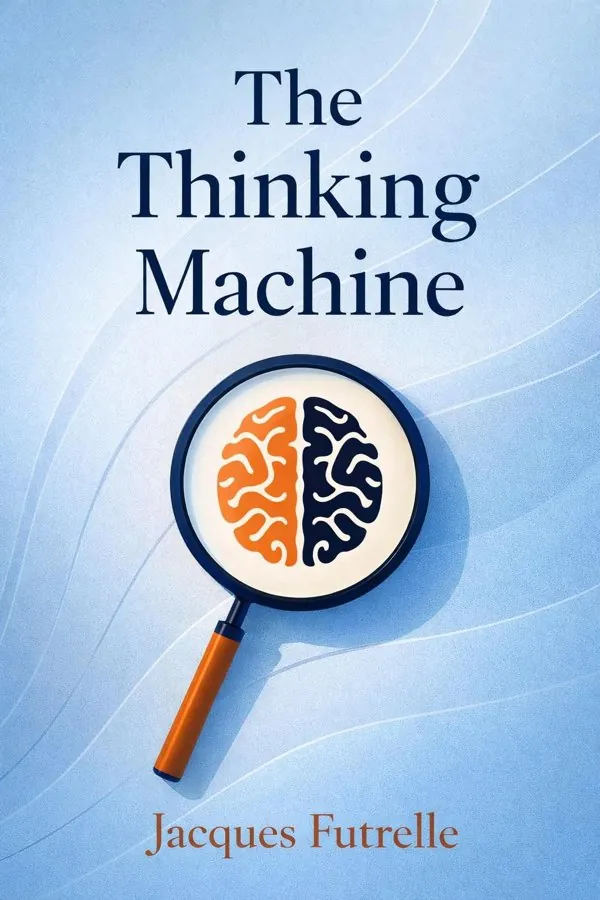
The Thinking Machine: Summary & Key Insights
 10 min10 chaptersAudio available
Key Takeaways from The Thinking Machine
A great detective does not merely solve crimes; he embodies a worldview.
Even the coldest logic needs a human voice to make it visible.
Nothing proves intellectual power like escaping from the impossible.
Most people trust their instincts more than they admit, but Futrelle builds his mysteries to expose how unreliable intuition can be.
A crime scene is not merely a place; it is a record of thought translated into action.
What Is The Thinking Machine About?
The Thinking Machine by Jacques Futrelle is a mystery book spanning 10 pages. What if a human mind could function with the precision of a scientific instrument? That question lies at the heart of The Thinking Machine, Jacques Futrelle’s celebrated collection of mystery stories featuring Professor Augustus S. F. X. Van Dusen, a brilliant logician whose intellect seems capable of solving any puzzle. Nicknamed “The Thinking Machine,” Van Dusen approaches crime not through force, instinct, or sentiment, but through relentless reasoning. Every locked room, baffling disappearance, and impossible crime becomes, in his eyes, a problem that must yield to logic. The book matters because it represents a foundational moment in detective fiction. Long before many modern sleuths made deduction fashionable, Futrelle built stories around the thrilling idea that the mind itself could be the ultimate investigative tool. His tales helped shape the “armchair detective” tradition and influenced later mystery writers who prized intelligence over action. Futrelle wrote with the authority of a journalist and storyteller deeply attuned to human behavior, suspense, and the era’s faith in science. The result is a sharp, engaging collection that still feels fresh for readers who love mysteries built on ideas as much as plot.
This FizzRead summary covers all 10 key chapters of The Thinking Machine in approximately 10 minutes, distilling the most important ideas, arguments, and takeaways from Jacques Futrelle's work. Also available as an audio summary and Key Quotes Podcast.
The Thinking Machine
What if a human mind could function with the precision of a scientific instrument? That question lies at the heart of The Thinking Machine, Jacques Futrelle’s celebrated collection of mystery stories featuring Professor Augustus S. F. X. Van Dusen, a brilliant logician whose intellect seems capable of solving any puzzle. Nicknamed “The Thinking Machine,” Van Dusen approaches crime not through force, instinct, or sentiment, but through relentless reasoning. Every locked room, baffling disappearance, and impossible crime becomes, in his eyes, a problem that must yield to logic.
The book matters because it represents a foundational moment in detective fiction. Long before many modern sleuths made deduction fashionable, Futrelle built stories around the thrilling idea that the mind itself could be the ultimate investigative tool. His tales helped shape the “armchair detective” tradition and influenced later mystery writers who prized intelligence over action.
Futrelle wrote with the authority of a journalist and storyteller deeply attuned to human behavior, suspense, and the era’s faith in science. The result is a sharp, engaging collection that still feels fresh for readers who love mysteries built on ideas as much as plot.
Who Should Read The Thinking Machine?
This book is perfect for anyone interested in mystery and looking to gain actionable insights in a short read. Whether you're a student, professional, or lifelong learner, the key ideas from The Thinking Machine by Jacques Futrelle will help you think differently.
- ✓Readers who enjoy mystery and want practical takeaways
- ✓Professionals looking to apply new ideas to their work and life
- ✓Anyone who wants the core insights of The Thinking Machine in just 10 minutes
Want the full summary?
Get instant access to this book summary and 100K+ more with Fizz Moment.
Get Free SummaryAvailable on App Store • Free to download
Key Chapters
A great detective does not merely solve crimes; he embodies a worldview. Professor Augustus S. F. X. Van Dusen is not presented as a conventional hero but as the living expression of early twentieth-century confidence in intellect, science, and system. His nickname, “The Thinking Machine,” is more than colorful branding. It tells us that Futrelle imagined a mind so disciplined, so methodical, that it could process confusion the way a machine processes inputs and outputs. In an age fascinated by invention and industrial progress, Van Dusen stands as the human equivalent of a precision instrument.
What makes this concept compelling is the contrast between Van Dusen and the world around him. Most people are swayed by fear, vanity, prejudice, or haste. Van Dusen strips away all of that. He assumes that every mystery, no matter how impossible it appears, has a rational explanation. This confidence in reason becomes the engine of the stories. Readers are invited to see the detective not as a magician but as someone who observes more clearly and thinks more rigorously than others.
In practical terms, this character design teaches an enduring lesson: difficult problems often look supernatural only because we have not yet identified the right framework. Whether in business, research, negotiation, or personal decision-making, confusion shrinks when we define variables, test assumptions, and separate fact from interpretation.
The enduring appeal of Van Dusen lies in this promise: intelligence can bring order to chaos. Actionable takeaway: when confronted with a complex problem, stop reacting emotionally and ask what facts are certain, what assumptions are untested, and what explanation best accounts for all the evidence.
Even the coldest logic needs a human voice to make it visible. In The Thinking Machine, journalist Hutchinson Hatch serves as far more than a narrator. He is the bridge between Van Dusen’s abstract brilliance and the ordinary reader’s limited perspective. Through Hatch, Futrelle creates a vital storytelling dynamic: one character sees the world as a pattern of solvable equations, while the other sees its drama, tension, and human stakes.
This partnership matters because detective fiction depends on controlled revelation. If Van Dusen spoke only in final conclusions, the stories would feel mechanical. Hatch allows us to experience surprise, doubt, and curiosity. He asks the questions readers would ask. He notices what appears important, misses what truly matters, and records the professor’s triumphs with admiration tinged by bewilderment. That contrast makes Van Dusen seem even more extraordinary while keeping the stories accessible.
There is also a deeper point here about collaboration. Hatch and Van Dusen represent two complementary modes of intelligence: analytical reasoning and social observation. Hatch understands people, settings, and emotional atmosphere. Van Dusen understands structure, causation, and hidden logic. Modern teams often need both. A strategist may see systems clearly but communicate poorly; a communicator may capture context but miss technical subtleties. The strongest results emerge when those abilities work together.
In everyday life, this idea applies whenever expertise risks becoming isolated. A brilliant analyst needs someone who can translate findings into action. A visionary leader needs someone grounded in practical realities. Futrelle’s detective pair shows that genius becomes more powerful when it is interpreted, challenged, and conveyed.
Actionable takeaway: identify your “Hatch” or your “Van Dusen”—someone whose strengths complement your own—and use that partnership to turn insight into results.
Nothing proves intellectual power like escaping from the impossible. One of the most famous stories in the collection, “The Problem of Cell 13,” centers on Van Dusen’s astonishing wager that he can escape from a prison cell under conditions designed to make escape impossible. The story is thrilling not only because of the physical confinement, but because it turns a detective premise inside out: instead of solving a crime after the fact, Van Dusen must solve a living puzzle while trapped inside it.
The brilliance of the tale lies in how Futrelle reframes impossibility. A locked cell seems secure because people imagine prison as a total system of control. Van Dusen approaches it differently. He studies procedures, weaknesses, habits, and hidden assumptions. The problem is not the bars alone but the network of people, signals, timings, and routines around them. In other words, “impossible” usually means “not yet examined closely enough.”
This story has broad practical relevance. Many modern obstacles resemble Cell 13. A stalled career, a rigid institution, a bureaucratic process, or a competitive market can feel airtight. Yet systems are built by humans, and human systems contain patterns, loopholes, dependencies, and blind spots. Creative reasoning often reveals options that panic obscures. Van Dusen does not waste energy lamenting constraints; he maps them.
The story also reminds us that intelligence is not just accumulation of facts. It is the ability to understand structure. Van Dusen’s achievement comes from noticing how one small factor can influence a larger chain of events.
Actionable takeaway: when a situation feels impossible, diagram the system around you—rules, routines, incentives, timing, gatekeepers—and look for the hidden leverage points that others ignore.
Most people trust their instincts more than they admit, but Futrelle builds his mysteries to expose how unreliable intuition can be. Again and again, The Thinking Machine contrasts common-sense judgments with Van Dusen’s disciplined logic. Witnesses leap to conclusions based on appearances. Police suspect whoever looks guilty. Bystanders assume motives from gossip or emotion. Van Dusen refuses all of it. For him, intuition is useful only if it can survive verification.
This does not mean the stories deny human insight altogether. Rather, they show that instinct often notices something real but expresses it poorly. Someone may sense that a suspect is lying, yet be wrong about why. Someone may feel a scene is staged, yet fail to identify the mechanism. Van Dusen’s method is to turn vague impressions into testable propositions. He asks: What exactly happened? What had to be true for this outcome to occur? Which explanation accounts for every detail, not just the dramatic ones?
That distinction remains highly relevant today. In hiring, investing, medicine, politics, and relationships, people routinely confuse confidence with accuracy. A charismatic speaker sounds truthful. A neat narrative sounds plausible. A familiar face feels trustworthy. But facts often tell a different story. Logical discipline slows us down enough to check whether our interpretation is evidence-based or merely emotionally satisfying.
Futrelle’s enduring insight is that reason is not the enemy of human judgment; it is its corrective. Intuition may point, but logic must prove. The stories reward readers who learn to resist the first obvious answer and instead examine contradictions, omissions, and incentives.
Actionable takeaway: whenever your “gut feeling” is strong, write down the evidence supporting it, the evidence against it, and what fact would conclusively test your belief.
A crime scene is not merely a place; it is a record of thought translated into action. One of Futrelle’s signature achievements is showing how Van Dusen reconstructs events not by chasing suspects dramatically, but by reasoning backward from outcomes. If a murder occurred under unusual conditions, then certain prior decisions must have been made. If a body was discovered in a certain position, then someone either moved it or intended a message. If a theft appears random, then the choice of target may reveal a hidden purpose. Van Dusen treats every result as a clue to the structure of the act.
This analytical reversal is what gives the stories their intellectual pleasure. Instead of collecting details passively, Van Dusen asks what sequence of causes could have produced the observed facts. He eliminates impossibilities and reduces the case to the explanation that fits all known elements. In this way, mystery becomes almost mathematical. The reader sees that deduction is not guesswork in elegant language; it is a disciplined reconstruction of necessity.
Outside fiction, this method has powerful uses. Investigators use it, of course, but so do engineers diagnosing failures, executives analyzing a collapsed project, and doctors tracing symptoms to underlying disease. The key is to stop fixating on the visible problem and instead infer the hidden chain that created it. Effects are easier to see; causes are what matter.
Futrelle invites us to think like system-builders rather than spectators. Every outcome, whether successful or disastrous, leaves traces of the decisions behind it. If we learn to read those traces, we become better at solving problems and preventing repetition.
Actionable takeaway: after any unexpected outcome, ask yourself to reconstruct the chain of causes step by step until you identify the earliest decision or condition that made the result likely.
The most dangerous obstacle in any mystery is rarely the lack of evidence; it is the distortion of judgment. Throughout The Thinking Machine, Futrelle presents crime as something deeply entangled with jealousy, fear, pride, greed, panic, and wounded vanity. Van Dusen succeeds not because he is less human in a biological sense, but because he is less governed by emotional turbulence. He understands that people often create mysteries through irrational behavior and then make them harder to solve through lies, self-protection, and wishful thinking.
This theme gives the stories psychological depth. Criminals do not merely act; they rationalize. Witnesses do not simply report; they edit. Victims themselves may conceal facts from embarrassment or misplaced loyalty. Law officers may cling to a theory because admitting error would damage their authority. In this world, truth is obscured not only by cunning plans but by ordinary human weakness. Van Dusen’s coolness allows him to see around these distortions.
The lesson is timeless. In daily life, many bad decisions arise not from insufficient intelligence but from unexamined emotion. A manager defends a failing strategy because it was their idea. A buyer overpays because fear of missing out overrides analysis. A friend misreads a conversation because insecurity supplies the meaning before facts do. Rationality is not merely having a high IQ; it is maintaining clarity when emotions tempt us to simplify reality.
Futrelle does not suggest becoming emotionless. Rather, he shows the value of noticing how emotion alters perception. Self-awareness is a practical investigative tool.
Actionable takeaway: when stakes feel personal, pause before deciding and ask, “What interpretation would I make if my pride, fear, or attachment were not involved?”
Knowledge becomes powerful when it moves from abstraction to application. In The Thinking Machine, scientific principles are not decorative references added to make Van Dusen seem clever. They are active tools. Futrelle repeatedly shows how chemistry, physics, timing, communication systems, and mechanical understanding can illuminate crimes that appear baffling to those relying only on surface impressions. At the same time, he reveals that science can aid both truth and deception. A criminal may exploit technical knowledge to stage an illusion, manipulate evidence, or create a false explanation.
This tension makes the stories especially modern. Futrelle understood that progress expands both problem-solving capacity and opportunities for fraud. The same intelligence that can detect patterns can also design sophisticated misdirection. Van Dusen remains superior because he does not worship complexity for its own sake. He asks what principles are actually operating. He reduces spectacle to mechanism.
In the real world, this remains crucial. Data can clarify decisions, but it can also be cherry-picked. Technical language can educate, but it can also intimidate and mislead. A convincing presentation of expertise is not the same as truth. Van Dusen models a better approach: understand the basics deeply enough to test claims instead of being dazzled by them.
The stories therefore advocate scientific thinking more than scientific ornament. Observation, hypothesis, verification, and causal reasoning matter more than jargon. Futrelle’s message is that the disciplined use of knowledge defeats both ignorance and manipulation.
Actionable takeaway: when confronted with a technical claim, do not ask whether it sounds impressive; ask what principle it depends on, what evidence supports it, and what alternative explanation might also fit the facts.
Institutions often resist the very insight they need most. In many stories, Van Dusen’s relationship with police and officials is marked by friction. Law enforcement represents procedure, authority, and practical urgency, while Van Dusen represents detached intellect and unconventional reasoning. The resulting tension is one of the collection’s recurring pleasures. Police may resent his arrogance, doubt his methods, or commit too early to a suspect. Yet they also need him when ordinary investigation fails.
Futrelle uses this conflict to explore a broader issue: expertise does not operate in a vacuum. Brilliant reasoning can solve a case, but real justice requires institutions capable of acting on that reasoning. Conversely, institutions are necessary but can become rigid, defensive, or unimaginative. The best outcomes arise when procedure and creativity cooperate rather than compete.
This pattern appears in every modern organization. Analysts clash with operators. Researchers frustrate administrators. Consultants challenge internal teams. Frontline staff know constraints that outsiders ignore, while outsiders see assumptions insiders no longer notice. Futrelle shows that mutual contempt is costly. Van Dusen may be right, but he still benefits from access, manpower, and official channels. The police may have authority, but without intellectual flexibility, they risk failure.
The stories also warn against status-driven thinking. A badge, title, or rank does not guarantee truth; neither does brilliance excuse poor communication. Effective problem-solving depends on evidence, humility, and coordinated action.
Actionable takeaway: when working across expertise or hierarchy, focus discussion on shared facts and desired outcomes rather than defending territory, because the goal is solving the problem, not protecting professional pride.
People do not see reality directly; they see reality through expectation. Futrelle repeatedly exploits this fact by constructing mysteries in which the crucial trick lies not in what happened, but in what observers assumed had happened. A witness hears a sound and supplies a meaning. A suspect performs innocence or guilt for an audience. A criminal counts on social habits, visual shortcuts, or emotional distraction to guide others toward the wrong conclusion. Van Dusen’s superiority comes from recognizing that perception itself is vulnerable.
This gives The Thinking Machine a surprisingly sophisticated psychological edge. Long before modern cognitive science named common biases, Futrelle dramatized them. We anchor on first impressions. We overlook what seems ordinary. We remember selectively. We interpret behavior according to stereotype or convenience. In a mystery, these tendencies make deception possible. In life, they can distort hiring, conflict resolution, negotiation, and media consumption.
One practical lesson from these stories is that manipulation often works best when it does not fabricate entirely new realities. Instead, it nudges people to complete the picture incorrectly on their own. A misleading clue is effective because observers are eager to create a coherent story. Van Dusen resists this trap by withholding belief until each element has been tested against the whole.
Readers can apply this insight widely. Before accepting an explanation, ask whether it reflects direct evidence or your mind filling in gaps. The most persuasive story is not always the truest one.
Actionable takeaway: in any confusing situation, separate what you personally observed from what you inferred, and be especially suspicious of conclusions that feel satisfying too quickly.
Reason can solve astonishing problems, but Futrelle is too good a storyteller to make logic feel simplistic. The collection celebrates the triumph of pure reasoning, yet it also reveals its boundaries. Van Dusen can decode crimes, expose frauds, and dismantle illusions because he trusts that the world is intelligible. That faith is the book’s central argument and its great pleasure. Still, the stories are populated by human beings whose motives emerge from grief, ambition, resentment, love, and desperation. Logic explains what happened; it does not always redeem why it happened.
This balance is what keeps The Thinking Machine from becoming a sterile puzzle book. Futrelle invites admiration for intellect, but he also reminds us that intellect operates in a morally messy world. Solving a case may restore order, yet it cannot erase suffering or prevent the existence of vice. In that sense, reason is powerful but not total. It is a means of clarity, not a replacement for ethics or compassion.
For modern readers, this is a valuable final lesson. Analytical thinking is indispensable, especially in an era crowded with misinformation and emotional manipulation. But being right is not the only human task. We also need judgment, communication, and moral seriousness. The strongest problem-solvers combine clear reasoning with awareness of consequences.
Futrelle’s great achievement is to make the mind itself dramatic. He shows that thought can be an adventure and that disciplined intelligence can pierce confusion without denying complexity.
Actionable takeaway: cultivate rigorous reasoning as your default method, but pair it with empathy and ethical reflection so that solving problems does not blind you to their human meaning.
All Chapters in The Thinking Machine
About the Author
Jacques Futrelle (1875–1912) was an American journalist and mystery writer best known for creating Professor Augustus S. F. X. Van Dusen, the brilliant detective nicknamed “The Thinking Machine.” Born in Georgia, Futrelle began his career in journalism, working as a reporter and editor before turning to fiction. His reporting background helped shape his crisp storytelling, eye for detail, and instinct for suspense. Futrelle became an important early voice in detective literature by building stories around logic, scientific reasoning, and seemingly impossible crimes. His Van Dusen tales influenced the development of puzzle-centered mystery fiction in the twentieth century. Futrelle’s life was cut short when he died in the sinking of the RMS Titanic in 1912. Despite his early death, his detective stories remain a significant part of mystery fiction’s foundations.
Get This Summary in Your Preferred Format
Read or listen to the The Thinking Machine summary by Jacques Futrelle anytime, anywhere. FizzRead offers multiple formats so you can learn on your terms — all free.
Available formats: App · Audio · PDF · EPUB — All included free with FizzRead
Download The Thinking Machine PDF and EPUB Summary
Key Quotes from The Thinking Machine
“A great detective does not merely solve crimes; he embodies a worldview.”
“Even the coldest logic needs a human voice to make it visible.”
“Nothing proves intellectual power like escaping from the impossible.”
“Most people trust their instincts more than they admit, but Futrelle builds his mysteries to expose how unreliable intuition can be.”
“A crime scene is not merely a place; it is a record of thought translated into action.”
Frequently Asked Questions about The Thinking Machine
The Thinking Machine by Jacques Futrelle is a mystery book that explores key ideas across 10 chapters. What if a human mind could function with the precision of a scientific instrument? That question lies at the heart of The Thinking Machine, Jacques Futrelle’s celebrated collection of mystery stories featuring Professor Augustus S. F. X. Van Dusen, a brilliant logician whose intellect seems capable of solving any puzzle. Nicknamed “The Thinking Machine,” Van Dusen approaches crime not through force, instinct, or sentiment, but through relentless reasoning. Every locked room, baffling disappearance, and impossible crime becomes, in his eyes, a problem that must yield to logic. The book matters because it represents a foundational moment in detective fiction. Long before many modern sleuths made deduction fashionable, Futrelle built stories around the thrilling idea that the mind itself could be the ultimate investigative tool. His tales helped shape the “armchair detective” tradition and influenced later mystery writers who prized intelligence over action. Futrelle wrote with the authority of a journalist and storyteller deeply attuned to human behavior, suspense, and the era’s faith in science. The result is a sharp, engaging collection that still feels fresh for readers who love mysteries built on ideas as much as plot.
You Might Also Like





Browse by Category
Ready to read The Thinking Machine?
Get the full summary and 100K+ more books with Fizz Moment.