
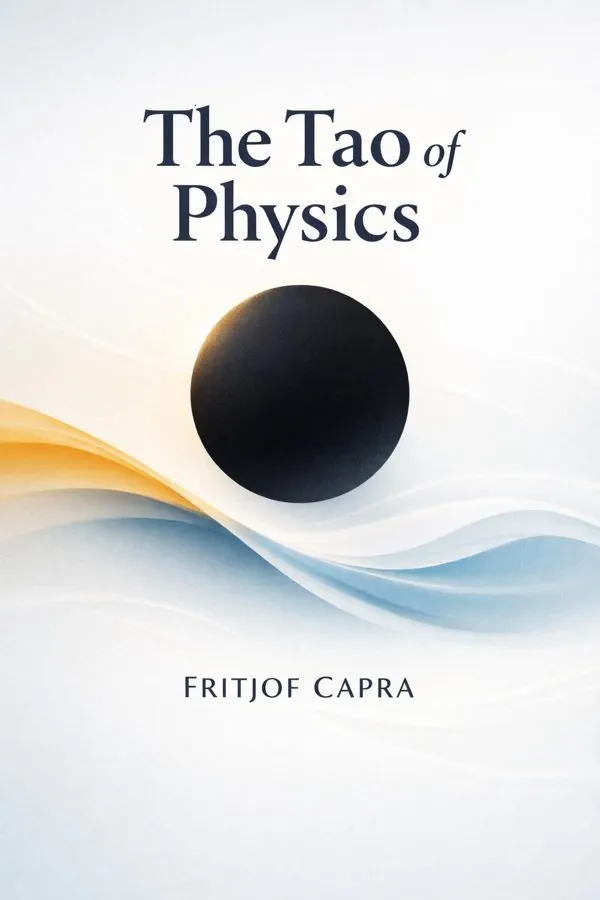
The Tao of Physics: An Exploration of the Parallels Between Modern Physics and Eastern Mysticism: Summary & Key Insights
 10 min9 chaptersAudio available
What Is The Tao of Physics: An Exploration of the Parallels Between Modern Physics and Eastern Mysticism About?
The Tao of Physics: An Exploration of the Parallels Between Modern Physics and Eastern Mysticism by Fritjof Capra is a popular_sci book spanning 9 pages. The Tao of Physics explores the striking parallels between the concepts of modern physics—such as quantum theory and relativity—and the mystical insights of Eastern traditions like Taoism, Buddhism, and Hinduism. Fritjof Capra argues that both science and mysticism, though using different languages and methods, ultimately converge in their understanding of the unity and interconnectedness of all things.
This FizzRead summary covers all 9 key chapters of The Tao of Physics: An Exploration of the Parallels Between Modern Physics and Eastern Mysticism in approximately 10 minutes, distilling the most important ideas, arguments, and takeaways from Fritjof Capra's work. Also available as an audio summary and Key Quotes Podcast.
The Tao of Physics: An Exploration of the Parallels Between Modern Physics and Eastern Mysticism
The Tao of Physics explores the striking parallels between the concepts of modern physics—such as quantum theory and relativity—and the mystical insights of Eastern traditions like Taoism, Buddhism, and Hinduism. Fritjof Capra argues that both science and mysticism, though using different languages and methods, ultimately converge in their understanding of the unity and interconnectedness of all things.
Who Should Read The Tao of Physics: An Exploration of the Parallels Between Modern Physics and Eastern Mysticism?
This book is perfect for anyone interested in popular_sci and looking to gain actionable insights in a short read. Whether you're a student, professional, or lifelong learner, the key ideas from The Tao of Physics: An Exploration of the Parallels Between Modern Physics and Eastern Mysticism by Fritjof Capra will help you think differently.
- ✓Readers who enjoy popular_sci and want practical takeaways
- ✓Professionals looking to apply new ideas to their work and life
- ✓Anyone who wants the core insights of The Tao of Physics: An Exploration of the Parallels Between Modern Physics and Eastern Mysticism in just 10 minutes
Want the full summary?
Get instant access to this book summary and 100K+ more with Fizz Moment.
Get Free SummaryAvailable on App Store • Free to download
Key Chapters
To appreciate the convergence between physics and mysticism, we must first trace the evolution of scientific thought. Western science began its ascent under the banner of rational clarity and mechanical precision. Newton’s laws offered a vision of the cosmos as a grand clockwork mechanism—matter composed of tiny particles, space and time as immutable containers, and motion governed by deterministic laws. This worldview gave humankind immense power to predict and control, but it came at a cost: it divided the observer from the observed, humanity from nature.
For centuries, this mechanistic ideal defined the Western mind. But in the early twentieth century, revolutionary discoveries began to shake its foundations. Einstein’s theory of relativity showed that space and time were not fixed backgrounds—they were interwoven aspects of dynamic reality, warped by the presence of matter and energy. Quantum mechanics went even further, revealing a world where particles dissolve into probabilities, where observation itself affects the outcome of an experiment.
These ideas broke open the walls of the Newtonian machine, exposing a universe of profound interconnection. No longer could we speak of isolated objects. Every particle is part of an inseparable web of relationships, and the act of observation itself becomes part of that web. Physics began to sound less like engineering and more like mysticism—an exploration of the unity underlying all forms.
In this shift, I saw the rebirth of wonder. The physicist now confronts a universe that is alive, unpredictable, and creative. And here, the Western scientist begins to stand alongside the Eastern sage, both gazing into the infinite dance of energy.
Under classical physics, reality seemed comfortably simple. Matter was solid, objective, and separate. Space was empty, infinite, and unchanging. The observer could measure the world without disturbing it. This worldview supported the triumphs of modern industry and technology but also reinforced an image of a fragmented universe where nature was to be dominated rather than understood.
However, as physicists plunged deeper into the structure of atoms, this solidity vanished. Electrons were not tiny balls—it turned out they behaved like waves under some conditions, like particles under others. The more closely we examined, the less definite things became. The act of observation itself changed what was being observed, an idea profoundly unsettling to the classical mindset.
This transformation echoes the spiritual turning point described in Eastern philosophies. The Upanishads speak of Brahman, the ultimate reality that transcends all distinctions. Taoist texts remind us that when we cling to rigid categories, we lose sight of the flow of life. Modern physics, too, teaches that certainty and separation are illusions. What we find instead is a universe of relationships, processes, and patterns—a cosmos that is holistic, dynamic, and participatory.
As I reflected on this dissolution of objectivity, I realized that science was not betraying its mission—it was fulfilling it. To know reality is not to dissect it but to enter into its rhythm. The physicist and the mystic, each in their own way, learn to let go of the illusion of separateness and perceive the unity behind all phenomena.
+ 7 more chapters — available in the FizzRead app
All Chapters in The Tao of Physics: An Exploration of the Parallels Between Modern Physics and Eastern Mysticism
About the Author
Fritjof Capra is an Austrian-born physicist and systems theorist known for his work on the philosophical implications of modern science. He has written extensively on the connections between science, society, and ecology, and is a founding director of the Center for Ecoliteracy in Berkeley, California.
Get This Summary in Your Preferred Format
Read or listen to the The Tao of Physics: An Exploration of the Parallels Between Modern Physics and Eastern Mysticism summary by Fritjof Capra anytime, anywhere. FizzRead offers multiple formats so you can learn on your terms — all free.
Available formats: App · Audio · PDF · EPUB — All included free with FizzRead
Download The Tao of Physics: An Exploration of the Parallels Between Modern Physics and Eastern Mysticism PDF and EPUB Summary
Key Quotes from The Tao of Physics: An Exploration of the Parallels Between Modern Physics and Eastern Mysticism
“To appreciate the convergence between physics and mysticism, we must first trace the evolution of scientific thought.”
“Under classical physics, reality seemed comfortably simple.”
Frequently Asked Questions about The Tao of Physics: An Exploration of the Parallels Between Modern Physics and Eastern Mysticism
The Tao of Physics: An Exploration of the Parallels Between Modern Physics and Eastern Mysticism by Fritjof Capra is a popular_sci book that explores key ideas across 9 chapters. The Tao of Physics explores the striking parallels between the concepts of modern physics—such as quantum theory and relativity—and the mystical insights of Eastern traditions like Taoism, Buddhism, and Hinduism. Fritjof Capra argues that both science and mysticism, though using different languages and methods, ultimately converge in their understanding of the unity and interconnectedness of all things.
You Might Also Like
Structures: Or Why Things Don"t Fall Down
J.E. Gordon
10 min
The Road to Wigan Pier
George Orwell
10 min
Bonk: The Curious Coupling of Science and Sex
Mary Roach
10 min
First Bite: How We Learn to Eat
Bee Wilson
10 min
In Pursuit Of The Unknown: 17 Equations That Changed The World
Ian Stewart
10 min
Napoleon's Buttons: 17 Molecules That Changed History
Penny Le Couteur and Jay Burreson
10 minBrowse by Category
Ready to read The Tao of Physics: An Exploration of the Parallels Between Modern Physics and Eastern Mysticism?
Get the full summary and 100K+ more books with Fizz Moment.