
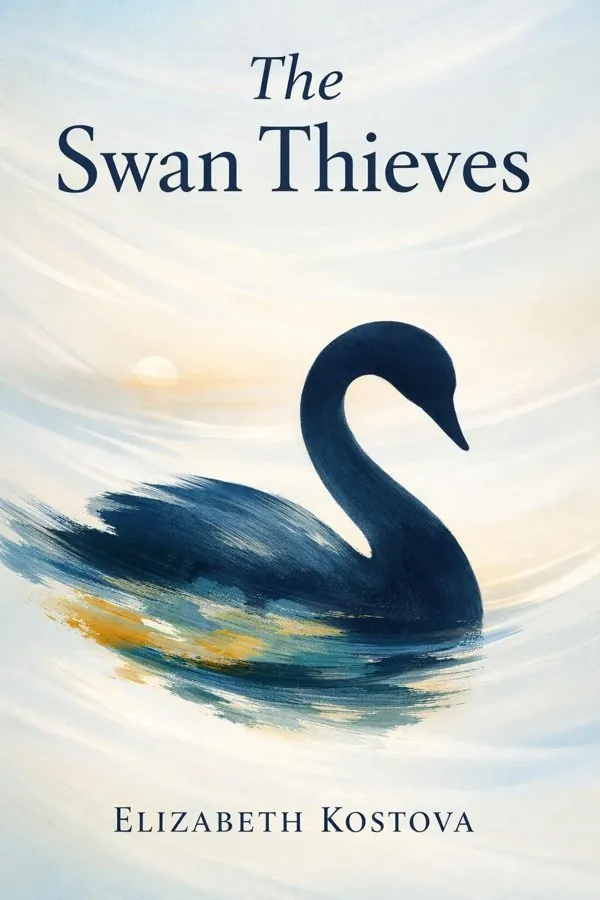
The Swan Thieves: Summary & Key Insights
 10 min9 chaptersAudio available
Key Takeaways from The Swan Thieves
Some mysteries begin not with a question, but with a silence so complete that it demands to be interpreted.
No person can be understood from a single point of view, especially someone as elusive as Robert Oliver.
Sometimes the dead exert more power over the living than the living ever could.
Beauty is not a cure, but it can become a lifeline when ordinary language fails.
One of the novel’s sharpest insights is that devotion and obsession can look dangerously similar from the outside.
What Is The Swan Thieves About?
The Swan Thieves by Elizabeth Kostova is a bestsellers book spanning 4 pages. What happens when a brilliant artist stops speaking, attacks a painting in a museum, and leaves behind only fragments of a story no one can fully explain? In The Swan Thieves, Elizabeth Kostova turns this haunting premise into a richly layered novel about art, desire, memory, and the dangerous power of obsession. At the center is psychiatrist Andrew Marlow, whose professional curiosity slowly becomes a deeply personal quest as he tries to understand his patient, the celebrated painter Robert Oliver. What begins as a psychiatric case unfolds into a mystery stretching from contemporary America to the world of nineteenth-century French Impressionism. Kostova brings unusual authority to this material because she combines literary elegance with deep historical and artistic knowledge. Best known for The Historian, she has a gift for blending research, atmosphere, and psychological depth into immersive storytelling. In The Swan Thieves, she does more than tell a mystery: she examines how people use art to express what they cannot say aloud, how love can become fixation, and how the past lingers in the present. This is a novel for readers who enjoy emotional complexity, intellectual intrigue, and the quiet suspense of hidden lives.
This FizzRead summary covers all 9 key chapters of The Swan Thieves in approximately 10 minutes, distilling the most important ideas, arguments, and takeaways from Elizabeth Kostova's work. Also available as an audio summary and Key Quotes Podcast.
The Swan Thieves
What happens when a brilliant artist stops speaking, attacks a painting in a museum, and leaves behind only fragments of a story no one can fully explain? In The Swan Thieves, Elizabeth Kostova turns this haunting premise into a richly layered novel about art, desire, memory, and the dangerous power of obsession. At the center is psychiatrist Andrew Marlow, whose professional curiosity slowly becomes a deeply personal quest as he tries to understand his patient, the celebrated painter Robert Oliver. What begins as a psychiatric case unfolds into a mystery stretching from contemporary America to the world of nineteenth-century French Impressionism.
Kostova brings unusual authority to this material because she combines literary elegance with deep historical and artistic knowledge. Best known for The Historian, she has a gift for blending research, atmosphere, and psychological depth into immersive storytelling. In The Swan Thieves, she does more than tell a mystery: she examines how people use art to express what they cannot say aloud, how love can become fixation, and how the past lingers in the present. This is a novel for readers who enjoy emotional complexity, intellectual intrigue, and the quiet suspense of hidden lives.
Who Should Read The Swan Thieves?
This book is perfect for anyone interested in bestsellers and looking to gain actionable insights in a short read. Whether you're a student, professional, or lifelong learner, the key ideas from The Swan Thieves by Elizabeth Kostova will help you think differently.
- ✓Readers who enjoy bestsellers and want practical takeaways
- ✓Professionals looking to apply new ideas to their work and life
- ✓Anyone who wants the core insights of The Swan Thieves in just 10 minutes
Want the full summary?
Get instant access to this book summary and 100K+ more with Fizz Moment.
Get Free SummaryAvailable on App Store • Free to download
Key Chapters
Some mysteries begin not with a question, but with a silence so complete that it demands to be interpreted. That is exactly how The Swan Thieves opens Andrew Marlow’s journey. Robert Oliver, a gifted and well-known painter, has attacked a painting in a museum and is then placed under psychiatric care. Yet the most unsettling part of the episode is not the violence itself but Robert’s refusal to explain it. He withdraws into near-total silence, leaving Marlow with a patient who seems to be guarding a truth too painful, too sacred, or too dangerous to reveal.
This premise immediately establishes one of the novel’s central concerns: the limits of language. Marlow is trained to diagnose, interpret, and guide people toward self-understanding through conversation. But Robert cannot be reached through ordinary clinical methods. His silence forces Marlow to become something more than a psychiatrist. He becomes an investigator, archivist, and reluctant participant in another man’s emotional history.
What makes this dynamic compelling is how it mirrors real life. Often the people we most want to understand cannot or will not give us direct answers. We are left to read behavior, relationships, objects, habits, and absences. In Robert’s case, his paintings, letters, and the testimony of those who knew him become clues to an inner world he cannot verbalize.
For readers, this idea has practical resonance. It reminds us that understanding others requires patience and humility. Not every truth emerges through direct questioning. Sometimes insight comes from listening to what is missing, observing patterns, and resisting the urge to force a neat explanation.
Actionable takeaway: When someone’s behavior confuses you, look beyond their words. Notice their actions, recurring themes, and emotional silences before rushing to judgment.
No person can be understood from a single point of view, especially someone as elusive as Robert Oliver. One of the novel’s greatest strengths is its decision to reveal him through the women who loved him, lived with him, and suffered from his distance. Kate, his ex-wife, and Mary, his student and lover, offer Marlow very different portraits of the same man. Their accounts are not objective reports; they are intimate, wounded, affectionate, and incomplete. Yet precisely because they are partial, they feel true.
Kostova uses these voices to show that identity is relational. Robert is not only a painter in crisis. He is also a husband who withdrew, a lover who inspired longing and frustration, a teacher who affected others without fully understanding his impact. The women’s narratives reveal how genius can coexist with emotional blindness and how devotion to beauty can come at a human cost.
This structure also demonstrates an important literary and psychological insight: memory is shaped by love. Kate sees Robert through the lens of history, family, and accumulated disappointment. Mary sees him through youthful fascination and artistic admiration. Each woman notices different aspects of his character, and together they create a fuller, more unsettling picture than Robert could provide himself.
In everyday life, this has a useful application. We often reduce people to the version we personally experienced. But most lives contain contradictions visible only when multiple perspectives are considered. A colleague may seem cold to one person and deeply generous to another; both impressions may be valid.
Actionable takeaway: To understand a complex person or situation, seek more than one perspective. Truth often emerges in the overlap between differing accounts rather than in any single testimony.
Sometimes the dead exert more power over the living than the living ever could. Béatrice de Clerval, the nineteenth-century French artist and figure at the heart of Robert Oliver’s obsession, is one of the novel’s most haunting presences. She is not merely a historical curiosity or romantic ideal. She becomes a kind of ghost in the canvas, a woman whose beauty, talent, and sorrow ripple forward across generations.
As Marlow follows the trail of Robert’s fixation, Béatrice emerges through paintings, letters, and fragments of art history. She represents many things at once: lost love, unrealized artistic identity, female erasure, and the seductive force of the inaccessible past. Robert’s attachment to her is not rational. He seems to feel that he has discovered someone who speaks to him across time with a clarity no living person can match.
Kostova uses Béatrice to explore how art preserves emotional intensity. A painting can outlast a body, and a letter can carry longing across centuries. But this preservation has a darker side. It can tempt us into idealizing the past, turning a human life into a symbol that serves our own needs. Robert is drawn to Béatrice not only because of who she was, but because of what she allows him to imagine.
Readers can apply this idea beyond literature. We often become attached to unavailable people, lost eras, or imagined versions of reality because they cannot disappoint us in ordinary ways. The past can feel purer than the present precisely because we cannot test it.
Actionable takeaway: Be wary of what you idealize. When something distant or unattainable feels overwhelmingly meaningful, ask whether you are responding to reality or to a longing you have projected onto it.
Beauty is not a cure, but it can become a lifeline when ordinary language fails. Throughout The Swan Thieves, art is presented not as decoration or prestige but as a necessary form of survival. Paintings carry desire, grief, memory, and reverence. For Robert, artistic creation seems inseparable from emotional existence; for Marlow, immersion in Robert’s artistic world expands his understanding of what healing might mean.
Kostova avoids simplistic claims that beauty solves suffering. Instead, she suggests something more nuanced: beauty gives shape to suffering. A painting can contain what the mind cannot easily organize. This is especially important in a novel centered on silence and psychological fracture. Robert cannot articulate his crisis directly, but his connection to visual art becomes the map to his inner life.
Marlow’s own development also reflects this idea. As a psychiatrist, he begins from a framework of diagnosis and treatment. But as he encounters art more deeply, he comes to recognize that human beings do not live by analysis alone. We also need mystery, contemplation, and contact with things that awaken us emotionally without offering immediate explanations.
In practical terms, this insight matters far beyond the novel. People often underestimate how restorative beauty can be: music after exhaustion, painting after grief, architecture that induces calm, a poem that names a feeling we could not express. These experiences do not erase pain, but they can make life more bearable and meaningful.
Actionable takeaway: Build small rituals of beauty into your life. Visit a museum, keep a journal, listen closely to music, or spend time with art that helps you feel more present and less alone.
One of the novel’s sharpest insights is that devotion and obsession can look dangerously similar from the outside. Robert Oliver’s attachment to Béatrice, and his emotional intensity more broadly, raises a difficult question: when does love stop being care for another person and become surrender to one’s own consuming fantasy? Kostova does not answer this in a tidy way, which is exactly why the novel lingers.
Obsession in The Swan Thieves is not portrayed as simple madness. It is seductive, meaningful, and often linked to authentic feeling. Robert’s fixation is fueled by beauty, artistic recognition, and the sense of discovering a soul with whom he shares a secret understanding. But the cost is immense. The living women around him are neglected, confused, and wounded by a passion that seems always to point elsewhere.
This dynamic reveals an uncomfortable truth about human relationships. We may claim to love another person while really loving the intensity they awaken in us, the story they allow us to inhabit, or the version of ourselves we become in their presence. Genuine love requires seeing the other person as fully real; obsession tends to flatten them into a symbol.
Readers can recognize this pattern in many forms: idealized romance, creative fixation, professional ambition, even nostalgia. The problem is not intensity itself but the refusal to remain grounded in reality and responsibility.
Actionable takeaway: When a desire begins to dominate your emotional life, ask what it is costing you and others. If your passion makes real relationships harder to sustain, it may be time to reexamine whether it is love, purpose, or obsession.
Human beings are drawn to what remains unresolved. One reason The Swan Thieves is so compelling is that it understands the psychological grip of incomplete stories. Robert’s silence, the fragments of Béatrice’s life, the conflicting testimony of those around him, and the gaps between art and explanation all create a powerful sense of incompletion. Marlow is not simply solving a puzzle; he is being pulled into the emotional force field of what has not been settled.
Kostova suggests that unfinished stories hold unusual power because they invite projection. When facts are scarce, imagination fills in the blanks. That can be creative and illuminating, but it can also become dangerous. Robert seems unable to let go partly because what he seeks can never be fully possessed or verified. The incomplete remains alive precisely because it resists closure.
This has practical implications for readers. We often spend enormous emotional energy on unresolved conversations, abandoned ambitions, former relationships, or family mysteries. The mind returns to them repeatedly, hoping that one more thought will produce completion. Yet some stories remain fragmentary no matter how much attention we give them.
The novel does not argue that closure is always available. Instead, it implies that maturity may involve learning to live alongside ambiguity without being consumed by it. Marlow’s journey teaches him that understanding can deepen even when certainty remains elusive.
Actionable takeaway: Identify one unresolved story in your life and ask whether you need full closure or simply a more compassionate way of holding uncertainty. Sometimes peace begins where perfect answers end.
Professional expertise is powerful, but it cannot explain everything that makes a life meaningful or broken. Andrew Marlow enters the novel as a psychiatrist, a man trained to approach disturbance through diagnosis, therapeutic process, and disciplined interpretation. Yet Robert Oliver’s case pushes him toward the edge of his professional framework. The problem is not that psychiatry is useless; it is that Robert’s crisis is woven from art, history, longing, and imagination in ways that do not fit neatly into clinical categories.
This tension gives the novel much of its intellectual depth. Marlow must confront the difference between understanding symptoms and understanding a soul. He can observe Robert’s withdrawal and instability, but to truly grasp him he must enter a world of paintings, letters, and aesthetic devotion. In doing so, Marlow himself changes. He becomes less certain that rational explanation alone can account for human intensity.
Kostova’s portrayal is valuable because it avoids anti-psychological cliché. She does not dismiss psychiatry; rather, she enlarges the conversation. Human beings are interpretable in medical terms, relational terms, historical terms, and artistic terms all at once. Any single lens may miss what another reveals.
In daily life, this is an important reminder. Not every problem can be solved by logic alone, and not every emotional struggle should be romanticized into mystery. Wisdom often lies in combining disciplines: emotional honesty, practical care, professional help, and meaningful forms of expression.
Actionable takeaway: When facing a difficult inner struggle, use more than one lens. Seek practical support, but also ask what creative, relational, or historical forces may be shaping your experience.
The past is never truly past when it continues to shape what we desire, fear, and repeat. In The Swan Thieves, this idea operates on multiple levels. Robert is enthralled by a woman from another century. Marlow is drawn into histories that begin long before his involvement. The women around Robert carry their own memories, disappointments, and attachments into every present interaction. The novel becomes a study in inheritance, not just of objects and stories, but of emotional patterns.
Kostova shows how the present can be colonized by what came before. A historical figure like Béatrice does not remain confined to archives; she alters living relationships. Likewise, personal history affects perception. Kate and Mary cannot encounter Robert as a blank slate because their experiences with him already determine what they notice and what they fear. Marlow, too, becomes entangled as his own life and marriage are refracted through the case.
This matters because many readers assume that understanding the past is mainly an intellectual exercise. The novel argues otherwise. History is active. Family wounds, old loves, cultural memory, artistic tradition, and unresolved grief all move quietly through the present, often disguised as immediate feeling.
A practical reading of this theme can be transformative. If you find yourself reacting intensely to current events in your life, it may help to ask what older story is being activated. The present moment is often carrying more than itself.
Actionable takeaway: When a current relationship or conflict feels larger than it should, pause and ask what earlier memory, loss, or inherited narrative may be shaping your response.
All Chapters in The Swan Thieves
About the Author
Elizabeth Kostova is an American author celebrated for literary novels that combine historical depth, atmosphere, and psychological complexity. She rose to international prominence with her debut, The Historian, which became a major bestseller and introduced readers to her signature blend of research-driven storytelling and emotional intelligence. Kostova studied at Yale University and later earned an MFA from the University of Michigan. Her work often explores the enduring influence of the past, the power of art, and the hidden lives preserved in documents, places, and cultural memory. In The Swan Thieves, she brings those interests into the world of painting, weaving together psychiatry, romance, and art history with elegant prose. Kostova is widely admired for creating immersive novels that are both intellectually rich and emotionally resonant.
Get This Summary in Your Preferred Format
Read or listen to the The Swan Thieves summary by Elizabeth Kostova anytime, anywhere. FizzRead offers multiple formats so you can learn on your terms — all free.
Available formats: App · Audio · PDF · EPUB — All included free with FizzRead
Download The Swan Thieves PDF and EPUB Summary
Key Quotes from The Swan Thieves
“Some mysteries begin not with a question, but with a silence so complete that it demands to be interpreted.”
“No person can be understood from a single point of view, especially someone as elusive as Robert Oliver.”
“Sometimes the dead exert more power over the living than the living ever could.”
“Beauty is not a cure, but it can become a lifeline when ordinary language fails.”
“One of the novel’s sharpest insights is that devotion and obsession can look dangerously similar from the outside.”
Frequently Asked Questions about The Swan Thieves
The Swan Thieves by Elizabeth Kostova is a bestsellers book that explores key ideas across 9 chapters. What happens when a brilliant artist stops speaking, attacks a painting in a museum, and leaves behind only fragments of a story no one can fully explain? In The Swan Thieves, Elizabeth Kostova turns this haunting premise into a richly layered novel about art, desire, memory, and the dangerous power of obsession. At the center is psychiatrist Andrew Marlow, whose professional curiosity slowly becomes a deeply personal quest as he tries to understand his patient, the celebrated painter Robert Oliver. What begins as a psychiatric case unfolds into a mystery stretching from contemporary America to the world of nineteenth-century French Impressionism. Kostova brings unusual authority to this material because she combines literary elegance with deep historical and artistic knowledge. Best known for The Historian, she has a gift for blending research, atmosphere, and psychological depth into immersive storytelling. In The Swan Thieves, she does more than tell a mystery: she examines how people use art to express what they cannot say aloud, how love can become fixation, and how the past lingers in the present. This is a novel for readers who enjoy emotional complexity, intellectual intrigue, and the quiet suspense of hidden lives.
More by Elizabeth Kostova

You Might Also Like
The Godfather
Mario Puzo
10 min
The Handmaid's Tale
Margaret Atwood
10 min
The Hunger Games
Suzanne Collins
10 min
The Nightingale
Kristin Hannah
10 min
The Seven Husbands of Evelyn Hugo
Taylor Jenkins Reid
10 min
Backwater Justice
Fern Michaels
10 minBrowse by Category
Ready to read The Swan Thieves?
Get the full summary and 100K+ more books with Fizz Moment.