
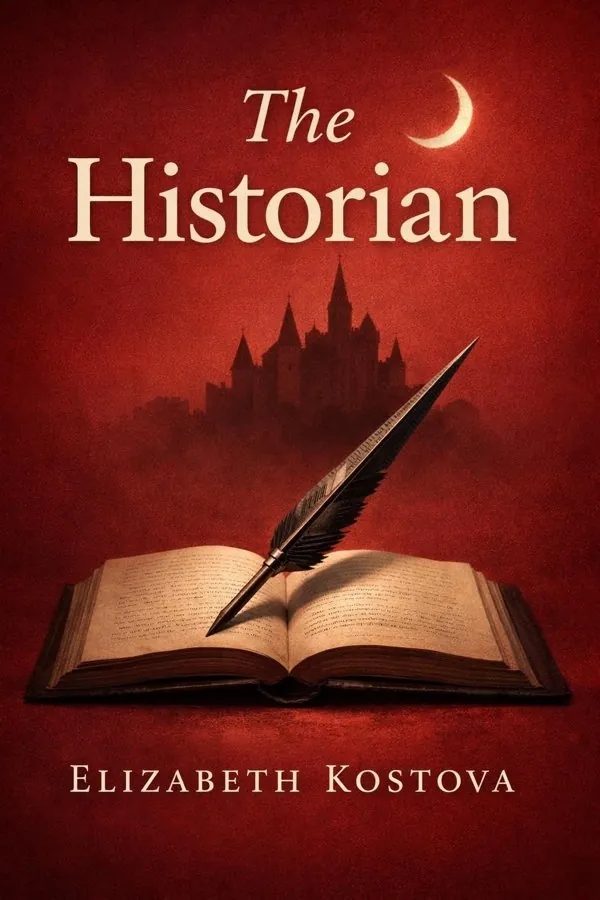
The Historian: Summary & Key Insights
 10 min9 chaptersAudio available
Key Takeaways from The Historian
A life devoted to quiet study can be upended by a single inexplicable object.
The disappearance of a mentor can reveal how much of our courage has been borrowed from another person.
Some truths cannot be understood from a desk alone.
The most illuminating guides are often those who refuse easy categories.
Documents do not merely preserve the past; they shape who gets remembered and how.
What Is The Historian About?
The Historian by Elizabeth Kostova is a bestsellers book spanning 11 pages. The Historian by Elizabeth Kostova is a literary thriller that transforms archival research into a haunting, globe-spanning adventure. Framed through letters, memoirs, and nested narratives, the novel follows a young woman who uncovers her father’s hidden past and is drawn into a decades-long search tied to the legend of Dracula. What begins with a strange, empty book and a cache of old correspondence becomes a pursuit through libraries, monasteries, Istanbul streets, and Eastern European landscapes where scholarship is never merely academic. In Kostova’s hands, history is alive, dangerous, and morally demanding. What makes the novel matter is not only its suspense, but its deeper question: how do the past’s violences continue shaping the present? The book blends Gothic atmosphere with serious engagement with memory, political trauma, religion, and the ethics of historical inquiry. Elizabeth Kostova brings unusual authority to this material through her deep research, elegant prose, and ability to fuse documented history with myth without reducing either. The result is a rare bestseller that satisfies as a mystery, a historical meditation, and a coming-of-age story about inheritance, courage, and the costs of pursuing truth.
This FizzRead summary covers all 9 key chapters of The Historian in approximately 10 minutes, distilling the most important ideas, arguments, and takeaways from Elizabeth Kostova's work. Also available as an audio summary and Key Quotes Podcast.
The Historian
The Historian by Elizabeth Kostova is a literary thriller that transforms archival research into a haunting, globe-spanning adventure. Framed through letters, memoirs, and nested narratives, the novel follows a young woman who uncovers her father’s hidden past and is drawn into a decades-long search tied to the legend of Dracula. What begins with a strange, empty book and a cache of old correspondence becomes a pursuit through libraries, monasteries, Istanbul streets, and Eastern European landscapes where scholarship is never merely academic. In Kostova’s hands, history is alive, dangerous, and morally demanding.
What makes the novel matter is not only its suspense, but its deeper question: how do the past’s violences continue shaping the present? The book blends Gothic atmosphere with serious engagement with memory, political trauma, religion, and the ethics of historical inquiry. Elizabeth Kostova brings unusual authority to this material through her deep research, elegant prose, and ability to fuse documented history with myth without reducing either. The result is a rare bestseller that satisfies as a mystery, a historical meditation, and a coming-of-age story about inheritance, courage, and the costs of pursuing truth.
Who Should Read The Historian?
This book is perfect for anyone interested in bestsellers and looking to gain actionable insights in a short read. Whether you're a student, professional, or lifelong learner, the key ideas from The Historian by Elizabeth Kostova will help you think differently.
- ✓Readers who enjoy bestsellers and want practical takeaways
- ✓Professionals looking to apply new ideas to their work and life
- ✓Anyone who wants the core insights of The Historian in just 10 minutes
Want the full summary?
Get instant access to this book summary and 100K+ more with Fizz Moment.
Get Free SummaryAvailable on App Store • Free to download
Key Chapters
A life devoted to quiet study can be upended by a single inexplicable object. That is the engine of Paul’s story, which begins not with monsters or violence but with graduate-school routine in the 1950s. He is a serious, disciplined young scholar focused on Ottoman and Eastern European history when he discovers a mysterious blank book marked only by the image of a dragon and the unsettling presence of age and intention. Soon afterward, his mentor, Professor Rossi, reveals that similar books have appeared across generations to certain scholars who ventured too close to a forbidden historical trail.
This beginning matters because Kostova turns scholarship itself into suspense. Paul is not a conventional action hero; his tools are languages, archives, patience, and intellectual honesty. Yet those same tools draw him toward danger. The novel suggests that curiosity is never neutral. Research can expose readers not only to facts but to buried obsessions, old crimes, and moral responsibilities they did not expect to inherit.
In practical terms, Paul’s arc offers a vivid model of how small anomalies can signal larger truths. In real life, this applies to any serious investigation: an odd financial record, a contradictory source, a family story that doesn’t align with dates, or a cultural myth that hides political memory. Breakthroughs often begin with something easy to dismiss.
The deeper insight is that expertise does not protect us from mystery; it may lead us directly into it. Paul’s first steps remind readers that disciplined attention is both a gift and a risk.
Actionable takeaway: when something in your work or life feels meaningfully out of place, do not ignore it too quickly. Follow the thread carefully, document what you find, and remain open to truths larger than your original question.
The disappearance of a mentor can reveal how much of our courage has been borrowed from another person. Professor Rossi is more than Paul’s academic advisor; he is a humane, intellectually rigorous figure whose seriousness gives Paul direction. When Rossi vanishes, leaving behind clues, fears, and the residue of a private investigation into Dracula and Vlad the Impaler, the mystery becomes personal. Paul is no longer chasing a historical puzzle for curiosity’s sake. He is confronting absence, loyalty, and the possibility that history can strike back.
Kostova uses Rossi’s disappearance to shift the novel from scholarly intrigue to ethical quest. The missing professor embodies the tension between knowledge and danger: he pursued truth because he believed the past mattered, yet that pursuit appears to have exposed him to forces beyond ordinary explanation. Paul must decide whether to retreat into safety or continue, knowing that research may require sacrifice.
This idea translates beyond fiction. In professional and personal life, many investigations become urgent only when they affect someone we love, respect, or depend on. A mentor’s illness may make us examine work culture; a family member’s silence may lead us into genealogy; a colleague’s unexplained departure may expose institutional corruption. Commitment often deepens when abstraction becomes relationship.
Rossi’s absence also teaches that intellectual inheritance is not just about information. It includes unfinished responsibilities. We often receive from teachers not neat conclusions but difficult questions they could not fully answer.
Actionable takeaway: honor your mentors not merely by admiring them, but by carrying forward their best questions with integrity. When someone important leaves behind an unresolved issue, engage it with care instead of letting it disappear into silence.
Some truths cannot be understood from a desk alone. As Paul follows Rossi’s trail through Eastern Europe, the novel expands from libraries into train stations, border crossings, old churches, village roads, and urban neighborhoods marked by layered empires and wounds. This journey matters because Kostova insists that history is inseparable from place. Archives preserve records, but landscapes preserve atmosphere, memory, and fear.
The route across Hungary, Romania, Bulgaria, and beyond transforms Dracula from a literary cliché into a historical and cultural presence embedded in geography. Local legends, political tension, hospitality, and suspicion all shape Paul’s understanding. He discovers that historical inquiry changes when one listens to those who live amid ruins, monasteries, contested borders, and inherited trauma. Facts become textured by weather, architecture, ritual, and silence.
For readers, this is a powerful reminder that context matters. Whether studying a business problem, a family conflict, or public history, distant analysis can flatten reality. Visiting the site, meeting stakeholders, and observing environment often reveal what documents omit. A school system looks different in policy reports than in actual classrooms; a family story changes when one visits the hometown; a conflict reads differently when one understands local memory.
Kostova also captures travel as destabilization. It strips characters of routine and pushes them into dependence on strangers, language skills, and intuition. That vulnerability creates growth.
Actionable takeaway: when trying to understand a complex issue, move beyond secondhand summaries. If possible, go to the place, speak to people closest to the experience, and let physical context challenge your assumptions.
The most illuminating guides are often those who refuse easy categories. Helen enters the novel as a brilliant, guarded scholar whose knowledge of Eastern European history and languages makes her indispensable to Paul’s search. But she is not simply a companion or romantic interest. She embodies divided inheritance, emotional discipline, and a deeply personal connection to the darkness they are investigating. Through Helen, Kostova explores how identity is shaped by family secrets, political upheaval, and the burden of origins.
Helen’s importance lies in how she complicates simplistic narratives. She is skeptical, fierce, and intellectually equal to Paul, often more perceptive than he is. Her presence prevents the quest from becoming a straightforward male pursuit of knowledge. Instead, it becomes a shared confrontation with ancestry, guilt, and chosen loyalty. Her own background reveals that the line between hunter and hunted, researcher and subject, is not always stable.
In practical terms, Helen represents the value of partnership with people whose experiences differ from our own. Complex problems demand multiple forms of insight: historical, emotional, cultural, and intuitive. A team becomes stronger when one person’s caution balances another’s idealism, or one person’s local knowledge grounds another’s broad theory.
Her guardedness also illustrates a truth about trust: the people most capable of helping us may carry wounds that make openness difficult. Building meaningful collaboration requires patience, respect, and attention to what remains unsaid.
Actionable takeaway: when tackling difficult questions, seek collaborators who challenge your assumptions and bring lived experience you do not possess. Listen especially to those whose reserve may hide hard-earned wisdom.
Documents do not merely preserve the past; they shape who gets remembered and how. Throughout The Historian, letters, manuscripts, maps, monastic records, diplomatic files, and personal testimonies form the backbone of the investigation. The novel’s structure mirrors this obsession, unfolding through found texts and layered narration. Kostova shows that archival work is not passive retrieval. It is interpretation under pressure.
As Paul, Helen, Rossi, and later the daughter pursue clues, they confront conflicting sources, missing pages, political censorship, and institutions that guard knowledge selectively. The search for Dracula becomes, in one sense, a search for how history itself is curated. Who writes records? Who destroys them? Which stories survive because they serve power, and which survive only in whispers, folklore, or hidden collections?
This theme has broad relevance. In modern life, we navigate archives constantly: media feeds, corporate records, public data, legal documents, family photos, even email trails. Information abundance can create false confidence. Sources require scrutiny. A neatly preserved file may conceal bias; a fragmented oral account may contain more truth than an official report.
Kostova’s characters succeed not because they possess every answer, but because they read patiently across genres and institutions. They compare testimony, note absences, and respect ambiguity. That is a valuable method in any era of misinformation.
The novel also celebrates the beauty of archival labor. To read old handwriting, trace provenance, or decode references is to participate in a conversation across centuries.
Actionable takeaway: treat every source, including authoritative ones, as situated rather than neutral. Compare evidence, notice what is missing, and remember that understanding history requires both skepticism and imagination.
Children often discover that family history is less a story than a puzzle assembled from omissions. In the novel’s later timeline, the unnamed daughter finds a hidden book and letters in her father’s study, opening the path into Paul and Helen’s past. Her investigation parallels Paul’s earlier journey, but with a crucial difference: she is not just uncovering historical danger, she is uncovering her own identity. What her parents concealed was meant as protection, yet secrecy itself becomes the force that draws her onward.
This timeline gives The Historian emotional depth beyond its Gothic plot. The daughter experiences the classic coming-of-age realization that adults are not stable guardians of truth but fragile editors of it. She must learn how to read not only archives but the silences between her father’s words, the gaps in her mother’s absence, and the emotional patterns that shaped her childhood.
Many readers connect strongly with this theme because inheritance is rarely straightforward. Families pass down names, habits, fears, loyalties, and unresolved grief alongside explicit stories. Sometimes what is hidden exerts more power than what is told. The daughter’s courage lies in facing that inheritance directly rather than accepting a sanitized version of the past.
Practically, the novel encourages a mature relationship to family narratives. Investigating one’s origins can mean asking elders difficult questions, organizing old letters, examining immigration records, or recognizing generational trauma. The goal is not to expose for its own sake, but to understand what has been shaping us from the shadows.
Actionable takeaway: if your family history contains gaps or contradictions, approach them with respectful curiosity. Gather documents, ask open-ended questions, and allow complexity rather than forcing a comforting myth.
The closer the characters come to truth, the less safe ordinary life becomes. One of Kostova’s most effective ideas is that knowledge has consequences beyond the intellectual realm. As the search advances, Paul, Helen, Rossi, and the daughter encounter stalking presences, coded warnings, theft, surveillance, and moments of violence that suggest the object of their study is not inert history but an active force. The novel’s horror does not arise only from Dracula as a figure; it arises from the realization that some truths resist being observed without responding.
This heightening danger serves a thematic purpose. It dramatizes the cost of serious inquiry. In many contexts, exposing truth threatens entrenched interests. Journalists investigating corruption, employees documenting misconduct, historians revisiting national myths, or individuals confronting abusive family patterns all discover that revelation can produce backlash. The point is not that truth-seeking is always supernatural or catastrophic, but that it often disrupts systems built on denial.
Kostova balances fear with discipline. Her characters survive not by bravado but by preparation, collaboration, and persistence. They learn to protect documents, track movements, rely on networks, and distinguish panic from evidence. This makes the novel suspenseful while also grounding it in practical intelligence.
The lesson is not to avoid difficult knowledge but to respect its impact. Curiosity should be matched by readiness. If you uncover something significant, you may need allies, strategy, and emotional steadiness.
Actionable takeaway: when pursuing sensitive truths, do not rely on insight alone. Build safeguards, document carefully, share concerns with trusted people, and prepare for resistance instead of being surprised by it.
At some point, every investigation reaches a threshold where evidence is no longer enough and character must decide. The monastery confrontation in The Historian functions as that threshold. In sacred spaces filled with ritual, memory, and the accumulated weight of centuries, the pursuit of Dracula moves from scholarly reconstruction to direct encounter. Here Kostova stages the novel’s deepest tension: can disciplined, rational inquiry withstand a reality that seems to exceed rational categories?
The scene matters because it does not simply pit science against superstition. Instead, it reveals that human beings rely on multiple forms of knowledge when confronting extreme evil: historical understanding, moral conviction, spiritual tradition, and communal courage. The monastery, with its manuscripts and prayers, symbolizes a continuity of resistance. Preservation is shown as an act of defense, not mere nostalgia.
In broader life, threshold moments appear whenever analysis reaches its limit and action becomes necessary. A manager can study a toxic pattern for months, but eventually must intervene. A family can gather evidence of harm, but eventually must confront it. A citizen can learn history, but eventually must decide what responsibilities that knowledge imposes.
Kostova’s achievement is to make confrontation feel earned. The characters have read, traveled, doubted, and suffered enough that the final encounter tests not only their bravery but what they truly believe about evil, memory, and human dignity.
Actionable takeaway: when your values are tested, let preparation lead to action. Study matters, but there comes a point when you must stand publicly for what you know to be true and enlist community rather than acting alone.
Not every victory over darkness restores what was lost. The later resolution of Paul and Helen’s story, along with the daughter’s conclusion, gives the novel its melancholy power. Even as major mysteries are clarified and the immediate threat appears contained, the emotional costs remain. Relationships have been shaped by fear, separation, and secrecy. Helen’s fate, Paul’s efforts to protect their child, and the daughter’s final understanding all show that survival is not the same as wholeness.
This is one of the book’s most mature insights. Thrillers often end by reestablishing order, but The Historian leaves readers with a more realistic sense of aftermath. The past can be confronted, named, and partially defeated, yet it still leaves marks on the living. Memory continues. Grief continues. Love continues too, often in forms altered by absence.
The daughter’s closing perspective is especially significant. She emerges not with perfect certainty, but with greater depth. She has inherited not only danger but resilience, intellectual seriousness, and a more complicated love for her parents. In this way the novel becomes a story about growing into adulthood by accepting ambiguity rather than escaping it.
In practical terms, the ending encourages readers to think beyond crisis resolution. After a difficult truth is exposed, what then? Healing requires storytelling, mourning, boundary-setting, and the creation of new patterns. Knowledge alone does not repair the heart, but it can make honest repair possible.
Actionable takeaway: after confronting a painful truth, make space for aftermath. Reflect, grieve what cannot be restored, and intentionally build a life shaped by honesty rather than by the silence that came before.
All Chapters in The Historian
About the Author
Elizabeth Kostova is an American author celebrated for blending literary elegance with historical depth. Born in 1964, she developed an early interest in storytelling, music, and European culture, influences that later shaped her fiction. She studied at Yale University and earned an MFA in creative writing from the University of Michigan. Her debut novel, The Historian, became an international bestseller and was widely praised for its ambitious structure, scholarly detail, and atmospheric reimagining of Dracula lore. Kostova is known for immersive research and for exploring themes such as memory, art, identity, and the persistence of the past. Her later novels, including The Swan Thieves and The Shadow Land, continue her pattern of weaving mystery with psychological and historical insight, establishing her as a distinctive voice in contemporary literary fiction.
Get This Summary in Your Preferred Format
Read or listen to the The Historian summary by Elizabeth Kostova anytime, anywhere. FizzRead offers multiple formats so you can learn on your terms — all free.
Available formats: App · Audio · PDF · EPUB — All included free with FizzRead
Download The Historian PDF and EPUB Summary
Key Quotes from The Historian
“A life devoted to quiet study can be upended by a single inexplicable object.”
“The disappearance of a mentor can reveal how much of our courage has been borrowed from another person.”
“Some truths cannot be understood from a desk alone.”
“The most illuminating guides are often those who refuse easy categories.”
“Documents do not merely preserve the past; they shape who gets remembered and how.”
Frequently Asked Questions about The Historian
The Historian by Elizabeth Kostova is a bestsellers book that explores key ideas across 9 chapters. The Historian by Elizabeth Kostova is a literary thriller that transforms archival research into a haunting, globe-spanning adventure. Framed through letters, memoirs, and nested narratives, the novel follows a young woman who uncovers her father’s hidden past and is drawn into a decades-long search tied to the legend of Dracula. What begins with a strange, empty book and a cache of old correspondence becomes a pursuit through libraries, monasteries, Istanbul streets, and Eastern European landscapes where scholarship is never merely academic. In Kostova’s hands, history is alive, dangerous, and morally demanding. What makes the novel matter is not only its suspense, but its deeper question: how do the past’s violences continue shaping the present? The book blends Gothic atmosphere with serious engagement with memory, political trauma, religion, and the ethics of historical inquiry. Elizabeth Kostova brings unusual authority to this material through her deep research, elegant prose, and ability to fuse documented history with myth without reducing either. The result is a rare bestseller that satisfies as a mystery, a historical meditation, and a coming-of-age story about inheritance, courage, and the costs of pursuing truth.
More by Elizabeth Kostova
You Might Also Like
The Godfather
Mario Puzo
10 min
The Handmaid's Tale
Margaret Atwood
10 min
The Hunger Games
Suzanne Collins
10 min
The Nightingale
Kristin Hannah
10 min
The Seven Husbands of Evelyn Hugo
Taylor Jenkins Reid
10 min
Backwater Justice
Fern Michaels
10 minBrowse by Category
Ready to read The Historian?
Get the full summary and 100K+ more books with Fizz Moment.