
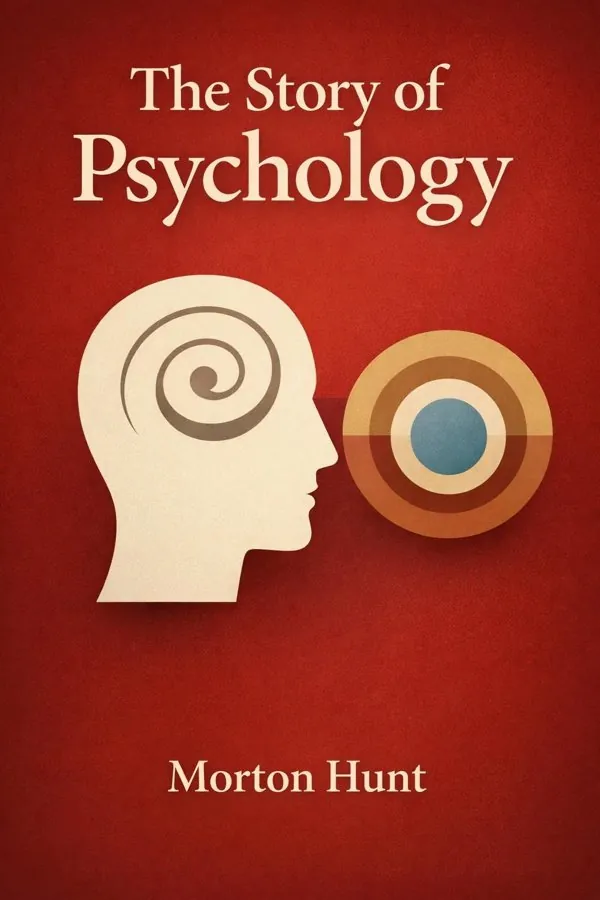
The Story of Psychology: Summary & Key Insights
by Morton Hunt
 10 min13 chaptersAudio available
What Is The Story of Psychology About?
The Story of Psychology by Morton Hunt is a psychology book spanning 13 pages. A comprehensive chronicle of the thinkers and scientists who, over twenty-five hundred years, have explored the mysteries of the human mind and behavior. Morton Hunt presents a lucid and engaging narrative of psychology’s evolution from ancient philosophy to modern science, highlighting key figures, discoveries, and debates that shaped the discipline.
This FizzRead summary covers all 13 key chapters of The Story of Psychology in approximately 10 minutes, distilling the most important ideas, arguments, and takeaways from Morton Hunt's work. Also available as an audio summary and Key Quotes Podcast.
The Story of Psychology
A comprehensive chronicle of the thinkers and scientists who, over twenty-five hundred years, have explored the mysteries of the human mind and behavior. Morton Hunt presents a lucid and engaging narrative of psychology’s evolution from ancient philosophy to modern science, highlighting key figures, discoveries, and debates that shaped the discipline.
Who Should Read The Story of Psychology?
This book is perfect for anyone interested in psychology and looking to gain actionable insights in a short read. Whether you're a student, professional, or lifelong learner, the key ideas from The Story of Psychology by Morton Hunt will help you think differently.
- ✓Readers who enjoy psychology and want practical takeaways
- ✓Professionals looking to apply new ideas to their work and life
- ✓Anyone who wants the core insights of The Story of Psychology in just 10 minutes
Want the full summary?
Get instant access to this book summary and 100K+ more with Fizz Moment.
Get Free SummaryAvailable on App Store • Free to download
Key Chapters
Every science traces its lineage to philosophy, and psychology’s earliest roots are tangled deep in Greek soil. The Greeks asked questions that would reverberate through millennia: What is the soul? Where does thought reside? How do reason and passion contend within us? Plato’s world of ideal forms offered a dualism that would haunt Western thought, separating the eternal soul from the transient body. Aristotle, his greatest student and critic, brought the inquiry back to earth. For him, the soul was not an ethereal creature floating above matter but the animating principle of life itself. His observations on memory, association, and perception—rudimentary as they were—already hinted at the logic of cognitive science.
As I recount these early speculations, I wish readers to see them not as primitive errors but as the first gropings toward a language of mind. The Greeks wrestled with questions we still face. Can reason tame emotion, or are we forever at war within ourselves? From Socrates’ relentless questioning to Aristotle’s methodical observation, the seeds of psychology were being sown in a terrain that united philosophy, ethics, and biology.
These thinkers lacked microscopes and laboratories, but they possessed an instrument just as powerful: reflection. Out of reflection grew curiosity about motive, temperament, and conscience—the raw material for everything psychology would later quantify. By beginning with wonder, the Greeks launched the long dialogue that would define human self-inquiry.
After the glory of Greece faded, psychological speculation fell under the shadow of theology. The medieval mind viewed the soul not as an object of study but as the essence of divine mystery. Thinkers like Augustine wrestled profoundly with inner life, confessing the torments of desire and guilt, yet always interpreting them through faith. Scholastic philosophers such as Thomas Aquinas sought harmony between revelation and reason, reading Aristotle through the lens of Christian dogma. Though constrained by doctrine, they kept alive the discussion of perception, memory, and will.
The Renaissance reignited freedom of inquiry. Artists and scientists turned their gaze to the human body, while humanists rediscovered the power of individuality. Figures like Leonardo da Vinci sketched the anatomy of vision, and later thinkers began to treat the brain as a mechanism rather than a mystery. This period prepared the soil for psychology’s rebirth by restoring confidence in human observation. As humanity rediscovered itself as a worthy subject of study, the transition from theological introspection to humanistic inquiry began. I see this era as a reawakening—the mind stepping back into the light of reason after centuries cloaked in faith.
+ 11 more chapters — available in the FizzRead app
All Chapters in The Story of Psychology
About the Author
Morton Hunt (1920–2016) was an American psychologist, science writer, and journalist known for his accessible works on psychology and social science. He wrote extensively for publications such as The New Yorker and authored several influential books that made complex psychological concepts understandable to general readers.
Get This Summary in Your Preferred Format
Read or listen to the The Story of Psychology summary by Morton Hunt anytime, anywhere. FizzRead offers multiple formats so you can learn on your terms — all free.
Available formats: App · Audio · PDF · EPUB — All included free with FizzRead
Download The Story of Psychology PDF and EPUB Summary
Key Quotes from The Story of Psychology
“Every science traces its lineage to philosophy, and psychology’s earliest roots are tangled deep in Greek soil.”
“After the glory of Greece faded, psychological speculation fell under the shadow of theology.”
Frequently Asked Questions about The Story of Psychology
The Story of Psychology by Morton Hunt is a psychology book that explores key ideas across 13 chapters. A comprehensive chronicle of the thinkers and scientists who, over twenty-five hundred years, have explored the mysteries of the human mind and behavior. Morton Hunt presents a lucid and engaging narrative of psychology’s evolution from ancient philosophy to modern science, highlighting key figures, discoveries, and debates that shaped the discipline.
You Might Also Like
The Body Keeps the Score
Bessel van der Kolk
10 min
Surrounded by Idiots
Thomas Erikson
10 min
Emotional Intelligence
Daniel Goleman
10 min
Attached
Amir Levine
10 min
Why Does He Do That
Lundy Bancroft
10 min
Women Who Run with the Wolves
Clarissa Pinkola Estés
10 minBrowse by Category
Ready to read The Story of Psychology?
Get the full summary and 100K+ more books with Fizz Moment.