
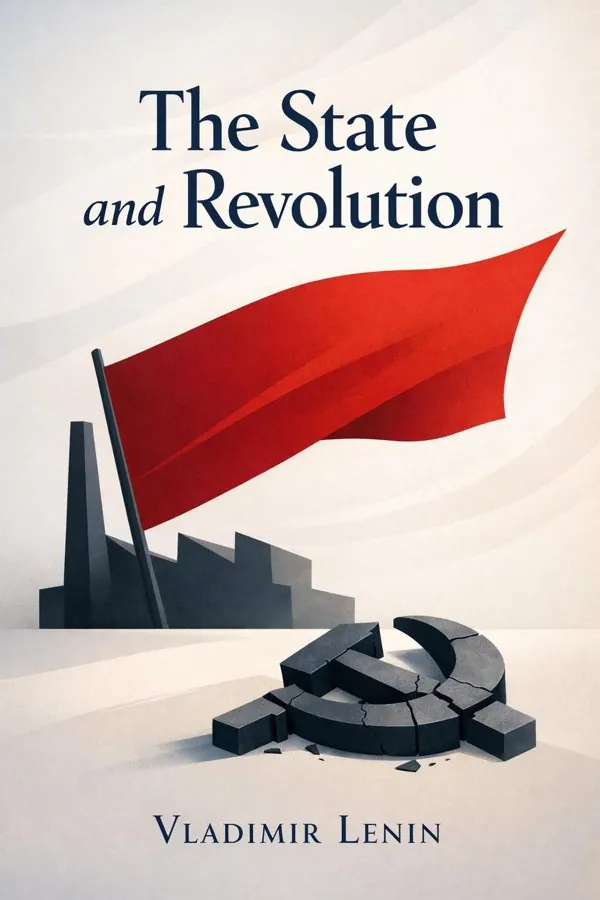
The State and Revolution: Summary & Key Insights
 10 min11 chaptersAudio available
What Is The State and Revolution About?
The State and Revolution by Vladimir Lenin is a politics book spanning 11 pages. The State and Revolution is a political and philosophical work by Vladimir Lenin, written in 1917. In it, Lenin analyzes the teachings of Marx and Engels on the state, examines the role of the state in class society, and argues for its eventual abolition following the proletarian revolution. The book became one of the key theoretical documents of Bolshevism and had a major influence on the development of Marxist theory and practice.
This FizzRead summary covers all 11 key chapters of The State and Revolution in approximately 10 minutes, distilling the most important ideas, arguments, and takeaways from Vladimir Lenin's work. Also available as an audio summary and Key Quotes Podcast.
The State and Revolution
The State and Revolution is a political and philosophical work by Vladimir Lenin, written in 1917. In it, Lenin analyzes the teachings of Marx and Engels on the state, examines the role of the state in class society, and argues for its eventual abolition following the proletarian revolution. The book became one of the key theoretical documents of Bolshevism and had a major influence on the development of Marxist theory and practice.
Who Should Read The State and Revolution?
This book is perfect for anyone interested in politics and looking to gain actionable insights in a short read. Whether you're a student, professional, or lifelong learner, the key ideas from The State and Revolution by Vladimir Lenin will help you think differently.
- ✓Readers who enjoy politics and want practical takeaways
- ✓Professionals looking to apply new ideas to their work and life
- ✓Anyone who wants the core insights of The State and Revolution in just 10 minutes
Want the full summary?
Get instant access to this book summary and 100K+ more with Fizz Moment.
Get Free SummaryAvailable on App Store • Free to download
Key Chapters
To understand revolution, we must first understand the state itself. Contrary to the comforting myths peddled by bourgeois scholars, the state is not a neutral arbiter standing above society. It is a machine—a mechanism created by the ruling class to oppress another. Marx and Engels were clear: the state emerges only when irreconcilable class antagonisms develop, when society is torn between exploiters and exploited. Its primary function is to keep these contradictions from exploding by enforcing domination through organized coercion.
In ancient societies, as private property divided people into masters and slaves, the state arose to preserve that division. The form changed through history—slaveholding states, feudal monarchies, capitalist republics—but the essence did not. Even the modern democratic state is nothing more than the dictatorship of the bourgeoisie veiled in constitutional rhetoric. Beneath the surface of elections and parliaments lies the machinery of police, judiciary, and military—all protecting the interests of those who own capital.
We cannot confuse the external forms of democracy with freedom itself. In capitalist democracy, workers may vote but remain wage-slaves. They may speak, but their words cannot change the fundamental relations of production. The state, in every capitalist nation, is organized violence against the exploited class. Recognizing this truth tears away the illusions of neutrality and prepares the working class for its revolutionary task: to destroy the old state apparatus and build a new one that serves the interests of the majority.
The Marxist theory of revolution is inseparable from its theory of the state. The state did not always exist, and it will not exist forever. It appears when society splits into classes, and it will disappear when classes are abolished. But that disappearance cannot come by peaceful decay or reform. It requires a revolutionary rupture—a violent overthrow of the bourgeois order. The ruling class will never surrender its privileges voluntarily, and so the proletariat must seize power by breaking the state apparatus that sustains exploitation.
This process is not simple destruction but transformation. After revolution, the working class must create its own state: a proletarian dictatorship that suppresses the resistance of exploiters and reorganizes production in the interests of all. This dictatorship is temporary, existing only to defend the new social order until exploitation becomes impossible. As Marx wrote, the state will then begin to wither away—not abolished artificially but rendered unnecessary by the end of class conflict.
Here lies the profound dialectic of revolution: the state, born of oppression, is destroyed through liberation, and through that destruction, humanity begins to live without coercion. The task of revolution is not merely to take over government but to abolish its very foundations.
+ 9 more chapters — available in the FizzRead app
All Chapters in The State and Revolution
About the Author
Vladimir Ilyich Lenin (1870–1924) was a Russian revolutionary, political leader, and Marxist theorist. He founded the Russian Soviet Republic and later the Soviet Union. His works on philosophy, political economy, and revolutionary theory profoundly influenced the global socialist movement.
Get This Summary in Your Preferred Format
Read or listen to the The State and Revolution summary by Vladimir Lenin anytime, anywhere. FizzRead offers multiple formats so you can learn on your terms — all free.
Available formats: App · Audio · PDF · EPUB — All included free with FizzRead
Download The State and Revolution PDF and EPUB Summary
Key Quotes from The State and Revolution
“To understand revolution, we must first understand the state itself.”
“The Marxist theory of revolution is inseparable from its theory of the state.”
Frequently Asked Questions about The State and Revolution
The State and Revolution by Vladimir Lenin is a politics book that explores key ideas across 11 chapters. The State and Revolution is a political and philosophical work by Vladimir Lenin, written in 1917. In it, Lenin analyzes the teachings of Marx and Engels on the state, examines the role of the state in class society, and argues for its eventual abolition following the proletarian revolution. The book became one of the key theoretical documents of Bolshevism and had a major influence on the development of Marxist theory and practice.
You Might Also Like

Antifa: The Anti-Fascist Handbook
Mark Bray
10 min
Attack from Within: How Disinformation Is Sabotaging America
Barbara McQuade
10 min
Coercion, Capital, and European States, AD 990–1992
Charles Tilly
10 min
Digital Democracy: Concepts, Methodologies, Tools, and Applications
Various Authors
10 min
Fascism
Stanley G. Payne
10 min
Fire And Fury: Inside The Trump White House
Michael Wolff
10 minBrowse by Category
Ready to read The State and Revolution?
Get the full summary and 100K+ more books with Fizz Moment.