
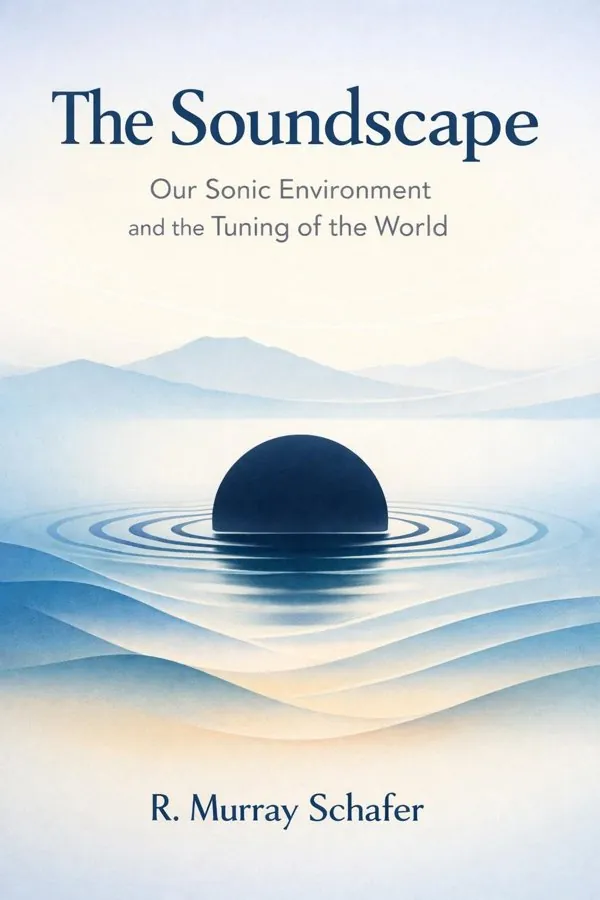
The Soundscape: Our Sonic Environment and the Tuning of the World: Summary & Key Insights
 10 min6 chaptersAudio available
What Is The Soundscape: Our Sonic Environment and the Tuning of the World About?
The Soundscape: Our Sonic Environment and the Tuning of the World by R. Murray Schafer is a music_film book spanning 6 pages. In this groundbreaking work, Canadian composer and environmentalist R. Murray Schafer explores the concept of the soundscape—the acoustic environment as perceived by humans. He examines how modern industrialization has transformed our auditory world, leading to what he calls 'sound pollution.' Schafer proposes ways to re-tune our relationship with sound, advocating for a more conscious and balanced acoustic ecology.
This FizzRead summary covers all 6 key chapters of The Soundscape: Our Sonic Environment and the Tuning of the World in approximately 10 minutes, distilling the most important ideas, arguments, and takeaways from R. Murray Schafer's work. Also available as an audio summary and Key Quotes Podcast.
The Soundscape: Our Sonic Environment and the Tuning of the World
In this groundbreaking work, Canadian composer and environmentalist R. Murray Schafer explores the concept of the soundscape—the acoustic environment as perceived by humans. He examines how modern industrialization has transformed our auditory world, leading to what he calls 'sound pollution.' Schafer proposes ways to re-tune our relationship with sound, advocating for a more conscious and balanced acoustic ecology.
Who Should Read The Soundscape: Our Sonic Environment and the Tuning of the World?
This book is perfect for anyone interested in music_film and looking to gain actionable insights in a short read. Whether you're a student, professional, or lifelong learner, the key ideas from The Soundscape: Our Sonic Environment and the Tuning of the World by R. Murray Schafer will help you think differently.
- ✓Readers who enjoy music_film and want practical takeaways
- ✓Professionals looking to apply new ideas to their work and life
- ✓Anyone who wants the core insights of The Soundscape: Our Sonic Environment and the Tuning of the World in just 10 minutes
Want the full summary?
Get instant access to this book summary and 100K+ more with Fizz Moment.
Get Free SummaryAvailable on App Store • Free to download
Key Chapters
When I first began studying sound environments, I realized that the acoustic character of the world has changed dramatically across history. Before industrialization, soundscapes were determined by geography, climate, and human ritual. The whisper of reeds, the rhythmic pounding of waves, the ring of bells, or the chatter of markets—all formed coherent auditory identities for places. These were *hi-fi soundscapes*, where each sound had space to be heard distinctly and meaningfully intertwined with daily life.
Then came the Industrial Revolution. As machines multiplied, the soundscape thickened into what I term *lo-fi*: a dense fog of overlapping frequencies where the ear struggles to discern individual sources. The once-recognizable sonic signature of a place dissolved into uniform mechanical noise. The modern city, filled with traffic, ventilation, and electronic hums, exemplifies this loss of clarity. Where the pre-industrial listener could identify a wagon’s approach or a church bell’s unique tone, modern ears are numbed by anonymity.
But soundscapes are not simply byproducts of environment—they reveal and influence how societies relate to time, community, and power. For instance, bells once regulated collective activity; their control symbolized authority. The disappearance of such sound signals parallels a shift toward centralized, abstract control—time regulated not by bells but by industrial clocks and factory sirens. Each transformation in acoustic culture marks a transformation in social structure.
To comprehend our sonic condition, then, we must first learn to hear historically. Sound is an archive of civilization’s development, an echo chamber of human values. Listening carefully tells us who we were, who we are, and where we might be heading.
To understand any environment acoustically, I propose three fundamental categories of sound: keynotes, signals, and soundmarks. Together they form what I call the grammar of the soundscape.
Keynote sounds are the background tones of a place—the wind in a canyon, the distant surf, or the hum of urban electricity. They are often unnoticed because they form the acoustic ground against which other sounds stand out. Yet they shape the psychological feel of a location as profoundly as climate or architecture. For example, the constant murmur of traffic defines the modern city’s keynote, lending both energy and tension to urban life.
Sound signals, by contrast, demand attention: the cry of a hawker in a marketplace, the ring of a telephone, the wail of a siren. They act as auditory punctuation, guiding behavior and communication. In traditional societies, signals were intimately woven into communal rhythms; their disappearance or replacement says much about how technological media have abstracted human interaction.
Finally, soundmarks are the sonic equivalents of landmarks—the unique sounds that define a community’s identity and memory. The foghorn of a coastal village, the chanting of monks in a temple valley, even the whirr of a traditional craft. When a soundmark vanishes, something of cultural memory is lost. To preserve a people’s sense of place, we must therefore protect these auditory icons as carefully as we do visual heritage sites.
In naming and classifying these categories, I intended more than taxonomy—I sought to awaken sensitivity. Once we can name the voices of the world, we can begin to listen responsibly, recognizing that each sound, whether natural or human-made, carries the resonance of communal life.
+ 4 more chapters — available in the FizzRead app
All Chapters in The Soundscape: Our Sonic Environment and the Tuning of the World
About the Author
R. Murray Schafer (1933–2021) was a Canadian composer, writer, and environmentalist known for his pioneering work in acoustic ecology. He founded the World Soundscape Project and authored influential texts on the relationship between humans and their sonic environment.
Get This Summary in Your Preferred Format
Read or listen to the The Soundscape: Our Sonic Environment and the Tuning of the World summary by R. Murray Schafer anytime, anywhere. FizzRead offers multiple formats so you can learn on your terms — all free.
Available formats: App · Audio · PDF · EPUB — All included free with FizzRead
Download The Soundscape: Our Sonic Environment and the Tuning of the World PDF and EPUB Summary
Key Quotes from The Soundscape: Our Sonic Environment and the Tuning of the World
“When I first began studying sound environments, I realized that the acoustic character of the world has changed dramatically across history.”
“To understand any environment acoustically, I propose three fundamental categories of sound: keynotes, signals, and soundmarks.”
Frequently Asked Questions about The Soundscape: Our Sonic Environment and the Tuning of the World
The Soundscape: Our Sonic Environment and the Tuning of the World by R. Murray Schafer is a music_film book that explores key ideas across 6 chapters. In this groundbreaking work, Canadian composer and environmentalist R. Murray Schafer explores the concept of the soundscape—the acoustic environment as perceived by humans. He examines how modern industrialization has transformed our auditory world, leading to what he calls 'sound pollution.' Schafer proposes ways to re-tune our relationship with sound, advocating for a more conscious and balanced acoustic ecology.
You Might Also Like

Beethoven: A Documentary Study
H. C. Robbins Landon
10 min
Cinema Speculation
Quentin Tarantino
10 min
Deep Listening: A Composer's Sound Practice
Pauline Oliveros
10 min
Dylan Goes Electric!: Newport, Seeger, Dylan, and the Night That Split the Sixties
Elijah Wald
10 min
Future Frames
Maria Walsh
10 min
Hamilton: The Revolution: Being the Complete Libretto of the Broadway Musical, with a True Account of Its Creation, and Concise Remarks on Hip-Hop, the Power of Stories, and the New America
Lin-Manuel Miranda, Jeremy McCarter
10 minBrowse by Category
Ready to read The Soundscape: Our Sonic Environment and the Tuning of the World?
Get the full summary and 100K+ more books with Fizz Moment.