
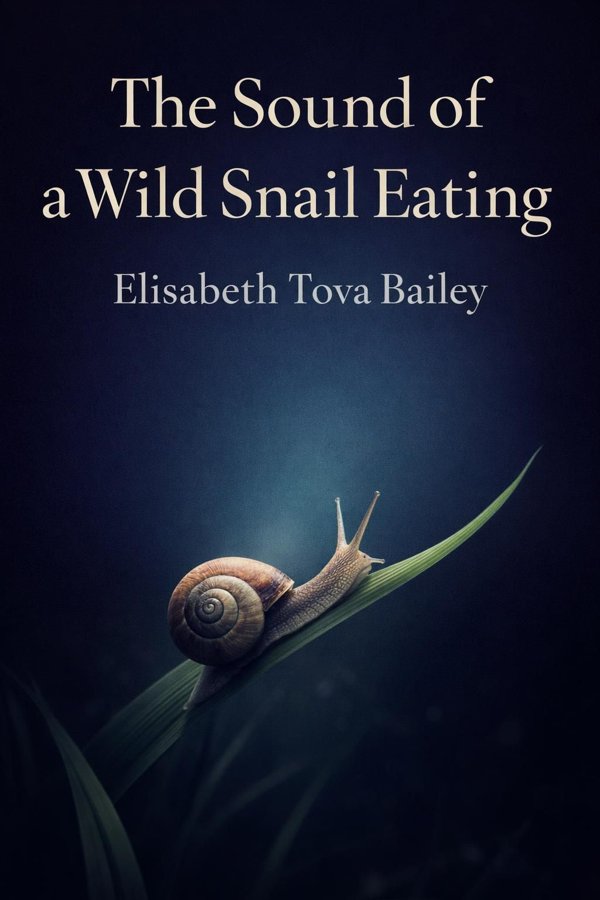
The Sound of a Wild Snail Eating: Summary & Key Insights
 10 min9 chaptersAudio available
Key Takeaways from The Sound of a Wild Snail Eating
When ordinary life disappears, the smallest details can become newly vivid.
Companionship does not always arrive in familiar forms.
The more closely we look at another creature, the less simple it appears.
We often assume that a meaningful life must move quickly, but Bailey’s illness places her in a radically different experience of time.
Recovery is rarely dramatic; more often it is gradual, uneven, and difficult to narrate.
What Is The Sound of a Wild Snail Eating About?
The Sound of a Wild Snail Eating by Elisabeth Tova Bailey is a life_science book spanning 5 pages. What can a tiny woodland snail teach a person whose life has been narrowed by severe illness to the dimensions of a bed and a bedside table? In The Sound of a Wild Snail Eating, Elisabeth Tova Bailey turns an experience of extreme physical limitation into a work of profound attention, natural history, and quiet philosophical depth. After a debilitating viral illness leaves her largely bedridden, a friend brings her a potted violet containing an unexpected guest: a small wild snail. What begins as mild curiosity becomes an intimate study of another creature’s rhythms, habits, and survival. Bailey’s book matters because it transforms observation into understanding. She does not romanticize sickness, nor does she force inspiration from suffering. Instead, she shows how careful attention to a seemingly insignificant life can restore meaning, perspective, and connection. Blending memoir, science, and meditative reflection, she reveals that resilience is not always dramatic; sometimes it is measured in patience, adaptation, and the ability to keep moving through constraint. As a writer and naturalist drawing on both lived experience and careful research, Bailey brings unusual authority and tenderness to a story that speaks to readers interested in nature, illness, recovery, and the hidden complexity of the living world.
This FizzRead summary covers all 9 key chapters of The Sound of a Wild Snail Eating in approximately 10 minutes, distilling the most important ideas, arguments, and takeaways from Elisabeth Tova Bailey's work. Also available as an audio summary and Key Quotes Podcast.
The Sound of a Wild Snail Eating
What can a tiny woodland snail teach a person whose life has been narrowed by severe illness to the dimensions of a bed and a bedside table? In The Sound of a Wild Snail Eating, Elisabeth Tova Bailey turns an experience of extreme physical limitation into a work of profound attention, natural history, and quiet philosophical depth. After a debilitating viral illness leaves her largely bedridden, a friend brings her a potted violet containing an unexpected guest: a small wild snail. What begins as mild curiosity becomes an intimate study of another creature’s rhythms, habits, and survival.
Bailey’s book matters because it transforms observation into understanding. She does not romanticize sickness, nor does she force inspiration from suffering. Instead, she shows how careful attention to a seemingly insignificant life can restore meaning, perspective, and connection. Blending memoir, science, and meditative reflection, she reveals that resilience is not always dramatic; sometimes it is measured in patience, adaptation, and the ability to keep moving through constraint. As a writer and naturalist drawing on both lived experience and careful research, Bailey brings unusual authority and tenderness to a story that speaks to readers interested in nature, illness, recovery, and the hidden complexity of the living world.
Who Should Read The Sound of a Wild Snail Eating?
This book is perfect for anyone interested in life_science and looking to gain actionable insights in a short read. Whether you're a student, professional, or lifelong learner, the key ideas from The Sound of a Wild Snail Eating by Elisabeth Tova Bailey will help you think differently.
- ✓Readers who enjoy life_science and want practical takeaways
- ✓Professionals looking to apply new ideas to their work and life
- ✓Anyone who wants the core insights of The Sound of a Wild Snail Eating in just 10 minutes
Want the full summary?
Get instant access to this book summary and 100K+ more with Fizz Moment.
Get Free SummaryAvailable on App Store • Free to download
Key Chapters
When ordinary life disappears, the smallest details can become newly vivid. One of the book’s central insights is that serious illness does not merely interrupt a schedule; it can dismantle identity itself. Bailey’s condition leaves her unable to participate in the world as she once did. Activities that had seemed effortless—walking, socializing, reading for long stretches, making plans—become difficult or impossible. Time slows, space contracts, and the self that was built around action, productivity, and movement suddenly has nowhere to stand.
What makes this idea powerful is that Bailey does not present stillness as inherently noble. Confinement is painful, lonely, and destabilizing. Yet within that painful narrowing, perception sharpens. The room becomes an ecosystem of sound, light, routine, and waiting. What had once gone unnoticed now enters awareness. Illness strips away distraction, and in that stripped-down state, attention becomes both refuge and method of survival.
This has wider application beyond chronic illness. Anyone who has experienced burnout, grief, caregiving, or forced pause may recognize how periods of limitation can reconfigure what matters. The book suggests that when life feels smaller, it is still possible for awareness to grow larger. Instead of measuring worth only through output, Bailey invites us to consider presence as a meaningful form of participation in life.
A practical way to apply this is to notice what your fast life prevents you from seeing. Spend ten minutes each day observing one ordinary thing—a houseplant, a bird at the window, the changing light in a room—without trying to optimize or interpret it too quickly. Actionable takeaway: when circumstances reduce your range, practice letting attention expand rather than assuming your life has lost significance.
Companionship does not always arrive in familiar forms. A friend brings Bailey a potted violet from the woods, and hidden in the soil is a small snail. This chance arrival becomes the emotional and intellectual center of the book. At first the snail is simply a curiosity, but soon it becomes a presence with its own routines, preferences, and mysteries. Bailey watches it emerge at night, extend its tentacles, explore the rim of the pot, and leave behind a glistening trail that marks both movement and persistence.
The significance of the snail lies not in sentimentality but in relationship through attention. Bailey does not turn it into a cartoon or a symbol detached from reality. Instead, she comes to know it by observing what it actually does. That disciplined curiosity creates a bond. In a period when human interaction is limited by illness and fatigue, the snail offers a form of company that is quiet, undemanding, and alive. It gives Bailey something beyond her own suffering to care about.
This idea matters because many people underestimate how healing it can be to direct attention outward. A pet, a garden, a bird feeder, or even a recurring tree outside a window can become a stabilizing relationship. Such connections do not erase hardship, but they can reduce isolation and renew interest in the world.
In practical terms, the book encourages readers to cultivate small forms of companionship with living things. You do not need a dramatic lifestyle change. You might keep a plant journal, observe insects on a balcony, or learn the routines of animals in a nearby park. Actionable takeaway: choose one nonhuman life near you and study it with patience; companionship often begins where sustained attention replaces casual noticing.
The more closely we look at another creature, the less simple it appears. As Bailey studies the snail, she begins reading scientific literature and comparing research with her own observations. She learns about the mechanics of locomotion, the function of the shell, the rasping mouthpart called the radula, the sensitivity of tentacles, and the surprising complexity of a snail’s sensory and adaptive capacities. What first seemed like a tiny, slow, almost featureless animal reveals itself as an elegant piece of evolutionary design.
This movement from wonder to knowledge is one of the book’s most satisfying achievements. Bailey shows that awe deepens when it is informed. Scientific understanding does not diminish mystery; it refines it. Learning how the snail eats, navigates, estivate, or repairs damage makes its existence more impressive, not less. The creature on the nightstand becomes a portal into biology, ecology, and the hidden sophistication of small lives.
There is also a lesson here about method. Bailey does not rush to conclusions. She watches, compares, reads, and revises her assumptions. That process models a way of thinking increasingly rare in an age of instant interpretation. It is a reminder that attention paired with study can transform idle curiosity into real understanding.
Readers can apply this by choosing something ordinary they have overlooked and learning one layer deeper about it. A garden snail, urban pigeon, neighborhood tree, or even household mold patterns can become a gateway into natural science. Read, observe, and test what you think you know. Actionable takeaway: treat everyday nature as worthy of research; one carefully studied detail can restore a sense of wonder and intellectual engagement.
We often assume that a meaningful life must move quickly, but Bailey’s illness places her in a radically different experience of time. Days no longer revolve around appointments, goals, and visible progress. Instead, time is measured through rest, symptom fluctuations, the angle of light, and the nocturnal habits of a snail. This altered rhythm is initially disorienting because modern identity is tightly tied to productivity. If you cannot do, who are you?
The book’s answer is subtle: the self can be rebuilt around attention rather than acceleration. Observing the snail’s patient movements helps Bailey inhabit a tempo she did not choose but gradually learns to understand. Slowness becomes not a moral ideal but a perceptual reality. In that slower frame, details emerge that speed had erased. Reflection deepens. Emotional states become more legible. The world feels less like a sequence of tasks and more like a web of processes unfolding in time.
This insight applies broadly. Many readers are not bedridden, but they are trapped in forms of haste that fracture attention and drain meaning. The book challenges the assumption that faster always means fuller. It suggests that a slower tempo can reveal neglected dimensions of thought, memory, and relationship.
A practical application is to build one slow ritual into your day with no productivity goal attached: sipping tea without screens, watching dusk arrive, taking a deliberate walk, or journaling what changed in a single hour. Such practices retrain attention and make time feel inhabited rather than consumed. Actionable takeaway: stop measuring every day by output alone; experiment with one recurring practice that lets you experience time as depth instead of speed.
Recovery is rarely dramatic; more often it is gradual, uneven, and difficult to narrate. Bailey’s story does not offer a simplistic arc from sickness to triumph. Instead, renewal emerges as a subtle widening of connection—to the snail, to scientific knowledge, to the larger natural world, and eventually to her own returning capacities. The period of forced stillness changes her, not because suffering is inherently transformative, but because she remains receptive to what can still be learned within it.
One of the book’s deeper contributions is its redefinition of healing. Healing is not presented as the total disappearance of pain or the restoration of a previous identity. It is a renewed ability to be in relationship with life. Through her observations, Bailey feels less sealed off inside illness. The snail becomes evidence that even within a confined space, life is active, adaptive, and connected to broader ecological patterns. That recognition gently counters despair.
This perspective can help readers facing long recoveries, emotional exhaustion, or life transitions. Renewal may begin before circumstances fully improve. It may start with curiosity, with noticing, with one small relationship to the living world. Instead of waiting to feel whole before engaging again, Bailey shows that engagement itself can be part of becoming whole.
Practically, this means identifying one connection that can be sustained even in difficult periods: caring for a plant, tracking weather, keeping a nature notebook, or writing one observation per day. These acts are small, but they create continuity and participation. Actionable takeaway: do not postpone connection until you feel fully restored; begin with one modest daily act that ties you back to the living world.
To observe carefully is to grant significance. Throughout the book, Bailey demonstrates that attention is not passive; it is an ethical act. By watching the snail closely, learning its needs, and respecting its pace and habitat, she practices a form of compassion rooted in humility. The snail is not important because it serves human goals. It is important because it is a living being with its own existence, vulnerabilities, and capacities.
This is a quietly radical idea in a culture inclined to rank life by utility, charisma, or size. Tiny creatures are easy to dismiss. Ill people are also often overlooked when they can no longer perform normal social roles. Bailey’s identification with the snail’s vulnerability creates an implicit bridge: both the sick person and the small creature can become invisible to a world that prizes speed and strength. Careful attention resists that invisibility.
The practical significance of this idea extends to human relationships as well. To truly observe another person without rushing to fix, judge, or extract value is a form of respect. In caregiving, friendship, parenting, or leadership, attention communicates dignity. The same principle applies to environments. A park, wetland, or patch of soil is more likely to be protected if people have learned to see what lives there.
You can apply this by practicing “slow noticing” with both people and places. In conversation, ask one more question before offering advice. In nature, pause long enough to see patterns rather than surfaces. Keep a notebook of what you would otherwise ignore. Actionable takeaway: choose to notice what your habits teach you to overlook; sustained attention is one of the simplest ways to become more compassionate.
A single snail on a bedside table may seem isolated, but Bailey uses this intimate setting to reveal a much larger truth: no creature exists alone. The snail carries the forest into the sickroom. Its needs for moisture, calcium, shelter, and food point outward to soil, plants, weather, and habitat. Even in confinement, Bailey is reminded that every life is shaped by networks of dependence. The snail’s survival depends on environmental conditions, and Bailey’s understanding of it depends on the work of naturalists, biologists, and caregivers who sustain her own life.
This ecological perspective expands the book beyond memoir. The snail is not just a companion or metaphor; it is a living example of interconnection. To study it seriously is to study relationships among organisms, environments, and systems of care. Bailey’s attentiveness makes visible how fragile and intricate those relationships are.
This matters in an era of ecological crisis, when environmental issues can feel abstract or overwhelming. The book offers a more intimate entry point. It suggests that environmental awareness often begins not with grand theory but with loyalty to one small life and the habitat that makes that life possible. Care grows from familiarity.
Readers can bring this insight into everyday life by tracing the dependencies of something nearby. What does a snail, bee, sparrow, or houseplant need to survive? What conditions support it? What threatens it? This kind of inquiry turns vague concern into grounded ecological literacy. Actionable takeaway: start your environmental awareness at a local scale; understanding the needs of one small organism can awaken responsibility for an entire web of life.
Some books offer personal feeling without facts, while others provide facts without emotional resonance. Bailey accomplishes something rarer: she lets memoir and natural history illuminate one another. Her observations of the snail arise from lived necessity, not academic detachment, yet she does not remain at the level of subjective impression. She consults scientific texts, compares findings, and enriches the narrative with biological detail. The result is a hybrid form in which research sharpens intimacy and intimacy gives research emotional force.
This combination matters because it models a more integrated way of understanding the world. Personal experience can inspire inquiry, and scientific inquiry can deepen personal meaning. Bailey shows that one does not need to choose between lyric attention and factual rigor. In fact, each protects against the weaknesses of the other. Memoir alone might become self-enclosed; science alone might feel remote. Together, they create a fuller picture of reality.
For readers, this is also a lesson in how to learn well. Curiosity becomes more durable when it is anchored in direct encounter. If you first notice a caterpillar eating leaves on your windowsill, you are far more likely to care about metamorphosis, host plants, and insect life cycles. Emotion can motivate disciplined learning.
To apply this, pair observation with research in your own life. If something captures your attention, write what you see, then look up reliable sources and compare your assumptions with evidence. This method works for nature, health, art, and even relationships. Actionable takeaway: when something moves your curiosity, do both parts—feel it closely and study it carefully.
One of the book’s quiet triumphs is its refusal to accept that a restricted life is an empty life. Bailey does not deny loss; her illness is severe, frightening, and deeply limiting. Yet the presence of the snail helps reveal that meaning does not depend exclusively on freedom, achievement, or outward mobility. It can arise through observation, learning, care, and the recognition that life continues in forms both delicate and resilient.
This idea is especially important for readers who fear that illness, aging, disability, or changed circumstances have diminished their worth. The book offers a corrective without becoming preachy. Bailey’s days may be constrained, but they are not devoid of discovery. In fact, the very limits that seem to erase significance create the conditions for a different kind of richness. The snail’s minute actions—a glide across a leaf, a night of feeding, a pause in its shell—become events worthy of notice. Such moments restore texture to time and counter despair.
In broader life, constraint is unavoidable. Careers stall, bodies change, responsibilities increase, and plans fail. The question is not whether limits will appear, but whether we can still find forms of engagement within them. Bailey suggests that meaningful attention is one answer.
A practical exercise is to ask, in any constrained season: what remains available to me? Perhaps not travel, ambition, or intensity—but maybe reading, listening, noticing, writing, or tending. Building life from what remains is not resignation; it is an act of resilience. Actionable takeaway: when your options narrow, identify the forms of meaning still open to you and invest in them deliberately.
All Chapters in The Sound of a Wild Snail Eating
About the Author
Elisabeth Tova Bailey is an American writer and naturalist best known for The Sound of a Wild Snail Eating. Her work is marked by close observation, lyrical clarity, and a deep respect for the natural world. Bailey wrote her acclaimed debut after a severe viral illness left her largely bedridden, an experience that reshaped her relationship to time, perception, and the living environment around her. Drawing on both personal experience and scientific research, she developed a distinctive voice that bridges memoir and natural history. Her writing has been praised for its emotional intelligence, precision, and ability to reveal the extraordinary within the seemingly ordinary. Bailey is especially admired by readers interested in nature writing, illness narratives, and reflective nonfiction that uncovers meaning through patient attention.
Get This Summary in Your Preferred Format
Read or listen to the The Sound of a Wild Snail Eating summary by Elisabeth Tova Bailey anytime, anywhere. FizzRead offers multiple formats so you can learn on your terms — all free.
Available formats: App · Audio · PDF · EPUB — All included free with FizzRead
Download The Sound of a Wild Snail Eating PDF and EPUB Summary
Key Quotes from The Sound of a Wild Snail Eating
“When ordinary life disappears, the smallest details can become newly vivid.”
“Companionship does not always arrive in familiar forms.”
“The more closely we look at another creature, the less simple it appears.”
“We often assume that a meaningful life must move quickly, but Bailey’s illness places her in a radically different experience of time.”
“Recovery is rarely dramatic; more often it is gradual, uneven, and difficult to narrate.”
Frequently Asked Questions about The Sound of a Wild Snail Eating
The Sound of a Wild Snail Eating by Elisabeth Tova Bailey is a life_science book that explores key ideas across 9 chapters. What can a tiny woodland snail teach a person whose life has been narrowed by severe illness to the dimensions of a bed and a bedside table? In The Sound of a Wild Snail Eating, Elisabeth Tova Bailey turns an experience of extreme physical limitation into a work of profound attention, natural history, and quiet philosophical depth. After a debilitating viral illness leaves her largely bedridden, a friend brings her a potted violet containing an unexpected guest: a small wild snail. What begins as mild curiosity becomes an intimate study of another creature’s rhythms, habits, and survival. Bailey’s book matters because it transforms observation into understanding. She does not romanticize sickness, nor does she force inspiration from suffering. Instead, she shows how careful attention to a seemingly insignificant life can restore meaning, perspective, and connection. Blending memoir, science, and meditative reflection, she reveals that resilience is not always dramatic; sometimes it is measured in patience, adaptation, and the ability to keep moving through constraint. As a writer and naturalist drawing on both lived experience and careful research, Bailey brings unusual authority and tenderness to a story that speaks to readers interested in nature, illness, recovery, and the hidden complexity of the living world.
You Might Also Like
The Selfish Gene
Richard Dawkins
10 min
Awakenings
Oliver Sacks
10 min
Parasite Rex: Inside the Bizarre World of Nature's Most Dangerous Creatures
Carl Zimmer
10 min
The Atlas of Life on Earth
Various
10 min
The Book of Humans: The Story of How We Became Us
Adam Rutherford
10 min
The Horse
Wendy Williams
10 minBrowse by Category
Ready to read The Sound of a Wild Snail Eating?
Get the full summary and 100K+ more books with Fizz Moment.