
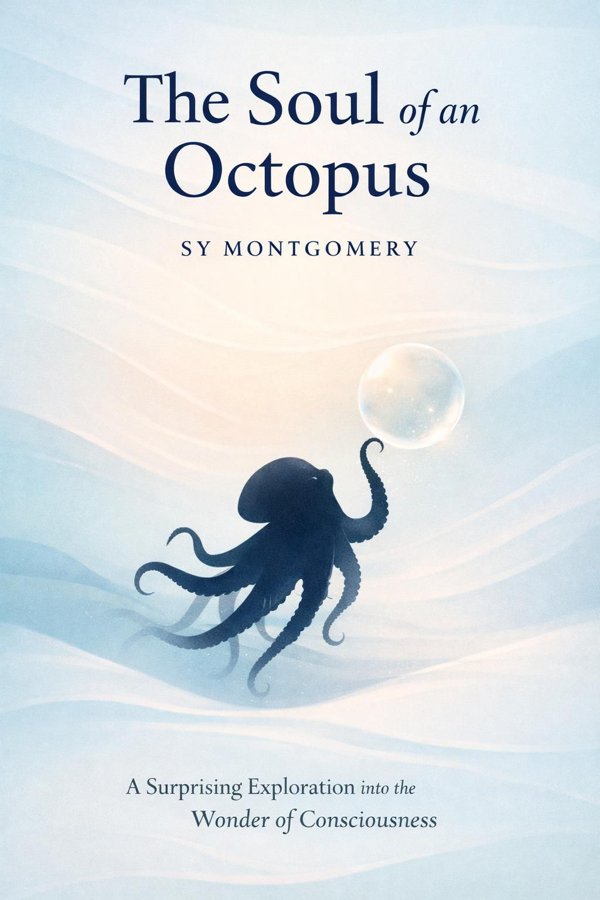
The Soul of an Octopus: A Surprising Exploration into the Wonder of Consciousness: Summary & Key Insights
 10 min9 chaptersAudio available
Key Takeaways from The Soul of an Octopus: A Surprising Exploration into the Wonder of Consciousness
Sometimes a single encounter changes the boundaries of your world.
Knowledge is rarely built alone; it grows in communities of attention.
Intelligence becomes easier to recognize when it resembles our own, but that is precisely the trap Montgomery urges us to avoid.
One of the strongest signs of inner life is not efficiency but play.
Communication does not begin with language; it begins with attention to signals.
What Is The Soul of an Octopus: A Surprising Exploration into the Wonder of Consciousness About?
The Soul of an Octopus: A Surprising Exploration into the Wonder of Consciousness by Sy Montgomery is a life_science book spanning 7 pages. What does it mean to meet a mind radically unlike our own? In The Soul of an Octopus, naturalist and acclaimed author Sy Montgomery turns that question into a vivid, intimate, and unforgettable inquiry. Centered on her encounters with several giant Pacific octopuses at the New England Aquarium, the book blends memoir, science writing, animal behavior, and philosophy to explore whether consciousness, emotion, and personality extend far beyond the human world. Montgomery does not present octopuses as laboratory curiosities; she introduces them as distinct individuals with preferences, moods, curiosity, and apparent capacities for play, trust, and connection. What makes the book matter is its challenge to human assumptions. Octopuses are evolutionarily distant from us, soft-bodied, short-lived, and equipped with a decentralized nervous system that seems almost alien. Yet they repeatedly display intelligence that feels startlingly familiar. Montgomery’s authority comes from years as a naturalist and storyteller who combines careful observation with scientific research and emotional honesty. The result is a moving exploration of animal minds that invites readers to rethink empathy, intelligence, and the boundaries of consciousness itself.
This FizzRead summary covers all 9 key chapters of The Soul of an Octopus: A Surprising Exploration into the Wonder of Consciousness in approximately 10 minutes, distilling the most important ideas, arguments, and takeaways from Sy Montgomery's work. Also available as an audio summary and Key Quotes Podcast.
The Soul of an Octopus: A Surprising Exploration into the Wonder of Consciousness
What does it mean to meet a mind radically unlike our own? In The Soul of an Octopus, naturalist and acclaimed author Sy Montgomery turns that question into a vivid, intimate, and unforgettable inquiry. Centered on her encounters with several giant Pacific octopuses at the New England Aquarium, the book blends memoir, science writing, animal behavior, and philosophy to explore whether consciousness, emotion, and personality extend far beyond the human world. Montgomery does not present octopuses as laboratory curiosities; she introduces them as distinct individuals with preferences, moods, curiosity, and apparent capacities for play, trust, and connection.
What makes the book matter is its challenge to human assumptions. Octopuses are evolutionarily distant from us, soft-bodied, short-lived, and equipped with a decentralized nervous system that seems almost alien. Yet they repeatedly display intelligence that feels startlingly familiar. Montgomery’s authority comes from years as a naturalist and storyteller who combines careful observation with scientific research and emotional honesty. The result is a moving exploration of animal minds that invites readers to rethink empathy, intelligence, and the boundaries of consciousness itself.
Who Should Read The Soul of an Octopus: A Surprising Exploration into the Wonder of Consciousness?
This book is perfect for anyone interested in life_science and looking to gain actionable insights in a short read. Whether you're a student, professional, or lifelong learner, the key ideas from The Soul of an Octopus: A Surprising Exploration into the Wonder of Consciousness by Sy Montgomery will help you think differently.
- ✓Readers who enjoy life_science and want practical takeaways
- ✓Professionals looking to apply new ideas to their work and life
- ✓Anyone who wants the core insights of The Soul of an Octopus: A Surprising Exploration into the Wonder of Consciousness in just 10 minutes
Want the full summary?
Get instant access to this book summary and 100K+ more with Fizz Moment.
Get Free SummaryAvailable on App Store • Free to download
Key Chapters
Sometimes a single encounter changes the boundaries of your world. For Sy Montgomery, that moment came when she met Athena, a giant Pacific octopus at the New England Aquarium. Athena did not behave like an unfeeling sea creature on display. She reached out, explored Montgomery with her suckers, changed color and texture, and interacted with clear intentionality. What began as fascination became a serious challenge to the assumption that intelligence must look human to count.
Montgomery shows that curiosity often starts not with theory but with contact. Athena’s touch felt purposeful, delicate, and investigative, as though two beings were studying each other across an immense evolutionary distance. That experience prompted Montgomery to ask deeper questions: Can an animal with no bones, three hearts, and a distributed nervous system possess individuality? Can consciousness arise in forms unlike our own? The book’s answer is not a simplistic yes or no, but a patient accumulation of evidence through relationship.
This first encounter matters because it reframes observation itself. Instead of treating animals as specimens, Montgomery learns to meet them as subjects. That shift has practical implications beyond octopuses. Whether we are watching wildlife, caring for pets, or engaging with people who think differently from us, we often understand more when we begin with humility rather than certainty.
A useful application is to practice “attentive curiosity.” In daily life, pause before labeling a being or situation. Look for patterns, preferences, and responses. Ask what the other party might be perceiving that you are missing.
Actionable takeaway: Replace snap judgments with sustained observation; wonder is often the first step toward deeper understanding.
Knowledge is rarely built alone; it grows in communities of attention. As Montgomery spends more time at the New England Aquarium, she becomes part of a network that includes aquarists, volunteers, trainers, and visitors. Each person brings a different perspective, but all are shaped by encounters with octopuses whose behavior repeatedly exceeds expectation. The aquarium becomes more than a facility for display. It becomes a living classroom where relationships with animals teach humans how to notice better.
Montgomery highlights the caretakers’ deep respect for the octopuses as individuals. Feeding is not merely maintenance. Enrichment is not entertainment. Every interaction is a chance to observe preference, mood, problem-solving, and trust. Some octopuses are shy. Others are mischievous. Some seek contact. Others withdraw. This variation reminds us that personality is not a human monopoly.
The broader lesson is that empathy can become institutional rather than merely personal. When an organization treats animals as sentient individuals, its routines change. Staff members design environments that stimulate curiosity, reduce stress, and support natural behaviors. This principle applies in many settings: schools can better serve students when they recognize differing temperaments; workplaces improve when leaders understand people as individuals rather than roles; families thrive when care is tailored rather than generic.
Montgomery also reveals that learning happens in both directions. Humans care for octopuses, but octopuses also influence the emotional and moral development of their human caretakers. They invite patience, sensitivity, and responsiveness.
Actionable takeaway: In any group you belong to, create systems that reflect respect for individual differences rather than assuming one-size-fits-all behavior.
Intelligence becomes easier to recognize when it resembles our own, but that is precisely the trap Montgomery urges us to avoid. Octopuses solve puzzles, escape enclosures, manipulate objects, and learn through exploration, yet their intelligence evolved along a path radically different from that of mammals or birds. Their nervous system is distributed, with a large proportion of neurons located in their arms, giving each arm a semi-independent capacity to sense and act. This makes the octopus not just smart, but differently organized at the deepest biological level.
Montgomery uses stories of aquarium octopuses opening jars, investigating toys, and altering routines to show that problem-solving is not mechanical reflex. These animals exhibit flexibility, experimentation, and what often appears to be play. They do not merely repeat conditioned responses; they improvise. That matters because true intelligence often reveals itself through adaptation in novel situations.
The practical lesson is about broadening our definitions. In education, management, and parenting, people frequently mistake conformity for intelligence. Yet real intelligence may appear in unusual problem-solving styles, indirect communication, or exploratory behavior that initially looks messy. Recognizing diverse forms of cognition helps us avoid underestimating others.
Montgomery’s observations also encourage a more creative approach to our own lives. The octopus survives through responsiveness, not rigidity. It tests openings, changes color, reshapes its body, and uses its environment dynamically. We can apply the same mindset when facing uncertainty: experiment, stay flexible, and learn from feedback rather than clinging to one strategy.
Actionable takeaway: When evaluating intelligence, look for adaptability, curiosity, and problem-solving instead of expecting everyone to think or behave in familiar ways.
One of the strongest signs of inner life is not efficiency but play. Montgomery describes octopuses who interact with objects, people, and routines in ways that seem delightfully unnecessary for survival. They squirt water, toss toys, manipulate enrichment items, and sometimes appear to enjoy surprising their caretakers. Such behavior suggests that octopuses are not merely stimulus-response machines. They have preferences, temperaments, and perhaps even senses of boredom and amusement.
The importance of this idea lies in how personality changes moral perception. It is harder to dismiss an animal as an object once you witness distinct habits and moods. One octopus may be outgoing and tactile, another reserved and cautious. One may relish novelty; another may prefer routine. Montgomery’s narrative insists that individuality is not sentimental projection but something observable through repeated interaction.
This insight has practical relevance because personality awareness improves the quality of care. Zoos, aquariums, shelters, and homes function better when handlers adapt to the individual animal rather than the species stereotype. The same is true in human contexts. Teams perform better when leaders understand who thrives under pressure, who needs reflection time, and who gains energy from experimentation.
There is also a deeper philosophical implication. If play exists in a creature so different from us, then joy, curiosity, and spontaneity may be more widespread in nature than we imagine. That possibility expands our sense of kinship with life.
In daily practice, you can sharpen this awareness by observing recurring behavioral patterns in the beings around you. Instead of asking only what category they belong to, ask what kind of individual they are.
Actionable takeaway: Pay attention to playful and idiosyncratic behavior; it often reveals personality, needs, and hidden intelligence.
It is one thing to meet an octopus in an aquarium and another to encounter one in the ocean, on its own terms. Montgomery’s dives into the wild extend the book’s inquiry beyond captivity and controlled observation. In the sea, octopuses become less like ambassadors and more like mysteries embedded in a living ecosystem. Their dens, camouflage, hunting strategies, and evasions reveal how much of their intelligence is shaped by freedom, danger, and constant adaptation.
Wild encounters deepen Montgomery’s respect by showing how little humans truly know. In aquariums, octopuses can form relationships with familiar caretakers, but in the ocean they are sovereign, elusive, and context-dependent. This balance is important. The book never reduces them to companions for human emotional fulfillment. Instead, it acknowledges their otherness while still affirming connection.
The practical lesson is that understanding any being requires context. Behavior observed in isolation may not reflect how an animal or person acts in a natural environment. A student may struggle in one classroom and thrive in another. An employee may seem disengaged in a rigid culture but become inventive in a supportive one. Context reveals capacity.
Montgomery’s dives also underscore humility in science and in life. The natural world is not a machine we have finished decoding. It remains full of intelligence that resists easy explanation. That realization can make us more careful thinkers and more ethical participants in the world we share.
Actionable takeaway: When trying to understand behavior, consider the environment shaping it; context often explains what labels cannot.
A life does not need to be long to be profound. One of the most moving threads in Montgomery’s book is the octopus’s short lifespan. These brilliant, curious beings often live only a few years, and females die after tending their eggs. Their brevity intensifies every relationship and transforms the book into a meditation on mortality, attachment, and grief.
Montgomery does not avoid the sadness of losing individual octopuses she comes to know. Instead, she uses those losses to ask what it means to value a consciousness that burns brightly and briefly. The emotional force of the book comes partly from this tension: octopuses are astonishingly intelligent, yet their lives are fragile and fleeting. Rather than making them less significant, this fragility makes each interaction more precious.
This insight has broad application. Many people defer appreciation because they assume there will be more time—with loved ones, places, seasons of life, or even their own health. The octopus reminds us that meaning is not measured in duration alone. Presence, depth, and attention create significance.
Montgomery’s reflections also complicate how we think about loss. Grief is not proof that attachment was misguided. It is evidence that a relationship mattered. Whether in caring professions, family life, or friendship, allowing ourselves to be changed by brief connections can be a strength rather than a weakness.
A practical response is to cultivate deliberate appreciation now: notice who and what enriches your life, express gratitude, and avoid postponing tenderness.
Actionable takeaway: Treat short-lived connections as worthy of full attention; impermanence is a reason to care more deeply, not less.
The most radical possibility in The Soul of an Octopus is not that octopuses are clever, but that consciousness itself may be more widespread, varied, and mysterious than human-centered thinking allows. Montgomery does not claim to solve the hard problem of consciousness. Instead, she invites readers to confront evidence that subjective experience might exist in forms that challenge our categories.
Because octopuses are so evolutionarily distant from humans, their apparent awareness carries special weight. If a creature with such a different body plan, brain structure, and life history can display curiosity, recognition, problem-solving, and relationship, then consciousness may not be a narrow ladder with humans at the top. It may be a branching, diverse phenomenon expressed in many ways.
This has ethical consequences. How we define consciousness affects whom we consider worthy of care, protection, and moral consideration. The book gently pushes readers toward a less arrogant worldview. Instead of asking whether animals are enough like us to matter, we might ask whether our standards for mattering have been too limited.
In practical life, this perspective can inspire more responsible choices: supporting humane animal care, protecting marine ecosystems, and engaging science with moral seriousness. It can also enrich personal philosophy by replacing dominance with wonder. We become less isolated when we imagine ourselves as participants in a living world full of other centers of experience.
Actionable takeaway: Let uncertainty about other minds make you more compassionate, not less; when in doubt, err on the side of respect.
Wonder is often dismissed as a childish emotion, but Montgomery presents it as a disciplined moral practice. To wonder is not merely to be amazed; it is to remain open to realities that exceed our assumptions. Throughout the book, the octopus becomes a teacher in this deeper sense. It disrupts certainty, unsettles human exceptionalism, and draws the observer into a more reverent relationship with life.
This spiritual thread does not depend on formal religion. Rather, it arises from repeated encounters with intelligence, beauty, and mystery in a being radically unlike ourselves. Montgomery suggests that when we truly see another life-form, we are also forced to reconsider ourselves. The boundaries between observer and observed become less rigid. We recognize that consciousness may not be a private human possession but part of a wider, richer web of existence.
The practical value of wonder is that it changes behavior. People protect what they feel connected to. They listen more carefully when they realize they do not already know everything. In a time of environmental crisis and technological distraction, wonder can restore attention and responsibility. It can also deepen ordinary life by making us more present to the living beings around us.
You can cultivate this stance through simple habits: spend unhurried time in nature, observe animals without forcing interpretation, read science with humility, and allow unanswered questions to remain alive rather than rushing to closure.
Actionable takeaway: Practice wonder intentionally; openness to mystery can make you both wiser and more compassionate.
All Chapters in The Soul of an Octopus: A Surprising Exploration into the Wonder of Consciousness
About the Author
Sy Montgomery is an American naturalist, author, and scriptwriter celebrated for her immersive writing on animals, science, and the natural world. Her work often blends firsthand experience, scientific research, and reflective storytelling, allowing readers to engage emotionally as well as intellectually with nonhuman life. Over the course of her career, she has written extensively about a wide range of species, from birds and mammals to marine creatures, with a particular gift for revealing the individuality and mystery of animals often overlooked or misunderstood. Montgomery is known for making complex biological and ethical questions accessible to general readers without sacrificing depth. In The Soul of an Octopus, she brings those strengths together to explore consciousness, empathy, and the astonishing intelligence of one of the ocean’s most fascinating creatures.
Get This Summary in Your Preferred Format
Read or listen to the The Soul of an Octopus: A Surprising Exploration into the Wonder of Consciousness summary by Sy Montgomery anytime, anywhere. FizzRead offers multiple formats so you can learn on your terms — all free.
Available formats: App · Audio · PDF · EPUB — All included free with FizzRead
Download The Soul of an Octopus: A Surprising Exploration into the Wonder of Consciousness PDF and EPUB Summary
Key Quotes from The Soul of an Octopus: A Surprising Exploration into the Wonder of Consciousness
“Sometimes a single encounter changes the boundaries of your world.”
“Knowledge is rarely built alone; it grows in communities of attention.”
“Intelligence becomes easier to recognize when it resembles our own, but that is precisely the trap Montgomery urges us to avoid.”
“One of the strongest signs of inner life is not efficiency but play.”
“Communication does not begin with language; it begins with attention to signals.”
Frequently Asked Questions about The Soul of an Octopus: A Surprising Exploration into the Wonder of Consciousness
The Soul of an Octopus: A Surprising Exploration into the Wonder of Consciousness by Sy Montgomery is a life_science book that explores key ideas across 9 chapters. What does it mean to meet a mind radically unlike our own? In The Soul of an Octopus, naturalist and acclaimed author Sy Montgomery turns that question into a vivid, intimate, and unforgettable inquiry. Centered on her encounters with several giant Pacific octopuses at the New England Aquarium, the book blends memoir, science writing, animal behavior, and philosophy to explore whether consciousness, emotion, and personality extend far beyond the human world. Montgomery does not present octopuses as laboratory curiosities; she introduces them as distinct individuals with preferences, moods, curiosity, and apparent capacities for play, trust, and connection. What makes the book matter is its challenge to human assumptions. Octopuses are evolutionarily distant from us, soft-bodied, short-lived, and equipped with a decentralized nervous system that seems almost alien. Yet they repeatedly display intelligence that feels startlingly familiar. Montgomery’s authority comes from years as a naturalist and storyteller who combines careful observation with scientific research and emotional honesty. The result is a moving exploration of animal minds that invites readers to rethink empathy, intelligence, and the boundaries of consciousness itself.
You Might Also Like
The Selfish Gene
Richard Dawkins
10 min
Awakenings
Oliver Sacks
10 min
Parasite Rex: Inside the Bizarre World of Nature's Most Dangerous Creatures
Carl Zimmer
10 min
The Atlas of Life on Earth
Various
10 min
The Book of Humans: The Story of How We Became Us
Adam Rutherford
10 min
The Horse
Wendy Williams
10 minBrowse by Category
Ready to read The Soul of an Octopus: A Surprising Exploration into the Wonder of Consciousness?
Get the full summary and 100K+ more books with Fizz Moment.