
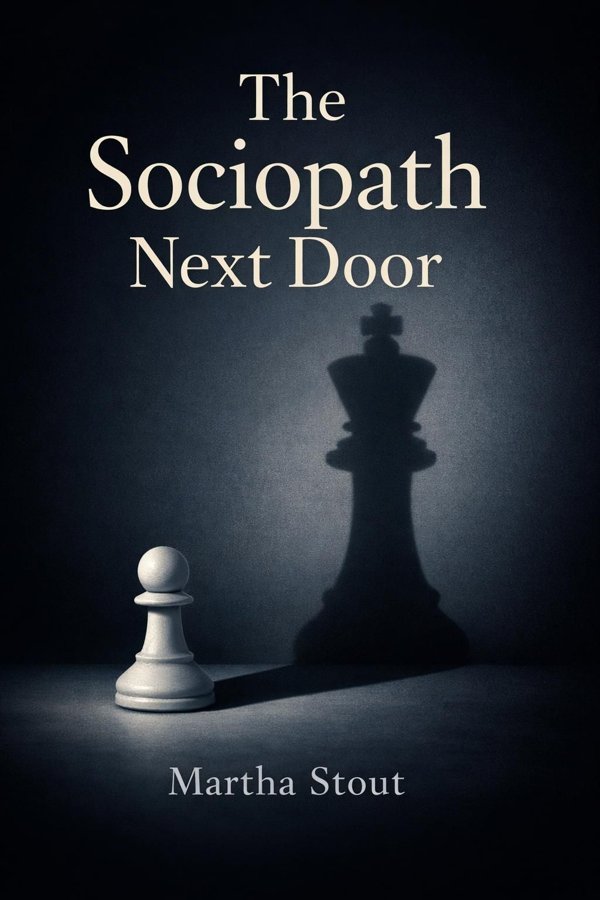
The Sociopath Next Door: The Ruthless Versus the Rest of Us: Summary & Key Insights
by Martha Stout
 10 min3 chaptersAudio available
What Is The Sociopath Next Door: The Ruthless Versus the Rest of Us About?
The Sociopath Next Door: The Ruthless Versus the Rest of Us by Martha Stout is a psychology book spanning 3 pages. In this groundbreaking work, Harvard psychologist Martha Stout reveals that approximately one in twenty-five ordinary Americans secretly has no conscience and can do anything at all without feeling guilt or remorse. Drawing on case studies and psychological research, Stout explains how to recognize sociopaths in everyday life and how to protect oneself from their manipulative behavior.
This FizzRead summary covers all 3 key chapters of The Sociopath Next Door: The Ruthless Versus the Rest of Us in approximately 10 minutes, distilling the most important ideas, arguments, and takeaways from Martha Stout's work. Also available as an audio summary and Key Quotes Podcast.
The Sociopath Next Door: The Ruthless Versus the Rest of Us
In this groundbreaking work, Harvard psychologist Martha Stout reveals that approximately one in twenty-five ordinary Americans secretly has no conscience and can do anything at all without feeling guilt or remorse. Drawing on case studies and psychological research, Stout explains how to recognize sociopaths in everyday life and how to protect oneself from their manipulative behavior.
Who Should Read The Sociopath Next Door: The Ruthless Versus the Rest of Us?
This book is perfect for anyone interested in psychology and looking to gain actionable insights in a short read. Whether you're a student, professional, or lifelong learner, the key ideas from The Sociopath Next Door: The Ruthless Versus the Rest of Us by Martha Stout will help you think differently.
- ✓Readers who enjoy psychology and want practical takeaways
- ✓Professionals looking to apply new ideas to their work and life
- ✓Anyone who wants the core insights of The Sociopath Next Door: The Ruthless Versus the Rest of Us in just 10 minutes
Want the full summary?
Get instant access to this book summary and 100K+ more with Fizz Moment.
Get Free SummaryAvailable on App Store • Free to download
Key Chapters
When I use the word ‘sociopath,’ I’m not describing a villain from fiction but a real, clinically observable condition—a profound absence of conscience. Roughly four percent of people fit this pattern. That means millions of individuals who, while appearing normal, cannot feel guilt or genuine empathy. This absence isn’t the result of bad parenting or trauma; it’s a deeper deficit, a missing emotional foundation.
Through decades of psychological research, I’ve come to see conscience as an emotional faculty built on empathy. It is what gives rise to moral reasoning and what makes guilt a productive, guiding emotion. In most people, guilt prevents cruelty, stabilizes cooperation, and encourages compassion. But the sociopath is different. Their emotional landscape is flat in one crucial dimension: they may mimic concern or affection, but these performances are strategic.
Take, for instance, the case studies I describe—individuals who effortlessly exploit trust. One might manipulate a partner with loving words while secretly draining their finances. Another might climb a corporate hierarchy through deliberate deceit and calculated charm. Each sociopath tailors their behavior to others’ expectations, crafting an appearance of sincerity that conceals total indifference to others’ welfare.
What’s most chilling is how ordinary many sociopaths appear. Unlike the violent criminals who make headlines, most sociopaths lead socially integrated lives. They hold respectable jobs, attend community gatherings, and maintain families. Their success depends on society’s assumption that empathy and remorse are universal traits. Once you recognize that this assumption has exceptions, you begin to see how sociopaths thrive unnoticed. They manipulate social conventions as tools—pretending morality where it serves their interests, discarding it where it doesn’t.
This recognition can be disturbing, but it’s essential. To understand sociopathy is to accept that conscience—a sense of moral emotion—is neither universal nor guaranteed. That insight changes everything about how we perceive character and trust.
When sociopaths enter our personal sphere, the consequences can be devastating. Because they lack emotional empathy, they approach relationships as arenas of power and control. In intimate partnerships, they may shower attention and affection at first, only to employ subtle manipulation once trust is secured. Their charm can be extraordinary, almost hypnotic, because it’s free of self-consciousness. But that charm is a device—a calculated method for gaining advantage.
Within workplaces, the sociopath often excels precisely because of this emotional detachment. They can make ruthless decisions without anxiety or remorse, which sometimes gets misread as strength or leadership. A sociopathic executive might take credit for others’ work, sabotage competition, or manufacture alliances to climb rapidly. Their success, however, relies on exploiting the natural decency of those around them—people who hesitate to suspect true malice because conscience blinds them to its absence.
Across communities, sociopaths contribute to subtle erosion of trust. They engage socially, even philanthropically, when it benefits their reputation or influence, but their motives are always self-serving. I have observed that their ability to remain undetected is partly social: many people simply cannot imagine the absence of conscience and thus rationalize sociopathic behavior as ambition or eccentricity.
Understanding this dynamic helps you guard against manipulation. Sociopaths rely on your empathy; they assume you’ll respond to appeals for pity or forgive betrayals that seem momentary. The moment you learn to recognize those patterns—the charm without depth, the words that contradict deeds—you reclaim power. Through awareness, you can choose distance rather than engagement, reason rather than guilt. That is the first act of self-protection.
+ 1 more chapters — available in the FizzRead app
All Chapters in The Sociopath Next Door: The Ruthless Versus the Rest of Us
About the Author
Martha Stout, Ph.D., is a clinical psychologist and former instructor in the Department of Psychiatry at Harvard Medical School. She has written extensively on psychological trauma, conscience, and sociopathy, and is known for her accessible and insightful works on human behavior.
Get This Summary in Your Preferred Format
Read or listen to the The Sociopath Next Door: The Ruthless Versus the Rest of Us summary by Martha Stout anytime, anywhere. FizzRead offers multiple formats so you can learn on your terms — all free.
Available formats: App · Audio · PDF · EPUB — All included free with FizzRead
Download The Sociopath Next Door: The Ruthless Versus the Rest of Us PDF and EPUB Summary
Key Quotes from The Sociopath Next Door: The Ruthless Versus the Rest of Us
“When I use the word ‘sociopath,’ I’m not describing a villain from fiction but a real, clinically observable condition—a profound absence of conscience.”
“When sociopaths enter our personal sphere, the consequences can be devastating.”
Frequently Asked Questions about The Sociopath Next Door: The Ruthless Versus the Rest of Us
The Sociopath Next Door: The Ruthless Versus the Rest of Us by Martha Stout is a psychology book that explores key ideas across 3 chapters. In this groundbreaking work, Harvard psychologist Martha Stout reveals that approximately one in twenty-five ordinary Americans secretly has no conscience and can do anything at all without feeling guilt or remorse. Drawing on case studies and psychological research, Stout explains how to recognize sociopaths in everyday life and how to protect oneself from their manipulative behavior.
More by Martha Stout

You Might Also Like
The Body Keeps the Score
Bessel van der Kolk
10 min
Surrounded by Idiots
Thomas Erikson
10 min
Emotional Intelligence
Daniel Goleman
10 min
Attached
Amir Levine
10 min
Why Does He Do That
Lundy Bancroft
10 min
Women Who Run with the Wolves
Clarissa Pinkola Estés
10 minBrowse by Category
Ready to read The Sociopath Next Door: The Ruthless Versus the Rest of Us?
Get the full summary and 100K+ more books with Fizz Moment.