
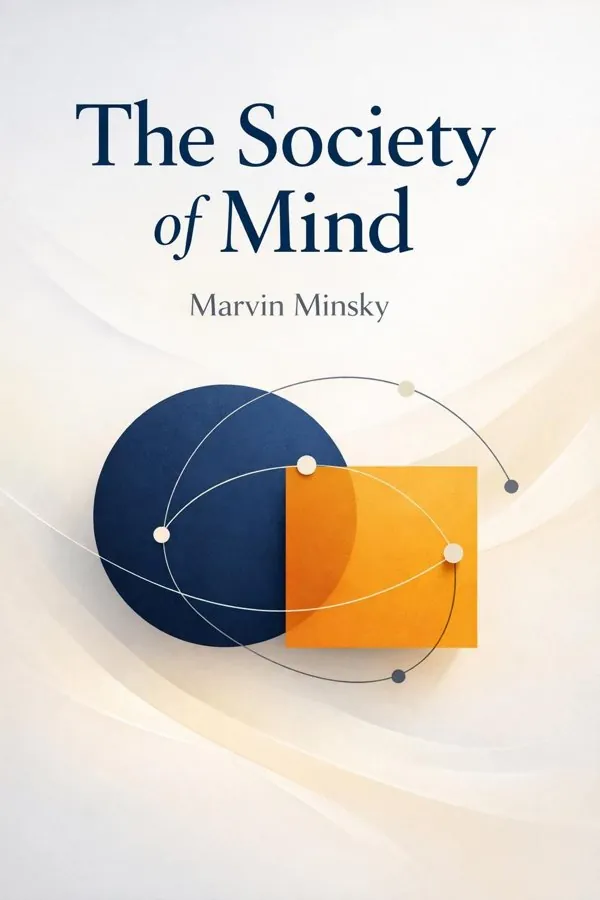
The Society of Mind: Summary & Key Insights
 10 min5 chaptersAudio available
What Is The Society of Mind About?
The Society of Mind by Marvin Minsky is a ai_ml book spanning 5 pages. In this groundbreaking work, Marvin Minsky presents a theory of how the human mind might be structured as a society of smaller, simpler processes called agents. Each agent performs basic functions, and together they give rise to complex thought, perception, and behavior. The book explores how intelligence, learning, and consciousness could emerge from the interactions of these agents, offering a computational model of the mind that bridges psychology, artificial intelligence, and philosophy.
This FizzRead summary covers all 5 key chapters of The Society of Mind in approximately 10 minutes, distilling the most important ideas, arguments, and takeaways from Marvin Minsky's work. Also available as an audio summary and Key Quotes Podcast.
The Society of Mind
In this groundbreaking work, Marvin Minsky presents a theory of how the human mind might be structured as a society of smaller, simpler processes called agents. Each agent performs basic functions, and together they give rise to complex thought, perception, and behavior. The book explores how intelligence, learning, and consciousness could emerge from the interactions of these agents, offering a computational model of the mind that bridges psychology, artificial intelligence, and philosophy.
Who Should Read The Society of Mind?
This book is perfect for anyone interested in ai_ml and looking to gain actionable insights in a short read. Whether you're a student, professional, or lifelong learner, the key ideas from The Society of Mind by Marvin Minsky will help you think differently.
- ✓Readers who enjoy ai_ml and want practical takeaways
- ✓Professionals looking to apply new ideas to their work and life
- ✓Anyone who wants the core insights of The Society of Mind in just 10 minutes
Want the full summary?
Get instant access to this book summary and 100K+ more with Fizz Moment.
Get Free SummaryAvailable on App Store • Free to download
Key Chapters
When I speak of 'agents,' I mean small, specialized processes or mechanisms, each performing a narrow task. An agent might recognize a shape, register a sound, or recall a simple rule. Alone, such agents are neither aware nor intelligent. But when they cooperate in groups—what I call 'agencies'—they can carry out complex operations like interpreting language or navigating through space. You can think of an agency as a working community bound by internal protocols and communication channels.
This means that any feature of mental life—reasoning, memory, perception—can be understood as the work of an organization. For example, your ability to recognize a face may involve agents for detecting edges, shapes, colors, and spatial patterns, each contributing to higher-level agents that infer identity and emotion. Through hierarchical arrangement, each agency manages subsets of agents, passing signals upward and downward to coordinate processing.
The beauty of this model is that it bypasses the need for a master controller. Intelligence is distributed. Decision-making emerges from negotiation, consensus, or conflict among agents. When you experience indecision, it’s not a failure of logic but a genuine argument unfolding within your inner society. Some agents advocate one action, others another; through feedback and inhibition, a resolution crystallizes.
In a sense, agents are both your mental workers and your internal citizens. They operate under learned constraints and cooperate for shared goals, yet their relations aren’t static. Through growth and learning, new agencies form, obsolete ones dissolve. What we call development is the evolution of this inner community from primitive reflexes to integrated intellect.
This view provides a striking alternative to classical psychology. Rather than conceiving the mind as a singular entity with faculties or modules, the society of mind depicts fluid organizations whose patterns shift dynamically. Intelligence stems from structural orchestration, not from a central soul.
In perceiving the world, we do not simply absorb sensory data; we interpret it through webs of agents that transform raw input into structured understanding. Vision, hearing, touch—all are handled by hierarchies in which lower-level agents detect elementary features and higher-level ones synthesize them into meaningful patterns. Such processes illustrate how representation emerges. Each agency ‘knows’ its domain through what I call frames and scripts—schemes that organize experience by filling typical slots, much like expectations.
Memory is not stored in a single vault; it is distributed across countless agents. When you recall a familiar situation, what happens is not a retrieval of a static file but a reactivation of the society that built that experience. Frames provide the scaffolding—'this is a room,' 'this is a face,' 'this is a conversation'—while scripts supply dynamic sequences of expected events. They allow us to interpret, predict, and reconstruct context even from partial clues.
This distributed model explains why memory is flexible and fallible. Since information is not centralized, reconstruction depends on which agents happen to be active at the time. It also clarifies how learning modifies perception itself: by strengthening or weakening connections between agents, experience alters what is noticed and how it is categorized. Over time the mind becomes a layered archive, where perception and memory feed into each other. We literally see with memories and remember through perceptions.
Through the interaction of perception and representation, the mind does not mirror the world as it is, but as its agents organize it to be. Meaning arises through structure, through networks that interpret rather than simply record.
+ 3 more chapters — available in the FizzRead app
All Chapters in The Society of Mind
About the Author
Marvin Minsky (1927–2016) was an American cognitive scientist and one of the founding figures of artificial intelligence. A professor at the Massachusetts Institute of Technology, he co-founded the MIT AI Laboratory and made pioneering contributions to robotics, cognitive theory, and computer science. His works, including 'The Society of Mind' and 'The Emotion Machine', have profoundly influenced AI research and the philosophy of mind.
Get This Summary in Your Preferred Format
Read or listen to the The Society of Mind summary by Marvin Minsky anytime, anywhere. FizzRead offers multiple formats so you can learn on your terms — all free.
Available formats: App · Audio · PDF · EPUB — All included free with FizzRead
Download The Society of Mind PDF and EPUB Summary
Key Quotes from The Society of Mind
“When I speak of 'agents,' I mean small, specialized processes or mechanisms, each performing a narrow task.”
“In perceiving the world, we do not simply absorb sensory data; we interpret it through webs of agents that transform raw input into structured understanding.”
Frequently Asked Questions about The Society of Mind
The Society of Mind by Marvin Minsky is a ai_ml book that explores key ideas across 5 chapters. In this groundbreaking work, Marvin Minsky presents a theory of how the human mind might be structured as a society of smaller, simpler processes called agents. Each agent performs basic functions, and together they give rise to complex thought, perception, and behavior. The book explores how intelligence, learning, and consciousness could emerge from the interactions of these agents, offering a computational model of the mind that bridges psychology, artificial intelligence, and philosophy.
More by Marvin Minsky
You Might Also Like
Life 3.0
Max Tegmark
10 min
Superintelligence
Nick Bostrom
10 min
TensorFlow in Action
Thushan Ganegedara
10 min
AI Made Simple: A Beginner’s Guide to Generative AI, ChatGPT, and the Future of Work
Rajeev Kapur
10 min
AI Snake Oil
Arvind Narayanan, Sayash Kapoor
10 min
AI Superpowers: China, Silicon Valley, and the New World Order
Kai-Fu Lee
10 minBrowse by Category
Ready to read The Society of Mind?
Get the full summary and 100K+ more books with Fizz Moment.