
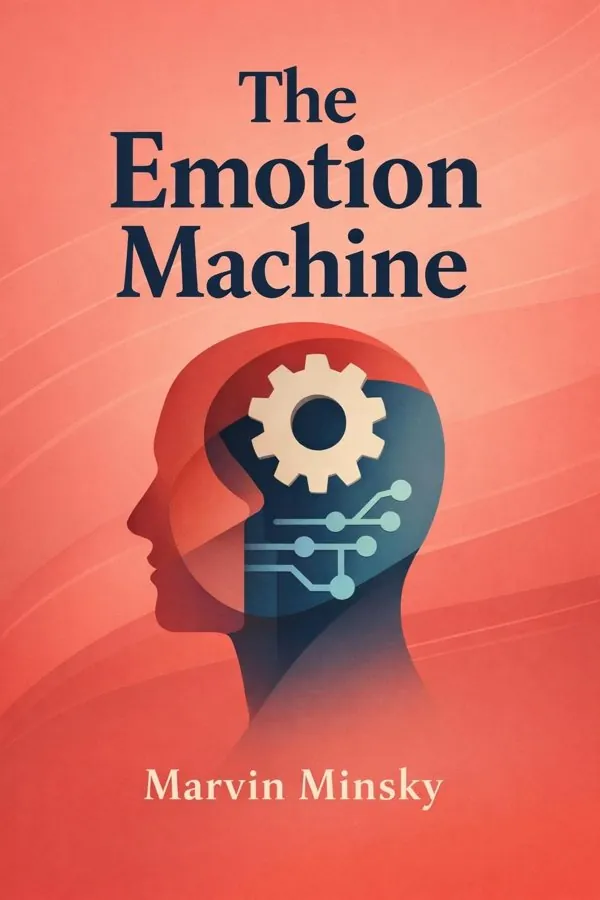
The Emotion Machine: Commonsense Thinking, Artificial Intelligence, and the Future of the Human Mind: Summary & Key Insights
 10 min11 chaptersAudio available
What Is The Emotion Machine: Commonsense Thinking, Artificial Intelligence, and the Future of the Human Mind About?
The Emotion Machine: Commonsense Thinking, Artificial Intelligence, and the Future of the Human Mind by Marvin Minsky is a ai_ml book spanning 11 pages. In this influential work, cognitive scientist Marvin Minsky explores how the human mind works by comparing it to a machine composed of many interacting parts. He proposes that emotions, reasoning, and consciousness arise from layers of mental processes that can be understood through artificial intelligence. The book extends his earlier ideas from 'The Society of Mind' and offers a framework for understanding how machines might one day emulate human thought.
This FizzRead summary covers all 11 key chapters of The Emotion Machine: Commonsense Thinking, Artificial Intelligence, and the Future of the Human Mind in approximately 10 minutes, distilling the most important ideas, arguments, and takeaways from Marvin Minsky's work. Also available as an audio summary and Key Quotes Podcast.
The Emotion Machine: Commonsense Thinking, Artificial Intelligence, and the Future of the Human Mind
In this influential work, cognitive scientist Marvin Minsky explores how the human mind works by comparing it to a machine composed of many interacting parts. He proposes that emotions, reasoning, and consciousness arise from layers of mental processes that can be understood through artificial intelligence. The book extends his earlier ideas from 'The Society of Mind' and offers a framework for understanding how machines might one day emulate human thought.
Who Should Read The Emotion Machine: Commonsense Thinking, Artificial Intelligence, and the Future of the Human Mind?
This book is perfect for anyone interested in ai_ml and looking to gain actionable insights in a short read. Whether you're a student, professional, or lifelong learner, the key ideas from The Emotion Machine: Commonsense Thinking, Artificial Intelligence, and the Future of the Human Mind by Marvin Minsky will help you think differently.
- ✓Readers who enjoy ai_ml and want practical takeaways
- ✓Professionals looking to apply new ideas to their work and life
- ✓Anyone who wants the core insights of The Emotion Machine: Commonsense Thinking, Artificial Intelligence, and the Future of the Human Mind in just 10 minutes
Want the full summary?
Get instant access to this book summary and 100K+ more with Fizz Moment.
Get Free SummaryAvailable on App Store • Free to download
Key Chapters
In my earlier work, *The Society of Mind*, I argued that intelligence emerges from the interaction of many small mental agents, each performing a distinct function. No single part of the mind knows everything or controls everything; instead, cognition arises from their collaboration. That idea challenged the classical notion of a unified self or a central controller. Yet one area remained incomplete—the role of emotion and self-awareness in that system.
In *The Emotion Machine*, I expand this model by introducing new layers that deal with reflection and emotion. Reasoning, imagination, and feeling are not separate faculties but different modes of computation distributed across mental agents. Each can activate or suppress others depending on context. When you feel enthusiasm, certain networks accelerate exploration and creativity. When you feel fear, different networks prioritize caution and memory retrieval. The mind constantly switches between these modes, negotiating among them to produce coherent action.
This expansion also bridges the gap between artificial and human intelligence. The original Society model explained how machines could exhibit intelligent behavior by combining specialized modules. Now, by adding emotional and reflective mechanisms, I propose a roadmap for creating machines that can understand their own thinking. Such machines would not merely process information; they would evaluate, adapt, and introspect—a goal far beyond the computational systems of my time.
So, the transition from the Society to the Emotion Machine represents more than an intellectual evolution; it marks a philosophical one. It acknowledges that understanding emotion is essential to understanding reasoning. To think well, you must feel well. To design intelligent machines, we must build them to adjust their own emotional states according to the problems they face.
If we look carefully at our own minds, we can see distinct layers of activity that operate together but with different purposes. I propose several levels: instinctive, learned, deliberative, reflective, and self-reflective. These are not rigid divisions but functional strata, each representing a step in cognitive sophistication.
At the base are instinctive processes—fast, automatic responses inherited or hardwired. They save us time when we face immediate danger or routine events. Above them are the learned processes, shaped by experience and repetition. These handle habits, social conventions, and the procedural knowledge we accumulate through practice.
The deliberative level is where reasoning becomes active—where we start planning, solving puzzles, weighing alternatives. It makes use of memory and imagination to construct possible actions. Beyond that lies the reflective level, which assesses how the deliberative level is performing. When you pause to ask whether you’re using the right method, you invoke reflection. Finally, self-reflective processes go a step deeper: they analyze your own patterns of thinking, question your motives, and alter your strategies accordingly.
Each level can correct or enhance the one beneath it. This recursive structure gives the mind adaptability. You don’t think about walking—it’s instinctive. But if you trip, your reflective layer steps in to revise how you walk next time. Similarly, when you encounter a moral dilemma, your self-reflective level allows you to challenge not just the decision but the premises behind your reasoning.
From this hierarchy arises the richness of human thought. Machines typically operate in the lower levels, performing learned and deliberative tasks. To move toward human-like intelligence, they must acquire reflective processes, enabling them to monitor and optimize their own performance.
+ 9 more chapters — available in the FizzRead app
All Chapters in The Emotion Machine: Commonsense Thinking, Artificial Intelligence, and the Future of the Human Mind
About the Author
Marvin Minsky (1927–2016) was an American cognitive scientist and one of the founding figures of artificial intelligence. A professor at MIT, he made pioneering contributions to AI, robotics, and cognitive psychology, and authored several seminal works including 'The Society of Mind' and 'The Emotion Machine'.
Get This Summary in Your Preferred Format
Read or listen to the The Emotion Machine: Commonsense Thinking, Artificial Intelligence, and the Future of the Human Mind summary by Marvin Minsky anytime, anywhere. FizzRead offers multiple formats so you can learn on your terms — all free.
Available formats: App · Audio · PDF · EPUB — All included free with FizzRead
Download The Emotion Machine: Commonsense Thinking, Artificial Intelligence, and the Future of the Human Mind PDF and EPUB Summary
Key Quotes from The Emotion Machine: Commonsense Thinking, Artificial Intelligence, and the Future of the Human Mind
“In my earlier work, *The Society of Mind*, I argued that intelligence emerges from the interaction of many small mental agents, each performing a distinct function.”
“If we look carefully at our own minds, we can see distinct layers of activity that operate together but with different purposes.”
Frequently Asked Questions about The Emotion Machine: Commonsense Thinking, Artificial Intelligence, and the Future of the Human Mind
The Emotion Machine: Commonsense Thinking, Artificial Intelligence, and the Future of the Human Mind by Marvin Minsky is a ai_ml book that explores key ideas across 11 chapters. In this influential work, cognitive scientist Marvin Minsky explores how the human mind works by comparing it to a machine composed of many interacting parts. He proposes that emotions, reasoning, and consciousness arise from layers of mental processes that can be understood through artificial intelligence. The book extends his earlier ideas from 'The Society of Mind' and offers a framework for understanding how machines might one day emulate human thought.
More by Marvin Minsky
You Might Also Like
Life 3.0
Max Tegmark
10 min
Superintelligence
Nick Bostrom
10 min
TensorFlow in Action
Thushan Ganegedara
10 min
AI Made Simple: A Beginner’s Guide to Generative AI, ChatGPT, and the Future of Work
Rajeev Kapur
10 min
AI Snake Oil
Arvind Narayanan, Sayash Kapoor
10 min
AI Superpowers: China, Silicon Valley, and the New World Order
Kai-Fu Lee
10 minBrowse by Category
Ready to read The Emotion Machine: Commonsense Thinking, Artificial Intelligence, and the Future of the Human Mind?
Get the full summary and 100K+ more books with Fizz Moment.