
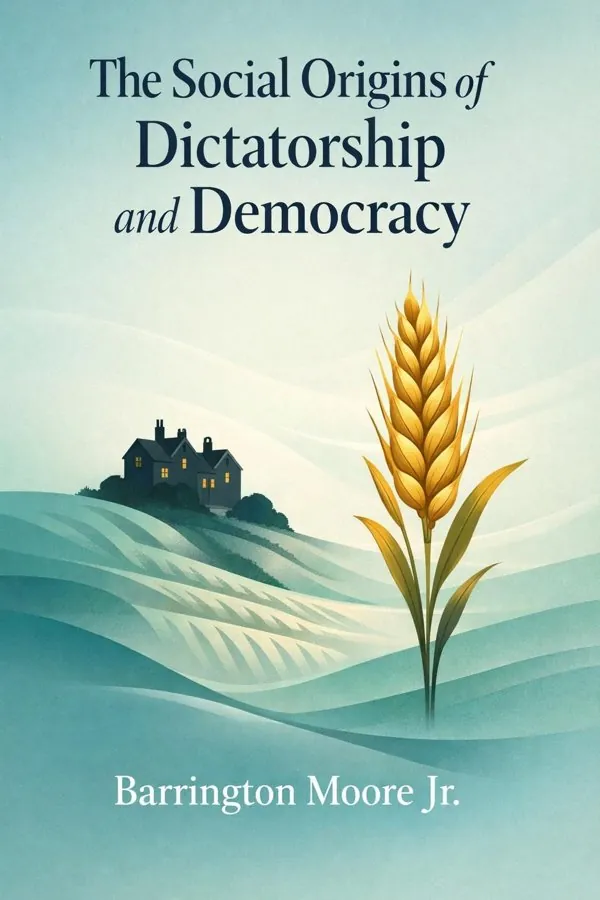
The Social Origins of Dictatorship and Democracy: Lord and Peasant in the Making of the Modern World: Summary & Key Insights
 10 min9 chaptersAudio available
What Is The Social Origins of Dictatorship and Democracy: Lord and Peasant in the Making of the Modern World About?
The Social Origins of Dictatorship and Democracy: Lord and Peasant in the Making of the Modern World by Barrington Moore Jr. is a sociology book spanning 9 pages. This landmark work of comparative historical sociology examines how different social structures and class relations shaped the political outcomes of modernization in England, France, the United States, China, Japan, and India. Moore argues that the paths to modernity—democracy, fascism, and communism—were determined by the relationships between landlords and peasants, and by the timing and nature of agrarian transformations. His famous dictum, 'no bourgeois, no democracy,' encapsulates the book’s central thesis about the social foundations of political systems.
This FizzRead summary covers all 9 key chapters of The Social Origins of Dictatorship and Democracy: Lord and Peasant in the Making of the Modern World in approximately 10 minutes, distilling the most important ideas, arguments, and takeaways from Barrington Moore Jr.'s work. Also available as an audio summary and Key Quotes Podcast.
The Social Origins of Dictatorship and Democracy: Lord and Peasant in the Making of the Modern World
This landmark work of comparative historical sociology examines how different social structures and class relations shaped the political outcomes of modernization in England, France, the United States, China, Japan, and India. Moore argues that the paths to modernity—democracy, fascism, and communism—were determined by the relationships between landlords and peasants, and by the timing and nature of agrarian transformations. His famous dictum, 'no bourgeois, no democracy,' encapsulates the book’s central thesis about the social foundations of political systems.
Who Should Read The Social Origins of Dictatorship and Democracy: Lord and Peasant in the Making of the Modern World?
This book is perfect for anyone interested in sociology and looking to gain actionable insights in a short read. Whether you're a student, professional, or lifelong learner, the key ideas from The Social Origins of Dictatorship and Democracy: Lord and Peasant in the Making of the Modern World by Barrington Moore Jr. will help you think differently.
- ✓Readers who enjoy sociology and want practical takeaways
- ✓Professionals looking to apply new ideas to their work and life
- ✓Anyone who wants the core insights of The Social Origins of Dictatorship and Democracy: Lord and Peasant in the Making of the Modern World in just 10 minutes
Want the full summary?
Get instant access to this book summary and 100K+ more with Fizz Moment.
Get Free SummaryAvailable on App Store • Free to download
Key Chapters
At the core of my argument lies a conviction that politics cannot be understood apart from its social base. Every political outcome—be it democratic, fascist, or communist—originates in the configuration of landholding, peasant dependency, and the balance between land and commerce. I use the concepts of landlord, peasant, and bourgeoisie not as rigid categories but as relational positions within a structure of economic and social control.
In preindustrial societies, power derived from land. The way land was owned, cultivated, and protected determined who commanded resources and who remained dependent. The landlord-peasant relationship was thus the primary axis of authority. But modernization disrupted these ancient relations, as markets expanded and new economic actors—the bourgeoisie—emerged. The arrival of a commercial and industrial class capable of challenging the landed elite set the stage for fundamental political transformations.
The question was not simply whether a bourgeoisie existed, but what alliances and conflicts it formed. If the bourgeoisie allied with peasants or urban workers against the old aristocracy, a path toward democracy opened, as in England. If, instead, the old elites adapted to modern capitalism and subdued both peasantry and bourgeoisie, an authoritarian path developed, as in Japan. And when both peasants and elites resisted commercial transformation, revolutionary upheaval followed, as in China.
Thus modernization is not a uniform process but a spectrum of social struggles. And it is in these struggles that the moral question of coercion and consent arises: to what extent must societies rely on violence to achieve historical progress?
England’s transformation rested on the enclosure movement—the gradual privatization and commercialization of land that displaced peasants yet created a dynamic agricultural economy. The nobility, rather than resisting capitalism, embraced it. They became entrepreneurial landlords, investing in agricultural improvement and forming an alliance with a rising bourgeoisie. This pragmatic accommodation between the old and new classes laid the ground for parliamentary democracy.
The English Revolution of the seventeenth century was neither purely bourgeois nor peasant—it was a complex realignment of interests in which the landed aristocracy’s adaptation to capitalist agriculture prevented widespread peasant rebellion. The social cost was high: the traditional village economy was destroyed, and many peasants were reduced to wage laborers. Yet the long-term outcome was a political order capable of compromise, representation, and reform. England thus followed what I call the bourgeois-democratic route to modernity.
+ 7 more chapters — available in the FizzRead app
All Chapters in The Social Origins of Dictatorship and Democracy: Lord and Peasant in the Making of the Modern World
About the Author
Barrington Moore Jr. (1913–2005) was an American political sociologist and historian, best known for his work on the social origins of political regimes and the comparative study of revolutions. He taught at Harvard University and was a major figure in the development of historical sociology.
Get This Summary in Your Preferred Format
Read or listen to the The Social Origins of Dictatorship and Democracy: Lord and Peasant in the Making of the Modern World summary by Barrington Moore Jr. anytime, anywhere. FizzRead offers multiple formats so you can learn on your terms — all free.
Available formats: App · Audio · PDF · EPUB — All included free with FizzRead
Download The Social Origins of Dictatorship and Democracy: Lord and Peasant in the Making of the Modern World PDF and EPUB Summary
Key Quotes from The Social Origins of Dictatorship and Democracy: Lord and Peasant in the Making of the Modern World
“At the core of my argument lies a conviction that politics cannot be understood apart from its social base.”
“England’s transformation rested on the enclosure movement—the gradual privatization and commercialization of land that displaced peasants yet created a dynamic agricultural economy.”
Frequently Asked Questions about The Social Origins of Dictatorship and Democracy: Lord and Peasant in the Making of the Modern World
The Social Origins of Dictatorship and Democracy: Lord and Peasant in the Making of the Modern World by Barrington Moore Jr. is a sociology book that explores key ideas across 9 chapters. This landmark work of comparative historical sociology examines how different social structures and class relations shaped the political outcomes of modernization in England, France, the United States, China, Japan, and India. Moore argues that the paths to modernity—democracy, fascism, and communism—were determined by the relationships between landlords and peasants, and by the timing and nature of agrarian transformations. His famous dictum, 'no bourgeois, no democracy,' encapsulates the book’s central thesis about the social foundations of political systems.
You Might Also Like
Between the World and Me
Ta-Nehisi Coates
10 min
Half the Sky
Nicholas D. Kristof, Sheryl WuDunn
10 min
Men Explain Things To Me
Rebecca Solnit
10 min
Rational Ritual
Michael Suk-Young Chwe
10 min
The New Jim Crow
Michelle Alexander
10 min
Beyond Culture
Edward T. Hall
10 minBrowse by Category
Ready to read The Social Origins of Dictatorship and Democracy: Lord and Peasant in the Making of the Modern World?
Get the full summary and 100K+ more books with Fizz Moment.