
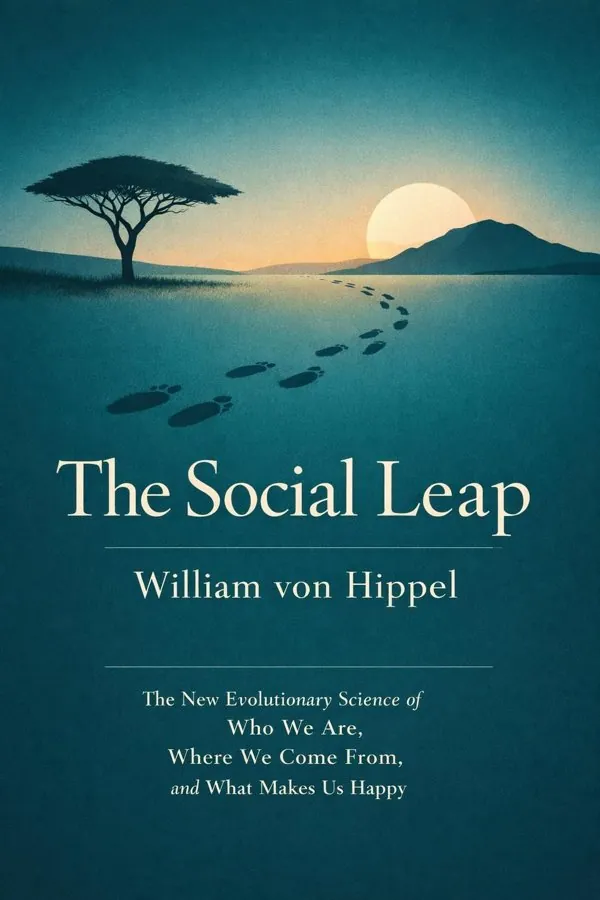
The Social Leap: Summary & Key Insights
 10 min10 chaptersAudio available
Key Takeaways from The Social Leap
Human nature was forged not in comfort, but in disruption.
The most powerful human technology was not the spear or the fire pit, but cooperation.
Raw intelligence matters, but social intelligence changed the game.
Necessity may be the mother of invention, but social life is often the father.
Humans value equality, yet we repeatedly organize ourselves into hierarchies.
What Is The Social Leap About?
The Social Leap by William von Hippel is a psychology book published in 2018 spanning 10 pages. What made humans so different from every other animal is not just that we became smarter, but that we became more social. In The Social Leap, psychologist William von Hippel argues that the decisive turning point in human evolution came when our ancestors left the relative safety of the forest and adapted to life on the open savanna. That environmental shift exposed them to new dangers and opportunities, pushing them to cooperate more deeply, communicate more effectively, and think more creatively than ever before. Over time, those pressures helped produce the traits we now consider most human: friendship, culture, leadership, morality, innovation, and the pursuit of happiness. What makes this book especially compelling is the way von Hippel connects distant evolutionary history to modern life. He explains why we crave belonging, why status still matters so much, why loneliness hurts, and why many people feel strangely dissatisfied despite material abundance. Drawing on psychology, anthropology, and evolutionary biology, he shows that our modern minds were built for intensely social lives, not isolated individualism. As a professor of psychology and a leading researcher in social intelligence, von Hippel brings both scientific credibility and storytelling skill to a question that matters to everyone: how did we become who we are, and what does that mean for living well today?
This FizzRead summary covers all 10 key chapters of The Social Leap in approximately 10 minutes, distilling the most important ideas, arguments, and takeaways from William von Hippel's work. Also available as an audio summary and Key Quotes Podcast.
The Social Leap
What made humans so different from every other animal is not just that we became smarter, but that we became more social. In The Social Leap, psychologist William von Hippel argues that the decisive turning point in human evolution came when our ancestors left the relative safety of the forest and adapted to life on the open savanna. That environmental shift exposed them to new dangers and opportunities, pushing them to cooperate more deeply, communicate more effectively, and think more creatively than ever before. Over time, those pressures helped produce the traits we now consider most human: friendship, culture, leadership, morality, innovation, and the pursuit of happiness.
What makes this book especially compelling is the way von Hippel connects distant evolutionary history to modern life. He explains why we crave belonging, why status still matters so much, why loneliness hurts, and why many people feel strangely dissatisfied despite material abundance. Drawing on psychology, anthropology, and evolutionary biology, he shows that our modern minds were built for intensely social lives, not isolated individualism. As a professor of psychology and a leading researcher in social intelligence, von Hippel brings both scientific credibility and storytelling skill to a question that matters to everyone: how did we become who we are, and what does that mean for living well today?
Who Should Read The Social Leap?
This book is perfect for anyone interested in psychology and looking to gain actionable insights in a short read. Whether you're a student, professional, or lifelong learner, the key ideas from The Social Leap by William von Hippel will help you think differently.
- ✓Readers who enjoy psychology and want practical takeaways
- ✓Professionals looking to apply new ideas to their work and life
- ✓Anyone who wants the core insights of The Social Leap in just 10 minutes
Want the full summary?
Get instant access to this book summary and 100K+ more with Fizz Moment.
Get Free SummaryAvailable on App Store • Free to download
Key Chapters
Human nature was forged not in comfort, but in disruption. Von Hippel begins with a dramatic ecological shift: our ancestors moved from forest environments, where trees offered food and protection, into open grasslands that were far more dangerous and unpredictable. In the forest, survival depended heavily on climbing ability and familiar routines. On the savanna, those advantages weakened. Predators were more visible, food was more scattered, and safety could no longer be secured by retreating to the branches. This transition forced early humans to solve entirely new kinds of problems.
The key insight is that environmental instability can become the engine of transformation. On the savanna, our ancestors had to travel farther, scan for threats, coordinate movements, and secure resources in groups. Individual strength was no longer enough. Flexibility, planning, and social interdependence became crucial. In evolutionary terms, this was not merely a geographic move but a psychological revolution. The mind had to become more adaptive because the world had become less forgiving.
This idea remains relevant today. Modern life often rewards those who can handle uncertainty, collaborate across differences, and learn quickly when old routines stop working. Career changes, technological disruption, and social upheaval all resemble, in a sense, our ancestors’ move into new terrain. We are still shaped by the challenge of adapting together.
Actionable takeaway: When your environment changes, do not cling blindly to old habits. Treat uncertainty as a cue to become more flexible, more cooperative, and more open to new ways of solving problems.
The most powerful human technology was not the spear or the fire pit, but cooperation. Von Hippel argues that once life on the savanna exposed our ancestors to greater danger, working together became a decisive survival advantage. Groups could hunt more effectively, defend against predators, share child-rearing duties, and support injured or vulnerable members. A lone human was fragile; a coordinated group was formidable.
But cooperation is harder than it sounds. It requires trust, reciprocity, memory, and the ability to detect cheaters. Humans evolved psychological systems that made group life possible: we care about fairness, remember who helped us, resent freeloaders, and often feel obligated to return favors. These are not random quirks. They are the emotional architecture of collective survival. In this way, morality and practical necessity began to overlap.
You can see the same logic in everyday life. Teams at work succeed when members share information freely and believe others will pull their weight. Families thrive when responsibilities are distributed fairly. Communities become resilient when people are willing to sacrifice a little for the common good. Even informal acts, like helping a neighbor or mentoring a colleague, strengthen networks that often return benefits later.
Von Hippel’s broader point is that humans do best when they are embedded in dependable social systems. Hyper-individualism may look impressive in theory, but our species rose through mutual reliance.
Actionable takeaway: Invest deliberately in reciprocal relationships. Be the kind of person who contributes, follows through, and helps create trust, because cooperation remains one of the most reliable paths to both success and security.
Necessity may be the mother of invention, but social life is often the father. Von Hippel shows that human creativity did not emerge in a vacuum. It grew out of the practical demands of surviving in changing environments and coordinating with others. Once our ancestors could no longer depend on fixed forest routines, they needed novel solutions: better tools, new hunting strategies, flexible shelters, and improved ways of sharing knowledge. Innovation became adaptive.
Importantly, creativity was not just individual genius. It was cumulative and social. One person discovered a useful trick, others copied it, refined it, and passed it on. This is one of humanity’s greatest advantages over other species: we do not merely solve problems; we build on one another’s solutions across generations. Culture became a storage system for innovation.
In modern life, the same principle applies. The best ideas often emerge where different minds interact. A workplace that encourages experimentation will outperform one that punishes every mistake. A family that remains open to trying new routines can adapt better to stress. Even personal growth depends on creative flexibility: if one strategy fails, can you invent another?
Von Hippel invites readers to see creativity as deeply connected to social conditions. People think more boldly when they feel safe enough to explore and connected enough to share. Innovation flourishes where trust and communication allow ideas to circulate.
Actionable takeaway: Put yourself in environments where ideas can mix. Talk to people outside your usual circle, test small experiments, and treat problems as invitations to invent rather than signs to retreat.
Humans value equality, yet we repeatedly organize ourselves into hierarchies. Von Hippel explains this apparent contradiction by showing that hierarchy can be socially useful when groups need coordination. As human communities grew more complex, someone often had to make decisions, settle disputes, direct effort, or represent the group’s interests. Leadership emerged not only from dominance, but also from competence, trustworthiness, and the ability to serve collective goals.
This evolutionary background helps explain why status remains so psychologically powerful. We track who is respected, who has influence, and where we stand relative to others. Status affects confidence, attention, mating prospects, and access to resources. At the same time, people resist leaders who seem selfish, unfair, or detached from group welfare. Our minds are prepared to accept hierarchy, but only conditionally.
The distinction between prestige and dominance is especially important. Dominance relies on fear and coercion. Prestige relies on earned admiration. In workplaces, classrooms, and communities, the most durable leaders are often those who create value for others and are recognized for their competence. People follow them voluntarily.
This perspective can improve how we think about authority. Effective leadership is not simply about control; it is about aligning individual interests with group success. The best managers, teachers, and parents guide rather than merely command.
Actionable takeaway: If you want influence, build prestige instead of relying on pressure. Become useful, fair, and dependable, and people will be far more willing to trust your direction.
Our moral instincts feel lofty, but they are also practical. Von Hippel argues that morality evolved because highly social groups needed stable rules for cooperation. Without expectations around fairness, loyalty, sharing, punishment, and obligation, collective life would collapse under the weight of mistrust. Moral emotions such as guilt, shame, gratitude, and outrage help regulate behavior in ways that support group functioning.
This does not mean morality is fake or reducible to cold calculation. Rather, it means our ethical sense has deep roots in the realities of living together. We admire generosity because generosity helps groups thrive. We condemn betrayal because betrayal endangers everyone. Altruism, too, can be understood through an evolutionary lens: helping kin, assisting allies, and building a reputation for reliability all increase long-term survival and social support.
Modern examples are everywhere. Companies with cultures of fairness retain people more effectively. Friendships deepen when people honor commitments. Communities become safer when norm violations have consequences. Even charitable giving often reflects our need to participate in something larger than ourselves.
Von Hippel’s view also explains why moral disagreements can feel so intense. They are rarely just abstract philosophical disputes. They often concern competing visions of how social life should be organized and protected.
Actionable takeaway: Treat morality as a daily social practice, not a set of slogans. Keep promises, reciprocate kindness, and respond consistently to unfairness, because trust is built through repeated moral behavior.
One of the oldest features of the human mind is our tendency to compare ourselves with others. Von Hippel explains that status mattered deeply in ancestral environments because it influenced access to resources, mates, allies, and protection. As a result, humans evolved to monitor rank with extraordinary sensitivity. We notice who is admired, who is ignored, and whether we are rising or falling in the social order.
This tendency helps explain many modern frustrations. Social media intensifies status comparison by presenting endless curated evidence of other people’s success, beauty, wealth, and happiness. But even offline, people evaluate themselves constantly through career titles, neighborhoods, educational credentials, and social networks. The problem is that status competitions can become endless. Once basic needs are met, relative position often matters more psychologically than absolute comfort.
Von Hippel does not suggest that status striving is entirely bad. Status can motivate effort, skill-building, and contribution. In healthy forms, it pushes people to become competent and valued. The trouble comes when comparison becomes obsessive or detached from genuine meaning. Then achievement produces only brief relief before the next comparison begins.
A more satisfying path is to seek forms of status connected to service, mastery, or respect rather than vanity alone. People who are admired for generosity, wisdom, or reliability often enjoy more stable well-being than those chasing visibility.
Actionable takeaway: Notice the status games you are playing and choose better ones. Compete less for appearance and more for character, contribution, and competence.
Many of our most common struggles are not personal failures but evolutionary mismatches. Von Hippel argues that the modern world often conflicts with the conditions our minds were designed for. Humans evolved in small, interdependent groups with frequent face-to-face interaction, shared labor, physical movement, and visible purpose. Today, many people live amid abundance yet feel isolated, sedentary, over-stimulated, and strangely unfulfilled.
This mismatch shows up in countless ways. We consume more digital interaction but often get less emotional nourishment. We enjoy privacy and autonomy, yet many people suffer from loneliness and weak community ties. We have unprecedented convenience, but our bodies and minds were not built for constant sitting, fragmented attention, and minimal collective responsibility. Even anxiety can be amplified by modern conditions that flood us with information while depriving us of grounding social bonds.
Von Hippel does not romanticize prehistory; ancient life was dangerous and hard. But he does suggest that our well-being still depends on ingredients common in ancestral life: belonging, meaningful contribution, movement, trust, and shared identity. The lesson is not to abandon modernity, but to design our lives more intelligently within it.
This might mean prioritizing in-person friendships, joining groups, eating with others, spending more time outdoors, and choosing work or hobbies that create visible value. Small shifts can reconnect us with ancient needs.
Actionable takeaway: Audit your life for evolutionary mismatches. Add more real connection, movement, and communal purpose where modern routines have left you isolated or disengaged.
If human beings evolved for social living, then happiness cannot be reduced to private pleasure. Von Hippel’s final message is that fulfillment depends heavily on the same forces that shaped our species: close relationships, social belonging, meaningful contribution, and a sense of valued place within a group. Modern culture often presents happiness as personal freedom, consumption, or individual achievement. But those rewards are usually shallow when disconnected from human connection.
This helps explain an uncomfortable paradox: people can become richer, safer, and more comfortable while not becoming happier. Once basic needs are met, well-being depends less on accumulating more and more and more on whether life feels socially rooted and meaningful. Friendship, family, shared projects, community identity, and opportunities to matter to others all feed psychological systems that evolved over millennia.
Happiness, then, is not merely a feeling to chase but a pattern of living. People tend to flourish when they are needed, respected, and woven into reliable relationships. They also benefit from challenges that engage their abilities in service of something larger than themselves. In this view, purpose and belonging are not luxuries. They are core human requirements.
Von Hippel leaves readers with an optimistic insight: the ingredients of a good life are not mysterious. They are often simple, ancient, and available through intentional choices.
Actionable takeaway: Build your life around people and purpose. Strengthen close relationships, contribute where you can, and measure success partly by how connected and useful you feel, not just by what you own.
All Chapters in The Social Leap
About the Author
William von Hippel is a social psychologist and professor known for his work on evolutionary psychology, social intelligence, and the cognitive foundations of human behavior. He has taught and conducted research at the University of Queensland in Australia and has published extensively in leading academic journals. His scholarship often explores how the demands of group living shaped the human mind, influencing everything from cooperation and status seeking to decision-making and well-being. Von Hippel is especially skilled at translating complex scientific ideas into engaging narratives for general readers. In The Social Leap, he brings together psychology, anthropology, and evolutionary biology to explain how social living transformed human development. His writing is valued for being both intellectually rigorous and highly accessible.
Get This Summary in Your Preferred Format
Read or listen to the The Social Leap summary by William von Hippel anytime, anywhere. FizzRead offers multiple formats so you can learn on your terms — all free.
Available formats: App · Audio · PDF · EPUB — All included free with FizzRead
Download The Social Leap PDF and EPUB Summary
Key Quotes from The Social Leap
“Human nature was forged not in comfort, but in disruption.”
“The most powerful human technology was not the spear or the fire pit, but cooperation.”
“Raw intelligence matters, but social intelligence changed the game.”
“Necessity may be the mother of invention, but social life is often the father.”
“Humans value equality, yet we repeatedly organize ourselves into hierarchies.”
Frequently Asked Questions about The Social Leap
The Social Leap by William von Hippel is a psychology book that explores key ideas across 10 chapters. What made humans so different from every other animal is not just that we became smarter, but that we became more social. In The Social Leap, psychologist William von Hippel argues that the decisive turning point in human evolution came when our ancestors left the relative safety of the forest and adapted to life on the open savanna. That environmental shift exposed them to new dangers and opportunities, pushing them to cooperate more deeply, communicate more effectively, and think more creatively than ever before. Over time, those pressures helped produce the traits we now consider most human: friendship, culture, leadership, morality, innovation, and the pursuit of happiness. What makes this book especially compelling is the way von Hippel connects distant evolutionary history to modern life. He explains why we crave belonging, why status still matters so much, why loneliness hurts, and why many people feel strangely dissatisfied despite material abundance. Drawing on psychology, anthropology, and evolutionary biology, he shows that our modern minds were built for intensely social lives, not isolated individualism. As a professor of psychology and a leading researcher in social intelligence, von Hippel brings both scientific credibility and storytelling skill to a question that matters to everyone: how did we become who we are, and what does that mean for living well today?
You Might Also Like

The Body Keeps the Score
Bessel van der Kolk
10 min
Surrounded by Idiots
Thomas Erikson
10 min
Emotional Intelligence
Daniel Goleman
10 min
Attached
Amir Levine
10 min
Why Does He Do That
Lundy Bancroft
10 min
Women Who Run with the Wolves
Clarissa Pinkola Estés
10 minBrowse by Category
Ready to read The Social Leap?
Get the full summary and 100K+ more books with Fizz Moment.