
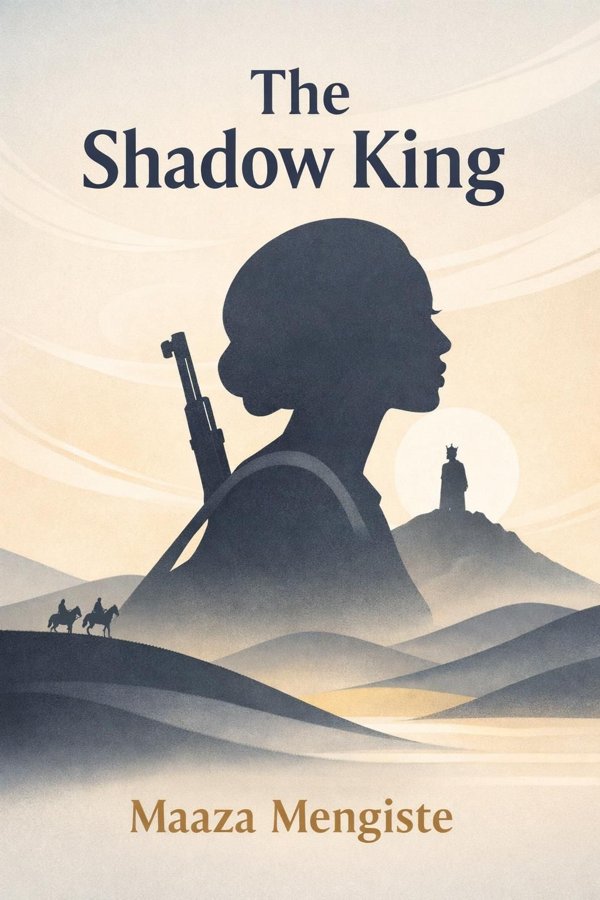
The Shadow King: Summary & Key Insights
 10 min9 chaptersAudio available
Key Takeaways from The Shadow King
Before war explodes, it often announces itself through tension, pride, and denial.
Courage does not always begin as confidence; sometimes it begins as refusal.
Privilege can protect, but it can also imprison.
Power often depends less on truth than on what people agree to believe.
One of the novel’s boldest claims is that women have always been part of war, even when history pretends otherwise.
What Is The Shadow King About?
The Shadow King by Maaza Mengiste is a war_military book spanning 6 pages. Set against the brutal backdrop of Italy’s 1935 invasion of Ethiopia, The Shadow King is a sweeping historical novel about war, memory, power, and the people history often leaves behind. Maaza Mengiste centers the story on women—especially Hirut and Aster—whose courage, grief, and defiance complicate conventional narratives of battle that usually focus only on men and rulers. As Ethiopia struggles against fascist aggression, the novel asks who gets remembered as a hero, who is erased, and who has the right to tell the story of a nation’s survival. What makes this book especially powerful is that it does more than recount a war: it reclaims hidden lives from official history and turns silence into testimony. Mengiste, an Ethiopian-American novelist and essayist known for exploring war, migration, and gender, brings both literary brilliance and deep cultural insight to the subject. The result is a novel that feels intimate and epic at once—an unforgettable meditation on resistance, colonial violence, and the urgent need to preserve the voices of those pushed into the margins.
This FizzRead summary covers all 9 key chapters of The Shadow King in approximately 10 minutes, distilling the most important ideas, arguments, and takeaways from Maaza Mengiste's work. Also available as an audio summary and Key Quotes Podcast.
The Shadow King
Set against the brutal backdrop of Italy’s 1935 invasion of Ethiopia, The Shadow King is a sweeping historical novel about war, memory, power, and the people history often leaves behind. Maaza Mengiste centers the story on women—especially Hirut and Aster—whose courage, grief, and defiance complicate conventional narratives of battle that usually focus only on men and rulers. As Ethiopia struggles against fascist aggression, the novel asks who gets remembered as a hero, who is erased, and who has the right to tell the story of a nation’s survival. What makes this book especially powerful is that it does more than recount a war: it reclaims hidden lives from official history and turns silence into testimony. Mengiste, an Ethiopian-American novelist and essayist known for exploring war, migration, and gender, brings both literary brilliance and deep cultural insight to the subject. The result is a novel that feels intimate and epic at once—an unforgettable meditation on resistance, colonial violence, and the urgent need to preserve the voices of those pushed into the margins.
Who Should Read The Shadow King?
This book is perfect for anyone interested in war_military and looking to gain actionable insights in a short read. Whether you're a student, professional, or lifelong learner, the key ideas from The Shadow King by Maaza Mengiste will help you think differently.
- ✓Readers who enjoy war_military and want practical takeaways
- ✓Professionals looking to apply new ideas to their work and life
- ✓Anyone who wants the core insights of The Shadow King in just 10 minutes
Want the full summary?
Get instant access to this book summary and 100K+ more with Fizz Moment.
Get Free SummaryAvailable on App Store • Free to download
Key Chapters
Before war explodes, it often announces itself through tension, pride, and denial. The Shadow King opens in an Ethiopia poised at the edge of catastrophe, where Mussolini’s Italy seeks colonial conquest under the false banner of restoring imperial glory. Mengiste shows that invasion is never only a military act; it begins in imagination, propaganda, and entitlement. Italy does not merely want land. It wants a story in which Ethiopia becomes proof of fascist power and African subjugation.
At the same time, Ethiopia is not depicted as a simple victim. It is a nation of layered hierarchies, loyalties, and vulnerabilities. Ordinary people feel the coming danger, yet their responses are shaped by class, gender, and proximity to power. This complexity matters because it prevents war from becoming abstract. The invasion is experienced not from the top of government alone, but through villages, households, and bodies.
Mengiste’s great insight is that history changes long before the first battle begins. Political speeches, imperial fantasies, and social inequalities prepare the ground for violence. In modern life, the same principle applies: major crises are often preceded by smaller signs people ignore—dehumanizing rhetoric, concentrated power, and the normalization of injustice.
A practical way to read this chapter of history is to pay attention to the early language of domination. Whether in politics, workplaces, or communities, contempt often precedes harm. If we want to resist violence, we must learn to recognize the conditions that make it possible.
Actionable takeaway: Train yourself to notice the stories power tells before conflict starts, because those stories often become the blueprint for what follows.
Courage does not always begin as confidence; sometimes it begins as refusal. Hirut, one of the novel’s central figures, starts from a place of vulnerability and constraint. She is a servant, a young woman shaped by loss and by the expectations of those above her. Yet as war advances, she becomes one of the clearest embodiments of resistance. Mengiste uses Hirut to show how history is often moved by people who were never meant to matter in official records.
What makes Hirut compelling is not that she is fearless, but that she acts despite fear. Her transformation reveals that resistance is not reserved for the powerful or already heroic. It can emerge from humiliation, anger, necessity, and a deepening understanding of what is at stake. Through her, the novel challenges assumptions about who can be a soldier, who can be brave, and whose sacrifices count.
This idea carries beyond the battlefield. In everyday life, many people wait to feel fully prepared before speaking up, defending themselves, or stepping into responsibility. Hirut’s arc suggests that agency often develops through action, not before it. People discover strength by using it.
A practical application of this insight is to rethink leadership and bravery in your own life. The quiet person in a team, the underestimated worker, or the marginalized member of a community may hold the greatest reserves of resolve when circumstances demand it.
Actionable takeaway: Do not measure your ability to resist injustice by your current status; begin with one act of self-assertion, and let courage grow from practice.
Privilege can protect, but it can also imprison. Aster, a noblewoman of fierce intelligence and intensity, represents a different kind of resistance from Hirut’s. She lives inside structures of status and patriarchy that grant her visibility while denying her full power. Mengiste portrays her not as a symbol of refinement but as a woman burning against confinement, grief, and the limitations imposed on her by gender.
Aster’s rebellion is emotional, strategic, and political all at once. She refuses passivity in a world that expects elite women to remain ornamental while men decide the terms of war. Her frustration with male weakness and indecision becomes part of the novel’s broader critique: when societies define valor too narrowly, they waste the strength of half their people. Aster sees what others fail to see—that survival may require women to step beyond prescribed roles and claim authority directly.
Her story also shows that suffering does not erase contradiction. She can be commanding, wounded, controlling, and brave. Mengiste allows her complexity to stand, which is one reason the novel feels so alive. Resistance is not always pure or gentle. Sometimes it is jagged, impatient, and born from accumulated silencing.
In practical terms, Aster’s character invites readers to examine how social roles can distort talent. In organizations, families, and institutions, people are often boxed into identities that underuse their abilities. Transformation begins when those scripts are challenged.
Actionable takeaway: Identify one role or expectation that limits your voice, and consciously act beyond it in a way that aligns with your deeper capacity.
Power often depends less on truth than on what people agree to believe. One of the novel’s most striking ideas is the creation of a “shadow king,” a stand-in figure used to inspire Ethiopian resistance after Emperor Haile Selassie’s absence leaves a vacuum. This act of political theater is not treated as mere deception. Instead, Mengiste presents it as a profound meditation on symbols, morale, and the fragile architecture of authority.
The shadow king becomes important because nations at war do not survive on strategy alone. They survive on faith, image, and the ability to imagine continuity when leadership falters. In this sense, the novel asks a difficult question: if a symbol helps people endure and fight, is it false, or does it become real through its effects? Mengiste does not offer a simple answer. She shows that performed power can sustain a people, but it can also expose how dependent systems are on spectacle.
This idea applies far beyond monarchy or war. In modern institutions, leaders are often judged not only by what they do but by how convincingly they inhabit authority. Titles, rituals, and public narratives shape collective behavior. Teams rally around confidence, even when the structure behind it is unstable.
The practical lesson is not to become cynical about symbols, but to understand them. Morale matters. Representation matters. Stories of continuity matter. The question is whether these symbols serve the people or manipulate them.
Actionable takeaway: When you encounter a powerful public image or leader, ask not only whether it is authentic, but what work that image is doing for those who believe in it.
One of the novel’s boldest claims is that women have always been part of war, even when history pretends otherwise. The Shadow King restores women to the center of armed resistance, not as background mourners or symbolic mothers, but as strategists, fighters, caretakers, witnesses, and survivors. Mengiste’s achievement lies in showing that women do not merely endure war’s consequences; they shape its course.
This matters because official histories tend to narrow conflict into medals, generals, and treaties. Such accounts often erase labor that is less visible but equally essential: carrying supplies, tending the wounded, gathering intelligence, preserving morale, and at times taking up arms directly. By foregrounding female experience, the novel broadens our understanding of what warfare actually is. War is not only what happens at the front. It is what happens to bodies, homes, memories, and roles.
Mengiste also reveals how gendered erasure works. Even when women participate, their contributions are recast as exceptional, secondary, or unrecorded. This pattern extends into many fields today. In business, science, activism, and family life, women’s labor is often foundational yet under-credited.
A practical way to apply this insight is to revise how you define contribution. In any collective effort, ask who is doing the unrecognized work that enables visible success. Recognition is not a courtesy; it is a correction.
Actionable takeaway: In your workplace, family, or community, name and credit one overlooked contribution this week, especially if it comes from someone history or hierarchy would normally ignore.
War is often discussed in maps and victories, but Mengiste insists that its truest record is written on the body. In The Shadow King, bodies carry hunger, exhaustion, desire, fear, wounds, and trauma. They become sites where nationalism, colonial violence, and personal history collide. This attention to embodiment makes the novel visceral: readers do not simply learn about war; they feel its pressure through flesh and breath.
For women especially, the body becomes doubly politicized. It is burdened by gendered expectations even before conflict begins, then exposed to new forms of danger and exploitation during war. Yet Mengiste does not portray the body only as vulnerable. It is also a source of endurance, memory, and defiance. Marching, fighting, carrying, hiding, mourning—these are bodily acts that become historical acts.
This idea has practical resonance because modern institutions still treat people as abstractions: workers as output, citizens as numbers, soldiers as strategy. Mengiste pushes back against that flattening. Every policy, conflict, or crisis eventually enters someone’s body as stress, injury, fatigue, or grief.
To apply this insight, bring embodied awareness into how you think about difficult systems. Whether discussing war, migration, healthcare, or labor, ask what these forces do to actual human beings in lived, physical terms. Empathy becomes sharper when it is grounded in bodily reality rather than slogans.
Actionable takeaway: When evaluating any large political or social issue, translate it into its bodily consequences—who is tired, displaced, injured, hungry, or forced to endure in silence.
The end of combat is not the end of war; memory keeps fighting long after weapons fall silent. Throughout The Shadow King, Mengiste presents memory as fragmented, haunting, and contested. People remember through flashes, repetitions, absences, and stories told imperfectly. This structure mirrors trauma itself, where the past does not sit neatly behind us but returns unexpectedly, often refusing coherence.
What makes the novel powerful is that memory is not treated merely as private feeling. It is political. Entire nations build identity through what they choose to remember and what they choose to suppress. Official history tends to favor clarity and heroism, but lived memory contains contradiction, shame, unfinished grief, and the voices of those who never made it into the archive.
This tension matters in everyday life too. Families, organizations, and communities all develop selective memory. They preserve flattering versions of themselves and omit painful truths. Yet healing and justice require fuller remembrance, not just comforting narratives.
A practical application of this idea is to approach memory with humility. Personal recollections and public histories are both partial. Listening across perspectives can reveal what singular narratives hide. This does not mean all accounts are equal, but it does mean truth is often layered.
Actionable takeaway: Revisit one story you think you know—about your family, workplace, or country—and seek out a missing perspective, especially from someone whose experience may have been overshadowed by the dominant version.
Stories do not merely preserve history; they repair it. The deepest project of The Shadow King is the reclamation of lives that official accounts overlooked, especially women who fought, suffered, and endured during Ethiopia’s resistance to fascist invasion. Mengiste writes against archival silence, suggesting that fiction can sometimes tell moral truth more fully than formal history when records are incomplete or biased.
This is not an argument against facts. It is an argument about the limits of what institutions choose to record. Archives often reflect the priorities of power: rulers, armies, diplomats, and victors. But what about the servant who becomes a fighter, the woman who sustains rebellion, the witness whose testimony was never solicited? By imagining these lives with dignity and depth, Mengiste turns literature into an act of historical restoration.
The relevance of this idea extends beyond the novel. In any community, many stories remain unwritten because the people living them lack status, access, or safety. If those stories disappear, our understanding of reality becomes distorted. Reclaiming them requires attention, curiosity, and a willingness to listen beyond institutions.
Practically, this can mean preserving family histories, reading marginalized writers, supporting oral history projects, or simply asking better questions about whose experiences are missing from the record.
Actionable takeaway: Make a habit of seeking one overlooked voice in every historical, political, or personal story you encounter; what is absent may be as important as what is documented.
All Chapters in The Shadow King
About the Author
Maaza Mengiste is an Ethiopian-American novelist and essayist whose work explores war, migration, memory, and the lives omitted from official history. Born in Addis Ababa, she left Ethiopia during the revolution and later built an international literary career shaped by questions of displacement, identity, and historical recovery. Mengiste is known for blending lyrical prose with sharp political and cultural insight, often focusing on how women experience conflict and how storytelling can challenge archival silence. Her novel The Shadow King received widespread acclaim for its reimagining of Ethiopia’s resistance to the 1935 Italian invasion and for its powerful restoration of women to the center of war history. Through fiction and essays alike, Mengiste has become an important voice in contemporary literature, especially on themes of empire, remembrance, and belonging.
Get This Summary in Your Preferred Format
Read or listen to the The Shadow King summary by Maaza Mengiste anytime, anywhere. FizzRead offers multiple formats so you can learn on your terms — all free.
Available formats: App · Audio · PDF · EPUB — All included free with FizzRead
Download The Shadow King PDF and EPUB Summary
Key Quotes from The Shadow King
“Before war explodes, it often announces itself through tension, pride, and denial.”
“Courage does not always begin as confidence; sometimes it begins as refusal.”
“Privilege can protect, but it can also imprison.”
“Power often depends less on truth than on what people agree to believe.”
“One of the novel’s boldest claims is that women have always been part of war, even when history pretends otherwise.”
Frequently Asked Questions about The Shadow King
The Shadow King by Maaza Mengiste is a war_military book that explores key ideas across 9 chapters. Set against the brutal backdrop of Italy’s 1935 invasion of Ethiopia, The Shadow King is a sweeping historical novel about war, memory, power, and the people history often leaves behind. Maaza Mengiste centers the story on women—especially Hirut and Aster—whose courage, grief, and defiance complicate conventional narratives of battle that usually focus only on men and rulers. As Ethiopia struggles against fascist aggression, the novel asks who gets remembered as a hero, who is erased, and who has the right to tell the story of a nation’s survival. What makes this book especially powerful is that it does more than recount a war: it reclaims hidden lives from official history and turns silence into testimony. Mengiste, an Ethiopian-American novelist and essayist known for exploring war, migration, and gender, brings both literary brilliance and deep cultural insight to the subject. The result is a novel that feels intimate and epic at once—an unforgettable meditation on resistance, colonial violence, and the urgent need to preserve the voices of those pushed into the margins.
You Might Also Like

Patriot
Andrew Britton
10 min
War
John Hersey
10 min
An Army at Dawn: The War in North Africa, 1942–1943
Rick Atkinson
10 min
Brave New War: The Next Stage of Terrorism and the End of Globalization
John Robb
10 min
Catch-22
Joseph Heller
10 min
Command and Control: Nuclear Weapons, the Damascus Accident, and the Illusion of Safety
Eric Schlosser
10 minBrowse by Category
Ready to read The Shadow King?
Get the full summary and 100K+ more books with Fizz Moment.