
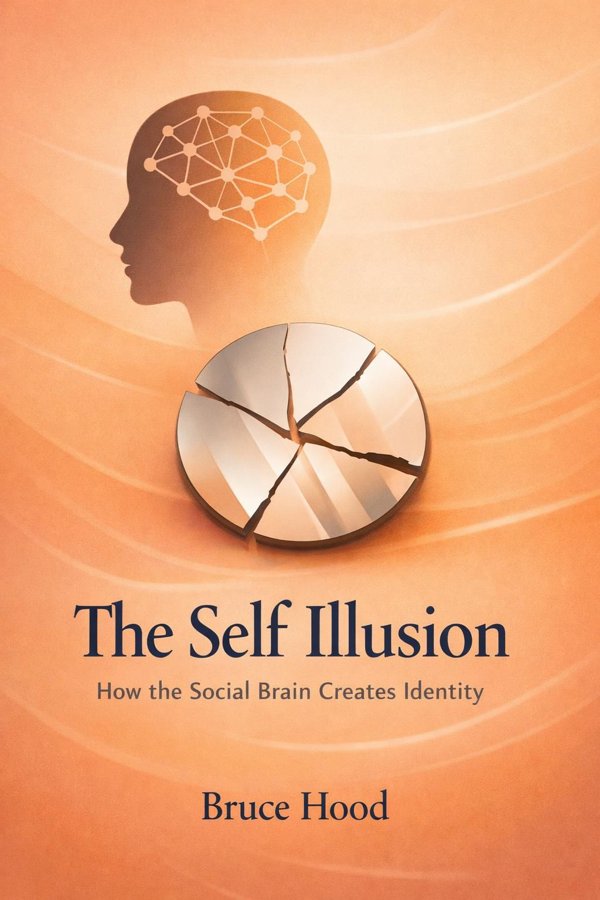
The Self Illusion: How the Social Brain Creates Identity: Summary & Key Insights
by Bruce Hood
 10 min9 chaptersAudio available
Key Takeaways from The Self Illusion: How the Social Brain Creates Identity
One of the book’s most provocative claims is that the self feels real not because it is a single inner entity, but because the brain is designed to create coherence.
We like to imagine that perception is straightforward: the world exists, our senses capture it, and the brain records it.
A powerful way to understand the self is to watch it develop.
Most people treat memory as proof of a stable self.
One of Hood’s central insights is that the self is fundamentally social.
What Is The Self Illusion: How the Social Brain Creates Identity About?
The Self Illusion: How the Social Brain Creates Identity by Bruce Hood is a neuroscience book spanning 11 pages. What if the person you call “me” is not a fixed inner core, but a remarkably persuasive construction? In The Self Illusion, cognitive neuroscientist Bruce Hood challenges one of our deepest assumptions: that somewhere inside us there exists a stable, independent self directing thought and action. Drawing on neuroscience, developmental psychology, philosophy, and behavioral research, Hood argues that identity is not discovered but assembled. The brain continuously interprets sensations, memories, and social feedback to generate the feeling of being a unified person. This idea matters because it reshapes how we think about responsibility, relationships, childhood development, mental health, and even consumer behavior. If the self is flexible rather than permanent, then many of our habits, beliefs, and loyalties become easier to understand—and possibly easier to change. Hood is especially well placed to make this case. As an experimental psychologist known for his work on developmental cognition, belief, and social behavior, he combines scientific rigor with accessible storytelling. The result is a provocative, humane book that does not reduce us to machinery, but instead reveals how deeply our identity depends on the minds of others.
This FizzRead summary covers all 9 key chapters of The Self Illusion: How the Social Brain Creates Identity in approximately 10 minutes, distilling the most important ideas, arguments, and takeaways from Bruce Hood's work. Also available as an audio summary and Key Quotes Podcast.
The Self Illusion: How the Social Brain Creates Identity
What if the person you call “me” is not a fixed inner core, but a remarkably persuasive construction? In The Self Illusion, cognitive neuroscientist Bruce Hood challenges one of our deepest assumptions: that somewhere inside us there exists a stable, independent self directing thought and action. Drawing on neuroscience, developmental psychology, philosophy, and behavioral research, Hood argues that identity is not discovered but assembled. The brain continuously interprets sensations, memories, and social feedback to generate the feeling of being a unified person.
This idea matters because it reshapes how we think about responsibility, relationships, childhood development, mental health, and even consumer behavior. If the self is flexible rather than permanent, then many of our habits, beliefs, and loyalties become easier to understand—and possibly easier to change. Hood is especially well placed to make this case. As an experimental psychologist known for his work on developmental cognition, belief, and social behavior, he combines scientific rigor with accessible storytelling. The result is a provocative, humane book that does not reduce us to machinery, but instead reveals how deeply our identity depends on the minds of others.
Who Should Read The Self Illusion: How the Social Brain Creates Identity?
This book is perfect for anyone interested in neuroscience and looking to gain actionable insights in a short read. Whether you're a student, professional, or lifelong learner, the key ideas from The Self Illusion: How the Social Brain Creates Identity by Bruce Hood will help you think differently.
- ✓Readers who enjoy neuroscience and want practical takeaways
- ✓Professionals looking to apply new ideas to their work and life
- ✓Anyone who wants the core insights of The Self Illusion: How the Social Brain Creates Identity in just 10 minutes
Want the full summary?
Get instant access to this book summary and 100K+ more with Fizz Moment.
Get Free SummaryAvailable on App Store • Free to download
Key Chapters
One of the book’s most provocative claims is that the self feels real not because it is a single inner entity, but because the brain is designed to create coherence. We experience ourselves as unified, continuous, and separate from others, yet this impression is less like discovering a hidden essence and more like receiving a polished final edit of many competing processes. Thoughts, emotions, memories, bodily sensations, habits, and social expectations are all woven together into the story of “you.”
Hood challenges the ancient assumption that identity comes from an unchanging soul, ego, or mental core. Instead, he presents the self as an emergent construction: a practical illusion generated by the brain to organize behavior and navigate the world. This does not mean the self is fake in the trivial sense. It matters immensely. It influences choice, morality, relationships, and long-term planning. But it is not a thing sitting inside the head. It is an experience produced by the brain’s interpretive work.
A practical example appears whenever your mood changes how you see yourself. On one day, you may feel confident and decisive; on another, uncertain and fragmented. The underlying “self” seems to shift because what you call identity is partly assembled from current context. Social roles work the same way: you are not identical at work, with family, or alone, yet you still feel like one person.
The takeaway is to treat identity less as a fixed truth and more as an evolving construction. That mindset makes self-reflection more honest and personal change more possible.
We like to imagine that perception is straightforward: the world exists, our senses capture it, and the brain records it. Hood shows that this is deeply misleading. The brain does not passively receive reality like a camera. It actively predicts, filters, edits, and interprets incoming information. What you consciously experience is a model assembled from limited data, prior expectations, and the brain’s need for speed and coherence.
This matters because the self depends on the same constructive machinery. If your experience of color, motion, sound, and time is already shaped by neural interpretation, then your experience of being “someone” is also a product of construction rather than direct access to truth. Perceptual illusions reveal this vividly. We can see motion that is not there, misjudge size based on surrounding context, or fail to notice dramatic visual changes when attention is elsewhere. The brain prefers a useful story over a complete one.
The same principle operates in everyday life. Consider arguments between friends who recall the same event differently. Each person is not necessarily lying; each brain has built a plausible version from selective attention and emotional emphasis. Or think about first impressions, where a face, tone, or label can alter how we interpret someone’s behavior before we have much evidence.
Recognizing this does not require cynicism. It invites humility. Our convictions often feel immediate and certain because the brain presents its interpretations as reality itself. Hood’s deeper point is that the self emerges within this constructed world, not outside it.
The actionable takeaway is to question the certainty of your immediate experience. Pause before assuming your interpretation of events, other people, or even your own motives is the only valid one.
A powerful way to understand the self is to watch it develop. Hood shows that infants are not born with a fully formed sense of personal identity. Instead, selfhood emerges gradually through bodily awareness, memory, emotional regulation, and interaction with caregivers. The child learns not only that there is a world “out there,” but also that there is a bounded individual here who can act, be seen, and be named.
Early milestones reveal this construction in motion. Mirror recognition, the use of personal pronouns, embarrassment, pretend play, and the ability to remember past experiences all contribute to a more elaborate sense of self. Yet none of these capacities appears all at once. They are assembled over time. Crucially, this development is social. Caregivers respond to expressions, label emotions, reinforce traits, and help children distinguish between their own minds and the minds of others. In this way, identity is not simply generated from within; it is co-authored.
This helps explain why childhood environments matter so deeply. A child consistently treated as capable may internalize confidence; one repeatedly defined as difficult or inadequate may absorb those labels into self-concept. Even family stories—“she’s the brave one,” “he’s the quiet one”—become building blocks of identity. The self develops through repeated feedback loops between the child’s behavior and the social world’s interpretation of it.
For parents, teachers, and mentors, the implication is practical and urgent. The ways adults speak to children do not merely describe them; they help create the identities children grow into.
The takeaway is to use labels carefully and encourage flexible growth-based language. Describe behaviors and efforts, not fixed essences, so developing selves remain open rather than trapped.
Most people treat memory as proof of a stable self. After all, if you can remember your past, doesn’t that show that the same person has persisted through time? Hood turns this assumption inside out. Memory does help create continuity, but it does so imperfectly, selectively, and reconstructively. Rather than storing exact recordings, the brain rebuilds the past each time it is recalled, combining fragments with current beliefs and emotional needs.
This process gives rise to what psychologists often call the narrative self: the sense that your life forms a meaningful story with a central protagonist. That story is essential for planning, moral responsibility, and social identity. But it is also vulnerable to distortion. We misremember what we felt, exaggerate consistency, and edit our history to preserve a coherent self-image. You may recall yourself as always independent, always anxious, or always ambitious, even if the real pattern was more uneven.
Everyday life is full of these subtle rewrites. In relationships, people often reinterpret past conflicts to fit the current state of the bond. In careers, setbacks can later be recast as necessary turning points. Even nostalgia relies on selective remembering. None of this means our memories are worthless. It means memory is less like an archive and more like a storyteller.
Hood’s point is not to dismiss personal history, but to show that identity is maintained through active reconstruction. The self feels continuous because memory keeps stitching moments together, even when the stitching is rough.
The actionable takeaway is to revisit your personal story with curiosity. Journaling, therapy, or conversation can help you see where your narrative is rigid, incomplete, or self-protective—and where a more accurate story could free you.
One of Hood’s central insights is that the self is fundamentally social. We often think identity is private, something that exists deep inside and only later gets expressed outwardly. But much of who we become depends on how others perceive us, respond to us, and signal what counts as acceptable, admirable, or shameful. The social brain evolved not just to detect other minds but to orient the self around them.
From childhood onward, we monitor status, belonging, approval, and exclusion. We compare ourselves with peers, imitate group norms, and internalize cultural values. This process can be subtle. Clothing choices, accents, political loyalties, moral intuitions, and personal ambitions often feel self-generated, yet many have been shaped through social learning. Even the desire to be “different” is frequently a reaction to group expectations.
Modern life amplifies this mechanism. Social media offers continuous feedback about what kinds of selves earn attention and approval. A person may begin by sharing spontaneously and slowly develop an online identity designed around likes, status, or belonging. Workplace culture does something similar by rewarding certain traits and muting others. In both cases, the self adapts to social incentives while preserving the illusion of being fully autonomous.
Hood does not suggest we are helpless puppets. Rather, he shows that autonomy itself develops within relationships. The more aware we are of social shaping, the more freedom we gain to evaluate it.
The takeaway is to audit your influences. Ask which parts of your identity reflect deeply held values and which are inherited from pressure, imitation, or the need to belong. Awareness is the first step toward deliberate self-authorship.
If the self is socially constructed, then understanding other minds is not optional—it is central to identity itself. Hood explores empathy and theory of mind, the human capacities that allow us to infer what others feel, believe, intend, and know. These abilities let us coordinate, teach, deceive, cooperate, comfort, and belong. More importantly, they feed back into self-awareness. We come to know ourselves partly by imagining how we appear to others.
Theory of mind develops gradually in childhood and becomes the foundation for social life. Once children recognize that others can hold beliefs different from their own, the social world grows dramatically more complex. Reputation matters. Embarrassment becomes possible. So does strategic communication. Empathy adds emotional resonance, allowing another person’s distress or joy to affect us internally. The result is a self that is increasingly relational rather than isolated.
This helps explain why loneliness, rejection, or chronic misunderstanding can feel like threats to the self, not just to comfort. When no one seems to “get” us, our own identity can feel unstable. Conversely, being deeply seen by another person often strengthens self-coherence. Teams, friendships, and intimate relationships rely on these reciprocal acts of mind-reading and emotional alignment.
Empathy also has practical value. Leaders who can model perspective-taking build stronger trust. Parents who acknowledge a child’s internal world foster emotional security. In conflict, asking what the other person believes they are protecting can shift the conversation from attack to understanding.
The actionable takeaway is simple: practice perspective-taking deliberately. Before reacting, ask what the other person may be feeling or assuming. Better understanding of others often leads to a wiser, steadier understanding of yourself.
Few ideas are more unsettling than the possibility that conscious choice is not the true origin of our actions. Hood examines research suggesting that many decisions begin in unconscious brain processes before we become aware of choosing. The conscious self may function less as a commander issuing orders and more as a spokesperson explaining what has already begun.
This does not mean human beings are robots with no responsibility. Hood’s point is subtler. The feeling of being in control is often inflated. We regularly claim authorship over thoughts, preferences, and actions that were heavily shaped by automatic processes, environmental cues, habits, and social pressures. Studies on priming, confabulation, and decision timing all suggest that introspection is a poor guide to the true causes of behavior.
Everyday examples are easy to find. You may think you chose a product for rational reasons when packaging, placement, and branding did much of the work. You may believe you formed an opinion independently when repetition and group identity influenced it. In conversation, people often explain their choices confidently even when the real causes remain hidden from awareness.
Yet Hood avoids fatalism. Conscious reflection still matters because it can reshape habits, environments, and future choices. We may not initiate every mental event, but we can build systems that improve behavior: routines, accountability, therapy, meditation, education, and better social structures.
The takeaway is to be less impressed by your immediate sense of control and more intentional about the conditions that guide action. If willpower is limited, then designing supportive environments becomes one of the smartest forms of self-management.
The boundaries of the self do not stop at the skin. Hood argues that people naturally extend identity into possessions, relationships, places, and symbolic objects. We say “my home,” “my team,” “my country,” or “my work” in ways that reveal more than ownership. These external attachments become part of how we experience who we are. Losing them can feel like losing a piece of the self.
This extended self helps explain behaviors that otherwise seem irrational. People fiercely protect personal objects of little market value because those objects carry memory and identity. A wedding ring, childhood book, or inherited watch can feel almost sacred. Brand loyalty works similarly at a commercial level. Consumers often defend products, teams, or lifestyles because these affiliations reinforce a desired identity. Group membership also expands the self. National, religious, and political identities can become so fused with personal identity that criticism of the group feels like a personal attack.
Hood’s analysis sheds light on clutter, grief, tribalism, and status competition. It also explains why transitions—moving house, retirement, divorce, immigration—can be destabilizing. When the external scaffolding of identity changes, the inner sense of self must reorganize. That reorganization can be painful, but it can also be liberating.
Practically, this means we should examine what we have attached ourselves to. Some extensions support growth and belonging; others trap us in defensiveness or superficial self-worth. Minimalism, ritual, and intentional community can all reshape the extended self in healthier ways.
The actionable takeaway is to inventory your identity attachments. Ask which possessions, roles, and group loyalties genuinely enrich your life and which ones you are using to prop up a fragile sense of self.
Perhaps the most hopeful lesson in The Self Illusion is that if the self is constructed, it is also changeable. Hood shows that identity is both fragile and flexible: vulnerable to distortion, injury, and social pressure, but also open to revision, growth, and healing. Neurological disorders, trauma, addiction, and mental illness can all disrupt self-experience, revealing how contingent it really is. At the same time, education, relationships, therapy, and new environments can reshape how we see ourselves.
This flexibility has ethical and social consequences. If people are less like fixed essences and more like dynamic systems, then harsh moral labels become less useful. Instead of asking, “What kind of person is this?” we might ask, “What experiences, contexts, habits, and beliefs are producing this behavior?” That shift does not erase accountability, but it encourages compassion and better intervention. It matters in parenting, criminal justice, education, and public discourse.
On a personal level, a flexible view of self can reduce shame. Someone struggling with anxiety, compulsive behavior, or a painful past often feels trapped by identity: “This is just who I am.” Hood’s framework challenges that fatalism. If the self is an ongoing construction, then no single episode, trait, or label fully defines a person. Change may be difficult, but it is conceptually possible because there is no fixed inner core to protect.
The takeaway is to replace identity-based judgments with process-based thinking. Focus on patterns, contexts, and practices rather than fixed labels. That shift creates more room for growth in yourself and more generosity toward others.
All Chapters in The Self Illusion: How the Social Brain Creates Identity
About the Author
Bruce Hood is a British experimental psychologist and academic best known for his work on developmental psychology, cognitive science, and the origins of belief. He has served as a professor at the University of Bristol, where his research examined how children form concepts of self, agency, ownership, and social understanding. Hood’s work often explores the gap between how the mind feels from the inside and how it actually operates according to scientific evidence. He is especially interested in why humans are drawn to ideas of essence, identity, and supernatural meaning. In his writing, Hood combines rigorous research with an accessible style, making complex questions about consciousness, behavior, and the brain understandable to general readers. The Self Illusion is one of his most influential popular books.
Get This Summary in Your Preferred Format
Read or listen to the The Self Illusion: How the Social Brain Creates Identity summary by Bruce Hood anytime, anywhere. FizzRead offers multiple formats so you can learn on your terms — all free.
Available formats: App · Audio · PDF · EPUB — All included free with FizzRead
Download The Self Illusion: How the Social Brain Creates Identity PDF and EPUB Summary
Key Quotes from The Self Illusion: How the Social Brain Creates Identity
“One of the book’s most provocative claims is that the self feels real not because it is a single inner entity, but because the brain is designed to create coherence.”
“We like to imagine that perception is straightforward: the world exists, our senses capture it, and the brain records it.”
“A powerful way to understand the self is to watch it develop.”
“Most people treat memory as proof of a stable self.”
“One of Hood’s central insights is that the self is fundamentally social.”
Frequently Asked Questions about The Self Illusion: How the Social Brain Creates Identity
The Self Illusion: How the Social Brain Creates Identity by Bruce Hood is a neuroscience book that explores key ideas across 9 chapters. What if the person you call “me” is not a fixed inner core, but a remarkably persuasive construction? In The Self Illusion, cognitive neuroscientist Bruce Hood challenges one of our deepest assumptions: that somewhere inside us there exists a stable, independent self directing thought and action. Drawing on neuroscience, developmental psychology, philosophy, and behavioral research, Hood argues that identity is not discovered but assembled. The brain continuously interprets sensations, memories, and social feedback to generate the feeling of being a unified person. This idea matters because it reshapes how we think about responsibility, relationships, childhood development, mental health, and even consumer behavior. If the self is flexible rather than permanent, then many of our habits, beliefs, and loyalties become easier to understand—and possibly easier to change. Hood is especially well placed to make this case. As an experimental psychologist known for his work on developmental cognition, belief, and social behavior, he combines scientific rigor with accessible storytelling. The result is a provocative, humane book that does not reduce us to machinery, but instead reveals how deeply our identity depends on the minds of others.
You Might Also Like
Anxious
Joseph LeDoux
10 min
Hallucinations
Oliver Sacks
10 min
The Biological Mind: How Brain, Body, and Environment Collaborate to Make Us Who We Are
Alan Jasanoff
10 min
The Feeling of Life Itself: Why Consciousness Is Widespread but Can't Be Computed
Christof Koch
10 min
The No-Nonsense Meditation Book
Steven Laureys
10 min
A General Theory of Love
Thomas Lewis, Fari Amini, Richard Lannon
10 minBrowse by Category
Ready to read The Self Illusion: How the Social Brain Creates Identity?
Get the full summary and 100K+ more books with Fizz Moment.