
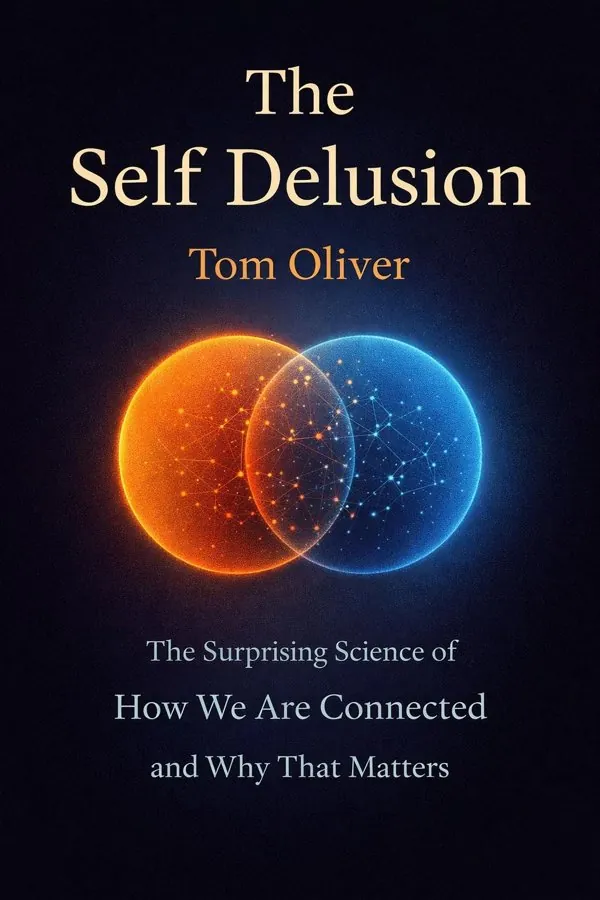
The Self Delusion: The Surprising Science of How We Are Connected and Why That Matters: Summary & Key Insights
by Tom Oliver
 10 min9 chaptersAudio available
What Is The Self Delusion: The Surprising Science of How We Are Connected and Why That Matters About?
The Self Delusion: The Surprising Science of How We Are Connected and Why That Matters by Tom Oliver is a popular_sci book spanning 9 pages. In this thought-provoking work, biologist Tom Oliver challenges the traditional notion of the self as an independent entity. Drawing on research from genetics, neuroscience, and psychology, he argues that our sense of individuality is an illusion—our minds, bodies, and behaviors are deeply interconnected with the world around us. The book explores how this understanding can reshape our approach to society, the environment, and personal well-being.
This FizzRead summary covers all 9 key chapters of The Self Delusion: The Surprising Science of How We Are Connected and Why That Matters in approximately 10 minutes, distilling the most important ideas, arguments, and takeaways from Tom Oliver's work. Also available as an audio summary and Key Quotes Podcast.
The Self Delusion: The Surprising Science of How We Are Connected and Why That Matters
In this thought-provoking work, biologist Tom Oliver challenges the traditional notion of the self as an independent entity. Drawing on research from genetics, neuroscience, and psychology, he argues that our sense of individuality is an illusion—our minds, bodies, and behaviors are deeply interconnected with the world around us. The book explores how this understanding can reshape our approach to society, the environment, and personal well-being.
Who Should Read The Self Delusion: The Surprising Science of How We Are Connected and Why That Matters?
This book is perfect for anyone interested in popular_sci and looking to gain actionable insights in a short read. Whether you're a student, professional, or lifelong learner, the key ideas from The Self Delusion: The Surprising Science of How We Are Connected and Why That Matters by Tom Oliver will help you think differently.
- ✓Readers who enjoy popular_sci and want practical takeaways
- ✓Professionals looking to apply new ideas to their work and life
- ✓Anyone who wants the core insights of The Self Delusion: The Surprising Science of How We Are Connected and Why That Matters in just 10 minutes
Want the full summary?
Get instant access to this book summary and 100K+ more with Fizz Moment.
Get Free SummaryAvailable on App Store • Free to download
Key Chapters
As a biologist, I start where our sense of separation falters most obviously: in the fabric of life. Every human body is less an individual and more an ecosystem. Half of the cells within us do not carry human DNA but belong to bacteria, fungi, and archaea. These organisms digest our food, train our immune systems, and influence our moods. The human genome, too, is not purely human; vast portions are remnants of ancient viral insertions. Evolution itself is a story of cooperation as much as competition. Genes, species, and ecosystems only survive through interconnection.
If you look at your hand, you might think you’re seeing something purely yours. Yet every cell in that hand owes its energy to photosynthesis performed by distant plants. The oxygen you breathe was exhaled by forests and oceans; the nutrients in your food were cycled through countless other organisms. In essence, biology reveals a humbling truth: we are not independent life forms but participants in a vast web of exchange. Once we perceive this, the border between self and environment becomes porous, both physically and conceptually.
This understanding reshapes how we approach health and sustainability. We cannot speak of individual well-being without acknowledging environmental well-being. When ecosystems degrade, so does the biological basis of our existence. To care for oneself, therefore, is to care for the living networks that sustain us.
Turning to the brain, the supposed seat of the self, we find more evidence that individuality is a construction. Neuroscience tells us there is no single location where ‘you’ reside. Our sense of continuity—the feeling of being a consistent subject—is produced by distributed processes spread across hemispheres and brain regions. The self is not a nucleus but an emergent pattern of activity, continuously rebuilt moment by moment.
Consider the split-brain experiments, where severing the corpus callosum leads to two centers of consciousness within one skull. Or the way damage to particular regions can alter identity, memory, or emotion. These findings force us to confront that the ‘I’ we experience is a story the brain tells to unify disparate processes. It’s a useful story—evolutionarily speaking—but it’s not reality.
This illusion of a central self also serves survival. Cohesion allows us to coordinate actions and motives. But it also deceives us into overestimating control. The more we learn about unconscious processing, the more we see that decisions are often made before we are aware of them. Recognizing this doesn’t strip meaning from life; rather, it brings compassion. When we understand that thoughts and behaviors arise from a network of influences beyond conscious intention, we cultivate humility and empathy—for ourselves and others.
+ 7 more chapters — available in the FizzRead app
All Chapters in The Self Delusion: The Surprising Science of How We Are Connected and Why That Matters
About the Author
Tom Oliver is a British biologist and professor of ecology at the University of Reading. His research focuses on biodiversity, ecosystems, and the interconnections between humans and nature. He is also a science communicator and advisor on environmental policy.
Get This Summary in Your Preferred Format
Read or listen to the The Self Delusion: The Surprising Science of How We Are Connected and Why That Matters summary by Tom Oliver anytime, anywhere. FizzRead offers multiple formats so you can learn on your terms — all free.
Available formats: App · Audio · PDF · EPUB — All included free with FizzRead
Download The Self Delusion: The Surprising Science of How We Are Connected and Why That Matters PDF and EPUB Summary
Key Quotes from The Self Delusion: The Surprising Science of How We Are Connected and Why That Matters
“As a biologist, I start where our sense of separation falters most obviously: in the fabric of life.”
“Turning to the brain, the supposed seat of the self, we find more evidence that individuality is a construction.”
Frequently Asked Questions about The Self Delusion: The Surprising Science of How We Are Connected and Why That Matters
The Self Delusion: The Surprising Science of How We Are Connected and Why That Matters by Tom Oliver is a popular_sci book that explores key ideas across 9 chapters. In this thought-provoking work, biologist Tom Oliver challenges the traditional notion of the self as an independent entity. Drawing on research from genetics, neuroscience, and psychology, he argues that our sense of individuality is an illusion—our minds, bodies, and behaviors are deeply interconnected with the world around us. The book explores how this understanding can reshape our approach to society, the environment, and personal well-being.
You Might Also Like

Structures: Or Why Things Don"t Fall Down
J.E. Gordon
10 min
The Road to Wigan Pier
George Orwell
10 min
Bonk: The Curious Coupling of Science and Sex
Mary Roach
10 min
First Bite: How We Learn to Eat
Bee Wilson
10 min
In Pursuit Of The Unknown: 17 Equations That Changed The World
Ian Stewart
10 min
Napoleon's Buttons: 17 Molecules That Changed History
Penny Le Couteur and Jay Burreson
10 minBrowse by Category
Ready to read The Self Delusion: The Surprising Science of How We Are Connected and Why That Matters?
Get the full summary and 100K+ more books with Fizz Moment.