
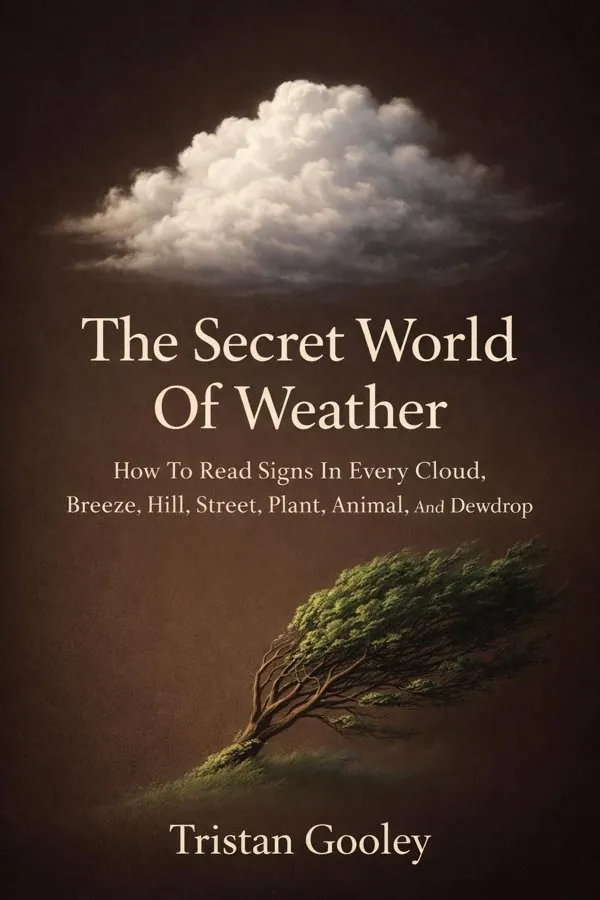
The Secret World Of Weather: How To Read Signs In Every Cloud, Breeze, Hill, Street, Plant, Animal, And Dewdrop: Summary & Key Insights
 10 min10 chaptersAudio available
Key Takeaways from The Secret World Of Weather: How To Read Signs In Every Cloud, Breeze, Hill, Street, Plant, Animal, And Dewdrop
Weather is never just something that arrives from above; it becomes something new the moment it meets the land.
The sky is never blank; it is always saying something.
Wind feels simple when reduced to speed and direction, but Gooley shows that it is far more expressive than a weather report suggests.
Some of the most useful weather clues appear while the world seems still.
Plants do not forecast in the human sense, but they respond so sensitively to moisture, temperature, light, and wind that they can act like distributed environmental sensors.
What Is The Secret World Of Weather: How To Read Signs In Every Cloud, Breeze, Hill, Street, Plant, Animal, And Dewdrop About?
The Secret World Of Weather: How To Read Signs In Every Cloud, Breeze, Hill, Street, Plant, Animal, And Dewdrop by Tristan Gooley is a popular_sci book spanning 10 pages. Most of us experience weather as a headline, an app notification, or a number on a screen. Tristan Gooley argues that this is only the thinnest version of what weather really is. In The Secret World Of Weather, he shows that the atmosphere is constantly leaving clues in plain sight: in the shape of clouds, the direction of ripples on water, the moisture on grass at dawn, the behavior of birds, and even the way streets and buildings bend the wind. This is not mystical guesswork, but a practical art grounded in close observation, pattern recognition, and the science of how air, land, water, heat, and life interact. Gooley is uniquely qualified to teach this skill. Known for his work on natural navigation, he has spent years exploring landscapes and learning how subtle environmental signs reveal hidden information. Here, he turns that same disciplined attention toward weather. The result is a book that blends meteorology, folklore, and fieldcraft into an accessible guide for anyone who wants to understand the world more deeply. It matters because it restores a human ability many people have outsourced: noticing what the sky and earth are already telling us.
This FizzRead summary covers all 10 key chapters of The Secret World Of Weather: How To Read Signs In Every Cloud, Breeze, Hill, Street, Plant, Animal, And Dewdrop in approximately 10 minutes, distilling the most important ideas, arguments, and takeaways from Tristan Gooley's work. Also available as an audio summary and Key Quotes Podcast.
The Secret World Of Weather: How To Read Signs In Every Cloud, Breeze, Hill, Street, Plant, Animal, And Dewdrop
Most of us experience weather as a headline, an app notification, or a number on a screen. Tristan Gooley argues that this is only the thinnest version of what weather really is. In The Secret World Of Weather, he shows that the atmosphere is constantly leaving clues in plain sight: in the shape of clouds, the direction of ripples on water, the moisture on grass at dawn, the behavior of birds, and even the way streets and buildings bend the wind. This is not mystical guesswork, but a practical art grounded in close observation, pattern recognition, and the science of how air, land, water, heat, and life interact.
Gooley is uniquely qualified to teach this skill. Known for his work on natural navigation, he has spent years exploring landscapes and learning how subtle environmental signs reveal hidden information. Here, he turns that same disciplined attention toward weather. The result is a book that blends meteorology, folklore, and fieldcraft into an accessible guide for anyone who wants to understand the world more deeply. It matters because it restores a human ability many people have outsourced: noticing what the sky and earth are already telling us.
Who Should Read The Secret World Of Weather: How To Read Signs In Every Cloud, Breeze, Hill, Street, Plant, Animal, And Dewdrop?
This book is perfect for anyone interested in popular_sci and looking to gain actionable insights in a short read. Whether you're a student, professional, or lifelong learner, the key ideas from The Secret World Of Weather: How To Read Signs In Every Cloud, Breeze, Hill, Street, Plant, Animal, And Dewdrop by Tristan Gooley will help you think differently.
- ✓Readers who enjoy popular_sci and want practical takeaways
- ✓Professionals looking to apply new ideas to their work and life
- ✓Anyone who wants the core insights of The Secret World Of Weather: How To Read Signs In Every Cloud, Breeze, Hill, Street, Plant, Animal, And Dewdrop in just 10 minutes
Want the full summary?
Get instant access to this book summary and 100K+ more with Fizz Moment.
Get Free SummaryAvailable on App Store • Free to download
Key Chapters
Weather is never just something that arrives from above; it becomes something new the moment it meets the land. One of Gooley’s most important insights is that every landscape reshapes the atmosphere and creates a local style of weather. A hill can force air upward, cooling it and helping clouds form. A valley can trap cold air overnight and produce frost in one field while a nearby slope stays clear. A south-facing bank may warm quickly in sunlight, while a shaded hollow remains damp and chilled far longer.
This means that broad regional forecasts are only the beginning. To truly understand what weather will feel like where you are standing, you need to study terrain. In hilly country, windward slopes often receive more moisture, while leeward sides can be drier and calmer. Valleys may funnel wind, making a moderate breeze feel stronger and more directional. Cold air, being heavier, often drains downhill after sunset like invisible water, pooling in low spots. That is why mist, frost, and dew frequently collect there first.
Gooley encourages readers to think of landscapes as weather machines. Notice where fog lingers, where snow melts last, where grass dries fastest after rain, and where trees lean from prevailing winds. These clues reveal repeated patterns, not random events. Farmers, walkers, gardeners, and runners can all use this knowledge. If you know which corner of a field is frost-prone or which ridge catches the strongest gusts, you begin to anticipate conditions rather than merely react to them.
Actionable takeaway: Choose one familiar local area and map its warm spots, cold pockets, windy corridors, and damp hollows over several weeks. You will start seeing its unique weather personality emerge.
The sky is never blank; it is always saying something. Gooley treats clouds as one of the richest and most readable weather texts available to anyone willing to look up carefully. Clouds reveal the movement of moisture, air stability, temperature changes, and the likelihood of approaching fronts. The trick is not memorizing obscure Latin names for their own sake, but learning what shape, height, texture, and motion suggest about what the atmosphere is doing.
High, thin, feathery clouds often indicate moisture arriving far above, sometimes ahead of a weather system. Tall, towering clouds signal rising unstable air and may point toward showers or thunderstorms. Flat gray layers can mean settled moisture and long, dull periods of overcast sky. Broken fair-weather cumulus may tell a story of daytime heating and modest upward movement, especially if they fade in the evening. The edges matter too: sharply defined puffy clouds can suggest active vertical development, while diffuse layers may signal a more stable atmosphere.
Gooley’s broader point is that cloud-reading becomes powerful when combined with change over time. A single cloud can mislead, but a progression from high wisps to thicker cover can hint that rain is drawing closer. Watching the speed and direction of clouds at different levels can also reveal shifts in wind aloft. Even color matters: brilliant white sunlit tops and dark undersides often suggest depth and moisture.
For everyday use, this skill helps with simple decisions: whether to bring waterproofs, when to leave for a walk, whether an evening event may stay dry, or whether a calm morning might become stormy later. The more often you compare what you saw with what later happened, the sharper your judgment becomes.
Actionable takeaway: Spend five minutes each day observing clouds at morning, midday, and evening, then compare your notes with the actual weather that follows.
Wind feels simple when reduced to speed and direction, but Gooley shows that it is far more expressive than a weather report suggests. Wind interacts with hills, trees, buildings, coastlines, and temperature differences, creating patterns that reveal what the wider atmosphere is doing. To read wind well, you must notice not only how strong it is, but how steady, gusty, warm, cool, moist, drying, rising, sinking, blocked, and redirected it feels.
A breeze on open ground can become turbulent near a woodland edge. Streets can channel airflow into strong corridors, while courtyards may remain oddly still. On coasts, daytime heating can draw sea breezes inland, while nighttime cooling can reverse the pattern. In mountains and valleys, the wind may shift with the daily cycle of heating and cooling. Even a slight change in direction can matter: a wind arriving across water may carry more moisture and softness, while one coming from dry land may feel sharper and clearer.
Gooley also highlights indirect signs. Leaves turning their pale undersides can signal strengthening gusts. Smoke, steam, seeds, grasses, and spider silk can all reveal fine structure in air movement that your skin alone might miss. The sound of wind is informative too. A distant roar in treetops may mean stronger air above ground level. Intermittent gusts can imply unstable mixing, while smooth steady movement may suggest a more uniform airflow.
This awareness has practical value for walkers, sailors, cyclists, photographers, and anyone planning time outdoors. By noticing how local features distort wind, you can find shelter, predict exposed stretches, and understand why one side of a hill feels entirely different from the other.
Actionable takeaway: On your next walk, track the wind every few minutes using your face, nearby vegetation, and loose particles like grass or dust, and note how terrain changes its behavior.
Some of the most useful weather clues appear while the world seems still. Dew and frost are not just pretty morning details; they are records of what happened overnight. Gooley uses them to teach a deeper truth: nighttime weather is shaped by radiation, humidity, cloud cover, surface type, and the movement of cold air close to the ground. If you can interpret dew and frost, you can reconstruct the night and improve your sense of what the next hours may bring.
Dew forms when surfaces cool enough for moisture in the air to condense. Frost forms when that cooling drops below freezing. The presence, absence, and uneven distribution of dew or frost can be highly revealing. Heavy dew often points to a clear, calm night in which surfaces lost heat efficiently to the sky. A lack of dew may suggest cloud cover, stronger wind, or drier air. Frost in hollows but not on slopes tells you where cold air pooled. Dew on one surface but not another can show which materials lose heat faster.
Gooley asks readers to observe not only whether dew exists, but where and when. Grass may dew up before stone. Car roofs may frost while sheltered ground remains wet. Bridges and exposed surfaces can cool differently from surrounding land. These subtleties teach us that the air near the ground is not uniform. It shifts by meters, not just miles.
This matters for practical reasons. Gardeners can protect vulnerable plants by learning which spots frost first. Campers can choose less damp sleeping areas. Morning walkers can infer whether fog is likely to linger. Dew can even hint at whether a settled high-pressure pattern remains in charge.
Actionable takeaway: At dawn, compare dew or frost across grass, soil, stone, cars, and shaded versus open ground to identify how your local landscape handles overnight cooling.
Plants do not forecast in the human sense, but they respond so sensitively to moisture, temperature, light, and wind that they can act like distributed environmental sensors. Gooley shows that if you watch vegetation closely, you begin to see weather written into posture, scent, texture, and timing. Trees, grasses, flowers, and leaves all carry information about both current conditions and repeated patterns over time.
Some plants open and close with humidity or light changes. Leaves may curl in dry conditions or become more supple in damp air. Strong prevailing winds can sculpt trees into asymmetric forms, permanently recording dominant airflow. Moss can mark persistently damp and shaded zones. The timing of budburst, flowering, or scent release can also align with shifts in temperature and moisture. Even the feel of the ground under plant cover can tell a story about evaporation and retained humidity.
Gooley’s larger argument is that plants reveal both immediate weather and local climate tendencies. A line of wind-pruned shrubs exposes an exposed corridor. Lush growth in one dip and sparse vegetation nearby may indicate a hidden moisture gradient. Before rain, some people notice stronger floral or earthy scents as humidity changes the way smells travel. Wet leaves reflect light differently, while dry leaves rustle in distinct ways. All of this can sharpen your weather sense if you slow down enough to compare one place with another.
This perspective is especially useful for gardeners, hikers, and nature observers. It also deepens respect for how living organisms negotiate the atmosphere continuously. Plants are not background scenery; they are active participants in the weather story.
Actionable takeaway: Pick three common local plants and observe how their shape, smell, movement, and moisture change across sunny, windy, damp, and calm days.
Animals often seem to know that weather is changing before people do, but Gooley treats this idea with balanced curiosity rather than superstition. He does not claim that every restless bird predicts rain or every low-flying swallow guarantees a storm. Instead, he explains that animals are deeply tuned to pressure changes, humidity, thermal currents, light levels, food availability, and shifts in air movement. Their behavior can therefore provide meaningful clues when interpreted carefully and in context.
Birds may alter their flight height when insect behavior changes in response to humidity and pressure. Livestock may seek shelter before harsh conditions arrive, not because they possess magic, but because they are highly sensitive to discomfort, wind direction, and subtle environmental cues. Insects can become more active or less visible depending on temperature and moisture. Spiders, bees, and seabirds all respond to conditions in ways that can be observed. Frogs may call differently, and coastal animals may react to incoming systems long before rain reaches land.
The key is not to rely on a single creature or folk saying in isolation. Gooley encourages pattern-based interpretation. If birds quiet down, insects shift lower, the wind changes character, and cloud cover thickens, the combined signal becomes more convincing. This is a practical method: use animal behavior as one strand in a wider braid of evidence.
For readers who spend time outdoors, this can be surprisingly useful. Anglers may notice fish behavior linked to pressure changes. Walkers can observe swifts and swallows, whose feeding height often mirrors insect height. Gardeners can track pollinator activity as a sign of changing conditions.
Actionable takeaway: Choose one common local animal group, such as birds or insects, and note how its behavior changes alongside wind, cloud, and humidity over several weeks.
Water is one of nature’s best translators of invisible forces. Gooley shows that ponds, lakes, rivers, puddles, and shorelines all reveal wind patterns, temperature contrasts, and subtle shifts in weather. Even a small surface of water can act like a screen on which the atmosphere projects its movements. To read water well, look for ripples, texture, reflected light, wave direction, sheltered patches, and the contrast between one section and another.
A calm patch beside a rippled one can reveal shelter created by banks, reeds, walls, or hedges. Long, even ripples may suggest a steady wind, while chaotic surface texture points to turbulence. On larger bodies of water, you may see gusts arrive as darkened streaks before they reach you. Reflections become crisper in still, stable conditions and break apart when air roughens the surface. Mist over water in the morning can indicate temperature differences between water and air, while steam-like effects may reveal cold air moving over relatively warmer water.
Gooley also uses water to teach local forecasting. If a breeze begins to travel up a valley lake at a regular time each sunny day, that pattern can help you anticipate later conditions. Coastal observers can learn from changing wave faces, foam lines, and sea-breeze timing. Even urban puddles can indicate subtle air movement around corners and through alleyways.
This way of seeing turns ordinary scenes into practical information. Paddlers can judge exposure, photographers can predict better reflections, and walkers can identify sheltered routes. More broadly, water teaches sensitivity to gradients and boundaries: where wind begins, where it is interrupted, and how local weather is rarely uniform.
Actionable takeaway: Next time you pass any body of water, pause to compare its different zones and ask what each texture reveals about wind, shelter, and temperature.
Many people assume nature-based weather reading belongs only in wild landscapes, but Gooley insists that cities are full of readable atmospheric clues. Urban areas generate their own microclimates through concrete, glass, brick, traffic, shade, trapped heat, drainage patterns, and wind tunnels. In some ways, cities make weather easier to study because the contrasts are so sharp. A sunny wall can radiate warmth long after sunset, while a narrow shaded lane stays damp and cool. Rooftops, courtyards, parks, and streets can each host noticeably different conditions within a short walk.
Buildings deflect and accelerate wind in surprising ways. One corner may be nearly calm while the next blasts air downward from higher structures. Dark surfaces absorb heat and contribute to warmer nighttime conditions, producing the urban heat island effect. Paved ground sheds water differently from soil, affecting evaporation and humidity. Street orientation influences sun exposure and therefore temperature. Trees in parks can soften extremes, create moisture pockets, and slow air movement compared with surrounding roads.
Gooley’s urban lesson is empowering: you do not need remote wilderness to sharpen observation. Watch litter move in eddies, notice where puddles evaporate first, compare the feel of air near stone and greenery, and pay attention to where frost appears late or not at all. Cities become outdoor laboratories for learning how materials and geometry shape weather.
This is practical for commuters, runners, cyclists, and anyone planning daily movement. Knowing which route is windier, icier, or hotter can improve comfort and safety. It also reconnects urban life with environmental awareness, reminding us that weather is never absent, only masked by habit.
Actionable takeaway: On a regular route through town, identify one warm spot, one wind tunnel, one moisture trap, and one unusually sheltered place, and revisit them in different conditions.
Traditional weather sayings are often dismissed as quaint or unreliable, yet Gooley approaches them with respect and discipline. His view is not that folklore should replace science, but that many old sayings emerged from generations of careful observation. Some are vague or false, but others encode genuine environmental patterns. The real value comes from testing them against direct experience and modern understanding.
A saying about a red sky, low-flying birds, halo around the moon, or morning mist may contain a kernel of atmospheric truth. For example, a halo can reflect ice crystals in high cloud, sometimes associated with an approaching front. A red sky can relate to light scattering and the position of weather systems relative to the observer. But Gooley stresses context. A proverb is not a universal law. Geography, season, and local conditions all matter.
This chapter’s deeper contribution is methodological. It trains readers to become discriminating observers rather than passive believers or cynical rejecters. Instead of asking whether folklore is “true” in the abstract, ask when it works, why it works, and what additional signs should confirm it. This is how practical natural knowledge develops: observation, comparison, correction, repetition.
Such an approach is valuable beyond weather. It teaches intellectual humility and curiosity. You can respect inherited wisdom without romanticizing it, and embrace science without becoming detached from lived experience. Gooley bridges these worlds elegantly, showing that attentive people in every era have tried to read the same atmosphere.
Actionable takeaway: Pick one weather proverb you know and test it over the next month, recording when it seems accurate, when it fails, and what other signs were present.
Perhaps the book’s most encouraging message is that weather awareness is not a rare gift but a skill that anyone can build. Gooley argues that modern people often assume expertise belongs only to professional meteorologists with instruments and models. Those tools are valuable, but they do not eliminate the usefulness of firsthand observation. Weather sense grows from repeated attention, memory, and feedback. The atmosphere leaves clues constantly; the challenge is learning to notice them and connect them.
This training begins with slowing down. Instead of stepping outside and merely registering hot or cold, ask more precise questions. Where is the wind coming from? Is the air dry, damp, sharp, heavy, or unstable? Are clouds changing type or altitude? Is dew present? How are birds behaving? What does the ground feel like under trees versus in open sun? By asking similar questions repeatedly, you build a library of patterns. Over time, you become better at matching present signs with likely short-term outcomes.
Gooley emphasizes that mistakes are part of the process. False predictions are not failures if they sharpen your understanding of which clues matter most. The goal is not perfect forecasting but richer contact with reality. This mindset also changes outdoor experience. Walks become investigations, familiar places reveal new layers, and weather stops being background noise.
The skill is widely useful: for planning exercise, gardening, photography, hiking, travel, or simply paying fuller attention to the day. More than that, it restores confidence in embodied knowledge. You can know something meaningful about weather before checking a screen.
Actionable takeaway: Start a simple weather journal with three daily entries: what you observed, what you predicted, and what actually happened. Review it weekly to sharpen your pattern recognition.
All Chapters in The Secret World Of Weather: How To Read Signs In Every Cloud, Breeze, Hill, Street, Plant, Animal, And Dewdrop
About the Author
Tristan Gooley is a British explorer, natural navigator, and bestselling author known for teaching readers how to interpret the signs of the natural world. He has traveled widely and led expeditions across multiple continents, building a reputation for turning close observation into practical knowledge. Gooley is the founder of Natural Navigator, an organization dedicated to sharing skills such as reading landscapes, weather, plants, and other environmental clues without overreliance on technology. His books combine field experience, scientific explanation, and an engaging curiosity about how humans can reconnect with overlooked abilities. In The Secret World Of Weather, he brings that distinctive approach to everyday meteorology, showing how subtle details in clouds, terrain, animals, and urban spaces can help anyone develop a sharper sense of place and atmosphere.
Get This Summary in Your Preferred Format
Read or listen to the The Secret World Of Weather: How To Read Signs In Every Cloud, Breeze, Hill, Street, Plant, Animal, And Dewdrop summary by Tristan Gooley anytime, anywhere. FizzRead offers multiple formats so you can learn on your terms — all free.
Available formats: App · Audio · PDF · EPUB — All included free with FizzRead
Download The Secret World Of Weather: How To Read Signs In Every Cloud, Breeze, Hill, Street, Plant, Animal, And Dewdrop PDF and EPUB Summary
Key Quotes from The Secret World Of Weather: How To Read Signs In Every Cloud, Breeze, Hill, Street, Plant, Animal, And Dewdrop
“Weather is never just something that arrives from above; it becomes something new the moment it meets the land.”
“The sky is never blank; it is always saying something.”
“Wind feels simple when reduced to speed and direction, but Gooley shows that it is far more expressive than a weather report suggests.”
“Some of the most useful weather clues appear while the world seems still.”
“Plants do not forecast in the human sense, but they respond so sensitively to moisture, temperature, light, and wind that they can act like distributed environmental sensors.”
Frequently Asked Questions about The Secret World Of Weather: How To Read Signs In Every Cloud, Breeze, Hill, Street, Plant, Animal, And Dewdrop
The Secret World Of Weather: How To Read Signs In Every Cloud, Breeze, Hill, Street, Plant, Animal, And Dewdrop by Tristan Gooley is a popular_sci book that explores key ideas across 10 chapters. Most of us experience weather as a headline, an app notification, or a number on a screen. Tristan Gooley argues that this is only the thinnest version of what weather really is. In The Secret World Of Weather, he shows that the atmosphere is constantly leaving clues in plain sight: in the shape of clouds, the direction of ripples on water, the moisture on grass at dawn, the behavior of birds, and even the way streets and buildings bend the wind. This is not mystical guesswork, but a practical art grounded in close observation, pattern recognition, and the science of how air, land, water, heat, and life interact. Gooley is uniquely qualified to teach this skill. Known for his work on natural navigation, he has spent years exploring landscapes and learning how subtle environmental signs reveal hidden information. Here, he turns that same disciplined attention toward weather. The result is a book that blends meteorology, folklore, and fieldcraft into an accessible guide for anyone who wants to understand the world more deeply. It matters because it restores a human ability many people have outsourced: noticing what the sky and earth are already telling us.
You Might Also Like

Structures: Or Why Things Don"t Fall Down
J.E. Gordon
10 min
The Road to Wigan Pier
George Orwell
10 min
Bonk: The Curious Coupling of Science and Sex
Mary Roach
10 min
First Bite: How We Learn to Eat
Bee Wilson
10 min
In Pursuit Of The Unknown: 17 Equations That Changed The World
Ian Stewart
10 min
Napoleon's Buttons: 17 Molecules That Changed History
Penny Le Couteur and Jay Burreson
10 minBrowse by Category
Ready to read The Secret World Of Weather: How To Read Signs In Every Cloud, Breeze, Hill, Street, Plant, Animal, And Dewdrop?
Get the full summary and 100K+ more books with Fizz Moment.