
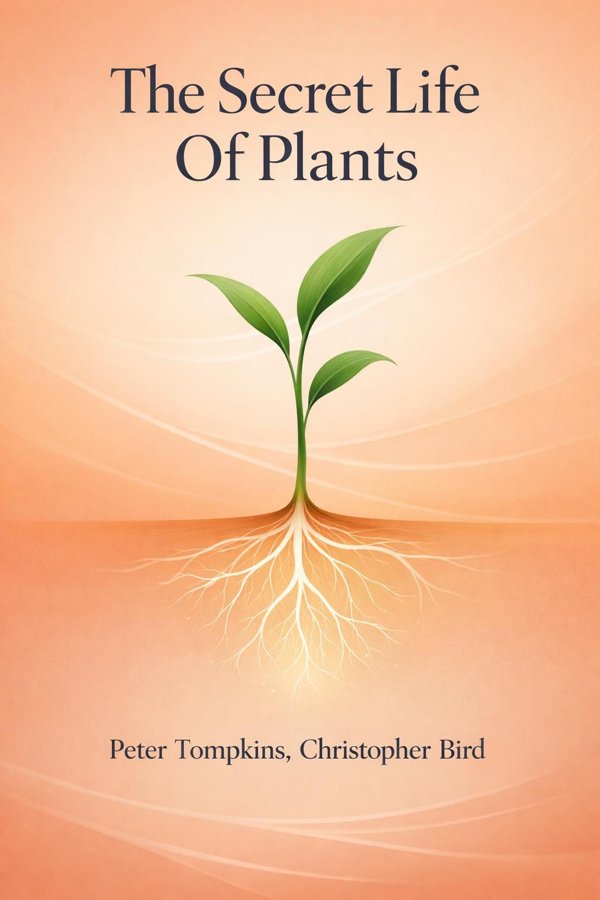
The Secret Life Of Plants: A Fascinating Account of the Physical, Emotional, and Spiritual Relations Between Plants and Man: Summary & Key Insights
by Peter Tompkins, Christopher Bird
 10 min9 chaptersAudio available
Key Takeaways from The Secret Life Of Plants: A Fascinating Account of the Physical, Emotional, and Spiritual Relations Between Plants and Man
Long before modern instruments tried to measure life, many cultures assumed plants were responsive beings rather than passive objects.
Scientific revolutions often begin when someone takes seriously what others dismiss.
Some ideas endure not because they are settled, but because they are impossible to forget.
Silence in nature is often just complexity we have not learned to hear.
We do not merely use plants; we live through them.
What Is The Secret Life Of Plants: A Fascinating Account of the Physical, Emotional, and Spiritual Relations Between Plants and Man About?
The Secret Life Of Plants: A Fascinating Account of the Physical, Emotional, and Spiritual Relations Between Plants and Man by Peter Tompkins, Christopher Bird is a popular_sci book spanning 8 pages. What if the plants around you are doing far more than growing, blooming, and photosynthesizing? In The Secret Life Of Plants, Peter Tompkins and Christopher Bird explore the startling idea that plants may sense, respond, communicate, and perhaps even participate in a deeper web of awareness that includes human beings. Blending scientific experiments, historical case studies, folklore, and spiritual traditions, the book challenges the strict boundary modern culture often places between human consciousness and the rest of nature. This is not a conventional botany text. It is an adventurous, provocative inquiry into whether plants possess forms of sensitivity that science has only partially understood. The authors examine early plant physiology research, controversial experiments involving lie detectors and intention, and broader ideas about ecology, agriculture, energy, and healing. Some claims remain disputed, but the book’s enduring value lies in the questions it dares to ask. Tompkins and Bird bring journalistic curiosity and wide-ranging research to a topic that continues to fascinate readers interested in science, nature, consciousness, and the hidden relationships that connect all living things.
This FizzRead summary covers all 9 key chapters of The Secret Life Of Plants: A Fascinating Account of the Physical, Emotional, and Spiritual Relations Between Plants and Man in approximately 10 minutes, distilling the most important ideas, arguments, and takeaways from Peter Tompkins, Christopher Bird's work. Also available as an audio summary and Key Quotes Podcast.
The Secret Life Of Plants: A Fascinating Account of the Physical, Emotional, and Spiritual Relations Between Plants and Man
What if the plants around you are doing far more than growing, blooming, and photosynthesizing? In The Secret Life Of Plants, Peter Tompkins and Christopher Bird explore the startling idea that plants may sense, respond, communicate, and perhaps even participate in a deeper web of awareness that includes human beings. Blending scientific experiments, historical case studies, folklore, and spiritual traditions, the book challenges the strict boundary modern culture often places between human consciousness and the rest of nature.
This is not a conventional botany text. It is an adventurous, provocative inquiry into whether plants possess forms of sensitivity that science has only partially understood. The authors examine early plant physiology research, controversial experiments involving lie detectors and intention, and broader ideas about ecology, agriculture, energy, and healing. Some claims remain disputed, but the book’s enduring value lies in the questions it dares to ask.
Tompkins and Bird bring journalistic curiosity and wide-ranging research to a topic that continues to fascinate readers interested in science, nature, consciousness, and the hidden relationships that connect all living things.
Who Should Read The Secret Life Of Plants: A Fascinating Account of the Physical, Emotional, and Spiritual Relations Between Plants and Man?
This book is perfect for anyone interested in popular_sci and looking to gain actionable insights in a short read. Whether you're a student, professional, or lifelong learner, the key ideas from The Secret Life Of Plants: A Fascinating Account of the Physical, Emotional, and Spiritual Relations Between Plants and Man by Peter Tompkins, Christopher Bird will help you think differently.
- ✓Readers who enjoy popular_sci and want practical takeaways
- ✓Professionals looking to apply new ideas to their work and life
- ✓Anyone who wants the core insights of The Secret Life Of Plants: A Fascinating Account of the Physical, Emotional, and Spiritual Relations Between Plants and Man in just 10 minutes
Want the full summary?
Get instant access to this book summary and 100K+ more with Fizz Moment.
Get Free SummaryAvailable on App Store • Free to download
Key Chapters
Long before modern instruments tried to measure life, many cultures assumed plants were responsive beings rather than passive objects. Ancient traditions in India, Greece, indigenous societies, and folk medicine often treated trees, herbs, and crops as living presences worthy of respect, ritual, and even conversation. This older worldview did not divide matter and spirit as sharply as modern industrial thinking often does. Instead, it assumed that life exists on a spectrum and that humans participate in a shared field with animals, plants, weather, and soil.
Tompkins and Bird use these traditions to suggest that humanity once possessed an instinctive understanding of plant vitality. Sacred groves, agricultural ceremonies, and plant-based healing systems reflected the belief that plants respond to care, intention, and environment in ways deeper than simple chemistry. Whether or not every traditional claim is scientifically testable, these practices reveal an important truth: people historically built relationships with plants, not just systems for exploiting them.
This matters because the book is not only making a scientific argument; it is challenging a cultural assumption. If plants are living participants in the world rather than green machinery, then agriculture, gardening, medicine, and daily life all acquire ethical and emotional dimensions.
A practical application is simple: notice how differently you behave when you treat a houseplant, garden bed, or tree as a living companion rather than décor or raw material. You may water more carefully, observe more attentively, and become more sensitive to subtle changes in growth and health.
Actionable takeaway: begin a week-long practice of closely observing one plant each day and record what changes when you approach it with curiosity instead of indifference.
Scientific revolutions often begin when someone takes seriously what others dismiss. One of the book’s strongest historical threads concerns early researchers who found that plants do not merely react mechanically but display complex responses to touch, heat, sound, chemicals, injury, and changing environments. Chief among them is Jagadish Chandra Bose, whose pioneering experiments showed that plants produce measurable electrical responses and physiological changes when stimulated.
Bose designed highly sensitive instruments to detect minute plant movements and reactions, arguing that the distinction between animal and plant life was narrower than commonly believed. His work suggested continuity in living processes: plants tire, recover, respond to shocks, and exhibit patterns resembling nervous activity, even if they lack nerves in the animal sense. The book presents Bose as a crucial figure because he translated intuitive ideas about plant sensitivity into experimental form.
The broader implication is that plants may process their environment dynamically rather than passively. Modern readers do not need to accept every extrapolation in the book to appreciate this shift. Even contemporary plant biology recognizes signaling systems, electrical activity, chemical messaging, and adaptive behavior far more sophisticated than older models allowed.
In practical terms, this perspective can reshape how we grow food and care for green spaces. A gardener who understands plants as responsive organisms may become more attentive to stress, crowding, overhandling, abrupt pruning, and environmental shock. A farmer may focus more on the whole conditions of life rather than fertilizer alone.
Actionable takeaway: when caring for plants, pay attention not just to inputs like water and light but also to stress factors such as sudden temperature changes, rough handling, and poor spacing.
Some ideas endure not because they are settled, but because they are impossible to forget. The book’s most famous and controversial chapter centers on Cleve Backster, a polygraph expert who attached lie-detector equipment to plants and claimed they showed responses resembling emotional reactions. According to Backster, plants appeared to react strongly not only to physical events but even to a person’s intention, especially when harm was contemplated.
These experiments became cultural lightning rods. To supporters, they suggested that plants could perceive human emotion or intention across surprising distances. To critics, they lacked rigorous controls and invited overinterpretation. Tompkins and Bird present Backster’s work as a challenge to mechanistic science: if plants can register something like threat, anticipation, or relational presence, then consciousness may not be confined to brains.
Whether one treats these results as groundbreaking or speculative, the larger lesson is valuable. The chapter asks readers to reconsider how narrow our definitions of perception may be. We often assume that if an organism lacks familiar sensory organs, it lacks meaningful experience. But nature repeatedly shows that life detects and responds through mechanisms we do not immediately recognize.
A practical application is not to accept extraordinary claims uncritically, but to cultivate disciplined openness. Gardeners, farmers, and nature lovers often report that plants seem to thrive under attentive care. While anecdote is not proof, direct observation can deepen one’s understanding of living systems.
Actionable takeaway: hold two attitudes at once—skepticism and curiosity. Test your own assumptions by observing whether consistent, attentive care changes how your plants grow, recover, or respond over time.
Silence in nature is often just complexity we have not learned to hear. A central argument of The Secret Life Of Plants is that plants are not isolated individuals but participants in dense networks of communication. The authors discuss how plants signal distress, respond to neighboring life, and interact with insects, soil, weather, and human beings. Although some examples in the book are speculative, the core insight has grown only more relevant: plants live by exchanging information.
Communication in the plant world may occur through chemical release, electrical change, root interaction, timing, scent, and subtle environmental response. A tree under attack may alter its chemistry. A vine can orient growth toward support. Seeds respond to seasonal cues. Crops behave differently depending on crowding and competition. These behaviors suggest that plants are engaged in constant negotiation with their surroundings.
This concept helps readers move beyond the image of plants as static background life. A garden is not a collection of objects but a community of signals and responses. This has practical implications for agriculture, landscaping, and ecosystem restoration. Mixed planting, companion species, soil health, biodiversity, and reduced chemical overload may support more resilient plant communities because they work with communication networks rather than disrupting them.
For everyday readers, even indoor plant care changes under this lens. Instead of asking only, “What does this plant need?” you begin asking, “What relationships shape this plant’s condition?” Light, airflow, humidity, neighboring plants, soil microbiology, and human attention all matter.
Actionable takeaway: assess one plant environment this week as a system rather than a single specimen, and improve one relationship in that system—such as soil quality, airflow, companion planting, or reduced chemical stress.
We do not merely use plants; we live through them. The book explores the idea that human well-being is deeply tied to our relationship with the plant world, not just nutritionally but emotionally, energetically, and psychologically. Plants feed us, oxygenate our atmosphere, regulate ecosystems, and shape the sensory texture of life. Yet Tompkins and Bird push further, suggesting that human beings may gain calm, vitality, and even healing from meaningful contact with plants.
The authors draw on traditions of herbal medicine, horticultural therapy, and anecdotal reports that people feel measurably better around gardens, forests, flowers, and cultivated green spaces. Today, even apart from the book’s more controversial claims, there is broad recognition that exposure to nature can reduce stress, support recovery, improve mood, and restore attention. Plants do not have to be mystical to be medicinal.
This idea is especially important in modern urban life, where many people spend most of their time indoors, surrounded by screens, artificial light, and hard surfaces. Reintroducing plants into homes, workplaces, schools, and hospitals can improve not only aesthetics but also patterns of care and attention. A room with living greenery often invites slower observation and a more grounded state of mind.
Practical applications range from maintaining a few houseplants to gardening, walking in parks, using herbs intentionally, or designing homes with more access to natural life. The key is to shift from occasional contact to ongoing relationship.
Actionable takeaway: add one regular plant-based ritual to your week—such as tending herbs, taking a forest walk, or spending ten quiet minutes with a houseplant—to strengthen your sense of connection and well-being.
When plants are treated as factory units, the land eventually reflects that disrespect. One of the book’s broadest themes is that industrial agriculture often ignores the living complexity of soil, crops, and ecological relationships. Tompkins and Bird argue for a more holistic approach to farming—one that sees plants as responsive beings embedded in a larger field of life rather than inert production assets to be pushed by chemicals and machinery.
The authors explore alternatives that emphasize soil vitality, biodiversity, timing, natural rhythms, and careful observation. They are interested in methods that cooperate with life processes instead of overwhelming them. Even where some examples lean toward the unconventional, the underlying principle remains powerful: healthier agriculture begins with deeper attention to living systems.
This argument is highly practical. Overreliance on synthetic inputs can degrade soil structure, weaken resilience, increase dependency, and reduce the subtle richness of ecosystems. By contrast, regenerative and ecological approaches often focus on compost, crop rotation, plant diversity, water stewardship, and respect for local conditions. These methods align with the book’s larger claim that life flourishes in relationship, not isolation.
For home gardeners, the lesson is equally relevant. Instead of trying to force growth through shortcuts, observe the rhythms of your space. Build better soil. Match plants to place. Encourage beneficial insects. Reduce unnecessary disturbance. In other words, work with the intelligence already present in nature.
Actionable takeaway: improve one growing area by focusing first on soil health—add compost, reduce chemical stress, and observe how plants respond when their environment is treated as a living ecosystem.
Across civilizations, plants have been more than biological entities; they have served as teachers, symbols, and bridges to the sacred. The book examines how religious and mystical traditions often assign spiritual significance to trees, flowers, herbs, and sacred landscapes. This recurring pattern suggests that human beings have long sensed something profound in plant life—something that invites contemplation, humility, and wonder.
Trees symbolize endurance, rootedness, and connection between earth and sky. Flowers represent transformation and impermanence. Sacred herbs appear in healing, blessing, and purification rites. Tompkins and Bird use such examples to argue that plants may play a role not only in physical ecology but also in the inner life of human beings. They help structure memory, ritual, identity, and encounters with mystery.
Even readers who do not share spiritual beliefs can appreciate the psychological truth here. Plants slow perception. They reveal cycles of growth, decay, rest, and renewal. A seed becoming a flower is a lesson in patience and hidden intelligence. Caring for a plant can become a small discipline of attention, gratitude, and responsibility.
This perspective also softens the human tendency toward domination. When a forest becomes a sacred place rather than a timber inventory, our behavior changes. Reverence becomes a form of conservation.
In daily life, this may mean creating a more intentional relationship with the natural world: keeping fresh flowers for reflection, tending a small garden as a meditative act, or learning the cultural meanings of important plants.
Actionable takeaway: choose one plant that carries personal or cultural meaning for you and use it as a focal point for reflection, gratitude, or daily mindfulness.
The deepest argument of the book is not simply that plants may feel or react; it is that nothing in life stands alone. Plants, animals, humans, microbes, water, light, and soil participate in an intricate web of dependence and exchange. The authors repeatedly return to this larger vision: once we stop seeing plants as inert scenery, we begin to understand that all life is relational.
Plants are foundational to this web. They convert sunlight into nourishment, stabilize climate systems, feed ecosystems, shape habitats, and make breathable air possible. But the book pushes beyond ecological mechanics toward a more philosophical point. If plants are responsive and relational, then our treatment of them reflects our understanding of life itself. Indifference to the green world is ultimately indifference to the conditions that sustain us.
This idea has ethical force. Environmental destruction is not merely a technical problem; it is a failure of perception. We damage what we fail to regard as alive, meaningful, or connected to us. By restoring a sense of kinship with plants, the book hopes to inspire a more careful, participatory way of living.
Practical implications include conservation, urban greening, sustainable food choices, and renewed attention to biodiversity. On a personal level, it means noticing that every meal, breath, and landscape ties us to plant life. Gratitude becomes a form of realism.
Actionable takeaway: make one ecological choice this month—plant something, support habitat restoration, buy from regenerative growers, or reduce waste—as a concrete expression of your connection to the wider web of life.
The most mature response to this book is neither blind belief nor easy dismissal. The Secret Life Of Plants is famous because it opens imaginative doors, but it is also debated because some of its claims stretch beyond mainstream scientific consensus. That tension is part of the book’s legacy. It reminds readers that curiosity is essential, yet so is careful evaluation.
Tompkins and Bird write with enthusiasm about experiments, anecdotes, and traditions that suggest hidden dimensions of plant life. Some of these ideas anticipated later interest in plant signaling and intelligence. Others remain controversial or weakly supported. The value of the book, then, lies partly in how it trains readers to think at the frontier between evidence and possibility. It asks us not to confuse the limits of current knowledge with the limits of reality, while also warning us not to mistake fascination for proof.
This is a useful mindset far beyond botany. In any field, progress requires openness to anomalies, respect for observation, and willingness to challenge rigid assumptions. But genuine discovery also requires replication, rigor, and intellectual humility. The book becomes strongest when read as an invitation to inquiry rather than a final verdict.
For readers, this means engaging actively. Compare claims with newer research. Separate metaphor from measurement. Keep what deepens your relationship with nature, and examine what demands stronger evidence.
Actionable takeaway: read the book as a starting point, then pair it with contemporary plant science so you can build a view of nature that is both expansive and well grounded.
All Chapters in The Secret Life Of Plants: A Fascinating Account of the Physical, Emotional, and Spiritual Relations Between Plants and Man
About the Authors
Peter Tompkins was an American journalist, historian, and bestselling author known for combining investigative research with accessible storytelling. He served in the Office of Strategic Services during World War II and later wrote widely on history, science, and unusual subjects that challenged conventional thinking. Christopher Bird was an American author and researcher with a deep interest in natural phenomena, alternative science, and holistic approaches to life. Together, they co-authored The Secret Life Of Plants, a book that brought public attention to questions about plant sensitivity, communication, and consciousness. Their collaboration reflected a shared curiosity about the hidden dimensions of nature and helped make the book an enduring classic for readers interested in ecology, consciousness, and the mysteries of the living world.
Get This Summary in Your Preferred Format
Read or listen to the The Secret Life Of Plants: A Fascinating Account of the Physical, Emotional, and Spiritual Relations Between Plants and Man summary by Peter Tompkins, Christopher Bird anytime, anywhere. FizzRead offers multiple formats so you can learn on your terms — all free.
Available formats: App · Audio · PDF · EPUB — All included free with FizzRead
Download The Secret Life Of Plants: A Fascinating Account of the Physical, Emotional, and Spiritual Relations Between Plants and Man PDF and EPUB Summary
Key Quotes from The Secret Life Of Plants: A Fascinating Account of the Physical, Emotional, and Spiritual Relations Between Plants and Man
“Long before modern instruments tried to measure life, many cultures assumed plants were responsive beings rather than passive objects.”
“Scientific revolutions often begin when someone takes seriously what others dismiss.”
“Some ideas endure not because they are settled, but because they are impossible to forget.”
“Silence in nature is often just complexity we have not learned to hear.”
“We do not merely use plants; we live through them.”
Frequently Asked Questions about The Secret Life Of Plants: A Fascinating Account of the Physical, Emotional, and Spiritual Relations Between Plants and Man
The Secret Life Of Plants: A Fascinating Account of the Physical, Emotional, and Spiritual Relations Between Plants and Man by Peter Tompkins, Christopher Bird is a popular_sci book that explores key ideas across 9 chapters. What if the plants around you are doing far more than growing, blooming, and photosynthesizing? In The Secret Life Of Plants, Peter Tompkins and Christopher Bird explore the startling idea that plants may sense, respond, communicate, and perhaps even participate in a deeper web of awareness that includes human beings. Blending scientific experiments, historical case studies, folklore, and spiritual traditions, the book challenges the strict boundary modern culture often places between human consciousness and the rest of nature. This is not a conventional botany text. It is an adventurous, provocative inquiry into whether plants possess forms of sensitivity that science has only partially understood. The authors examine early plant physiology research, controversial experiments involving lie detectors and intention, and broader ideas about ecology, agriculture, energy, and healing. Some claims remain disputed, but the book’s enduring value lies in the questions it dares to ask. Tompkins and Bird bring journalistic curiosity and wide-ranging research to a topic that continues to fascinate readers interested in science, nature, consciousness, and the hidden relationships that connect all living things.
You Might Also Like
Structures: Or Why Things Don"t Fall Down
J.E. Gordon
10 min
The Road to Wigan Pier
George Orwell
10 min
Bonk: The Curious Coupling of Science and Sex
Mary Roach
10 min
First Bite: How We Learn to Eat
Bee Wilson
10 min
In Pursuit Of The Unknown: 17 Equations That Changed The World
Ian Stewart
10 min
Napoleon's Buttons: 17 Molecules That Changed History
Penny Le Couteur and Jay Burreson
10 minBrowse by Category
Ready to read The Secret Life Of Plants: A Fascinating Account of the Physical, Emotional, and Spiritual Relations Between Plants and Man?
Get the full summary and 100K+ more books with Fizz Moment.