
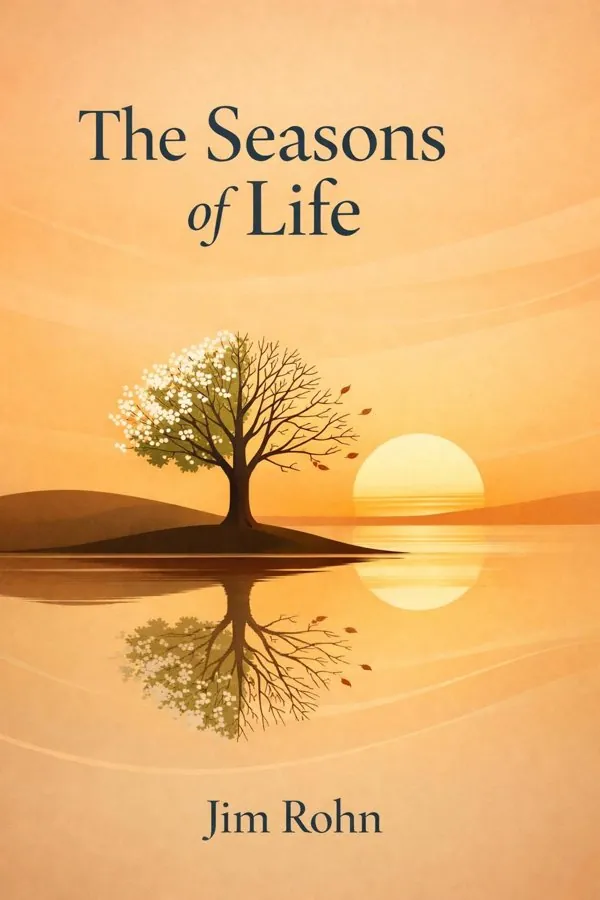
The Seasons of Life: Summary & Key Insights
by Jim Rohn
 10 min9 chaptersAudio available
Key Takeaways from The Seasons of Life
Every meaningful result in life starts long before it becomes visible.
Starting well is admirable, but sustaining effort through difficulty is what separates intention from achievement.
Fall, in Rohn’s framework, is the season of harvest, and harvest has a way of stripping away excuses.
Hardship is not an interruption of life; it is one of life’s recurring seasons.
Life may not always feel fair in timing, but it is remarkably consistent in principle: what you sow, you eventually reap.
What Is The Seasons of Life About?
The Seasons of Life by Jim Rohn is a mindset book spanning 9 pages. The Seasons of Life is Jim Rohn’s elegant meditation on one of the simplest and most powerful truths of human experience: life moves in cycles. Using the familiar pattern of spring, summer, fall, and winter, Rohn shows how growth, hardship, reward, and renewal are not random interruptions but natural seasons that shape every person’s journey. The book is not about passively waiting for life to change; it is about learning how to respond wisely in each phase so that setbacks become instruction and opportunities become results. What makes this message enduring is its practicality. Rohn connects timeless ideas—discipline, responsibility, patience, attitude, and effort—to everyday choices that determine long-term success. His seasonal metaphor helps readers understand why difficult periods are unavoidable, why fruitful periods must be earned, and why every season carries a lesson. As one of the most influential voices in personal development, Jim Rohn built his reputation on turning big principles into memorable guidance. In this concise but meaningful work, he offers a framework for living with more clarity, resilience, and intention.
This FizzRead summary covers all 9 key chapters of The Seasons of Life in approximately 10 minutes, distilling the most important ideas, arguments, and takeaways from Jim Rohn's work. Also available as an audio summary and Key Quotes Podcast.
The Seasons of Life
The Seasons of Life is Jim Rohn’s elegant meditation on one of the simplest and most powerful truths of human experience: life moves in cycles. Using the familiar pattern of spring, summer, fall, and winter, Rohn shows how growth, hardship, reward, and renewal are not random interruptions but natural seasons that shape every person’s journey. The book is not about passively waiting for life to change; it is about learning how to respond wisely in each phase so that setbacks become instruction and opportunities become results. What makes this message enduring is its practicality. Rohn connects timeless ideas—discipline, responsibility, patience, attitude, and effort—to everyday choices that determine long-term success. His seasonal metaphor helps readers understand why difficult periods are unavoidable, why fruitful periods must be earned, and why every season carries a lesson. As one of the most influential voices in personal development, Jim Rohn built his reputation on turning big principles into memorable guidance. In this concise but meaningful work, he offers a framework for living with more clarity, resilience, and intention.
Who Should Read The Seasons of Life?
This book is perfect for anyone interested in mindset and looking to gain actionable insights in a short read. Whether you're a student, professional, or lifelong learner, the key ideas from The Seasons of Life by Jim Rohn will help you think differently.
- ✓Readers who enjoy mindset and want practical takeaways
- ✓Professionals looking to apply new ideas to their work and life
- ✓Anyone who wants the core insights of The Seasons of Life in just 10 minutes
Want the full summary?
Get instant access to this book summary and 100K+ more with Fizz Moment.
Get Free SummaryAvailable on App Store • Free to download
Key Chapters
Every meaningful result in life starts long before it becomes visible. That is the essential lesson of spring in Jim Rohn’s philosophy: the season of beginnings is not merely about feeling hopeful, but about planting something worthy of harvest. Spring symbolizes opportunity, new ideas, fresh commitments, and the quiet work that precedes visible success. Many people admire outcomes while ignoring origins, yet Rohn reminds us that a better future is built through deliberate seeds planted today—habits, skills, relationships, and disciplined actions.
In practical terms, spring is the time to start what you know needs starting. If your health has been neglected, spring means beginning the walking routine, meal planning, and sleep discipline that may not show immediate results. If your finances are disorganized, spring means creating a budget, paying down debt, or learning about investing. If your career feels stagnant, spring means enrolling in a course, improving communication, or building a portfolio before opportunities appear.
Rohn’s insight is that spring should not be wasted in wishful thinking. Hope has value only when paired with action. Opportunity often looks ordinary at first; it arrives disguised as preparation, repetition, and early effort. You do not control the entire harvest, but you do control what you plant and whether you plant it at all.
The actionable takeaway is simple: identify one area of life that needs renewal and choose three seeds to plant this week—one habit, one skill, and one relationship-building action.
Starting well is admirable, but sustaining effort through difficulty is what separates intention from achievement. In Rohn’s seasonal model, summer represents the period after the seed has been planted but before the reward has arrived. This is the season of heat, resistance, inconvenience, and vigilance. It is when distractions grow, obstacles multiply, and motivation gets tested. Summer asks a painful question: do you want the harvest enough to defend what you began?
The challenge of summer is that progress can feel fragile. Weeds grow naturally; success does not. A business owner may launch with enthusiasm in spring, only to face competition, customer complaints, cash-flow pressure, and fatigue in summer. A person improving health may begin with energy but then confront cravings, social pressure, slow results, and emotional dips. In relationships, summer appears when initial excitement fades and commitment requires patience, listening, and repair.
Rohn argues that adversity is not evidence that you chose the wrong path. More often, it is proof that every valuable thing must be protected. The disciplined person expects resistance and develops systems to manage it: calendars instead of vague intentions, savings instead of dependence on luck, routines instead of mood-based effort, and boundaries instead of constant compromise.
Summer is where many quit because they expected growth to feel easier than it does. But pressure often strengthens character and clarifies desire. If you endure the season well, your roots deepen before the fruit appears.
The actionable takeaway: review one goal you have already started and list the three biggest ‘weeds’ threatening it. Then create one specific defense for each—time block, rule, accountability partner, or daily checklist.
Results are honest. Fall, in Rohn’s framework, is the season of harvest, and harvest has a way of stripping away excuses. It shows what was planted, how consistently it was nurtured, and whether discipline was sustained long enough to matter. Fall can be a time of celebration, gratitude, and reward—but it can also be a season of sobering clarity. The harvest never lies.
This idea matters because many people want rewards disconnected from process. They want confidence without preparation, wealth without value creation, strong relationships without investment, and peace of mind without self-command. Fall teaches that life responds to patterns more than wishes. If you have planted useful habits, developed integrity, and persisted through the hard months, fall often brings opportunity, trust, income, health improvements, or emotional stability. If you have neglected the essentials, fall reveals the cost.
Rohn does not frame this as punishment, but as feedback. A disappointing harvest is not the end of the story; it is information. If your career has stalled, the harvest may show a need for new skills or stronger initiative. If your finances remain fragile, the harvest may reveal impulsive spending or lack of planning. If your personal life feels shallow, the harvest may expose neglect in communication or generosity.
The wisdom of fall is to measure honestly without becoming bitter. Celebrate what has worked. Learn from what has not. Gratitude keeps success from becoming arrogance, while reflection keeps disappointment from becoming defeat.
The actionable takeaway: conduct a personal harvest review in one area of life. Write down what results you are getting, what actions likely produced them, and what should be planted differently in the next season.
Hardship is not an interruption of life; it is one of life’s recurring seasons. Winter, in Jim Rohn’s language, represents the difficult periods that arrive whether invited or not—loss, disappointment, rejection, illness, uncertainty, financial strain, or emotional fatigue. Winter can feel unfair because it does not always correspond neatly to effort. You may have planted wisely and still encounter storms. That is precisely why this lesson is so powerful: maturity means expecting winter without surrendering to it.
Rohn’s central point is that you cannot prevent every winter, but you can prepare your response. Resilience is rarely built in the middle of crisis; it is built before crisis through character, habits, savings, relationships, faith, and emotional stability. Winter exposes what was strong and what was superficial. A person with discipline may still suffer, but they recover faster because they have internal resources. A business with reserves may survive a downturn while others collapse. A family grounded in trust can endure stress better than one held together only by convenience.
Importantly, winter is not useless. It clarifies values, humbles ego, and deepens appreciation. It teaches patience when force will not work. It reveals who is dependable. It reminds us that growth is not only measured by outward progress but by inward strength.
Rohn does not romanticize pain, but he insists that hardship can refine rather than ruin us if we meet it with courage and perspective. Winter ends, but the person shaped by winter often emerges wiser than before.
The actionable takeaway: prepare for inevitable winters by strengthening one form of reserve now—financial savings, emotional support, spiritual practice, health discipline, or a problem-solving routine.
Life may not always feel fair in timing, but it is remarkably consistent in principle: what you sow, you eventually reap. The law of sowing and reaping is one of the foundational ideas in The Seasons of Life. Rohn uses it to emphasize personal responsibility without falling into harshness. The principle is not meant to shame people; it is meant to empower them. If results come from seeds, then future results can be changed by changing present behavior.
This law operates across every major domain. Plant patience and clear communication, and relationships tend to grow stronger. Plant neglect and resentment, and distance follows. Plant study, initiative, and reliability in your work, and your professional reputation strengthens. Plant excuses and inconsistency, and opportunities shrink. Plant exercise, sleep, and moderation, and your body usually rewards you over time. Plant chronic stress and disregard, and the body keeps score.
One of Rohn’s most useful implications is that small actions matter because seeds are small. A single conversation, a daily page of reading, a repeated hour of practice, or a tiny automatic transfer into savings can become surprisingly significant over time. The reverse is also true: tiny acts of carelessness accumulate quietly until they become visible consequences.
The law of sowing and reaping encourages patience. Farmers do not dig up seeds every morning to check progress; they trust process while tending responsibly. In the same way, growth often happens invisibly before it becomes measurable.
The actionable takeaway: choose one result you want six months from now and ask, ‘What exact seed would produce that outcome?’ Then commit to planting that seed consistently every day or every week.
Events shape life, but interpretation shapes experience. Rohn repeatedly emphasizes that while we cannot control every condition around us, we retain the power to choose our attitude. This does not mean pretending pain is pleasant or denying reality. It means recognizing that our inner posture determines whether a season becomes a prison or a classroom. Two people can enter the same winter and leave with completely different lives because one becomes bitter while the other becomes wiser.
Attitude matters because it influences perception, language, energy, and action. A person who sees difficulty as proof of personal failure often withdraws, complains, and stops trying. A person who sees difficulty as part of growth tends to ask better questions: What is this teaching me? What must I improve? What can still be done? The first mindset narrows possibilities; the second expands them.
In daily life, attitude shows up in subtle ways. After criticism at work, one person becomes defensive and discouraged, while another extracts the useful part and improves. During a slow season in business, one person panics and blames the market, while another uses the time to strengthen systems and client relationships. In family life, attitude determines whether conflict becomes ongoing resentment or an opportunity for deeper understanding.
Rohn’s view is not naïve optimism but chosen responsibility. Attitude does not erase hard seasons, but it changes how we travel through them. It turns frustration into discipline, delay into preparation, and disappointment into direction.
The actionable takeaway: the next time something goes wrong, pause before reacting and write two interpretations of the event—one disempowering and one constructive. Then choose the interpretation that leads to wise action.
Motivation is exciting, but discipline is dependable. One of Jim Rohn’s enduring beliefs is that success is less dramatic than most people imagine. It is rarely the result of one breakthrough moment; more often, it is the accumulation of ordinary actions repeated long enough to become transformative. Discipline is what keeps planting happening in spring, protection happening in summer, evaluation happening in fall, and endurance happening in winter.
What makes discipline so valuable is that it reduces dependence on mood. If you exercise only when inspired, save only when convenient, study only when curious, or communicate well only when calm, your progress will remain fragile. Discipline creates structure where emotion fluctuates. It makes excellence less accidental.
Rohn also understood that discipline works both ways: self-discipline creates freedom, while lack of discipline creates hidden penalties. A person who disciplines spending gains financial breathing room. A person who disciplines learning gains confidence and adaptability. A person who disciplines words gains trust. By contrast, indiscipline may feel easy in the moment but usually produces difficulty later—debt, stress, regret, conflict, or stagnation.
Practical discipline does not have to begin with giant changes. It can start with fixed wake times, a reading habit, daily planning, meal preparation, scheduled practice, or a weekly review. The power lies in consistency, not grandeur. Small disciplines become identity-forming. Eventually you are not merely doing disciplined actions; you become a disciplined person.
The actionable takeaway: choose one simple discipline that supports an important goal and practice it at the same time every day for the next 30 days, tracking completion visibly.
Not every lesson is learned merely by living through events. Some lessons are lost unless we stop long enough to examine them. Rohn highlights reflection as a crucial practice because experience by itself does not guarantee wisdom; interpreted experience does. The seasons come and go, but unless we reflect on what happened in each one, we may repeat the same mistakes while wondering why life feels unchanged.
Reflection allows us to ask better questions. What worked this season? What did I ignore? Where did my attitude help me, and where did it hurt me? What relationships improved? What habits weakened? What warning signs appeared early that I failed to notice? These questions transform life from a blur of reactions into a source of understanding.
This practice has practical applications in every area. Professionals who review completed projects improve faster than those who rush into the next task. Athletes who analyze performance sharpen technique. Couples who discuss conflict patterns with honesty build stronger trust. Individuals who journal after difficult periods often discover recurring triggers, strengths, and blind spots that would otherwise remain hidden.
Reflection also protects success from becoming complacency. A good harvest should be enjoyed, but it should also be studied. Why did this go well? What conditions made it possible? How can it be sustained or replicated? In this way, reflection turns victories into models and setbacks into instruction.
The actionable takeaway: establish a weekly reflection ritual. Spend 15 minutes reviewing the past seven days using three prompts: what went well, what did not, and what one adjustment would improve the next week.
The deepest insight in The Seasons of Life is that wisdom does not come from trying to live in one favorite season forever. Many people want perpetual spring without labor, endless fall without prior effort, or a life with no winters at all. Rohn teaches that maturity means understanding the role of each season and responding appropriately to each one. Life becomes more manageable when you stop demanding that it remain easy and start learning how to use every season well.
This integrated view changes how we see progress. Spring teaches initiative. Summer teaches protection and perseverance. Fall teaches gratitude and honest evaluation. Winter teaches resilience and preparation. None is complete by itself. A person who knows how to begin but not endure remains unfinished. A person who survives hardship but never reflects may become hard rather than wise. A person who enjoys success but never plants again eventually declines.
Integration also creates emotional balance. You stop panicking when difficulty arrives because you recognize winter. You stop wasting harvest because you recognize fall. You stop hesitating at new beginnings because you recognize spring. You stop resenting effort because you recognize summer. The pattern gives structure to uncertainty.
In modern life, where change feels constant and people often seek instant results, this message is especially valuable. The seasonal lens encourages patience without passivity and ambition without delusion. It reminds us that growth is rhythmic, not linear.
The actionable takeaway: identify which season you are currently in—beginning, struggle, harvest, or hardship—and ask one practical question for that season: What should I be planting, protecting, appreciating, or enduring right now?
All Chapters in The Seasons of Life
About the Author
Jim Rohn (1930–2009) was an American entrepreneur, author, and motivational speaker whose work helped shape the modern personal development movement. Rising from modest beginnings, he became known for teaching practical principles of success, leadership, discipline, and personal responsibility in a clear, memorable style. Rohn delivered seminars to audiences around the world and influenced generations of speakers, coaches, and business leaders, including Tony Robbins. His ideas focused less on quick fixes and more on the long-term impact of daily habits, mindset, and character. Through books, recordings, and live events, he built a reputation for turning timeless wisdom into actionable guidance. Decades after his peak speaking years, his work continues to be widely read because of its simplicity, depth, and enduring relevance.
Get This Summary in Your Preferred Format
Read or listen to the The Seasons of Life summary by Jim Rohn anytime, anywhere. FizzRead offers multiple formats so you can learn on your terms — all free.
Available formats: App · Audio · PDF · EPUB — All included free with FizzRead
Download The Seasons of Life PDF and EPUB Summary
Key Quotes from The Seasons of Life
“Every meaningful result in life starts long before it becomes visible.”
“Starting well is admirable, but sustaining effort through difficulty is what separates intention from achievement.”
“Fall, in Rohn’s framework, is the season of harvest, and harvest has a way of stripping away excuses.”
“Hardship is not an interruption of life; it is one of life’s recurring seasons.”
“Life may not always feel fair in timing, but it is remarkably consistent in principle: what you sow, you eventually reap.”
Frequently Asked Questions about The Seasons of Life
The Seasons of Life by Jim Rohn is a mindset book that explores key ideas across 9 chapters. The Seasons of Life is Jim Rohn’s elegant meditation on one of the simplest and most powerful truths of human experience: life moves in cycles. Using the familiar pattern of spring, summer, fall, and winter, Rohn shows how growth, hardship, reward, and renewal are not random interruptions but natural seasons that shape every person’s journey. The book is not about passively waiting for life to change; it is about learning how to respond wisely in each phase so that setbacks become instruction and opportunities become results. What makes this message enduring is its practicality. Rohn connects timeless ideas—discipline, responsibility, patience, attitude, and effort—to everyday choices that determine long-term success. His seasonal metaphor helps readers understand why difficult periods are unavoidable, why fruitful periods must be earned, and why every season carries a lesson. As one of the most influential voices in personal development, Jim Rohn built his reputation on turning big principles into memorable guidance. In this concise but meaningful work, he offers a framework for living with more clarity, resilience, and intention.
More by Jim Rohn


You Might Also Like


Browse by Category
Ready to read The Seasons of Life?
Get the full summary and 100K+ more books with Fizz Moment.