
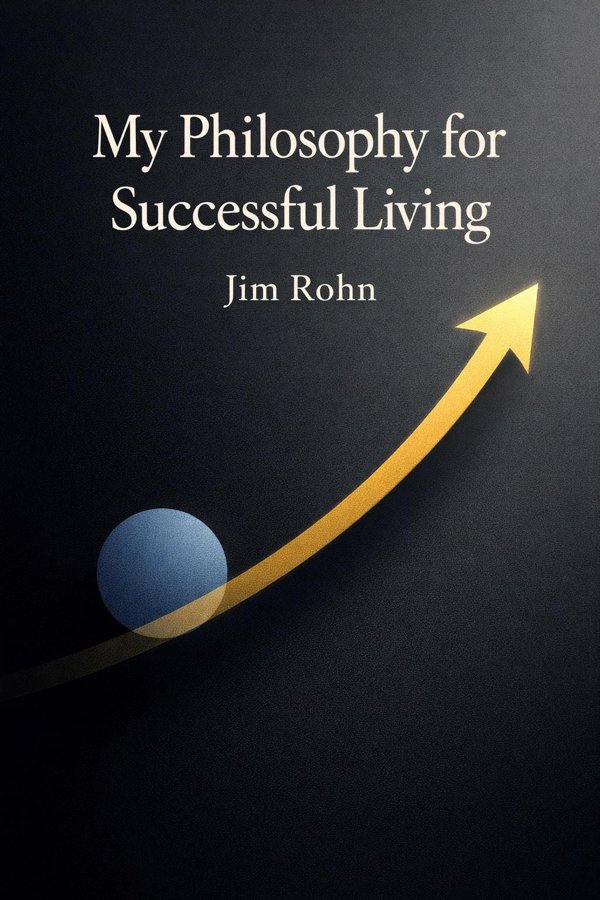
My Philosophy for Successful Living: Summary & Key Insights
by Jim Rohn
 10 min9 chaptersAudio available
Key Takeaways from My Philosophy for Successful Living
The quality of your life rarely rises above the quality of your philosophy.
What you see in life is often shaped less by circumstances than by the lens through which you view them.
A life without goals easily becomes a life of reaction.
The small choices you repeat every day eventually become the architecture of your life.
Formal education may help you make a living, but self-education helps you build a life.
What Is My Philosophy for Successful Living About?
My Philosophy for Successful Living by Jim Rohn is a mindset book spanning 12 pages. My Philosophy for Successful Living is Jim Rohn’s compact guide to the attitudes, habits, and principles that shape a successful life. Rather than offering quick fixes or motivational slogans, Rohn argues that lasting success begins with an internal shift: changing the way you think, choose, and act every day. Drawing on his own journey from struggling worker to respected entrepreneur and speaker, he explains how personal philosophy influences income, relationships, character, and fulfillment. The book explores timeless themes such as goal setting, discipline, self-education, financial responsibility, integrity, and service to others. What makes this book matter is its simplicity. Rohn takes big ideas and turns them into practical standards for living well. His message is not that life becomes easy, but that individuals become stronger, wiser, and more capable through intentional growth. As one of the foundational voices in modern personal development, Rohn writes with unusual authority: he lived the transformation he teaches. For readers who want a clear, grounded framework for improving their mindset and direction, this book remains a concise but powerful blueprint for personal and professional success.
This FizzRead summary covers all 9 key chapters of My Philosophy for Successful Living in approximately 10 minutes, distilling the most important ideas, arguments, and takeaways from Jim Rohn's work. Also available as an audio summary and Key Quotes Podcast.
My Philosophy for Successful Living
My Philosophy for Successful Living is Jim Rohn’s compact guide to the attitudes, habits, and principles that shape a successful life. Rather than offering quick fixes or motivational slogans, Rohn argues that lasting success begins with an internal shift: changing the way you think, choose, and act every day. Drawing on his own journey from struggling worker to respected entrepreneur and speaker, he explains how personal philosophy influences income, relationships, character, and fulfillment. The book explores timeless themes such as goal setting, discipline, self-education, financial responsibility, integrity, and service to others.
What makes this book matter is its simplicity. Rohn takes big ideas and turns them into practical standards for living well. His message is not that life becomes easy, but that individuals become stronger, wiser, and more capable through intentional growth. As one of the foundational voices in modern personal development, Rohn writes with unusual authority: he lived the transformation he teaches. For readers who want a clear, grounded framework for improving their mindset and direction, this book remains a concise but powerful blueprint for personal and professional success.
Who Should Read My Philosophy for Successful Living?
This book is perfect for anyone interested in mindset and looking to gain actionable insights in a short read. Whether you're a student, professional, or lifelong learner, the key ideas from My Philosophy for Successful Living by Jim Rohn will help you think differently.
- ✓Readers who enjoy mindset and want practical takeaways
- ✓Professionals looking to apply new ideas to their work and life
- ✓Anyone who wants the core insights of My Philosophy for Successful Living in just 10 minutes
Want the full summary?
Get instant access to this book summary and 100K+ more with Fizz Moment.
Get Free SummaryAvailable on App Store • Free to download
Key Chapters
The quality of your life rarely rises above the quality of your philosophy. Jim Rohn’s central claim is that results are not random; they are the visible expression of the beliefs, assumptions, and standards you live by. Early in his life, he blamed the economy, his circumstances, and other people for his lack of progress. His turning point came when his mentor challenged him to stop asking for life to become easier and start becoming wiser. That shift in thinking changed everything.
Personal philosophy is the set of invisible rules that govern your decisions. It influences how you interpret setbacks, whether you save or spend, whether you study or drift, and whether you hold yourself accountable or make excuses. Two people can face the same problem and produce opposite outcomes because they are operating from different internal philosophies. One says, “This is unfair.” The other says, “This is my chance to grow.” Over time, those responses create dramatically different lives.
Rohn insists that success begins long before outward achievement. It begins when you adopt principles such as responsibility, delayed gratification, self-respect, and continuous improvement. If your philosophy says comfort matters more than growth, your actions will reflect that. If it says your future is built one disciplined choice at a time, your behavior changes accordingly.
A practical way to apply this idea is to examine the beliefs behind your habits. Ask: What do I believe about work, money, learning, health, and relationships? Are those beliefs producing the life I want? Replace passive assumptions with stronger principles, then review them regularly. Actionable takeaway: write a one-page personal philosophy with five guiding rules you want to live by, and use it as a filter for daily decisions.
What you see in life is often shaped less by circumstances than by the lens through which you view them. Rohn teaches that attitude is not a minor personality trait; it is a force that affects performance, relationships, resilience, and opportunity. A negative attitude drains energy, narrows options, and invites blame. A constructive attitude creates momentum, encourages creativity, and helps people respond rather than react.
Rohn does not suggest that positive thinking means denying hardship. Instead, he argues that attitude is your chosen stance toward reality. You may not control every event, but you can control the meaning you assign to it. A missed sale can become proof of failure or a lesson in preparation. A difficult boss can become an excuse for bitterness or a challenge that develops professionalism and patience. The event may be the same, but the emotional and behavioral consequences differ greatly.
Attitude also affects the people around you. In business, people are drawn to those who are dependable, optimistic, and solution-oriented. In families and friendships, attitude sets the emotional climate. A person who constantly complains becomes exhausting to trust. A person who brings steadiness and hope becomes influential.
To strengthen attitude, Rohn would advise monitoring your mental language. Notice recurring patterns such as “nothing works,” “I never get a break,” or “it’s too late for me.” Replace them with more empowering statements grounded in truth: “This is difficult, but I can improve,” or “I can learn a better approach.” Your words train your mindset.
Actionable takeaway: for one week, catch every complaint before it leaves your mouth and replace it with either a solution, a lesson, or a specific next step.
A life without goals easily becomes a life of reaction. Rohn believes that one of the greatest differences between drift and progress is intentional direction. Goals do more than organize effort; they clarify identity, sharpen choices, and create a reason to persist when motivation fades. Without a target, energy gets scattered across distractions, urgencies, and other people’s agendas.
Rohn encourages setting goals in multiple areas of life, not just income or career. Financial goals matter, but so do family goals, health goals, learning goals, spiritual goals, and contribution goals. This broader approach protects against the common mistake of succeeding in one area while neglecting the rest. A person may build wealth but lose peace, respect, or connection. A worthy life, in Rohn’s philosophy, requires balance and conscious design.
Good goals should be personal and emotionally meaningful. They should stretch you without disconnecting from reality. For example, instead of vaguely wanting to “do better,” a person might aim to read twelve books in a year, save a set percentage of income, improve public speaking, or schedule a weekly family dinner. Specificity transforms desire into action. Writing goals down makes them real. Revisiting them keeps them alive.
Goals also shape character. When you commit to a difficult but worthwhile target, you begin to develop the discipline, courage, and consistency needed to reach it. In that way, the greatest value of a goal may not be what you get, but what you become while pursuing it.
Actionable takeaway: create written goals for the next 90 days in four areas—work, finances, health, and relationships—and review them every morning to keep your daily actions aligned.
The small choices you repeat every day eventually become the architecture of your life. Rohn treats discipline as one of the most important tools of success because it closes the gap between intention and result. Most people know what would improve their lives: save more, learn more, work with focus, keep promises, show up on time. The real issue is not ignorance but inconsistency. Discipline is the practice of doing what is wise even when it is inconvenient.
Rohn’s view of discipline is refreshing because he does not frame it as punishment. He frames it as freedom. The disciplined person gains options. Financial discipline creates security. Time discipline creates productivity. Emotional discipline prevents impulsive decisions. Health discipline creates strength and energy. By contrast, undisciplined living may feel comfortable in the moment but often leads to stress, debt, regret, and dependence later.
He also emphasizes that discipline is rarely dramatic. It lives in ordinary actions: making the sales call, reading ten pages, tracking expenses, arriving prepared, following through after enthusiasm fades. These modest behaviors seem insignificant in isolation, but compounded over months and years they produce extraordinary differences. Neglect compounds too. That is why Rohn warns against letting small errors slide simply because they seem harmless.
A useful way to apply this principle is to attach discipline to identity. Instead of saying, “I’m trying to be more organized,” say, “I am a person who honors commitments.” This strengthens consistency because behavior begins to support self-image.
Actionable takeaway: choose one neglected area of life and install a simple daily discipline you can keep for 30 days, such as budgeting for five minutes, reading ten pages, or planning tomorrow before bed.
Formal education may help you make a living, but self-education helps you build a life. Rohn repeatedly stresses that your market value and personal effectiveness grow as you grow. Waiting for schools, employers, or circumstances to educate you is a losing strategy. The most successful people take responsibility for their own development and treat learning as a lifelong discipline.
In Rohn’s philosophy, learning is not only about professional skill. It includes studying communication, leadership, money, psychology, ethics, and human nature. It also includes learning from experience, mentors, books, seminars, and observation. Every conversation, mistake, and challenge contains instruction if you are willing to pay attention. This mindset turns life itself into a classroom.
Self-education matters because income often reflects value, and value increases with knowledge, judgment, and capability. A person who can solve problems, lead others, communicate clearly, and adapt quickly becomes more useful in almost any field. But there is also a deeper reward: learning enlarges perspective. It improves confidence, broadens choices, and reduces dependence on luck.
Rohn’s own life illustrates this principle. He was transformed not by formal credentials but by exposure to ideas and mentors that elevated his thinking. Readers can follow the same pattern by creating a personal curriculum. For instance, someone wanting to advance in business might study sales, negotiation, writing, and financial literacy. Someone wanting stronger relationships might study listening, emotional intelligence, and conflict resolution.
Actionable takeaway: build a self-education plan for the next three months with one book, one audio program or course, and one mentor or model to learn from in an area that most needs improvement.
Time is democratic but outcomes are not. Everyone receives the same twenty-four hours, yet people produce vastly different lives because they assign those hours differently. Rohn teaches that time management is really priority management. The issue is not merely becoming busy; it is making sure your days reflect what matters most.
Many people lose progress not because they lack ambition, but because they live in reaction mode. Urgent tasks, interruptions, entertainment, and trivial obligations crowd out meaningful work. Days become full but not fruitful. Rohn’s philosophy calls for greater intentionality. If your goals matter, your calendar should prove it. What you say is important and what you repeatedly schedule should match.
This principle applies across life. A person who says family matters but never protects time for family is surrendering to drift. Someone who claims health is a priority but never plans exercise or meals is letting convenience govern outcomes. The same is true for reading, planning, skill building, and spiritual reflection. Important things rarely happen by accident; they are reserved, defended, and revisited.
A practical system might include planning the week in advance, identifying your top three priorities each day, and handling high-value tasks early before distractions take over. It also helps to measure where time leaks away. One hour of careless scrolling may seem harmless, but over a year it becomes a meaningful loss of attention and opportunity.
Rohn’s message is simple: the future is hidden in your schedule. Actionable takeaway: perform a seven-day time audit, identify your biggest sources of wasted attention, and block dedicated time each week for your most important goals before filling the rest of your calendar.
Money does not merely reveal what you earn; it reveals how you think. Rohn approaches financial responsibility as both a practical necessity and a moral discipline. He rejects the idea that wealth begins with high income alone. Instead, he argues that financial well-being starts with habits: earning honestly, spending carefully, saving consistently, investing intelligently, and avoiding the trap of lifestyle inflation.
One of his key insights is that income seldom solves poor money management. A person who spends without thought at one level often does the same at a higher level. That is why character and judgment matter so much in financial life. Financial stress is often less about scarcity than about the absence of planning, restraint, and long-term thinking. Rohn encourages readers to take ownership of their finances rather than leaving them to chance.
This means tracking where money goes, setting savings goals, reducing unnecessary debt, and making purchases in line with values rather than impulse. It also means seeing money as a tool, not an identity. Wealth can expand freedom and opportunity, but it should serve a life philosophy, not replace one. In Rohn’s framework, financial success supports dignity, generosity, and independence.
Practical application can be simple. A reader might begin by creating a monthly budget, saving a fixed percentage of every paycheck, or building an emergency fund before increasing discretionary spending. Learning basic investing and understanding compounding are also part of becoming financially literate.
Actionable takeaway: choose one money habit to begin immediately—track every expense for 30 days, automate savings, or create a debt reduction plan—and treat it as proof that you are becoming financially responsible.
Success that damages character or isolates you from others is not true success. Rohn ties achievement to the quality of the person achieving it. Character, in his philosophy, is the inner structure that keeps success from becoming hollow or unstable. It includes honesty, reliability, humility, fairness, and the courage to do what is right when it is inconvenient. Without character, talent becomes dangerous and opportunity becomes fragile.
Character also shapes relationships, and relationships in turn shape destiny. The people around you affect your standards, expectations, and emotional life. Rohn famously emphasized the power of association: who you listen to, work with, and spend time around matters deeply. Encouraging, disciplined, ethical people tend to elevate your thinking. Cynical, careless, or manipulative people tend to pull it down. This does not mean using relationships transactionally; it means respecting their influence.
Influence itself is earned, not demanded. People trust those who keep their word, listen well, add value, and treat others with dignity. Whether in leadership, sales, parenting, or friendship, your ability to influence grows when people sense integrity behind your words. A person may impress others briefly with charisma, but only character creates lasting respect.
Rohn also highlights contribution. The most meaningful life is not centered only on personal gain but on helping others grow. Teaching, encouraging, mentoring, and serving are part of a mature philosophy for living.
Actionable takeaway: evaluate the five people who most influence your thinking, strengthen one relationship with someone of high character, and choose one practical way each week to serve or mentor another person.
Difficulties do not automatically improve people, but they always give people a chance to improve. Rohn teaches that setbacks, disappointments, and hardship are unavoidable parts of life. What matters is whether you use them as excuses or as material for growth. In this way, adversity becomes a testing ground for philosophy. It reveals whether your principles are real or merely theoretical.
Rohn’s response to challenge is neither denial nor despair. He recommends reflection, adaptation, and renewed effort. If a plan fails, revise it. If a loss hurts, learn from it. If criticism arrives, examine it for truth without letting it destroy your confidence. Mature people do not expect a smooth path; they expect to develop stronger judgment through experience. Every challenge can sharpen patience, courage, resilience, and perspective.
This connects to Rohn’s idea of excellence. Excellence is not perfection but the consistent decision to do things well. It means raising standards in ordinary actions, not waiting for dramatic moments. Over time, excellence produces trust, competence, and self-respect. It also creates legacy. The true measure of a life is not just what you accumulated, but what you modeled, improved, and passed on to others.
Legacy includes values, example, and contribution. Children, coworkers, students, and friends often remember not your speeches but your habits—how you handled pressure, how you treated people, how seriously you took your responsibilities. A successful life leaves behind more than possessions; it leaves behind principles embodied in action.
Actionable takeaway: identify one recent setback and write three lessons it can teach you, then choose one area where you will raise your standard this week so your daily life reflects the legacy you want to leave.
All Chapters in My Philosophy for Successful Living
About the Author
Jim Rohn (1930–2009) was an American entrepreneur, author, and motivational speaker whose teachings helped define the modern personal development movement. Raised in rural Idaho, he often described himself as an ordinary person who transformed his life through mentorship, disciplined thinking, and self-education. After learning from businessman Earl Shoaff, Rohn built a successful career in business and later became known worldwide for his seminars on success, leadership, wealth, and personal responsibility. His speaking style combined practical advice, memorable one-liners, and deep emphasis on character and philosophy. Over the decades, he influenced millions of readers and listeners, as well as many later coaches, speakers, and business leaders. Rohn remains respected for turning timeless principles into clear, actionable guidance for living well and succeeding with integrity.
Get This Summary in Your Preferred Format
Read or listen to the My Philosophy for Successful Living summary by Jim Rohn anytime, anywhere. FizzRead offers multiple formats so you can learn on your terms — all free.
Available formats: App · Audio · PDF · EPUB — All included free with FizzRead
Download My Philosophy for Successful Living PDF and EPUB Summary
Key Quotes from My Philosophy for Successful Living
“The quality of your life rarely rises above the quality of your philosophy.”
“What you see in life is often shaped less by circumstances than by the lens through which you view them.”
“A life without goals easily becomes a life of reaction.”
“The small choices you repeat every day eventually become the architecture of your life.”
“Formal education may help you make a living, but self-education helps you build a life.”
Frequently Asked Questions about My Philosophy for Successful Living
My Philosophy for Successful Living by Jim Rohn is a mindset book that explores key ideas across 9 chapters. My Philosophy for Successful Living is Jim Rohn’s compact guide to the attitudes, habits, and principles that shape a successful life. Rather than offering quick fixes or motivational slogans, Rohn argues that lasting success begins with an internal shift: changing the way you think, choose, and act every day. Drawing on his own journey from struggling worker to respected entrepreneur and speaker, he explains how personal philosophy influences income, relationships, character, and fulfillment. The book explores timeless themes such as goal setting, discipline, self-education, financial responsibility, integrity, and service to others. What makes this book matter is its simplicity. Rohn takes big ideas and turns them into practical standards for living well. His message is not that life becomes easy, but that individuals become stronger, wiser, and more capable through intentional growth. As one of the foundational voices in modern personal development, Rohn writes with unusual authority: he lived the transformation he teaches. For readers who want a clear, grounded framework for improving their mindset and direction, this book remains a concise but powerful blueprint for personal and professional success.
More by Jim Rohn



You Might Also Like



Browse by Category
Ready to read My Philosophy for Successful Living?
Get the full summary and 100K+ more books with Fizz Moment.