
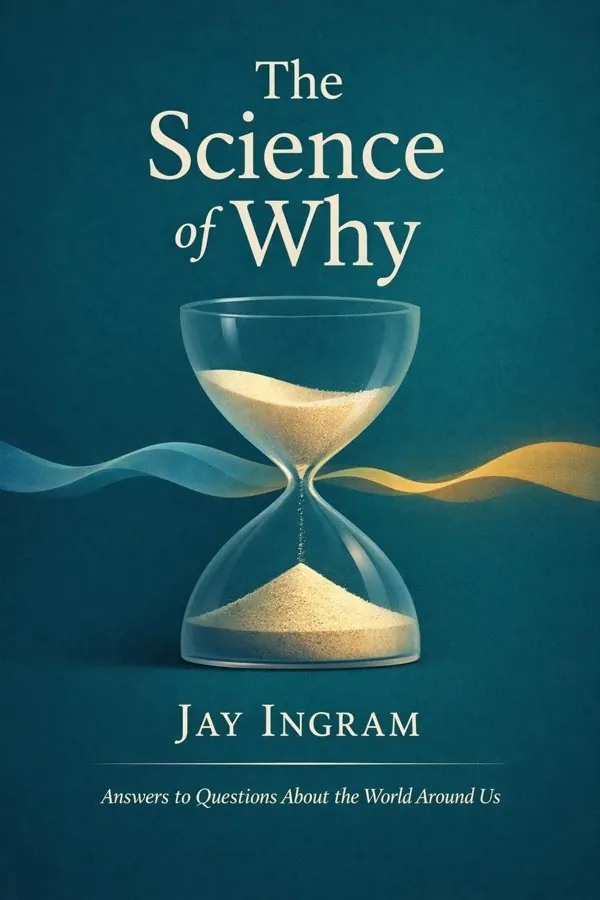
The Science of Why: Answers to Questions About the World Around Us: Summary & Key Insights
by Jay Ingram
 10 min10 chaptersAudio available
Key Takeaways from The Science of Why: Answers to Questions About the World Around Us
A yawn seems trivial until you realize how many mysteries are packed into one reflex.
Clock time is precise, but lived time is elastic.
Forgetting often feels like failure, but Ingram shows that it is also a vital feature of an efficient brain.
Dreaming is one of the strangest ordinary things humans do.
Sound is invisible, but its effects are immediate and powerful.
What Is The Science of Why: Answers to Questions About the World Around Us About?
The Science of Why: Answers to Questions About the World Around Us by Jay Ingram is a popular_sci book spanning 11 pages. Why do we yawn when others yawn? Why does time race during joyful moments and crawl during boredom? Why do music, color, smell, memory, and emotion feel so immediate and personal, yet obey discoverable scientific rules? In The Science of Why, Jay Ingram turns these familiar puzzles into an invitation to think more carefully about everyday life. Rather than treating science as a distant subject reserved for laboratories, he shows how it begins with ordinary curiosity: a noticed pattern, a strange habit, a simple question asked seriously. Drawing from biology, neuroscience, psychology, physics, and animal behavior, Ingram explains the mechanisms behind experiences most people rarely stop to analyze. His great strength is clarity without oversimplification. As a veteran science broadcaster and author, he knows how to translate research into lively, memorable insights while preserving the excitement of uncertainty and discovery. The result is a book that feels both educational and conversational. It matters because it changes how readers look at the world: not as a collection of routine events, but as a landscape of hidden processes. After reading it, even the smallest moments begin to feel richer, stranger, and more understandable.
This FizzRead summary covers all 10 key chapters of The Science of Why: Answers to Questions About the World Around Us in approximately 10 minutes, distilling the most important ideas, arguments, and takeaways from Jay Ingram's work. Also available as an audio summary and Key Quotes Podcast.
The Science of Why: Answers to Questions About the World Around Us
Why do we yawn when others yawn? Why does time race during joyful moments and crawl during boredom? Why do music, color, smell, memory, and emotion feel so immediate and personal, yet obey discoverable scientific rules? In The Science of Why, Jay Ingram turns these familiar puzzles into an invitation to think more carefully about everyday life. Rather than treating science as a distant subject reserved for laboratories, he shows how it begins with ordinary curiosity: a noticed pattern, a strange habit, a simple question asked seriously.
Drawing from biology, neuroscience, psychology, physics, and animal behavior, Ingram explains the mechanisms behind experiences most people rarely stop to analyze. His great strength is clarity without oversimplification. As a veteran science broadcaster and author, he knows how to translate research into lively, memorable insights while preserving the excitement of uncertainty and discovery. The result is a book that feels both educational and conversational. It matters because it changes how readers look at the world: not as a collection of routine events, but as a landscape of hidden processes. After reading it, even the smallest moments begin to feel richer, stranger, and more understandable.
Who Should Read The Science of Why: Answers to Questions About the World Around Us?
This book is perfect for anyone interested in popular_sci and looking to gain actionable insights in a short read. Whether you're a student, professional, or lifelong learner, the key ideas from The Science of Why: Answers to Questions About the World Around Us by Jay Ingram will help you think differently.
- ✓Readers who enjoy popular_sci and want practical takeaways
- ✓Professionals looking to apply new ideas to their work and life
- ✓Anyone who wants the core insights of The Science of Why: Answers to Questions About the World Around Us in just 10 minutes
Want the full summary?
Get instant access to this book summary and 100K+ more with Fizz Moment.
Get Free SummaryAvailable on App Store • Free to download
Key Chapters
Clock time is precise, but lived time is elastic. This is one of the book’s most illuminating ideas: human beings do not experience time in a steady, mechanical flow. Instead, our perception of duration changes with emotion, attention, novelty, age, and memory. Ingram shows that the same five minutes can feel fleeting during a lively conversation and endless in a waiting room. Time, as measured by instruments, is objective; time, as felt by consciousness, is deeply psychological.
This distinction helps explain many ordinary experiences. Novel events often seem longer in retrospect because the brain encodes more detail. Routine days, by contrast, may feel fast in memory because little stands out. Fear and anxiety can intensify the present moment, making time feel slowed down. Concentrated engagement can do the opposite, creating the sensation of flow, where hours seem compressed into minutes.
Understanding time perception has practical value. It affects how we plan work, endure stress, evaluate experiences, and remember our lives. People who fill their weeks with repetitive tasks may feel life is accelerating, while those who seek novelty often create richer, fuller-seeming memories. Even children and older adults can seem to inhabit different time worlds because their brains and expectations process duration differently.
Ingram’s larger point is that subjective time is not a flaw in the human system. It is part of how the brain organizes significance. The mind stretches what demands attention and compresses what fades into habit.
Actionable takeaway: To make life feel fuller and more memorable, deliberately add novelty, vary routines, and give focused attention to important moments instead of letting them blur together.
Forgetting often feels like failure, but Ingram shows that it is also a vital feature of an efficient brain. Memory is not a perfect recording device. It is selective, reconstructive, and shaped by usefulness rather than fidelity. We tend to imagine that a healthy memory should preserve everything exactly as it happened, yet that would be overwhelming. To function well, the brain must filter, compress, and revise experience.
This explains why people confidently misremember details, why emotional events can dominate recall, and why repetition matters more than intention alone. Memories are strengthened when revisited, linked to meaning, or tied to strong sensory cues. They weaken when unused, interfered with, or poorly encoded in the first place. Ingram emphasizes that remembering is an active process: every retrieval can subtly alter the memory itself.
This has consequences for education, relationships, and self-understanding. Students who reread passively may feel familiar with material without truly storing it. Witnesses may report events sincerely yet inaccurately. Family members may disagree about the same shared moment because memory is reconstructed from perspective and later interpretation, not replayed from an internal archive.
Seen this way, forgetting is not just loss. It helps us prioritize what matters now. The real challenge is learning how memory works well enough to support it intentionally. Meaning, repetition, emotion, and retrieval all matter more than raw exposure.
Actionable takeaway: If you want to remember something important, don’t just reread it. Test yourself, connect it to existing knowledge, and revisit it over time so the brain has multiple chances to strengthen the memory.
Dreaming is one of the strangest ordinary things humans do. Every night the brain generates vivid narratives, emotional episodes, bizarre images, and impossible transitions, often while the body lies still and disconnected from the outside world. Ingram treats dreams not as mystical messages but as windows into consciousness, memory, and brain activity. Their very oddness reveals something important: the mind is constantly active, even when rational control loosens.
Scientific research on sleep stages, especially REM sleep, suggests that dreaming may be connected to memory consolidation, emotional processing, and the brain’s effort to integrate fragments of experience. Dreams often recombine familiar people, fears, places, and concerns into unusual sequences. That does not mean every dream has a hidden symbolic code, but it does suggest that dream content reflects what the brain has recently been working on.
This perspective can make dreams more useful and less intimidating. A stressful dream before an exam or major decision may reflect emotional rehearsal, not prophecy. Creative people have long noticed that dreams can produce surprising associations precisely because waking logic is relaxed. The sleeping brain can connect ideas in unusual ways, offering insights that strict conscious reasoning might miss.
The chapter also raises a humbling point about consciousness itself. Much of mental life happens outside deliberate awareness. Dreams remind us that the self we experience while awake is only one mode of mind.
Actionable takeaway: Keep a notebook by your bed and jot down recurring dream themes. You may notice patterns tied to stress, unresolved concerns, or creative ideas worth exploring while awake.
Sound is invisible, but its effects are immediate and powerful. A melody can move us emotionally, a rhythm can synchronize a crowd, and a harsh noise can trigger stress in an instant. Ingram explores how sound becomes experience through the combined work of physics, biology, and psychology. Vibrations in air are transformed by the ear into neural signals, yet hearing is not a passive reception of data. The brain actively organizes pitch, rhythm, tone, and pattern into meaningful perceptual events.
Music is especially revealing because it shows how deeply structure and expectation matter. We do not hear isolated notes; we hear relationships. Tension, repetition, surprise, and resolution shape emotional response. Cultural learning influences musical preference, but some elements of rhythm and pattern tap into broad human tendencies toward prediction and coordination. That is why lullabies calm, drumbeats energize, and repeated motifs linger in memory.
The science of sound also has everyday applications. Noise pollution affects concentration and stress. Background music can improve mood for some tasks while disrupting deep thinking for others. Speech perception depends not only on the ear’s mechanics but on context and brain-based interpretation. People often think they hear exactly what was said, when in fact the mind fills in missing information from expectation.
Ingram’s broader insight is that hearing is an act of interpretation as much as sensation. What enters the ear is only the beginning of what the brain makes of it.
Actionable takeaway: Use sound deliberately. Reduce distracting noise when doing demanding cognitive work, and choose music that matches your goal rather than assuming all sound helps equally.
Color feels like a stable property of objects, but in scientific terms it is a negotiation between light, eyes, and brain. Ingram explains that what we call color depends on wavelengths of light, the sensitivity of retinal receptors, and the brain’s interpretation of context. A red apple appears red not because redness lives inside the apple, but because of how its surface reflects light and how our visual system processes that information.
This makes vision less like a camera and more like an active model-building system. The brain constantly corrects for changing illumination, compares surrounding hues, and creates a coherent visual world from incomplete input. Optical illusions and color contrast effects reveal how much perception depends on assumptions and context. Two shades can appear different or identical depending on what surrounds them, reminding us that seeing is partly inferential.
This insight matters beyond curiosity. Designers, artists, marketers, and architects all rely on the psychology of color and contrast. In daily life, it helps explain why clothing looks different indoors and outdoors, why screens can distort color, and why eyewitness descriptions are often less dependable than people assume. Even our language for color is shaped by culture, attention, and categorization.
Ingram uses color to make a larger point about perception itself: the brain does not simply receive reality; it organizes it into useful forms. That process is powerful, but it also introduces limits and biases.
Actionable takeaway: When color matters, compare objects under different lighting conditions and be cautious about trusting first impressions, especially when making aesthetic, design, or purchasing decisions.
Smell and taste are often treated as lesser senses compared with vision and hearing, yet they are among the most intimate and influential. Ingram shows that flavor is not produced by the tongue alone. It emerges from a partnership between taste receptors, smell, texture, temperature, and expectation. This is why food becomes strangely flat when you have a cold: much of what you call taste is actually smell.
These senses are deeply tied to memory and emotion. A scent can trigger a vivid recollection with a force that surprises us, because smell is closely linked to brain regions involved in emotional processing and memory. Taste, meanwhile, acts as both pleasure system and survival tool. Sweetness can signal energy-rich food, bitterness can warn of toxins, and preferences are shaped by biology, culture, and repeated exposure.
The practical implications are broad. Eating habits are affected by environment, presentation, and learned associations, not just hunger. Food companies exploit this by carefully engineering texture, aroma, and visual cues. On a healthier level, people can expand their palate through repeated tasting rather than assuming immediate dislike is permanent. Smell also matters in social life, danger detection, and environmental awareness more than many people realize.
By unpacking these senses, Ingram reminds readers that perception is multisensory. What seems like a simple experience of liking or disliking a food is actually a layered interaction between chemistry, brain processing, and personal history.
Actionable takeaway: If you want to change your eating habits, start by noticing sensory cues. Slow down, smell food before tasting it, and retry unfamiliar foods multiple times to allow preferences to develop.
Humans often overestimate the uniqueness of our own behavior, especially when it comes to communication and social intelligence. Ingram uses animal behavior to challenge that assumption. Across species, signals can be chemical, visual, vocal, tactile, or behavioral, and they often carry surprisingly specific information. Birds use song for territory and mating, bees communicate food locations through movement, and many mammals rely on posture or scent as much as sound.
What makes this scientifically rich is the balance between instinct and learning. Some signals are strongly hardwired, while others develop through experience, social context, or environmental pressure. Animal communication is not human language, but it is rarely random. It evolved because accurate signaling can improve survival, reproduction, and group coordination.
This perspective encourages more careful observation of the living world. A dog’s body position, a bird’s repeated call, or an insect’s movement pattern may be conveying information that casual human observers miss. It also invites humility. Human intelligence is exceptional in some respects, but many species solve problems, coordinate behavior, and transmit signals with remarkable sophistication suited to their ecological needs.
The practical payoff is strongest in how we relate to animals. Better understanding of species-specific cues can improve pet care, conservation, and wildlife observation. Misreading animal behavior often leads to avoidable conflict or mistaken judgments about intelligence.
Actionable takeaway: When observing an animal, focus on context and patterns rather than isolated actions. Ask what information the behavior might be transmitting within that species’ own world instead of interpreting it only through human assumptions.
Emotions feel deeply personal, yet they are also biological events shaped by brain systems, body signals, and interpretation. Ingram shows that feelings like fear, joy, anger, and sadness are not simply irrational interruptions to thought. They are part of the mind’s rapid-response system for evaluating significance, preparing action, and guiding decision-making. A racing heart, tightened muscles, and narrowed attention are not separate from emotion; they are part of how emotion is experienced.
At the same time, emotions are not purely automatic. The brain interprets bodily arousal in light of situation, memory, and expectation. Similar physical sensations can be labeled as panic, excitement, anticipation, or attraction depending on context. This is one reason emotional life is so variable across individuals and situations. Biology provides the machinery, but experience helps assign meaning.
This framework has practical value in everyday life. People who treat emotions as enemies often become less skilled at understanding them. People who assume every emotion is a direct reading of reality can also be misled. Anger may contain useful information about boundaries, but it can also distort judgment. Anxiety may reveal concern, but not necessarily danger. Emotional intelligence begins with noticing without immediately obeying.
Ingram’s account helps bridge science and lived experience. We do not need to choose between seeing emotions as chemical events or meaningful states. They are both.
Actionable takeaway: When a strong emotion arises, name it, notice the bodily sensations attached to it, and ask what interpretation you are adding. This brief pause can reduce reactivity and improve judgment.
Many people think physics belongs to textbooks, equations, and distant abstractions, yet Ingram demonstrates that it is woven through daily life. Why does a tossed ball arc the way it does? Why does ice make surfaces slippery? Why do mirrors reverse in one way but not another? The ordinary world is governed by physical principles that become more interesting, not less, once understood.
One of the pleasures of this material is that it restores surprise to familiar experiences. Friction, gravity, momentum, sound waves, pressure, and heat are not dry concepts when they explain the behavior of bicycles, kitchen tools, buildings, weather, and sports. Science becomes tangible when it answers practical questions: why some materials insulate better than others, why seatbelts matter, why a curve in the road changes how a car feels, or why hot and cold can be perceived differently depending on context.
This kind of understanding builds better intuition. It can help people make smarter decisions around safety, energy use, and household problem-solving. More importantly, it counters the mistaken belief that science is separate from normal life. Physics is not an extra layer added onto experience; it is the structure of experience itself.
Ingram’s treatment makes clear that curiosity about ordinary mechanisms is not childish but foundational. Asking why soap removes grease or why a ceiling fan changes comfort opens the door to the same reasoning scientists use on larger scales.
Actionable takeaway: Pick one everyday phenomenon each week and ask what physical principles explain it. Turning routine observations into small investigations is one of the fastest ways to think more scientifically.
All Chapters in The Science of Why: Answers to Questions About the World Around Us
About the Author
Jay Ingram is a Canadian science broadcaster, writer, and public communicator known for translating complex research into clear, engaging prose. Over the course of his career, he has become one of Canada’s most recognizable science voices through his work in television, radio, and print. He hosted Discovery Channel Canada’s Daily Planet and CBC Radio’s Quirks & Quarks, programs that helped bring scientific ideas to broad audiences without sacrificing depth or curiosity. Ingram has also written several popular science books that explore the connections between research and ordinary experience. His work is marked by intellectual range, conversational clarity, and a talent for turning everyday questions into compelling investigations. He is especially valued for showing that science is not remote from daily life, but embedded within it.
Get This Summary in Your Preferred Format
Read or listen to the The Science of Why: Answers to Questions About the World Around Us summary by Jay Ingram anytime, anywhere. FizzRead offers multiple formats so you can learn on your terms — all free.
Available formats: App · Audio · PDF · EPUB — All included free with FizzRead
Download The Science of Why: Answers to Questions About the World Around Us PDF and EPUB Summary
Key Quotes from The Science of Why: Answers to Questions About the World Around Us
“A yawn seems trivial until you realize how many mysteries are packed into one reflex.”
“Clock time is precise, but lived time is elastic.”
“Forgetting often feels like failure, but Ingram shows that it is also a vital feature of an efficient brain.”
“Dreaming is one of the strangest ordinary things humans do.”
“Sound is invisible, but its effects are immediate and powerful.”
Frequently Asked Questions about The Science of Why: Answers to Questions About the World Around Us
The Science of Why: Answers to Questions About the World Around Us by Jay Ingram is a popular_sci book that explores key ideas across 10 chapters. Why do we yawn when others yawn? Why does time race during joyful moments and crawl during boredom? Why do music, color, smell, memory, and emotion feel so immediate and personal, yet obey discoverable scientific rules? In The Science of Why, Jay Ingram turns these familiar puzzles into an invitation to think more carefully about everyday life. Rather than treating science as a distant subject reserved for laboratories, he shows how it begins with ordinary curiosity: a noticed pattern, a strange habit, a simple question asked seriously. Drawing from biology, neuroscience, psychology, physics, and animal behavior, Ingram explains the mechanisms behind experiences most people rarely stop to analyze. His great strength is clarity without oversimplification. As a veteran science broadcaster and author, he knows how to translate research into lively, memorable insights while preserving the excitement of uncertainty and discovery. The result is a book that feels both educational and conversational. It matters because it changes how readers look at the world: not as a collection of routine events, but as a landscape of hidden processes. After reading it, even the smallest moments begin to feel richer, stranger, and more understandable.
You Might Also Like

Structures: Or Why Things Don"t Fall Down
J.E. Gordon
10 min
The Road to Wigan Pier
George Orwell
10 min
Bonk: The Curious Coupling of Science and Sex
Mary Roach
10 min
First Bite: How We Learn to Eat
Bee Wilson
10 min
In Pursuit Of The Unknown: 17 Equations That Changed The World
Ian Stewart
10 min
Napoleon's Buttons: 17 Molecules That Changed History
Penny Le Couteur and Jay Burreson
10 minBrowse by Category
Ready to read The Science of Why: Answers to Questions About the World Around Us?
Get the full summary and 100K+ more books with Fizz Moment.