
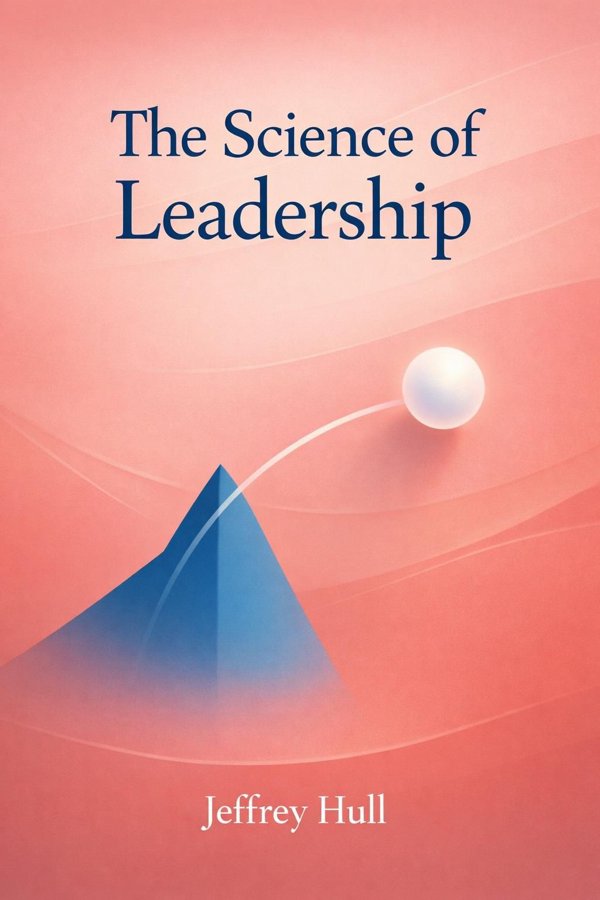
The Science of Leadership: Lessons from Research for Organizational Leaders: Summary & Key Insights
by Jeffrey Hull
 10 min9 chaptersAudio available
Key Takeaways from The Science of Leadership: Lessons from Research for Organizational Leaders
A powerful leadership lesson begins with humility: much of what people believe about leadership is outdated.
Leadership is not just a social skill; it is a biological event happening in real time in the brain.
The leaders who leave the strongest mark are not always the smartest in the room; they are often the most emotionally intelligent.
In unstable environments, the most dangerous sentence a leader can say is, “This is how I always lead.
A leader’s true capacity is often revealed not in calm periods but in moments of strain.
What Is The Science of Leadership: Lessons from Research for Organizational Leaders About?
The Science of Leadership: Lessons from Research for Organizational Leaders by Jeffrey Hull is a leadership book spanning 5 pages. Leadership is often treated as a matter of instinct, charisma, or personality, but Jeffrey Hull argues that effective leadership can be understood, developed, and improved through evidence. In The Science of Leadership, he brings together insights from psychology, neuroscience, and organizational behavior to show what actually helps leaders perform well in complex, fast-changing environments. Rather than relying on vague inspiration or management clichés, Hull focuses on research-backed principles that explain how leaders build trust, regulate emotion, make sound decisions, motivate teams, and adapt under pressure. What makes this book especially valuable is its ability to translate academic findings into practical leadership habits. Hull does not present science as abstract theory; he shows how it applies to meetings, conflict, change initiatives, feedback conversations, hiring decisions, and team culture. His perspective carries weight because he writes as both a psychologist and an executive coach who has worked closely with organizational leaders. The result is a book that bridges the gap between scholarship and practice, helping readers understand not only what great leadership looks like, but why it works and how to build it deliberately.
This FizzRead summary covers all 9 key chapters of The Science of Leadership: Lessons from Research for Organizational Leaders in approximately 10 minutes, distilling the most important ideas, arguments, and takeaways from Jeffrey Hull's work. Also available as an audio summary and Key Quotes Podcast.
The Science of Leadership: Lessons from Research for Organizational Leaders
Leadership is often treated as a matter of instinct, charisma, or personality, but Jeffrey Hull argues that effective leadership can be understood, developed, and improved through evidence. In The Science of Leadership, he brings together insights from psychology, neuroscience, and organizational behavior to show what actually helps leaders perform well in complex, fast-changing environments. Rather than relying on vague inspiration or management clichés, Hull focuses on research-backed principles that explain how leaders build trust, regulate emotion, make sound decisions, motivate teams, and adapt under pressure.
What makes this book especially valuable is its ability to translate academic findings into practical leadership habits. Hull does not present science as abstract theory; he shows how it applies to meetings, conflict, change initiatives, feedback conversations, hiring decisions, and team culture. His perspective carries weight because he writes as both a psychologist and an executive coach who has worked closely with organizational leaders. The result is a book that bridges the gap between scholarship and practice, helping readers understand not only what great leadership looks like, but why it works and how to build it deliberately.
Who Should Read The Science of Leadership: Lessons from Research for Organizational Leaders?
This book is perfect for anyone interested in leadership and looking to gain actionable insights in a short read. Whether you're a student, professional, or lifelong learner, the key ideas from The Science of Leadership: Lessons from Research for Organizational Leaders by Jeffrey Hull will help you think differently.
- ✓Readers who enjoy leadership and want practical takeaways
- ✓Professionals looking to apply new ideas to their work and life
- ✓Anyone who wants the core insights of The Science of Leadership: Lessons from Research for Organizational Leaders in just 10 minutes
Want the full summary?
Get instant access to this book summary and 100K+ more with Fizz Moment.
Get Free SummaryAvailable on App Store • Free to download
Key Chapters
A powerful leadership lesson begins with humility: much of what people believe about leadership is outdated. Early leadership research was dominated by trait theories, which assumed that great leaders were born with fixed characteristics such as confidence, intelligence, or charisma. Later, behavioral theories shifted attention toward what leaders do rather than who they are, emphasizing patterns like task orientation, relationship building, and decision style. Over time, contingency and situational models added another important insight: leadership effectiveness depends on context. A style that works in one team, crisis, or culture may fail in another.
Hull uses this historical progression to make a larger point. Leadership is not a static set of heroic qualities but a dynamic, learnable process shaped by interaction, environment, and purpose. Contemporary research increasingly views leadership as relational and adaptive. It involves influencing people, creating conditions for performance, and responding intelligently to uncertainty rather than simply directing others from above.
This evolution matters in practice. A leader running a startup cannot rely on the same habits as a leader overseeing a mature bureaucracy. A newly formed team may need structure and clarity, while an experienced team may need autonomy and coaching. Likewise, an organization facing disruption requires experimentation and resilience more than rigid command.
Hull’s survey of leadership theory helps readers let go of simplistic myths. The best leaders are not those who force one preferred style onto every challenge, but those who understand multiple frameworks and can use them wisely. Leadership development, then, becomes less about imitating a single ideal and more about building range, judgment, and self-awareness.
Actionable takeaway: Examine your default leadership assumptions and ask whether they fit your current context, team, and goals—or whether a different leadership approach is now required.
Leadership is not just a social skill; it is a biological event happening in real time in the brain. Hull draws on neuroscience to show that leadership decisions, emotional reactions, and interpersonal influence are rooted in neural processes. This matters because many leadership failures do not come from bad intentions but from predictable brain-based responses to stress, threat, and uncertainty.
One of the book’s central insights is that cognition and emotion are inseparable. Leaders often imagine they should be purely rational, yet the brain does not work that way. Emotions influence attention, memory, judgment, and motivation. When people feel threatened, the brain shifts into protective modes that reduce openness, creativity, and trust. A leader who humiliates an employee in a meeting may think they are increasing accountability, but in reality they may be activating defensiveness and narrowing the person’s ability to think clearly.
Neuroscience also helps explain why trust, recognition, and psychological safety matter so much. Positive social experiences can support engagement and collaboration, while chronic ambiguity or fear can erode performance. This means leadership is partly about managing the emotional climate of the workplace. Calm, clarity, and fairness are not soft extras; they directly affect how people process information and respond to challenge.
In practical terms, leaders can use neuroscience by slowing down before reacting, framing difficult change in ways that reduce unnecessary threat, and creating environments where people feel respected and included. For example, explaining the rationale behind a decision and inviting questions can calm anxiety far more effectively than issuing commands without context.
Hull’s larger argument is simple but profound: if leaders want better behavior from others, they must understand the human brain. Influence improves when leaders work with human nature rather than against it.
Actionable takeaway: Before your next high-stakes conversation, ask yourself what emotional state your words are likely to create—and adjust your approach to increase safety, focus, and trust.
The leaders who leave the strongest mark are not always the smartest in the room; they are often the most emotionally intelligent. Hull treats emotional intelligence as a core leadership capability because leadership happens through relationships, and relationships are shaped by emotional awareness, self-regulation, empathy, and social skill.
Emotional intelligence begins with self-awareness. Leaders who cannot recognize their own triggers, moods, and habitual reactions are likely to spread confusion or tension without realizing it. A manager who becomes impatient under pressure may believe they are simply being efficient, while the team experiences them as dismissive or unsafe. Self-awareness makes these patterns visible. Self-regulation then allows leaders to choose a more effective response rather than acting impulsively.
The second major dimension is awareness of others. Empathy does not mean lowering standards or avoiding hard truths. It means understanding what others are experiencing so that communication becomes more accurate and useful. A leader delivering difficult feedback with empathy can maintain accountability while preserving dignity and motivation. Without empathy, even correct feedback may trigger resistance.
Hull also emphasizes emotional intelligence in group settings. Teams read a leader’s emotional signals constantly. If a leader projects calm confidence in uncertainty, people are more likely to stay engaged. If the leader projects panic, cynicism, or defensiveness, those emotions become contagious. In this way, emotional intelligence shapes culture.
Practical applications are everywhere: pausing before responding to criticism, noticing nonverbal cues in meetings, asking clarifying questions in conflict, and reflecting on how one’s presence affects team energy. Emotional intelligence is not image management; it is disciplined attention to the emotional realities that drive behavior.
Hull’s message is that leadership credibility is earned not only through competence but through emotional maturity. People follow leaders who make them feel seen, respected, and capable.
Actionable takeaway: Build a daily habit of emotional check-ins by asking, “What am I feeling, how is it affecting my behavior, and how might others be experiencing me right now?”
In unstable environments, the most dangerous sentence a leader can say is, “This is how I always lead.” Hull argues that adaptability is one of the defining traits of effective modern leadership because organizations now face continuous change, shifting stakeholder demands, technological disruption, and ambiguous problems with no simple playbook.
Adaptability means more than flexibility in scheduling or openness to new ideas. It is the ability to read changing conditions, revise assumptions, and shift behavior without losing direction or values. Research in leadership and organizational behavior shows that leaders who cling too tightly to a single identity or method often fail when the environment changes. What worked during a period of growth may not work during crisis. What worked with one team may not work with another.
Hull connects adaptability with learning agility. Effective leaders treat feedback, surprises, and setbacks as data. Instead of defending past decisions at all costs, they ask what the current reality demands. For example, a leader used to making fast, top-down decisions may need to become more collaborative when solving a cross-functional problem that requires broad expertise. Likewise, a highly consensus-driven leader may need to become more directive during an emergency.
Adaptability also includes emotional resilience. Change creates discomfort, and leaders must tolerate uncertainty without transmitting panic. This does not mean pretending to be invulnerable. It means staying grounded enough to think clearly, communicate honestly, and keep people moving.
A practical example is organizational transformation. Leaders who explain why change is necessary, invite input, and adjust implementation based on real feedback tend to generate more commitment than those who impose sweeping plans with no room for learning. Adaptive leadership recognizes that execution improves when leaders remain responsive.
Actionable takeaway: Identify one leadership habit that serves you well in familiar conditions but may limit you in new ones, and experiment with an alternative behavior this week.
A leader’s true capacity is often revealed not in calm periods but in moments of strain. Hull presents resilience as a critical leadership competence because the modern workplace exposes leaders to constant pressure: uncertainty, overload, conflict, rapid change, and the emotional demands of managing others. Resilience is not simply endurance or toughness. It is the ability to recover, stay effective, and continue learning under stress.
Research shows that prolonged stress impairs judgment, reduces empathy, narrows attention, and increases reactivity. In other words, stress does not merely feel unpleasant; it can directly undermine leadership quality. Resilient leaders understand this and develop habits that protect their cognitive and emotional functioning. They create space for reflection, maintain perspective, manage energy, and avoid making every challenge feel like a catastrophe.
Hull pushes back against the glorification of burnout. Constant overextension may look like commitment in the short term, but over time it damages decision-making, relationships, and health. Sustainable leadership requires recovery. This includes practical behaviors such as setting boundaries, prioritizing intelligently, delegating effectively, and building support networks. Resilience is also social. Leaders recover faster when they are connected to trusted peers, mentors, or teams where they can process pressure honestly.
The book also frames resilience as meaning-making. People cope better when they understand what they are working toward. Leaders who can connect setbacks to a larger purpose help both themselves and others persist. During restructuring, for example, employees may tolerate discomfort more effectively if leaders acknowledge the strain, communicate transparently, and reinforce the long-term mission.
Hull’s perspective is especially valuable because it treats resilience not as a personality trait but as a set of practices. Leaders can cultivate it deliberately through awareness, recovery, perspective, and support.
Actionable takeaway: Choose one resilience ritual—such as protected reflection time, improved recovery habits, or regular peer support—and make it a non-negotiable part of your leadership routine.
Organizations often speak about diversity as a moral value, but Hull makes clear that it is also a leadership performance issue. Diverse teams, when led well, can generate better decisions, broader insight, and stronger innovation because they bring different perspectives, experiences, and ways of interpreting problems. Homogeneous groups may feel smoother in the short term, but they are more vulnerable to blind spots, conformity, and overconfidence.
The challenge is that diversity alone is not enough. Without inclusion, difference can become friction rather than strength. Inclusion means creating conditions where people feel safe contributing their views, where dissent is welcomed rather than punished, and where status does not silence insight. Leaders play a central role in whether diversity becomes an asset or a missed opportunity.
Hull encourages leaders to examine the subtle dynamics that shape participation. Who speaks first in meetings? Whose ideas are repeated and credited? Who gets stretch assignments, feedback, and visibility? Bias often operates through habits that seem small but accumulate into unequal opportunity and reduced trust. Evidence-based leadership requires paying attention to these patterns rather than assuming fairness automatically exists.
A practical example can be seen in decision-making. A leader can improve inclusion by inviting input from quieter members before finalizing a conclusion, rotating who leads discussions, or using structured processes that reduce the influence of hierarchy. In hiring, leaders can widen candidate pipelines and standardize evaluation criteria to reduce subjective bias. In team development, they can normalize respectful disagreement and ensure different communication styles are recognized as valid.
Hull’s contribution here is to connect diversity and inclusion directly to leadership effectiveness. Better leadership is not just about inspiring people who think like us; it is about unlocking the intelligence of people who do not.
Actionable takeaway: In your next team meeting, deliberately create space for underheard voices and measure whether the group’s thinking becomes broader, sharper, and more creative.
Few leadership tools are more valuable—or more misused—than feedback. Hull argues that organizations only become more capable when leaders create feedback-rich environments where people can learn quickly, adjust behavior, and improve performance. Yet many leaders either avoid feedback because it feels uncomfortable or deliver it so poorly that it triggers shame instead of development.
Research shows that feedback is most effective when it is specific, timely, behavior-focused, and tied to a clear standard or goal. Vague comments like “be more strategic” or “improve your communication” are too abstract to help. Useful feedback identifies observable behavior, explains its impact, and points toward improvement. For example, a leader might say, “In today’s meeting, you answered questions quickly, but you did not invite input from the operations team. That may have reduced buy-in. Next time, pause and ask for their perspective before deciding.”
Hull also emphasizes that feedback must flow in multiple directions. Senior leaders who only give feedback but never receive it become insulated from reality. Teams perform better when employees can safely tell leaders what is helping, what is confusing, and what needs to change. This requires psychological safety and humility. Leaders must model that feedback is a resource, not a threat.
Another important insight is that effective feedback is developmental rather than purely evaluative. The goal is not simply to judge past performance but to enable future growth. This shifts conversations from blame to learning. A leader can ask, “What did we learn from this?” rather than “Who failed?” and thereby improve both accountability and morale.
When done well, feedback creates trust because it shows investment in improvement. People generally do not resent honest guidance; they resent ambiguity, neglect, or criticism delivered without care.
Actionable takeaway: Before giving feedback, prepare one concrete behavior, one clear impact, and one practical next step so the conversation leads to learning rather than defensiveness.
Teams do not perform at their best simply because talented people are assembled in one place. Hull highlights a central finding from organizational research: trust and psychological safety are foundational conditions for collaboration, learning, and execution. When people fear embarrassment, punishment, or exclusion, they withhold questions, hide mistakes, and avoid taking intelligent risks. Performance suffers not because employees lack skill, but because the environment suppresses contribution.
Trust begins with consistency. Leaders build it when their words align with their actions, when decisions are explained fairly, and when people know what to expect from them. Safety grows when leaders respond constructively to bad news, uncertainty, and disagreement. If a team member raises a problem and is blamed or dismissed, others quickly learn to stay silent. If the same concern is met with curiosity and problem-solving, openness expands.
Hull shows that psychological safety is not about lowering standards or making work comfortable at all times. In fact, high-performing teams often combine safety with clear expectations and candid dialogue. The difference is that challenge occurs within a climate of respect. People can question assumptions, admit confusion, and test ideas without fearing personal humiliation.
A practical example is the leader who opens meetings by asking what risks the team may be overlooking or what assumptions may need to be challenged. Another is the manager who publicly takes responsibility for a flawed decision, signaling that learning matters more than ego. These small acts can reshape group norms over time.
In uncertain environments, trust becomes even more important because people rely on leaders for orientation. When trust is strong, teams can move faster, recover from mistakes more quickly, and coordinate more effectively across differences.
Actionable takeaway: In your next team interaction, reward candor by responding to disagreement or bad news with curiosity first, not judgment, so people learn that honesty is safe and useful.
One of Hull’s most important themes is that leadership should be treated less like a fixed identity and more like an ongoing discipline of inquiry. Evidence-based leadership means using research, reflection, and real-world feedback to guide action instead of relying solely on intuition, tradition, or authority. This does not mean leaders must become academics. It means they should become more curious, more skeptical of easy answers, and more committed to learning from results.
Many organizations continue to use leadership methods because they are familiar, not because they work. Hull challenges leaders to ask better questions: What does the evidence say about motivation? Which coaching practices improve performance? How do teams actually respond to change? This mindset reduces the influence of fad-driven management and encourages smarter experimentation.
Continuous learning also requires self-examination. Leaders need mechanisms for seeing themselves clearly, whether through coaching, 360-degree feedback, journaling, peer dialogue, or structured reflection after major decisions. Without such practices, experience alone can reinforce bad habits. People do not automatically improve just because they spend more years in leadership roles; they improve when they extract learning from those years.
A practical application is after-action review. Following a product launch, conflict, or strategic initiative, an evidence-based leader gathers the team to discuss what happened, why it happened, and what should change next time. This turns experience into knowledge. Another application is testing assumptions before rolling out policy changes rather than assuming seniority guarantees accuracy.
Hull ultimately presents leadership as a craft sharpened by disciplined learning. The leaders most likely to succeed in complex environments are not those who claim certainty, but those who update their understanding continuously while staying anchored in values and purpose.
Actionable takeaway: Adopt one formal learning practice—such as regular reflection, 360 feedback, or after-action reviews—to ensure your leadership improves through evidence, not just repetition.
All Chapters in The Science of Leadership: Lessons from Research for Organizational Leaders
About the Author
Jeffrey Hull, Ph.D., is a psychologist, executive coach, and leadership scholar known for translating behavioral science into practical tools for organizational leaders. He serves as a clinical instructor in psychology at Harvard Medical School and has been closely involved with leadership and coaching development through the Institute of Coaching at McLean Hospital. Hull has worked with senior executives, teams, and organizations across industries, helping them strengthen emotional intelligence, communication, adaptability, and performance. His work sits at the intersection of psychology, neuroscience, and organizational effectiveness, giving him a distinctive voice in the leadership field. In The Science of Leadership, he draws on both rigorous research and real-world coaching experience to show how leaders can become more effective, self-aware, and evidence-driven.
Get This Summary in Your Preferred Format
Read or listen to the The Science of Leadership: Lessons from Research for Organizational Leaders summary by Jeffrey Hull anytime, anywhere. FizzRead offers multiple formats so you can learn on your terms — all free.
Available formats: App · Audio · PDF · EPUB — All included free with FizzRead
Download The Science of Leadership: Lessons from Research for Organizational Leaders PDF and EPUB Summary
Key Quotes from The Science of Leadership: Lessons from Research for Organizational Leaders
“A powerful leadership lesson begins with humility: much of what people believe about leadership is outdated.”
“Leadership is not just a social skill; it is a biological event happening in real time in the brain.”
“The leaders who leave the strongest mark are not always the smartest in the room; they are often the most emotionally intelligent.”
“In unstable environments, the most dangerous sentence a leader can say is, “This is how I always lead.”
“A leader’s true capacity is often revealed not in calm periods but in moments of strain.”
Frequently Asked Questions about The Science of Leadership: Lessons from Research for Organizational Leaders
The Science of Leadership: Lessons from Research for Organizational Leaders by Jeffrey Hull is a leadership book that explores key ideas across 9 chapters. Leadership is often treated as a matter of instinct, charisma, or personality, but Jeffrey Hull argues that effective leadership can be understood, developed, and improved through evidence. In The Science of Leadership, he brings together insights from psychology, neuroscience, and organizational behavior to show what actually helps leaders perform well in complex, fast-changing environments. Rather than relying on vague inspiration or management clichés, Hull focuses on research-backed principles that explain how leaders build trust, regulate emotion, make sound decisions, motivate teams, and adapt under pressure. What makes this book especially valuable is its ability to translate academic findings into practical leadership habits. Hull does not present science as abstract theory; he shows how it applies to meetings, conflict, change initiatives, feedback conversations, hiring decisions, and team culture. His perspective carries weight because he writes as both a psychologist and an executive coach who has worked closely with organizational leaders. The result is a book that bridges the gap between scholarship and practice, helping readers understand not only what great leadership looks like, but why it works and how to build it deliberately.
You Might Also Like

Extreme Ownership
Jocko Willink
10 min
Dare to Lead
Brene Brown
10 min
Leaders Eat Last
Simon Sinek
10 min
The 21 Irrefutable Laws of Leadership
John Maxwell
10 min
Start With Why
Simon Sinek
10 min
How to Lead When You're Not in Charge
Clay Scroggins
10 minBrowse by Category
Ready to read The Science of Leadership: Lessons from Research for Organizational Leaders?
Get the full summary and 100K+ more books with Fizz Moment.