
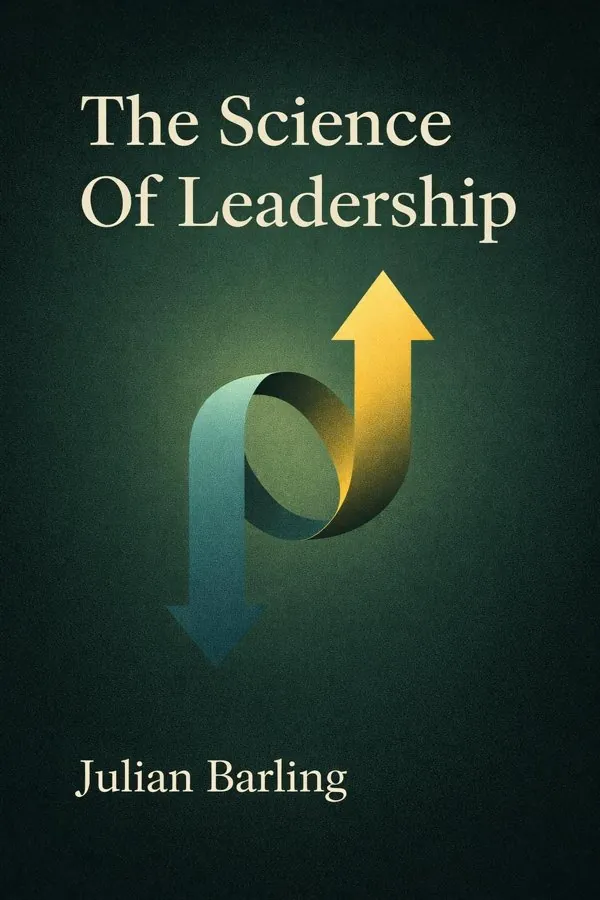
The Science Of Leadership: Summary & Key Insights
 10 min5 chaptersAudio available
What Is The Science Of Leadership About?
The Science Of Leadership by Julian Barling is a leadership book spanning 5 pages. The Science of Leadership es una obra que sintetiza más de cincuenta años de investigación sobre el liderazgo organizacional. Julian Barling explora cómo los líderes influyen en el rendimiento individual, de equipo y organizacional, basándose en evidencia empírica y estudios científicos. El libro ofrece una visión integral de las prácticas de liderazgo efectivas, la psicología del liderazgo y las dinámicas interpersonales que impulsan el éxito en las organizaciones.
This FizzRead summary covers all 5 key chapters of The Science Of Leadership in approximately 10 minutes, distilling the most important ideas, arguments, and takeaways from Julian Barling's work. Also available as an audio summary and Key Quotes Podcast.
The Science Of Leadership
The Science of Leadership es una obra que sintetiza más de cincuenta años de investigación sobre el liderazgo organizacional. Julian Barling explora cómo los líderes influyen en el rendimiento individual, de equipo y organizacional, basándose en evidencia empírica y estudios científicos. El libro ofrece una visión integral de las prácticas de liderazgo efectivas, la psicología del liderazgo y las dinámicas interpersonales que impulsan el éxito en las organizaciones.
Who Should Read The Science Of Leadership?
This book is perfect for anyone interested in leadership and looking to gain actionable insights in a short read. Whether you're a student, professional, or lifelong learner, the key ideas from The Science Of Leadership by Julian Barling will help you think differently.
- ✓Readers who enjoy leadership and want practical takeaways
- ✓Professionals looking to apply new ideas to their work and life
- ✓Anyone who wants the core insights of The Science Of Leadership in just 10 minutes
Want the full summary?
Get instant access to this book summary and 100K+ more with Fizz Moment.
Get Free SummaryAvailable on App Store • Free to download
Key Chapters
When scholarship on leadership first gained momentum in the early twentieth century, it was dominated by what we call the trait perspective—the belief that leaders are born, not made. Researchers sought to identify universal characteristics that distinguished great leaders from the rest: intelligence, dominance, confidence, charisma. Yet despite years of effort, the trait approach yielded inconsistent results. Success varied by situation, suggesting that context mattered at least as much as personal attributes.
This realization led to the behavioral era. We began examining what leaders actually do—their patterns of initiating structure, considering employee needs, and facilitating participation. Landmark studies at Ohio State and the University of Michigan revealed that effective leadership involves both task-oriented and people-oriented behaviors. Still, even behavioral models could not explain why some leaders thrive in crises while others excel in stable environments.
Out of this empirical puzzlement arose contingency theories. Fred Fiedler’s model, for example, mathematically linked leadership style to situational favorableness. Others, such as Hersey and Blanchard, proposed that flexibility—adapting one's approach to followers’ readiness—was key. Across these decades, the research narrative evolved from searching for universal traits toward recognizing that leadership effectiveness depends on a dynamic interplay between leader behavior and environmental context.
For me, this evolution underscored a crucial scientific truth: leadership is complex but not chaotic. Patterns exist, and through careful investigation we can distinguish what works where. This movement toward situational understanding laid the groundwork for today’s sophisticated empirical models of transformational and transactional leadership.
By the 1980s and 1990s, a new paradigm began reshaping how scholars and practitioners understood influence. Bernard Bass and James MacGregor Burns articulated two complementary forms of leadership: transactional and transformational. Transactional leadership emphasizes exchanges—the leader clarifies expectations, monitors performance, and rewards or disciplines accordingly. Transformational leadership, in contrast, uplifts followers by aligning them with higher ideals, inspiring commitment beyond mere compliance.
My own engagement with this literature revealed striking insights. Meta-analyses repeatedly show that transformational leadership correlates strongly with follower satisfaction, motivation, and performance across industries and cultures. What makes it powerful is the psychological process it ignites: followers internalize the leader’s vision and integrate it into their sense of purpose. Transactional leadership is not obsolete—it remains effective for maintaining structure and consistency—but it lacks transformational leadership’s capacity to elevate moral and emotional engagement.
Empirical studies of both dimensions show measurable impacts. In healthcare settings, transformational leadership improves patient safety because nurses feel empowered rather than monitored. In manufacturing contexts, transactional leadership supports reliability and efficiency. Together, these styles represent a continuum rather than a dichotomy; the most effective leaders exhibit flexibility, combining motivation through vision with accountability through clear expectations.
I advocate this integrated view because it reflects the reality of human motivation. Motivation is partly instrumental, partly inspirational. The science of leadership teaches that both forces must coexist in balance for organizations to thrive.
+ 3 more chapters — available in the FizzRead app
All Chapters in The Science Of Leadership
About the Author
Julian Barling es profesor de comportamiento organizacional en la Smith School of Business de la Queen’s University en Canadá. Es reconocido internacionalmente por su investigación sobre liderazgo, comportamiento organizacional y bienestar en el trabajo.
Get This Summary in Your Preferred Format
Read or listen to the The Science Of Leadership summary by Julian Barling anytime, anywhere. FizzRead offers multiple formats so you can learn on your terms — all free.
Available formats: App · Audio · PDF · EPUB — All included free with FizzRead
Download The Science Of Leadership PDF and EPUB Summary
Key Quotes from The Science Of Leadership
“When scholarship on leadership first gained momentum in the early twentieth century, it was dominated by what we call the trait perspective—the belief that leaders are born, not made.”
“By the 1980s and 1990s, a new paradigm began reshaping how scholars and practitioners understood influence.”
Frequently Asked Questions about The Science Of Leadership
The Science Of Leadership by Julian Barling is a leadership book that explores key ideas across 5 chapters. The Science of Leadership es una obra que sintetiza más de cincuenta años de investigación sobre el liderazgo organizacional. Julian Barling explora cómo los líderes influyen en el rendimiento individual, de equipo y organizacional, basándose en evidencia empírica y estudios científicos. El libro ofrece una visión integral de las prácticas de liderazgo efectivas, la psicología del liderazgo y las dinámicas interpersonales que impulsan el éxito en las organizaciones.
You Might Also Like

Extreme Ownership
Jocko Willink
10 min
Dare to Lead
Brene Brown
10 min
Leaders Eat Last
Simon Sinek
10 min
The 21 Irrefutable Laws of Leadership
John Maxwell
10 min
Start With Why
Simon Sinek
10 min
How to Lead When You're Not in Charge
Clay Scroggins
10 minBrowse by Category
Ready to read The Science Of Leadership?
Get the full summary and 100K+ more books with Fizz Moment.