
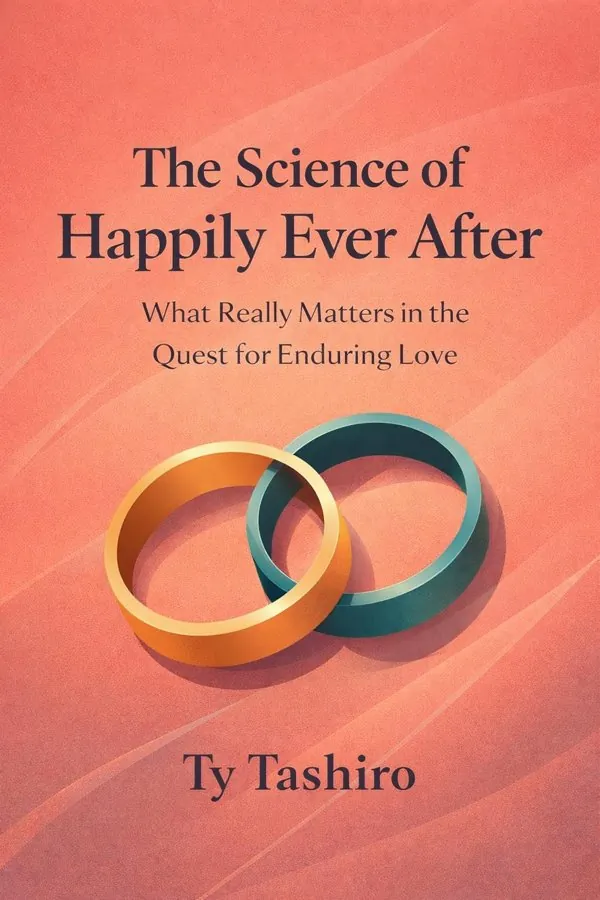
The Science of Happily Ever After: What Really Matters in the Quest for Enduring Love: Summary & Key Insights
by Ty Tashiro
 10 min9 chaptersAudio available
What Is The Science of Happily Ever After: What Really Matters in the Quest for Enduring Love About?
The Science of Happily Ever After: What Really Matters in the Quest for Enduring Love by Ty Tashiro is a psychology book spanning 9 pages. In this engaging exploration of love and relationships, psychologist Ty Tashiro applies scientific research to explain why so many people struggle to find lasting happiness in romance. Drawing on findings from psychology, sociology, and behavioral science, Tashiro reveals how our choices in partners often reflect unrealistic expectations and cognitive biases. He offers practical insights into how understanding these patterns can help individuals make wiser decisions in love and build more enduring, fulfilling relationships.
This FizzRead summary covers all 9 key chapters of The Science of Happily Ever After: What Really Matters in the Quest for Enduring Love in approximately 10 minutes, distilling the most important ideas, arguments, and takeaways from Ty Tashiro's work. Also available as an audio summary and Key Quotes Podcast.
The Science of Happily Ever After: What Really Matters in the Quest for Enduring Love
In this engaging exploration of love and relationships, psychologist Ty Tashiro applies scientific research to explain why so many people struggle to find lasting happiness in romance. Drawing on findings from psychology, sociology, and behavioral science, Tashiro reveals how our choices in partners often reflect unrealistic expectations and cognitive biases. He offers practical insights into how understanding these patterns can help individuals make wiser decisions in love and build more enduring, fulfilling relationships.
Who Should Read The Science of Happily Ever After: What Really Matters in the Quest for Enduring Love?
This book is perfect for anyone interested in psychology and looking to gain actionable insights in a short read. Whether you're a student, professional, or lifelong learner, the key ideas from The Science of Happily Ever After: What Really Matters in the Quest for Enduring Love by Ty Tashiro will help you think differently.
- ✓Readers who enjoy psychology and want practical takeaways
- ✓Professionals looking to apply new ideas to their work and life
- ✓Anyone who wants the core insights of The Science of Happily Ever After: What Really Matters in the Quest for Enduring Love in just 10 minutes
Want the full summary?
Get instant access to this book summary and 100K+ more with Fizz Moment.
Get Free SummaryAvailable on App Store • Free to download
Key Chapters
We often imagine our choice of a partner as deeply personal—a matter of instinct, chemistry, or fate. Yet psychological research shows our decisions are far more predictable and influenced by biases than we think. When I began investigating how men and women choose partners, I found patterns that echoed across data sets. People tend to misjudge what will make them happy in the long run. They confuse traits that attract initial attention with those that build security and satisfaction.
For instance, we are heavily swayed by the availability heuristic—the mental shortcut that makes us believe what we most frequently see or hear is most desirable. Films, songs, and stories tell us that physical attraction and passion are the core of lasting love, but empirically, these predictors fade over time. Another bias, the optimism bias, convinces us that we are the exceptions to common outcomes. When studies reveal divorce rates or patterns of dissatisfaction, many think: 'That won’t happen to me.' This bias blinds us to genuine risk.
Scientific data tells a sobering truth: making poor choices in romantic partners is rarely due to lack of intelligence—it stems from cognitive tendencies that prioritize short-term gratification. Attraction, novelty, excitement—all activate reward circuits in the brain, leading us to select partners who gratify immediate desire rather than lasting compatibility. Real wisdom in love begins when you understand the kind of choices that are sustainable. Psychology teaches us that conscious choice—setting criteria, understanding trade-offs—is not cold or calculating. It’s the foundation of contentment. Love flourishes when decisions are guided by clarity rather than impulse.
One of my favorite metaphors for wise partner selection comes from fairy tales. I ask readers to imagine they have three wishes for traits in a partner—only three. Modern dating culture makes us believe we can have everything: beauty, humor, financial success, kindness, passion, stability. But in reality, every additional wish costs something else. Science shows that perfection is unattainable because human compatibility depends on trade-offs.
When I designed the 'Three Wishes' framework, it came from statistical insights: if people prioritize about three core qualities they truly value, their chances of long-term satisfaction increase dramatically. The three wishes concept forces you to articulate what genuinely matters. Maybe you value emotional stability, kindness, and intellectual curiosity. Or perhaps honesty, humor, and a shared sense of purpose. What matters is that you choose consciously, knowing each additional item has diminishing returns.
The data shows that people who focus on too many ideals stretch themselves thin chasing fantasy partners who rarely exist. Instead, narrowing your priorities helps you recognize when someone embodies what you actually need rather than what culture tells you is desirable. From this framework arises the understanding that good relationships are about fit, not perfection. When you stop searching for a flawless person and start appreciating someone whose strengths align with your essential values, you create a foundation that can weather time and change. The science is clear: fewer wishes lead to better choices.
+ 7 more chapters — available in the FizzRead app
All Chapters in The Science of Happily Ever After: What Really Matters in the Quest for Enduring Love
About the Author
Ty Tashiro, Ph.D., is an American psychologist and author known for translating psychological research into practical insights about relationships and personal growth. He earned his doctorate in psychology from the University of Minnesota and has taught at the University of Maryland and the University of Colorado. His work focuses on the science of relationships, happiness, and human behavior.
Get This Summary in Your Preferred Format
Read or listen to the The Science of Happily Ever After: What Really Matters in the Quest for Enduring Love summary by Ty Tashiro anytime, anywhere. FizzRead offers multiple formats so you can learn on your terms — all free.
Available formats: App · Audio · PDF · EPUB — All included free with FizzRead
Download The Science of Happily Ever After: What Really Matters in the Quest for Enduring Love PDF and EPUB Summary
Key Quotes from The Science of Happily Ever After: What Really Matters in the Quest for Enduring Love
“We often imagine our choice of a partner as deeply personal—a matter of instinct, chemistry, or fate.”
“One of my favorite metaphors for wise partner selection comes from fairy tales.”
Frequently Asked Questions about The Science of Happily Ever After: What Really Matters in the Quest for Enduring Love
The Science of Happily Ever After: What Really Matters in the Quest for Enduring Love by Ty Tashiro is a psychology book that explores key ideas across 9 chapters. In this engaging exploration of love and relationships, psychologist Ty Tashiro applies scientific research to explain why so many people struggle to find lasting happiness in romance. Drawing on findings from psychology, sociology, and behavioral science, Tashiro reveals how our choices in partners often reflect unrealistic expectations and cognitive biases. He offers practical insights into how understanding these patterns can help individuals make wiser decisions in love and build more enduring, fulfilling relationships.
You Might Also Like
The Body Keeps the Score
Bessel van der Kolk
10 min
Surrounded by Idiots
Thomas Erikson
10 min
Emotional Intelligence
Daniel Goleman
10 min
Attached
Amir Levine
10 min
Why Does He Do That
Lundy Bancroft
10 min
Women Who Run with the Wolves
Clarissa Pinkola Estés
10 minBrowse by Category
Ready to read The Science of Happily Ever After: What Really Matters in the Quest for Enduring Love?
Get the full summary and 100K+ more books with Fizz Moment.