
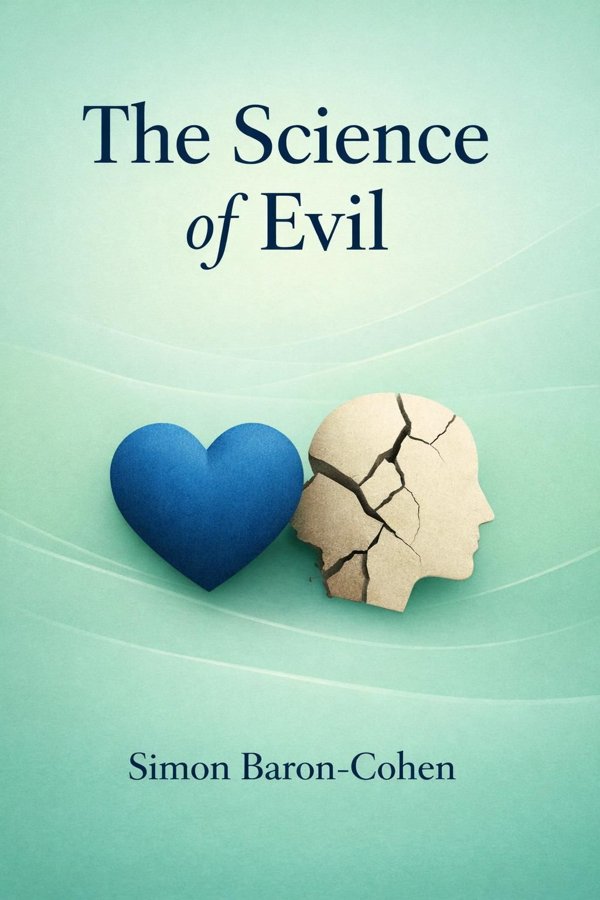
The Science of Evil: On Empathy and the Origins of Cruelty: Summary & Key Insights
 10 min10 chaptersAudio available
What Is The Science of Evil: On Empathy and the Origins of Cruelty About?
The Science of Evil: On Empathy and the Origins of Cruelty by Simon Baron-Cohen is a psychology book spanning 10 pages. In this book, Simon Baron-Cohen explores the psychological and neurological roots of human cruelty. He proposes that evil can be understood as a breakdown of empathy, examining how empathy functions in the brain and how its absence leads to acts of harm. Drawing on research in psychology, neuroscience, and genetics, Baron-Cohen offers a scientific framework for understanding moral behavior and the nature of compassion.
This FizzRead summary covers all 10 key chapters of The Science of Evil: On Empathy and the Origins of Cruelty in approximately 10 minutes, distilling the most important ideas, arguments, and takeaways from Simon Baron-Cohen's work. Also available as an audio summary and Key Quotes Podcast.
The Science of Evil: On Empathy and the Origins of Cruelty
In this book, Simon Baron-Cohen explores the psychological and neurological roots of human cruelty. He proposes that evil can be understood as a breakdown of empathy, examining how empathy functions in the brain and how its absence leads to acts of harm. Drawing on research in psychology, neuroscience, and genetics, Baron-Cohen offers a scientific framework for understanding moral behavior and the nature of compassion.
Who Should Read The Science of Evil: On Empathy and the Origins of Cruelty?
This book is perfect for anyone interested in psychology and looking to gain actionable insights in a short read. Whether you're a student, professional, or lifelong learner, the key ideas from The Science of Evil: On Empathy and the Origins of Cruelty by Simon Baron-Cohen will help you think differently.
- ✓Readers who enjoy psychology and want practical takeaways
- ✓Professionals looking to apply new ideas to their work and life
- ✓Anyone who wants the core insights of The Science of Evil: On Empathy and the Origins of Cruelty in just 10 minutes
Want the full summary?
Get instant access to this book summary and 100K+ more with Fizz Moment.
Get Free SummaryAvailable on App Store • Free to download
Key Chapters
Empathy, as I define it, involves two distinct but interconnected processes: cognitive empathy and affective empathy. Cognitive empathy is the ability to recognize and infer what someone else is thinking or feeling. It is the intellectual identification of another’s mental state. Affective empathy, by contrast, is our emotional resonance—the capacity to feel what another feels, to share their joy or pain. These two dimensions are separable yet interdependent. One can understand another’s sadness without feeling it; likewise, one can feel distress at another’s suffering without fully grasping the reasons behind it.
Empathy is not synonymous with kindness, nor is its absence synonymous with cruelty. It is a lens through which we perceive others. Like vision, it can be clear or blurred, narrow or expansive. Psychological and neurological studies reveal that empathy involves multiple brain regions: the medial prefrontal cortex allows us to step into another’s shoes, while the orbitofrontal cortex and amygdala help us translate that understanding into appropriate emotional response.
When I map empathy scientifically, I picture it as a dynamic system, not a static trait. Our empathic functioning varies depending on stress, social context, hormones, and even sleep. There are moments in daily life when empathy diminishes temporarily—we snap at loved ones under pressure, overlook suffering when we are preoccupied, or fail to register another’s distress in a crowd. Recognizing the fragility of empathy is key to understanding how cruelty can arise in ordinary circumstances.
The central thesis of my book is straightforward: acts of cruelty are the result of empathy erosion. When empathy diminishes, our ability to treat others as full human beings is compromised. The erosion can be transient—caused by stress, trauma, or ideologically driven detachment—or it can be chronic, embedded in personality or neurological dysfunction.
Empathy erosion explains how ordinary people can participate in acts of harm when social forces diminish their capacity to emotionally connect with others. It provides a scientific framework for atrocities that moral philosophy alone struggles to account for. Under extreme stress or ideological conditioning, entire groups can undergo collective empathy erosion, as seen in genocides, systemic oppression, or institutional neglect.
This model also reframes cruelty in a way that avoids moral dichotomy. Rather than labeling a person as 'evil,' I urge you to see the erosion of empathy as a measurable psychological process. Understanding empathy scientifically makes compassion more actionable. It becomes something that can be studied, restored, and strengthened, rather than merely preached.
+ 8 more chapters — available in the FizzRead app
All Chapters in The Science of Evil: On Empathy and the Origins of Cruelty
About the Author
Simon Baron-Cohen is a British clinical psychologist and professor of developmental psychopathology at the University of Cambridge. He is known for his pioneering research on autism, empathy, and theory of mind, and has authored several influential books in psychology and cognitive science.
Get This Summary in Your Preferred Format
Read or listen to the The Science of Evil: On Empathy and the Origins of Cruelty summary by Simon Baron-Cohen anytime, anywhere. FizzRead offers multiple formats so you can learn on your terms — all free.
Available formats: App · Audio · PDF · EPUB — All included free with FizzRead
Download The Science of Evil: On Empathy and the Origins of Cruelty PDF and EPUB Summary
Key Quotes from The Science of Evil: On Empathy and the Origins of Cruelty
“Empathy, as I define it, involves two distinct but interconnected processes: cognitive empathy and affective empathy.”
“The central thesis of my book is straightforward: acts of cruelty are the result of empathy erosion.”
Frequently Asked Questions about The Science of Evil: On Empathy and the Origins of Cruelty
The Science of Evil: On Empathy and the Origins of Cruelty by Simon Baron-Cohen is a psychology book that explores key ideas across 10 chapters. In this book, Simon Baron-Cohen explores the psychological and neurological roots of human cruelty. He proposes that evil can be understood as a breakdown of empathy, examining how empathy functions in the brain and how its absence leads to acts of harm. Drawing on research in psychology, neuroscience, and genetics, Baron-Cohen offers a scientific framework for understanding moral behavior and the nature of compassion.
You Might Also Like
The Body Keeps the Score
Bessel van der Kolk
10 min
Surrounded by Idiots
Thomas Erikson
10 min
Emotional Intelligence
Daniel Goleman
10 min
Attached
Amir Levine
10 min
Why Does He Do That
Lundy Bancroft
10 min
Women Who Run with the Wolves
Clarissa Pinkola Estés
10 minBrowse by Category
Ready to read The Science of Evil: On Empathy and the Origins of Cruelty?
Get the full summary and 100K+ more books with Fizz Moment.