
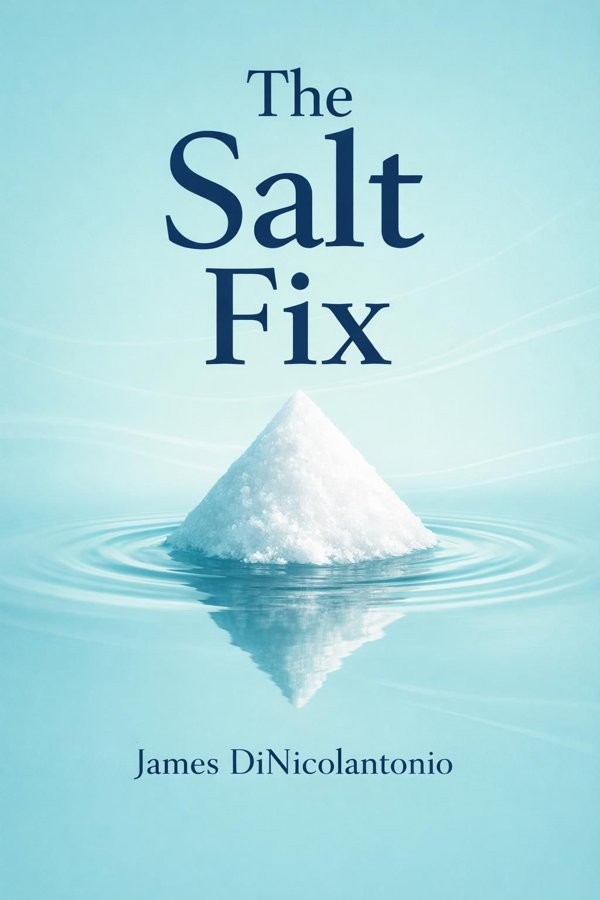
The Salt Fix: Why the Experts Got It All Wrong—and How Eating More Salt Can Save Your Life: Summary & Key Insights
 10 min10 chaptersAudio available
What Is The Salt Fix: Why the Experts Got It All Wrong—and How Eating More Salt Can Save Your Life About?
The Salt Fix: Why the Experts Got It All Wrong—and How Eating More Salt Can Save Your Life by James DiNicolantonio is a health_med book spanning 10 pages. In this groundbreaking work, cardiovascular research scientist James DiNicolantonio challenges decades of conventional wisdom about salt consumption. He argues that the widespread belief that salt is harmful is based on flawed science and that reducing salt intake may actually increase health risks. Drawing on extensive research and clinical evidence, DiNicolantonio explains how salt is essential for maintaining energy, hydration, and overall well-being, and offers practical guidance for restoring balance in the modern diet.
This FizzRead summary covers all 10 key chapters of The Salt Fix: Why the Experts Got It All Wrong—and How Eating More Salt Can Save Your Life in approximately 10 minutes, distilling the most important ideas, arguments, and takeaways from James DiNicolantonio's work. Also available as an audio summary and Key Quotes Podcast.
The Salt Fix: Why the Experts Got It All Wrong—and How Eating More Salt Can Save Your Life
In this groundbreaking work, cardiovascular research scientist James DiNicolantonio challenges decades of conventional wisdom about salt consumption. He argues that the widespread belief that salt is harmful is based on flawed science and that reducing salt intake may actually increase health risks. Drawing on extensive research and clinical evidence, DiNicolantonio explains how salt is essential for maintaining energy, hydration, and overall well-being, and offers practical guidance for restoring balance in the modern diet.
Who Should Read The Salt Fix: Why the Experts Got It All Wrong—and How Eating More Salt Can Save Your Life?
This book is perfect for anyone interested in health_med and looking to gain actionable insights in a short read. Whether you're a student, professional, or lifelong learner, the key ideas from The Salt Fix: Why the Experts Got It All Wrong—and How Eating More Salt Can Save Your Life by James DiNicolantonio will help you think differently.
- ✓Readers who enjoy health_med and want practical takeaways
- ✓Professionals looking to apply new ideas to their work and life
- ✓Anyone who wants the core insights of The Salt Fix: Why the Experts Got It All Wrong—and How Eating More Salt Can Save Your Life in just 10 minutes
Want the full summary?
Get instant access to this book summary and 100K+ more with Fizz Moment.
Get Free SummaryAvailable on App Store • Free to download
Key Chapters
The fear of salt is not as ancient as you might imagine. For most of human history, salt was treasured—so valuable it spurred trade routes, wars, and the development of entire civilizations. People instinctively understood their body’s craving for it. It was only in the twentieth century, particularly after the rise of chronic diseases in industrialized nations, that sodium began to attract suspicion. Large-scale epidemiological studies tried to link salt intake with hypertension, and early results—often conducted without rigorous dietary controls—seemed to show correlation. Over time, these correlations were treated as proofs, even though causation remained uncertain.
Government policies amplified the chorus. The 1977 U.S. Dietary Goals and subsequent recommendations from major health organizations began urging citizens to reduce their salt consumption dramatically. The guidelines were based more on theoretical extrapolation than on clinical validation; they failed to consider that too little sodium could be just as dangerous as too much. Scientific nuance vanished in public discourse. Salt became the easy villain for a problem with far more complex roots—insulin resistance, sugar consumption, sedentary living, and nutrient imbalance. In examining this history, I found a startling truth: we didn’t vilify salt because science demanded it, but because it made for a convenient scapegoat in a world desperate for simple dietary solutions.
Your body is a masterpiece of sodium regulation. Every thought, muscle contraction, heartbeat, and nerve transmission relies on the delicate dance of sodium and chloride ions. Without adequate salt, cells cannot maintain their electrochemical balance, and systems begin to falter. Sodium helps pull water into tissues, sustaining blood volume, and enabling circulation. Chloride stabilizes hydration and supports digestion by contributing to the production of stomach acid. It’s no exaggeration to say life depends on salt.
Through my research, I came to appreciate that salt does far more than affect blood pressure—it interacts intricately with hormones like aldosterone and renin, helps manage insulin and glucose, and influences the balance of other electrolytes, especially potassium and magnesium. A low-salt state triggers stress signals within the body, pushing it to conserve sodium at all costs. This response raises levels of stress hormones and compromises energy, often leading people to feel fatigued, dizzy, or irritable. When we understand the basic physiology, it becomes clear that adequate salt is not indulgence—it is survival.
The claims that our modern sodium intake far exceeds biological need overlook our body’s adaptability and the high salt turnover associated with physical activity, heat exposure, or carbohydrate-heavy diets. Indeed, the optimal amount of salt is not a fixed number but a flexible range determined through natural feedback mechanisms. Listening to those cues—cravings, energy levels, hydration—is the rational approach to maintaining balance.
+ 8 more chapters — available in the FizzRead app
All Chapters in The Salt Fix: Why the Experts Got It All Wrong—and How Eating More Salt Can Save Your Life
About the Author
James DiNicolantonio is a cardiovascular research scientist and doctor of pharmacy known for his work on nutrition and heart health. He has published numerous scientific papers and is a frequent contributor to medical journals and health media, advocating evidence-based approaches to diet and wellness.
Get This Summary in Your Preferred Format
Read or listen to the The Salt Fix: Why the Experts Got It All Wrong—and How Eating More Salt Can Save Your Life summary by James DiNicolantonio anytime, anywhere. FizzRead offers multiple formats so you can learn on your terms — all free.
Available formats: App · Audio · PDF · EPUB — All included free with FizzRead
Download The Salt Fix: Why the Experts Got It All Wrong—and How Eating More Salt Can Save Your Life PDF and EPUB Summary
Key Quotes from The Salt Fix: Why the Experts Got It All Wrong—and How Eating More Salt Can Save Your Life
“The fear of salt is not as ancient as you might imagine.”
“Your body is a masterpiece of sodium regulation.”
Frequently Asked Questions about The Salt Fix: Why the Experts Got It All Wrong—and How Eating More Salt Can Save Your Life
The Salt Fix: Why the Experts Got It All Wrong—and How Eating More Salt Can Save Your Life by James DiNicolantonio is a health_med book that explores key ideas across 10 chapters. In this groundbreaking work, cardiovascular research scientist James DiNicolantonio challenges decades of conventional wisdom about salt consumption. He argues that the widespread belief that salt is harmful is based on flawed science and that reducing salt intake may actually increase health risks. Drawing on extensive research and clinical evidence, DiNicolantonio explains how salt is essential for maintaining energy, hydration, and overall well-being, and offers practical guidance for restoring balance in the modern diet.
You Might Also Like

On Immunity
Eula Biss
10 min
The Three-Body Problem
Liu Cixin
10 min
Community Health Volunteer Toolkit: Training and Practical Activities
World Health Organization
10 min
Healing Back Pain: The Mind-Body Connection
John E. Sarno
10 min
Health Literacy for All: Practical Guides to Communicate Health Information (Compilations)
World Health Organization
10 min
The Complete Guide to Sports Supplements: An Evidence-Based Review
Anita Bean
10 minBrowse by Category
Ready to read The Salt Fix: Why the Experts Got It All Wrong—and How Eating More Salt Can Save Your Life?
Get the full summary and 100K+ more books with Fizz Moment.