
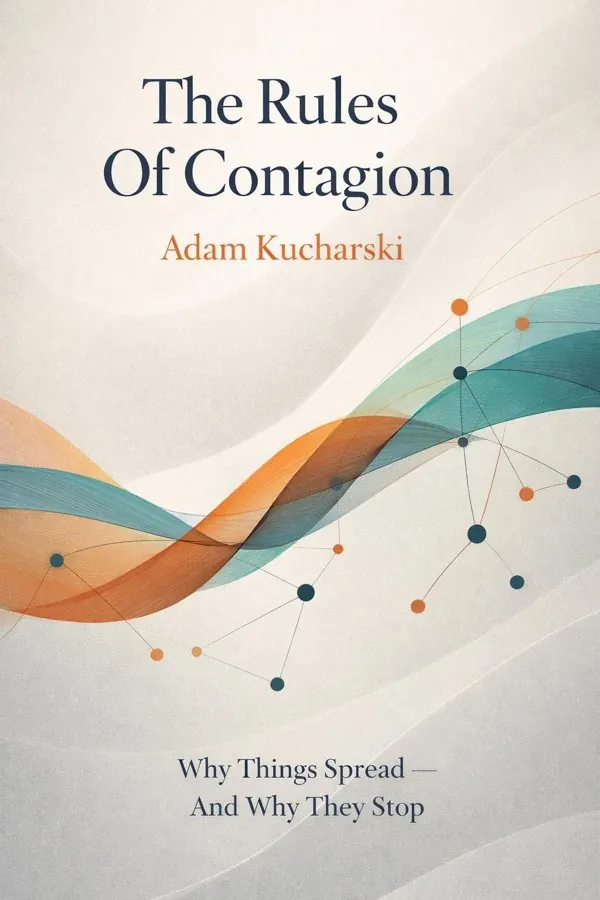
The Rules Of Contagion: Why Things Spread – And Why They Stop: Summary & Key Insights
 10 min7 chaptersAudio available
What Is The Rules Of Contagion: Why Things Spread – And Why They Stop About?
The Rules Of Contagion: Why Things Spread – And Why They Stop by Adam Kucharski is a popular_sci book spanning 7 pages. In this book, Adam Kucharski explores how ideas, behaviors, and diseases spread through populations. Drawing on mathematics, epidemiology, and social science, he explains the underlying principles that govern contagion in both biological and social contexts, showing how similar patterns emerge in viral outbreaks, financial crises, and online trends.
This FizzRead summary covers all 7 key chapters of The Rules Of Contagion: Why Things Spread – And Why They Stop in approximately 10 minutes, distilling the most important ideas, arguments, and takeaways from Adam Kucharski's work. Also available as an audio summary and Key Quotes Podcast.
The Rules Of Contagion: Why Things Spread – And Why They Stop
In this book, Adam Kucharski explores how ideas, behaviors, and diseases spread through populations. Drawing on mathematics, epidemiology, and social science, he explains the underlying principles that govern contagion in both biological and social contexts, showing how similar patterns emerge in viral outbreaks, financial crises, and online trends.
Who Should Read The Rules Of Contagion: Why Things Spread – And Why They Stop?
This book is perfect for anyone interested in popular_sci and looking to gain actionable insights in a short read. Whether you're a student, professional, or lifelong learner, the key ideas from The Rules Of Contagion: Why Things Spread – And Why They Stop by Adam Kucharski will help you think differently.
- ✓Readers who enjoy popular_sci and want practical takeaways
- ✓Professionals looking to apply new ideas to their work and life
- ✓Anyone who wants the core insights of The Rules Of Contagion: Why Things Spread – And Why They Stop in just 10 minutes
Want the full summary?
Get instant access to this book summary and 100K+ more with Fizz Moment.
Get Free SummaryAvailable on App Store • Free to download
Key Chapters
When I first began studying contagion, I was fascinated by how far back our attempts to understand epidemics go. The modern mathematical approach to disease spread began in the early 20th century, but its roots stretch to centuries of intuition about how sickness travels. The key intellectual breakthrough came from recognizing that epidemics are not random—they follow systematic, measurable patterns.
Ronald Ross, who worked on malaria, was among the first to frame disease transmission using mathematics. He realized that the interplay between infected and susceptible individuals determined whether an epidemic burned out or exploded. In the 1920s, Kermack and McKendrick formalized this insight with their SIR model, dividing a population into those susceptible (S), infected (I), and recovered (R). This model introduced us to thresholds—the idea that only above certain levels of contact and susceptibility would an epidemic take hold.
These developments did more than quantify outbreaks; they gave us language for understanding spread itself. Even when diseases differ, their underlying logic remains the same. Whether analyzing cholera in the 19th century or influenza in the 21st, we are still investigating how connections fuel contagion.
These foundations were revolutionary because they showed that human behavior matters as much as biology. The same pathogen could produce dramatically different outcomes depending on how people interacted. This realization opened the door to a broader view—one in which networks of contact, rather than pathogens alone, determine what spreads and how.
When we describe something as 'infectious,' we often mean it metaphorically. Yet mathematically, the metaphor holds true across contexts. At the heart of every contagion lies a few critical parameters: how often contacts occur, how likely transmission is during those contacts, and how long someone remains infectious. Their product gives rise to the concept of the basic reproduction number, R₀—the average number of new cases created by a single case in a fully susceptible population.
R₀ is both simple and profound. If it falls below one, spread fizzles out; if it rises above, chains of transmission multiply exponentially. But this seemingly clean threshold conceals enormous complexity. Real populations are not uniform. Some people have far more contacts than others, some are much more infectious, and environments vary in how easily transmission occurs. The result is that contagions often hinge on a small number of highly connected individuals or events—'superspreaders' in both disease and information networks.
Understanding mechanisms of spread requires us to turn to networks. Imagine every person as a node and every interaction as a link. Visualizing contagion this way changes everything: outbreaks look less like spheres expanding evenly and more like sparks following the paths of connection density. The shape of the network—whether clustered, random, or scale-free—determines how quickly things move and where interventions are most effective.
These principles underpin both public health strategies and social dynamics. Targeted vaccination of the most connected individuals can abruptly collapse disease transmission. Similarly, limiting amplification of misinformation at key nodes in online platforms can drastically reduce its reach. Contagion is therefore not an unstoppable force; it is a structural phenomenon whose effects depend on the architecture of our interactions.
+ 5 more chapters — available in the FizzRead app
All Chapters in The Rules Of Contagion: Why Things Spread – And Why They Stop
About the Author
Adam Kucharski is a British mathematician and epidemiologist. He is an associate professor at the London School of Hygiene & Tropical Medicine, specializing in infectious disease modeling and the dynamics of epidemics. His research focuses on understanding how diseases and behaviors spread and how mathematical models can inform public health responses.
Get This Summary in Your Preferred Format
Read or listen to the The Rules Of Contagion: Why Things Spread – And Why They Stop summary by Adam Kucharski anytime, anywhere. FizzRead offers multiple formats so you can learn on your terms — all free.
Available formats: App · Audio · PDF · EPUB — All included free with FizzRead
Download The Rules Of Contagion: Why Things Spread – And Why They Stop PDF and EPUB Summary
Key Quotes from The Rules Of Contagion: Why Things Spread – And Why They Stop
“When I first began studying contagion, I was fascinated by how far back our attempts to understand epidemics go.”
“When we describe something as 'infectious,' we often mean it metaphorically.”
Frequently Asked Questions about The Rules Of Contagion: Why Things Spread – And Why They Stop
The Rules Of Contagion: Why Things Spread – And Why They Stop by Adam Kucharski is a popular_sci book that explores key ideas across 7 chapters. In this book, Adam Kucharski explores how ideas, behaviors, and diseases spread through populations. Drawing on mathematics, epidemiology, and social science, he explains the underlying principles that govern contagion in both biological and social contexts, showing how similar patterns emerge in viral outbreaks, financial crises, and online trends.
You Might Also Like

Structures: Or Why Things Don"t Fall Down
J.E. Gordon
10 min
The Road to Wigan Pier
George Orwell
10 min
Bonk: The Curious Coupling of Science and Sex
Mary Roach
10 min
First Bite: How We Learn to Eat
Bee Wilson
10 min
In Pursuit Of The Unknown: 17 Equations That Changed The World
Ian Stewart
10 min
Napoleon's Buttons: 17 Molecules That Changed History
Penny Le Couteur and Jay Burreson
10 minBrowse by Category
Ready to read The Rules Of Contagion: Why Things Spread – And Why They Stop?
Get the full summary and 100K+ more books with Fizz Moment.