
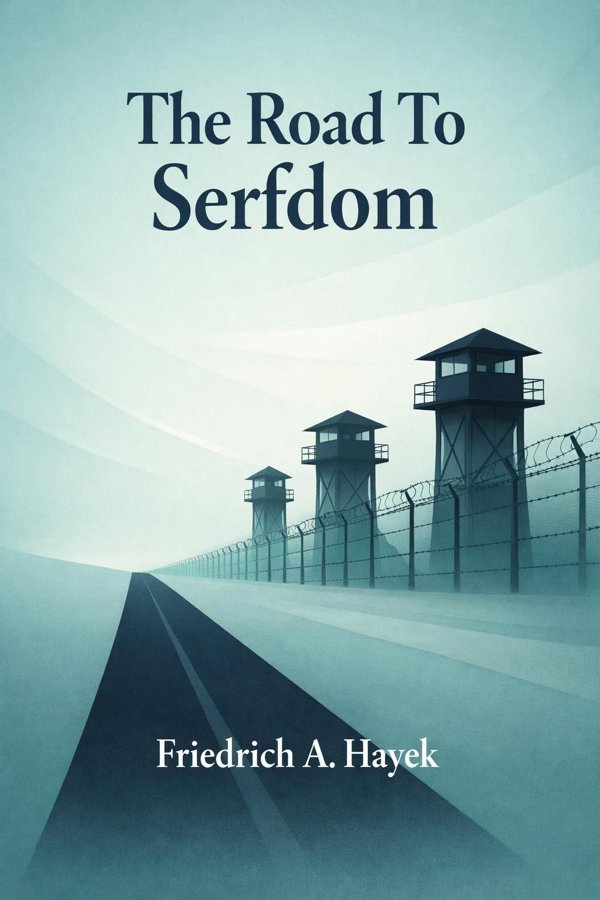
The Road To Serfdom: Summary & Key Insights
 10 min9 chaptersAudio available
Key Takeaways from The Road To Serfdom
A society rarely loses liberty all at once; it first loses the habits and institutions that make liberty possible.
What looks chaotic from above is often how societies learn.
Planning begins with a promise of justice but soon collides with a practical question: whose priorities will govern?
The road to tyranny is often paved with humane intentions.
Majority rule alone does not guarantee freedom.
What Is The Road To Serfdom About?
The Road To Serfdom by Friedrich A. Hayek is a economics book spanning 9 pages. Originally published in 1944 during the upheaval of World War II, The Road To Serfdom is Friedrich A. Hayek’s powerful warning about the political dangers hidden inside economic planning. Hayek argues that when governments take control of production, prices, and resource allocation in the name of fairness or efficiency, they do not merely change economic policy. They begin to reshape the entire structure of society, weakening individual choice, the rule of law, and eventually democracy itself. His central claim is provocative: large-scale central planning, even when motivated by good intentions, tends to concentrate power in ways that threaten liberty. The book still matters because the tension between freedom and state control has not disappeared. Debates over regulation, welfare, industrial policy, and emergency powers continue to raise Hayek’s question: how much centralized power can a free society tolerate before freedom becomes fragile? Hayek writes not as a polemicist alone, but as one of the 20th century’s most influential economists and political thinkers. His defense of decentralized decision-making, competitive markets, and constitutional limits on power remains a cornerstone of modern classical liberal thought.
This FizzRead summary covers all 9 key chapters of The Road To Serfdom in approximately 10 minutes, distilling the most important ideas, arguments, and takeaways from Friedrich A. Hayek's work. Also available as an audio summary and Key Quotes Podcast.
The Road To Serfdom
Originally published in 1944 during the upheaval of World War II, The Road To Serfdom is Friedrich A. Hayek’s powerful warning about the political dangers hidden inside economic planning. Hayek argues that when governments take control of production, prices, and resource allocation in the name of fairness or efficiency, they do not merely change economic policy. They begin to reshape the entire structure of society, weakening individual choice, the rule of law, and eventually democracy itself. His central claim is provocative: large-scale central planning, even when motivated by good intentions, tends to concentrate power in ways that threaten liberty.
The book still matters because the tension between freedom and state control has not disappeared. Debates over regulation, welfare, industrial policy, and emergency powers continue to raise Hayek’s question: how much centralized power can a free society tolerate before freedom becomes fragile? Hayek writes not as a polemicist alone, but as one of the 20th century’s most influential economists and political thinkers. His defense of decentralized decision-making, competitive markets, and constitutional limits on power remains a cornerstone of modern classical liberal thought.
Who Should Read The Road To Serfdom?
This book is perfect for anyone interested in economics and looking to gain actionable insights in a short read. Whether you're a student, professional, or lifelong learner, the key ideas from The Road To Serfdom by Friedrich A. Hayek will help you think differently.
- ✓Readers who enjoy economics and want practical takeaways
- ✓Professionals looking to apply new ideas to their work and life
- ✓Anyone who wants the core insights of The Road To Serfdom in just 10 minutes
Want the full summary?
Get instant access to this book summary and 100K+ more with Fizz Moment.
Get Free SummaryAvailable on App Store • Free to download
Key Chapters
A society rarely loses liberty all at once; it first loses the habits and institutions that make liberty possible. Hayek’s starting point is that economic freedom is not separate from political freedom but one of its essential foundations. When individuals can choose their work, spend their income, start enterprises, and exchange with others voluntarily, they retain meaningful control over their lives. But when the state decides what should be produced, who should receive what, and which goals matter most, personal independence begins to shrink.
Hayek challenges the comforting assumption that political rights can remain untouched while economic life is centrally directed. If the government controls access to jobs, housing, credit, or raw materials, it gains enormous influence over citizens’ choices. Formal rights may still exist on paper, but their substance weakens. A person cannot act freely if every important means of action depends on official permission.
This argument remains relevant in modern settings. Imagine a society where business licensing is arbitrary, access to banking depends on political approval, or professional advancement is tied to ideological loyalty. Even without open repression, people start self-censoring and conforming. Economic dependence becomes social and political dependence.
Hayek is not saying that all government activity destroys freedom. He is saying that liberty requires a protected sphere where individuals can make plans without constant direction from authority. Markets, private property, and open competition help create that sphere by dispersing power among millions of people instead of concentrating it in a single command center.
Actionable takeaway: evaluate public policy not only by its intentions, but by whether it increases or reduces individuals’ ability to act without political permission.
What looks chaotic from above is often how societies learn. Hayek argues that many critics misunderstand competition because they compare real markets to an imaginary world of perfect order. Planning appears clean, coordinated, and rational, while competition seems wasteful, duplicative, and unpredictable. But this contrast is misleading. Competition is valuable precisely because no one person or committee already knows the best use of resources, the right price, or the next innovation.
In Hayek’s view, competition is not merely a way to divide existing goods. It is a process for discovering information. Businesses test ideas, consumers reveal preferences through purchases, and prices transmit signals about scarcity and demand. Through this decentralized feedback loop, societies adapt continuously. Planning bodies cannot reproduce this process because they do not possess the countless fragments of local knowledge held by workers, entrepreneurs, buyers, and communities.
A simple example is food supply. If a drought affects one region, prices change, buyers adjust, transport shifts, and producers elsewhere respond. No central planner needs to know every farm’s condition or every household’s priority. The price system helps coordinate action across millions of people. Likewise, in technology, competing firms experiment with products and business models. Many fail, but failure itself generates knowledge.
Hayek does not deny that competition can be uncomfortable. It can expose mistakes, eliminate weak firms, and create uneven outcomes. Yet replacing it with centralized direction often suppresses adaptation, innovation, and accountability. Without competition, errors may persist because there is no corrective mechanism.
Actionable takeaway: when assessing whether a sector needs more planning, ask what valuable information might be lost if experimentation, price signals, and decentralized trial-and-error are reduced.
The road to tyranny is often paved with humane intentions. Hayek’s most famous and controversial claim is that central planning tends to produce authoritarian outcomes, not because every planner desires dictatorship, but because the logic of planning pushes in that direction. Once a government assumes responsibility for directing the economy, it must secure compliance, suppress resistance, and manage disagreement over outcomes. The broader the plan, the greater the need for discretionary power.
Hayek observed that totalitarian regimes did not arise only from brute force or ideological extremism. They also fed on the belief that society could be rationally organized from above. When results disappoint, planners rarely conclude that planning itself is flawed. Instead, they demand more powers, tighter controls, and harsher enforcement. Economic failures become excuses for political centralization.
He also notes a darker political dynamic: systems requiring extensive coercion tend to reward leaders who are willing to use it. In highly centralized states, the people most likely to rise are not necessarily the wisest or most virtuous, but those most comfortable imposing conformity. That helps explain why societies may drift from mild intervention to aggressive authoritarianism without a clear breaking point.
This argument does not mean every welfare program or regulation leads to dictatorship. Hayek’s warning is about direction and institutional design. When emergency powers become normal, when officials receive broad discretion to override law, and when dissenters are treated as obstacles to a national plan, liberal safeguards weaken.
Actionable takeaway: defend institutional limits early, before temporary controls, crisis powers, or economic directives harden into permanent tools of political domination.
Majority rule alone does not guarantee freedom. Hayek insists that democracy is valuable, but it is not sufficient to protect liberty if it becomes a vehicle for unlimited state power. A democratic government can still plan extensively, override minority rights, and grant sweeping discretion to administrators. The real safeguard of a free society is not just voting, but government constrained by general, predictable rules.
This is the paradox of planning within democracy. Citizens may support broad social goals such as fairness, full employment, or national reconstruction. But once those goals require detailed control over prices, wages, investment, and production, democratic deliberation becomes strained. Legislatures cannot realistically manage millions of complex decisions, so authority shifts to bureaucracies, agencies, and executive bodies. Public choice gives way to administrative command.
Hayek worries that this transformation weakens both democracy and accountability. Voters may think they are endorsing broad aims, but the actual allocation of benefits and burdens happens through opaque decisions that are difficult to monitor. Political conflict also intensifies, because every economic decision becomes a collective battle rather than a private choice.
A modern example is the expansion of emergency policymaking. During crises, legislatures often authorize broad interventions and leave implementation to specialists. Some delegation is unavoidable. Yet when such delegation becomes permanent, citizens retain the ritual of democracy while losing substantive control over how power is used.
For Hayek, democracy works best when it operates within constitutional limits and focuses on establishing rules that apply equally to all, rather than directing outcomes in every sector. That framework allows people with different values to coexist without having to agree on one central plan.
Actionable takeaway: judge democratic systems not only by elections, but by how firmly they limit discretionary power and protect equal rules for all.
The most important facts in society are often known only by someone on the spot. Hayek’s insight about knowledge is one of the book’s lasting contributions. He argues that economic coordination depends on countless bits of dispersed information: a mechanic knows which part is unavailable, a shop owner sees shifting customer demand, a farmer understands local weather patterns, and a family knows its own urgent needs. This knowledge is practical, changing, and often impossible to capture fully in statistics.
Central planners face an impossible task because they would need to gather, interpret, and continuously update this fragmented knowledge for an entire economy. Even with good intentions and technical expertise, they cannot match the speed and subtlety of decentralized decision-making. Markets help solve this problem through prices, profit and loss, and voluntary exchange. These mechanisms condense information into signals that people can act on without needing to know the whole picture.
Hayek’s point has become even more relevant in a world fascinated by data and algorithmic governance. More information does not automatically solve the problem of central control. Data may be delayed, incomplete, or stripped of local context. A planner may know that steel demand has risen nationally, yet still miss why one region needs it more urgently than another. Decentralized systems remain powerful because they allow people closest to a problem to respond directly.
This applies beyond economics. In education, healthcare, and urban planning, top-down rules often fail when they ignore local conditions. Better systems create broad frameworks while leaving room for adaptation by schools, clinics, neighborhoods, and entrepreneurs.
Actionable takeaway: whenever a problem involves rapidly changing local conditions, favor institutions that let frontline actors adjust quickly instead of waiting for centralized instructions.
Freedom survives not when rulers are benevolent, but when power is bound by known rules. Hayek places great emphasis on the rule of law, meaning that government should act through general, stable, and predictable rules rather than ad hoc commands aimed at particular people or outcomes. This legal framework allows individuals to plan their lives with confidence. They may not know exactly what will happen, but they know the rules under which they can act.
Under central planning, this predictability begins to disappear. If officials are tasked with achieving specific economic results, they need discretion to intervene whenever outcomes differ from the plan. That means permissions, exceptions, quotas, subsidies, and penalties become increasingly selective. Law shifts from being a neutral framework to an instrument of administration. Citizens are no longer protected by rules equally applied; they are exposed to decisions made case by case.
Hayek sees this as a profound political danger. Arbitrary discretion creates dependence, because success depends less on meeting general standards and more on obtaining official favor. Businesses lobby for protection, workers seek exemptions, and entire sectors become politicized. Corruption need not be overt for the system to become unfair.
Consider licensing, procurement, or industrial subsidies. If rules are transparent and universal, participants can compete on equal terms. If access depends on discretion, personal connections and political influence start to matter more than merit. Over time, trust in institutions erodes.
Hayek’s defense of the rule of law is therefore not abstract legalism. It is a practical defense of a society where people can pursue their aims without constantly navigating arbitrary power.
Actionable takeaway: support policies that operate through clear, general rules, and be skeptical of systems that rely heavily on exemptions, discretionary approvals, or targeted political favoritism.
People often surrender freedom gradually in exchange for promises of security. Hayek does not reject all forms of social protection. In fact, he accepts that a free society may provide a safety net, help those facing severe hardship, and insure against certain common risks. His warning is more precise: security becomes dangerous when it is used to justify comprehensive control over individual choices and economic life.
There is an important difference between offering minimum protection and guaranteeing particular outcomes for every group. The first can often be achieved through general rules that preserve initiative. The second invites detailed direction of wages, employment, prices, and investment. Once the state promises to shield everyone from market uncertainty, it must continuously intervene to manage consequences, and with each intervention the sphere of independent action narrows.
This distinction matters in current debates. Unemployment insurance, public health measures, or basic anti-poverty programs can coexist with liberty if they are limited, transparent, and rule-based. But systems that tie security to permanent dependence on political discretion may weaken responsibility, innovation, and pluralism.
Hayek also recognizes the psychological appeal of certainty. In periods of crisis, people may prefer clear direction to the risks of freedom. Yet a fully secure society, if security is defined as insulation from all economic change, would require an authority powerful enough to freeze social life. That price is too high.
A free society must therefore balance compassion with independence. It should reduce severe suffering without eliminating the uncertainty that comes with personal choice, entrepreneurship, and change.
Actionable takeaway: distinguish between safety nets that protect people in need and systems of control that make long-term security dependent on constant government direction.
Freedom can be undermined not only within nations but also through disorder between them. Hayek argues that a liberal society requires an international order that allows peaceful trade, legal predictability, and limits on economic nationalism. When countries pursue self-sufficiency, protectionism, and state-directed blocs, political rivalry deepens and domestic controls expand. The logic of planning does not stop at the border.
National economic planning often leads governments to restrict imports, subsidize favored industries, control currency, and manage trade to serve strategic goals. These policies may appear patriotic, but they can fuel conflict abroad and coercion at home. If the state must orchestrate the national economy to compete globally, citizens become instruments of geopolitical objectives. Economic freedom yields to national mobilization.
Hayek’s answer is not world government in the centralized sense, but a rules-based international order that reduces the incentives for destructive planning. Open trade, enforceable legal norms, and predictable relations among states make it easier for countries to remain liberal internally. When people and goods can move under stable rules, governments face fewer pressures to command production and ration scarcity.
This remains highly relevant in an era of trade wars, sanctions, industrial policy, and strategic decoupling. Some coordination for security may be necessary, but Hayek reminds us that sustained economic nationalism often comes with hidden domestic costs: more favoritism, more centralized control, and fewer opportunities for voluntary cooperation across borders.
Actionable takeaway: support international arrangements that expand peaceful exchange and common rules, while watching carefully for foreign-policy justifications that normalize permanent domestic economic control.
All Chapters in The Road To Serfdom
About the Author
Friedrich August von Hayek (1899–1992) was an Austrian-British economist, political philosopher, and one of the leading defenders of classical liberalism in the 20th century. Born in Vienna, he became associated with the Austrian School of economics and later taught at the London School of Economics, the University of Chicago, and the University of Freiburg. Hayek’s work ranged across economics, law, psychology, and political theory, with a central focus on how free societies coordinate knowledge through markets and legal institutions. He argued that prices communicate information that no central planner can fully possess, making decentralized decision-making essential to prosperity and liberty. In 1974, he received the Nobel Memorial Prize in Economic Sciences. His major works, including The Road To Serfdom and The Constitution of Liberty, remain foundational texts in debates about freedom, state power, and market order.
Get This Summary in Your Preferred Format
Read or listen to the The Road To Serfdom summary by Friedrich A. Hayek anytime, anywhere. FizzRead offers multiple formats so you can learn on your terms — all free.
Available formats: App · Audio · PDF · EPUB — All included free with FizzRead
Download The Road To Serfdom PDF and EPUB Summary
Key Quotes from The Road To Serfdom
“A society rarely loses liberty all at once; it first loses the habits and institutions that make liberty possible.”
“What looks chaotic from above is often how societies learn.”
“Planning begins with a promise of justice but soon collides with a practical question: whose priorities will govern?”
“The road to tyranny is often paved with humane intentions.”
“Majority rule alone does not guarantee freedom.”
Frequently Asked Questions about The Road To Serfdom
The Road To Serfdom by Friedrich A. Hayek is a economics book that explores key ideas across 9 chapters. Originally published in 1944 during the upheaval of World War II, The Road To Serfdom is Friedrich A. Hayek’s powerful warning about the political dangers hidden inside economic planning. Hayek argues that when governments take control of production, prices, and resource allocation in the name of fairness or efficiency, they do not merely change economic policy. They begin to reshape the entire structure of society, weakening individual choice, the rule of law, and eventually democracy itself. His central claim is provocative: large-scale central planning, even when motivated by good intentions, tends to concentrate power in ways that threaten liberty. The book still matters because the tension between freedom and state control has not disappeared. Debates over regulation, welfare, industrial policy, and emergency powers continue to raise Hayek’s question: how much centralized power can a free society tolerate before freedom becomes fragile? Hayek writes not as a polemicist alone, but as one of the 20th century’s most influential economists and political thinkers. His defense of decentralized decision-making, competitive markets, and constitutional limits on power remains a cornerstone of modern classical liberal thought.
You Might Also Like
Business Adventures
John Brooks
10 min
Nudge
Richard H. Thaler, Cass R. Sunstein
10 min
The Hitchhiker"s Guide to the Galaxy
Douglas Adams
10 minThe Muqaddimah
Ibn Khaldun
10 minThe Outsiders
William N. Thorndike
10 min
A Little History of Economics
Niall Kishtainy
10 minBrowse by Category
Ready to read The Road To Serfdom?
Get the full summary and 100K+ more books with Fizz Moment.