
Friedrich A. Hayek Books
Friedrich August von Hayek (1899–1992) was an Austrian-British economist and philosopher known for his defense of classical liberalism and free-market capitalism. He was awarded the Nobel Memorial Prize in Economic Sciences in 1974 for his pioneering work in the theory of money and economic fluctuations and for his analysis of the interdependence of economic and institutional phenomena.
Known for: The Road To Serfdom
Books by Friedrich A. Hayek
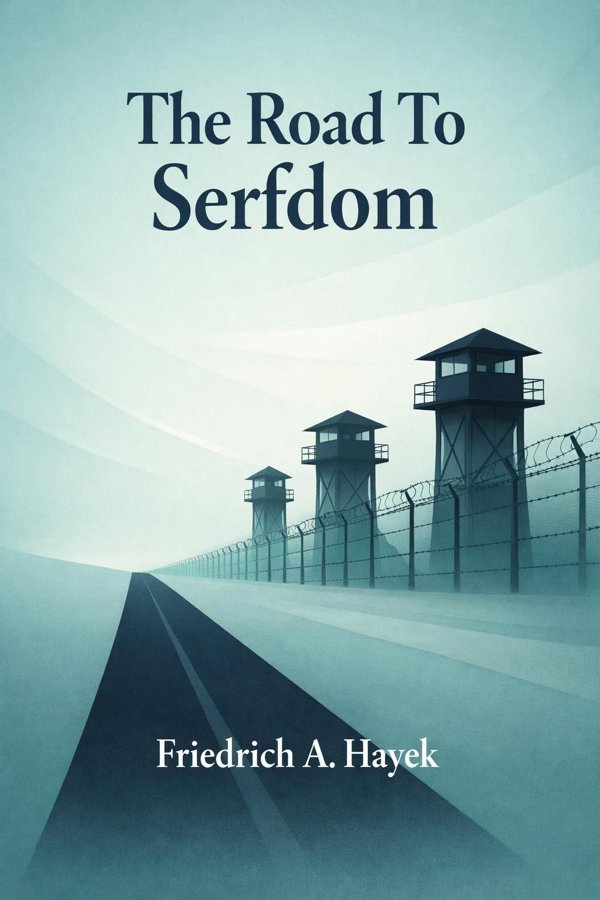
The Road To Serfdom
Originally published in 1944 during the upheaval of World War II, The Road To Serfdom is Friedrich A. Hayek’s powerful warning about the political dangers hidden inside economic planning. Hayek argues that when governments take control of production, prices, and resource allocation in the name of fairness or efficiency, they do not merely change economic policy. They begin to reshape the entire structure of society, weakening individual choice, the rule of law, and eventually democracy itself. His central claim is provocative: large-scale central planning, even when motivated by good intentions, tends to concentrate power in ways that threaten liberty. The book still matters because the tension between freedom and state control has not disappeared. Debates over regulation, welfare, industrial policy, and emergency powers continue to raise Hayek’s question: how much centralized power can a free society tolerate before freedom becomes fragile? Hayek writes not as a polemicist alone, but as one of the 20th century’s most influential economists and political thinkers. His defense of decentralized decision-making, competitive markets, and constitutional limits on power remains a cornerstone of modern classical liberal thought.
Read SummaryKey Insights from Friedrich A. Hayek
Freedom Depends on Economic Independence
A society rarely loses liberty all at once; it first loses the habits and institutions that make liberty possible. Hayek’s starting point is that economic freedom is not separate from political freedom but one of its essential foundations. When individuals can choose their work, spend their income, ...
From The Road To Serfdom
Competition Is a Discovery Process
What looks chaotic from above is often how societies learn. Hayek argues that many critics misunderstand competition because they compare real markets to an imaginary world of perfect order. Planning appears clean, coordinated, and rational, while competition seems wasteful, duplicative, and unpredi...
From The Road To Serfdom
Socialism Requires Coercive Priority Setting
Planning begins with a promise of justice but soon collides with a practical question: whose priorities will govern? Hayek’s critique of socialism is not simply that it is inefficient, though he believes it often is. His deeper argument is that comprehensive economic planning requires society to agr...
From The Road To Serfdom
Planning Opens the Door to Tyranny
The road to tyranny is often paved with humane intentions. Hayek’s most famous and controversial claim is that central planning tends to produce authoritarian outcomes, not because every planner desires dictatorship, but because the logic of planning pushes in that direction. Once a government assum...
From The Road To Serfdom
Democracy Cannot Replace General Rules
Majority rule alone does not guarantee freedom. Hayek insists that democracy is valuable, but it is not sufficient to protect liberty if it becomes a vehicle for unlimited state power. A democratic government can still plan extensively, override minority rights, and grant sweeping discretion to admi...
From The Road To Serfdom
Local Knowledge Beats Central Intelligence
The most important facts in society are often known only by someone on the spot. Hayek’s insight about knowledge is one of the book’s lasting contributions. He argues that economic coordination depends on countless bits of dispersed information: a mechanic knows which part is unavailable, a shop own...
From The Road To Serfdom
About Friedrich A. Hayek
Friedrich August von Hayek (1899–1992) was an Austrian-British economist and philosopher known for his defense of classical liberalism and free-market capitalism. He was awarded the Nobel Memorial Prize in Economic Sciences in 1974 for his pioneering work in the theory of money and economic fluctuat...
Read more
Friedrich August von Hayek (1899–1992) was an Austrian-British economist and philosopher known for his defense of classical liberalism and free-market capitalism. He was awarded the Nobel Memorial Prize in Economic Sciences in 1974 for his pioneering work in the theory of money and economic fluctuat...
Friedrich August von Hayek (1899–1992) was an Austrian-British economist and philosopher known for his defense of classical liberalism and free-market capitalism. He was awarded the Nobel Memorial Prize in Economic Sciences in 1974 for his pioneering work in the theory of money and economic fluctuations and for his analysis of the interdependence of economic and institutional phenomena.


Frequently Asked Questions
Friedrich August von Hayek (1899–1992) was an Austrian-British economist and philosopher known for his defense of classical liberalism and free-market capitalism. He was awarded the Nobel Memorial Prize in Economic Sciences in 1974 for his pioneering work in the theory of money and economic fluctuations and for his analysis of the interdependence of economic and institutional phenomena.
Read Friedrich A. Hayek's books in 15 minutes
Get AI-powered summaries with key insights from 1 book by Friedrich A. Hayek.