
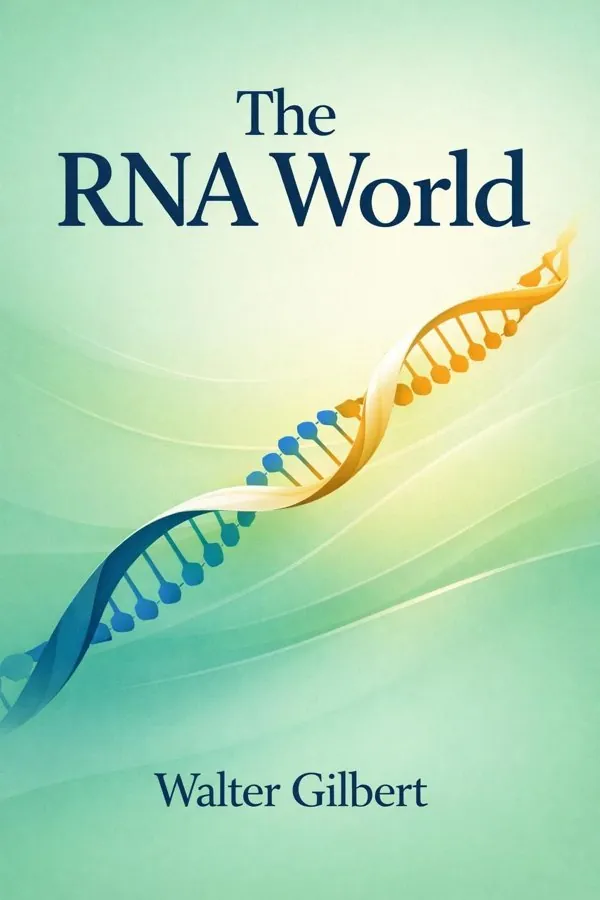
The RNA World: The Nature of Modern RNA Suggests a Prebiotic RNA World: Summary & Key Insights
 10 min11 chaptersAudio available
What Is The RNA World: The Nature of Modern RNA Suggests a Prebiotic RNA World About?
The RNA World: The Nature of Modern RNA Suggests a Prebiotic RNA World by Walter Gilbert is a life_science book spanning 11 pages. This work explores the hypothesis that life on Earth began with self-replicating RNA molecules before the evolution of DNA and proteins. Walter Gilbert, a Nobel laureate in Chemistry, introduced the concept of an 'RNA World' to describe a stage in early evolution where RNA served both as genetic material and as a catalyst for biochemical reactions. The book and related papers discuss the biochemical, evolutionary, and molecular evidence supporting this theory, which has become a cornerstone in molecular biology and origin-of-life research.
This FizzRead summary covers all 11 key chapters of The RNA World: The Nature of Modern RNA Suggests a Prebiotic RNA World in approximately 10 minutes, distilling the most important ideas, arguments, and takeaways from Walter Gilbert's work. Also available as an audio summary and Key Quotes Podcast.
The RNA World: The Nature of Modern RNA Suggests a Prebiotic RNA World
This work explores the hypothesis that life on Earth began with self-replicating RNA molecules before the evolution of DNA and proteins. Walter Gilbert, a Nobel laureate in Chemistry, introduced the concept of an 'RNA World' to describe a stage in early evolution where RNA served both as genetic material and as a catalyst for biochemical reactions. The book and related papers discuss the biochemical, evolutionary, and molecular evidence supporting this theory, which has become a cornerstone in molecular biology and origin-of-life research.
Who Should Read The RNA World: The Nature of Modern RNA Suggests a Prebiotic RNA World?
This book is perfect for anyone interested in life_science and looking to gain actionable insights in a short read. Whether you're a student, professional, or lifelong learner, the key ideas from The RNA World: The Nature of Modern RNA Suggests a Prebiotic RNA World by Walter Gilbert will help you think differently.
- ✓Readers who enjoy life_science and want practical takeaways
- ✓Professionals looking to apply new ideas to their work and life
- ✓Anyone who wants the core insights of The RNA World: The Nature of Modern RNA Suggests a Prebiotic RNA World in just 10 minutes
Want the full summary?
Get instant access to this book summary and 100K+ more with Fizz Moment.
Get Free SummaryAvailable on App Store • Free to download
Key Chapters
When molecular biology first mapped the central dogma—DNA makes RNA, RNA makes protein—we believed this flow was unbreakable. Yet I found this framing incomplete; it described how life operates now, not how it began. Molecular evolution must have had a simpler starting point.
In reflecting on the discoveries of messenger RNA and catalytic RNA, I realized that RNA is not merely an intermediary between DNA and proteins—it is a versatile molecule with both informational and functional identities. That realization was revolutionary, not in its technical details, but in its philosophical implications. It suggested that the earliest form of life could be self-replicating RNA molecules, operating without proteins or DNA.
I trace the conceptual roots of this idea back to experiments in enzymatic catalysis and the discovery of ribonuclease P and self-splicing RNA sequences. These findings shattered the assumption that only proteins could be enzymes. Life’s earliest chemistry could therefore have been carried out by RNA itself, simplifying the transition from chemistry to biology.
DNA and protein systems form a beautiful partnership today, each depending upon the other’s existence. However, in searching for life’s origin, that dependency becomes a paradox. DNA needs proteins to replicate; proteins require DNA to exist. The cycle is closed—too closed to serve as the starting point of life.
I argue that before this interdependence could exist, the world must have been chemically driven by molecules that carried both memory and function. The DNA–protein world cannot explain how the first genetic code was formed, or how the machinery of translation evolved. Without RNA’s capacity to both store genetic information and catalyze reactions, the DNA–protein relationship could never have begun.
This limitation leads us toward a conceptual opening: understanding life not as a binary between genetic material and catalyst, but as a continuum beginning with one molecule capable of performing both roles.
+ 9 more chapters — available in the FizzRead app
All Chapters in The RNA World: The Nature of Modern RNA Suggests a Prebiotic RNA World
About the Author
Walter Gilbert is an American molecular biologist and Nobel Prize winner in Chemistry (1980) for his contributions to DNA sequencing. He is known for his pioneering work in molecular genetics and for proposing the 'RNA World' hypothesis, which has profoundly influenced research on the origins of life.
Get This Summary in Your Preferred Format
Read or listen to the The RNA World: The Nature of Modern RNA Suggests a Prebiotic RNA World summary by Walter Gilbert anytime, anywhere. FizzRead offers multiple formats so you can learn on your terms — all free.
Available formats: App · Audio · PDF · EPUB — All included free with FizzRead
Download The RNA World: The Nature of Modern RNA Suggests a Prebiotic RNA World PDF and EPUB Summary
Key Quotes from The RNA World: The Nature of Modern RNA Suggests a Prebiotic RNA World
“When molecular biology first mapped the central dogma—DNA makes RNA, RNA makes protein—we believed this flow was unbreakable.”
“DNA and protein systems form a beautiful partnership today, each depending upon the other’s existence.”
Frequently Asked Questions about The RNA World: The Nature of Modern RNA Suggests a Prebiotic RNA World
The RNA World: The Nature of Modern RNA Suggests a Prebiotic RNA World by Walter Gilbert is a life_science book that explores key ideas across 11 chapters. This work explores the hypothesis that life on Earth began with self-replicating RNA molecules before the evolution of DNA and proteins. Walter Gilbert, a Nobel laureate in Chemistry, introduced the concept of an 'RNA World' to describe a stage in early evolution where RNA served both as genetic material and as a catalyst for biochemical reactions. The book and related papers discuss the biochemical, evolutionary, and molecular evidence supporting this theory, which has become a cornerstone in molecular biology and origin-of-life research.
You Might Also Like
The Selfish Gene
Richard Dawkins
10 min
Awakenings
Oliver Sacks
10 min
Parasite Rex: Inside the Bizarre World of Nature's Most Dangerous Creatures
Carl Zimmer
10 min
The Atlas of Life on Earth
Various
10 min
The Book of Humans: The Story of How We Became Us
Adam Rutherford
10 min
The Horse
Wendy Williams
10 minBrowse by Category
Ready to read The RNA World: The Nature of Modern RNA Suggests a Prebiotic RNA World?
Get the full summary and 100K+ more books with Fizz Moment.