
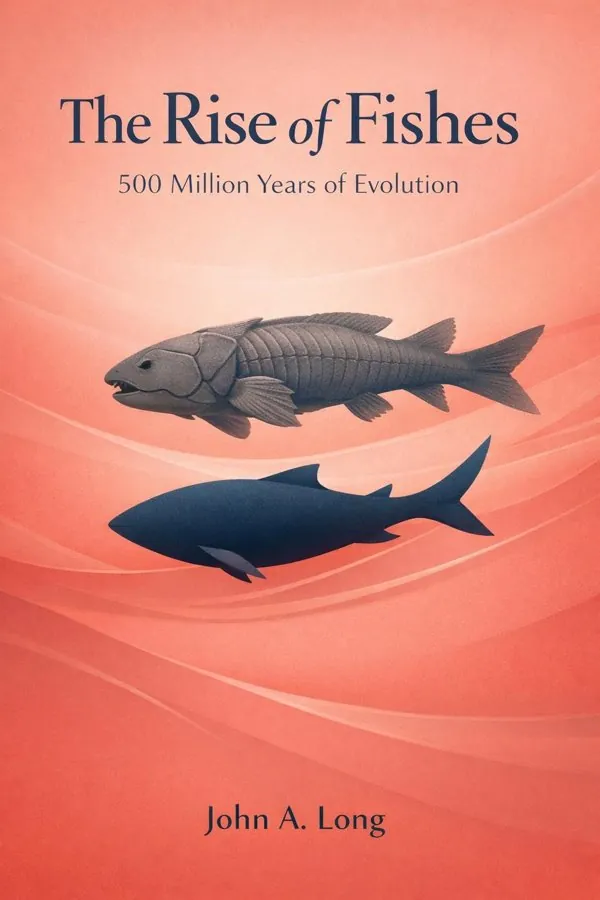
The Rise of Fishes: 500 Million Years of Evolution: Summary & Key Insights
by John A. Long
 10 min6 chaptersAudio available
What Is The Rise of Fishes: 500 Million Years of Evolution About?
The Rise of Fishes: 500 Million Years of Evolution by John A. Long is a life_science book spanning 6 pages. This book presents a comprehensive account of the evolutionary history of fishes, tracing their origins from the earliest vertebrates to the diverse species that inhabit modern oceans and freshwater systems. It combines fossil evidence with modern biological insights to illustrate how fishes evolved over 500 million years, shaping the course of vertebrate evolution.
This FizzRead summary covers all 6 key chapters of The Rise of Fishes: 500 Million Years of Evolution in approximately 10 minutes, distilling the most important ideas, arguments, and takeaways from John A. Long's work. Also available as an audio summary and Key Quotes Podcast.
The Rise of Fishes: 500 Million Years of Evolution
This book presents a comprehensive account of the evolutionary history of fishes, tracing their origins from the earliest vertebrates to the diverse species that inhabit modern oceans and freshwater systems. It combines fossil evidence with modern biological insights to illustrate how fishes evolved over 500 million years, shaping the course of vertebrate evolution.
Who Should Read The Rise of Fishes: 500 Million Years of Evolution?
This book is perfect for anyone interested in life_science and looking to gain actionable insights in a short read. Whether you're a student, professional, or lifelong learner, the key ideas from The Rise of Fishes: 500 Million Years of Evolution by John A. Long will help you think differently.
- ✓Readers who enjoy life_science and want practical takeaways
- ✓Professionals looking to apply new ideas to their work and life
- ✓Anyone who wants the core insights of The Rise of Fishes: 500 Million Years of Evolution in just 10 minutes
Want the full summary?
Get instant access to this book summary and 100K+ more with Fizz Moment.
Get Free SummaryAvailable on App Store • Free to download
Key Chapters
In the Cambrian period, the stage was set for one of evolution’s most transformative experiments—the origin of vertebrates. The seas teemed with invertebrate life, yet among these complex ecosystems emerged a small lineage of chordate-like creatures that carried a hint of something unprecedented: a supportive rod, the notochord. This slender rod represented a new way of maintaining body rigidity while allowing flexibility, a precursor to the vertebral column that would define all subsequent vertebrates.
The fossil record of these earliest forms, such as *Pikaia* and *Haikouichthys*, shows simplicity yet sophistication. Unlike their soft-bodied ancestors, they had internal segmentation and rudimentary head structures. These features allowed directed swimming and coordinated motion—functionally small changes, but evolutionarily revolutionary. In this period, we see the beginnings of centralization of the nervous system, formation of sensory organs, and the first steps toward an endoskeleton. The ocean became a laboratory for vertebrate dynamics.
When studying Cambrian deposits, I have often imagined the delicate balance of innovation and preservation. Many fossils from these times are found in fine-grained shale beds where extraordinary detail survives, depicting the anatomy that once pulsed through ancient waters. Through these glimpses, we understand that the vertebrate lineage did not emerge suddenly but through gradual refinement—a tale of incremental complexity arising from functional necessity.
In these primitive chordates, evolution found its first engineer’s sketch for a vertebrate. Their success paved the way for diversification into more robust jawless forms that truly defined the early stages of vertebrate evolution.
When jaws did not yet exist, feeding was a task solved through suction, filter, or scavenging. Jawless fishes, collectively known as agnathans, represent the bridge between chordate simplicity and vertebrate complexity. Their fossils, abundant in Ordovician and Silurian strata, document experiments in armor, mobility, and ecological adaptation.
Among them, the ostracoderms stand out, encased in delicate bony plates that protected soft internal tissues. This armor marks one of vertebrate evolution’s earliest uses of mineralized tissue—a cornerstone for skeletal development. These creatures lived in shallow coastal environments, moving sluggishly across the substrate but wielding a stability that allowed evolutionary refinement of internal body organization.
Agnathans such as *Cephalaspis* reveal intricate design in the absence of jaws. Their head shields show sensory canals, evidence of electroreception, and the refinement of balance through semicircular canals. These biological innovations demonstrate that the vertebrate body plan was already capable of sophistication before the advent of jaws.
Studying these fossils, I see more than ancient anatomy—I see resilience. Jawless fishes endured multiple geological upheavals, surviving mass extinctions and radiating anew. Their persistence reinforces a theme central to evolution: major advances often emerge through gradual evolution rather than sudden transformation.
The agnathans teach us that the vertebrate form is deeply rooted in adaptation, and even in simplicity lies extraordinary potential for innovation. They prepared the stage for one of evolution’s boldest inventions—the jaw.
+ 4 more chapters — available in the FizzRead app
All Chapters in The Rise of Fishes: 500 Million Years of Evolution
About the Author
John A. Long is an Australian paleontologist and evolutionary biologist known for his research on early vertebrates and fossil fishes. He has served as a curator at several major museums and authored numerous scientific and popular works on paleontology and evolution.
Get This Summary in Your Preferred Format
Read or listen to the The Rise of Fishes: 500 Million Years of Evolution summary by John A. Long anytime, anywhere. FizzRead offers multiple formats so you can learn on your terms — all free.
Available formats: App · Audio · PDF · EPUB — All included free with FizzRead
Download The Rise of Fishes: 500 Million Years of Evolution PDF and EPUB Summary
Key Quotes from The Rise of Fishes: 500 Million Years of Evolution
“In the Cambrian period, the stage was set for one of evolution’s most transformative experiments—the origin of vertebrates.”
“When jaws did not yet exist, feeding was a task solved through suction, filter, or scavenging.”
Frequently Asked Questions about The Rise of Fishes: 500 Million Years of Evolution
The Rise of Fishes: 500 Million Years of Evolution by John A. Long is a life_science book that explores key ideas across 6 chapters. This book presents a comprehensive account of the evolutionary history of fishes, tracing their origins from the earliest vertebrates to the diverse species that inhabit modern oceans and freshwater systems. It combines fossil evidence with modern biological insights to illustrate how fishes evolved over 500 million years, shaping the course of vertebrate evolution.
You Might Also Like
The Selfish Gene
Richard Dawkins
10 min
Awakenings
Oliver Sacks
10 min
Parasite Rex: Inside the Bizarre World of Nature's Most Dangerous Creatures
Carl Zimmer
10 min
The Atlas of Life on Earth
Various
10 min
The Book of Humans: The Story of How We Became Us
Adam Rutherford
10 min
The Horse
Wendy Williams
10 minBrowse by Category
Ready to read The Rise of Fishes: 500 Million Years of Evolution?
Get the full summary and 100K+ more books with Fizz Moment.