
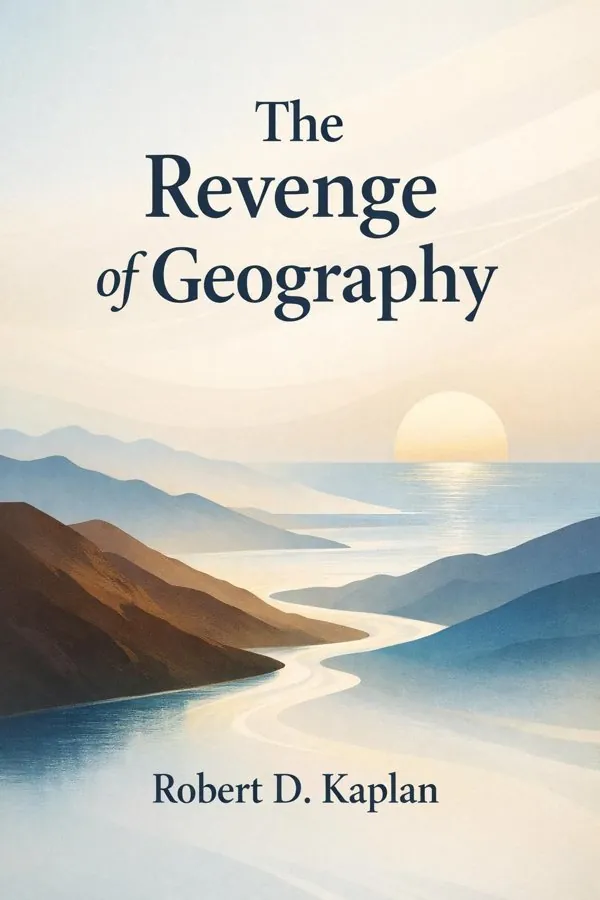
The Revenge of Geography: What the Map Tells Us About Coming Conflicts and the Battle Against Fate: Summary & Key Insights
 10 min10 chaptersAudio available
Key Takeaways from The Revenge of Geography: What the Map Tells Us About Coming Conflicts and the Battle Against Fate
One of Kaplan’s most important insights is that geography does not mechanically determine history, but it powerfully sets the boundaries within which history unfolds.
A striking feature of Kaplan’s book is his revival of older geopolitical thinkers who are often dismissed as relics of imperial strategy.
Kaplan insists that Eurasia is still the principal theater of world politics.
Europe may look like the triumph of post-geographical politics, but Kaplan argues that even Europe’s peace depends on geographical realities.
Few countries illustrate Kaplan’s thesis better than Russia.
What Is The Revenge of Geography: What the Map Tells Us About Coming Conflicts and the Battle Against Fate About?
The Revenge of Geography: What the Map Tells Us About Coming Conflicts and the Battle Against Fate by Robert D. Kaplan is a politics book spanning 11 pages. In The Revenge of Geography, Robert D. Kaplan makes a forceful case that the physical world still shapes political destiny, no matter how globalized, digital, or ideologically driven our age may seem. Mountains, coastlines, deserts, rivers, climate zones, and strategic chokepoints are not background scenery in world affairs; they are enduring constraints and opportunities that influence war, trade, state formation, and national ambition. Kaplan revisits classic geopolitical thinkers such as Halford Mackinder, Nicholas Spykman, and Alfred Thayer Mahan, then connects their insights to today’s flashpoints, from Russia and China to the Middle East, India, Africa, and the Americas. What emerges is a bracing argument against the illusion that technology or idealism has made geography obsolete. Kaplan writes with the authority of a veteran foreign correspondent and geopolitical analyst who has spent decades traveling through unstable regions and observing how terrain affects power on the ground. This book matters because it helps readers see world politics with greater realism: not as a series of isolated crises, but as recurring struggles shaped by the map itself.
This FizzRead summary covers all 10 key chapters of The Revenge of Geography: What the Map Tells Us About Coming Conflicts and the Battle Against Fate in approximately 10 minutes, distilling the most important ideas, arguments, and takeaways from Robert D. Kaplan's work. Also available as an audio summary and Key Quotes Podcast.
The Revenge of Geography: What the Map Tells Us About Coming Conflicts and the Battle Against Fate
In The Revenge of Geography, Robert D. Kaplan makes a forceful case that the physical world still shapes political destiny, no matter how globalized, digital, or ideologically driven our age may seem. Mountains, coastlines, deserts, rivers, climate zones, and strategic chokepoints are not background scenery in world affairs; they are enduring constraints and opportunities that influence war, trade, state formation, and national ambition. Kaplan revisits classic geopolitical thinkers such as Halford Mackinder, Nicholas Spykman, and Alfred Thayer Mahan, then connects their insights to today’s flashpoints, from Russia and China to the Middle East, India, Africa, and the Americas. What emerges is a bracing argument against the illusion that technology or idealism has made geography obsolete. Kaplan writes with the authority of a veteran foreign correspondent and geopolitical analyst who has spent decades traveling through unstable regions and observing how terrain affects power on the ground. This book matters because it helps readers see world politics with greater realism: not as a series of isolated crises, but as recurring struggles shaped by the map itself.
Who Should Read The Revenge of Geography: What the Map Tells Us About Coming Conflicts and the Battle Against Fate?
This book is perfect for anyone interested in politics and looking to gain actionable insights in a short read. Whether you're a student, professional, or lifelong learner, the key ideas from The Revenge of Geography: What the Map Tells Us About Coming Conflicts and the Battle Against Fate by Robert D. Kaplan will help you think differently.
- ✓Readers who enjoy politics and want practical takeaways
- ✓Professionals looking to apply new ideas to their work and life
- ✓Anyone who wants the core insights of The Revenge of Geography: What the Map Tells Us About Coming Conflicts and the Battle Against Fate in just 10 minutes
Want the full summary?
Get instant access to this book summary and 100K+ more with Fizz Moment.
Get Free SummaryAvailable on App Store • Free to download
Key Chapters
One of Kaplan’s most important insights is that geography does not mechanically determine history, but it powerfully sets the boundaries within which history unfolds. Nations still make choices, leaders still matter, and ideas still mobilize people. Yet all of those choices are made on a physical landscape that creates persistent incentives and limitations. A country surrounded by mountains will govern differently from one exposed on an open plain. A state with warm-water ports will think strategically in ways that a landlocked state cannot. Geography narrows the menu of realistic options.
Kaplan argues that modern observers often overcorrect in the other direction. In celebrating globalization, technology, and human agency, they forget that roads still have to cross deserts, armies still have to move through terrain, and populations still cluster where water, arable land, and trade routes make life possible. Political institutions may change rapidly, but the basic map changes very slowly. This is why geopolitical patterns often reappear across centuries.
A practical way to apply this idea is to examine any international conflict by first asking a geographical question. Why does Russia fear encirclement? Why does China care so deeply about its coastline and interior frontiers? Why is the Middle East repeatedly unstable? In each case, the answer begins not with ideology but with the map.
Actionable takeaway: before analyzing any country’s behavior, study its terrain, borders, access to seas, neighbors, and resources; geography won’t explain everything, but it will explain far more than most headlines do.
A striking feature of Kaplan’s book is his revival of older geopolitical thinkers who are often dismissed as relics of imperial strategy. He returns to figures such as Halford Mackinder, who emphasized the importance of Eurasia’s heartland; Nicholas Spykman, who focused on the rimland surrounding it; and Fernand Braudel, who saw geography as the slow-moving foundation beneath political events. Kaplan does not treat these thinkers as prophets whose ideas must be accepted whole. Instead, he uses them as intellectual tools for reading the present.
Their enduring relevance lies in scale. They looked beyond election cycles and diplomatic speeches to the long rhythms of power: control of coastlines, transport corridors, navigable rivers, and continental interiors. In a media environment dominated by breaking news, this long-range perspective is especially valuable. It reminds readers that today’s disputes over Eastern Europe, the South China Sea, or Middle Eastern transit routes are not random; they often fit older patterns of strategic competition.
This matters in practice because policymakers and citizens alike need frameworks that connect isolated events. A naval buildup in Asia, pipeline politics in Central Asia, and military pressure in Eastern Europe may seem separate, but classical geopolitics helps reveal the structural links among them.
Actionable takeaway: when trying to understand a major region, pair current reporting with one timeless geopolitical question: who controls the core landmass, the surrounding rimlands, and the routes between them?
Kaplan insists that Eurasia is still the principal theater of world politics. Stretching from Western Europe through Russia, the Middle East, Central Asia, India, and China to the Pacific, this immense landmass contains most of the world’s population, industrial capacity, military power, and strategic chokepoints. For that reason, shifts inside Eurasia reverberate globally. If power is balanced there, the wider world is relatively stable. If it becomes concentrated or violently contested, the consequences spread outward.
This argument updates Mackinder’s old intuition that whoever dominates the great continental core and its surrounding zones gains extraordinary leverage. Kaplan does not claim that one empire will simply seize Eurasia. Rather, he shows that competition over its corridors, buffer states, ports, and borderlands remains the central geopolitical drama of the modern era. Russia seeks depth and defensible frontiers; China seeks secure trade routes and strategic access; Europe seeks stability on its eastern periphery; the United States has long tried to prevent any hostile power from dominating the supercontinent.
Consider current examples: tensions in Ukraine, disputes in the South China Sea, instability in the Persian Gulf, and infrastructure competition across Central Asia all make more sense when viewed as parts of a broader Eurasian chessboard. The map ties them together.
Actionable takeaway: to understand the future of global order, watch not only great powers themselves but the Eurasian hinge zones between them, where buffers, corridors, and frontier regions often decide the balance.
Europe may look like the triumph of post-geographical politics, but Kaplan argues that even Europe’s peace depends on geographical realities. The continent’s navigable rivers, moderate climate, indented coastlines, and relatively accessible interior helped foster trade, urbanization, and interaction among states. These features supported the rise of commerce, pluralism, and eventually integration. Yet Europe’s map also produced recurring insecurity, especially across the great northern plain stretching from France through Germany into Poland and Russia, where invasion routes are historically open and difficult to seal.
This duality explains why Europe has alternated between cooperation and conflict. Its favorable internal geography encourages exchange, but its eastern exposure creates strategic anxiety. The European Union and NATO did not abolish these pressures; they managed them for a time. Kaplan suggests that Europe’s project is strongest when backed by American power, internal cohesion, and a stable frontier to the east. When those supports weaken, old geographical vulnerabilities return.
The implication is practical and contemporary. Questions about Ukraine, the Baltics, migration across the Mediterranean, or the Balkans are not peripheral technical issues; they sit at Europe’s pressure points. European unity often falters where the map becomes harder: mountain chains, borderlands, energy routes, and adjacent unstable regions.
Actionable takeaway: when assessing Europe’s future, look beyond institutions and ask where the continent is geographically exposed, because Europe’s political stability still depends on how it manages its frontiers.
Few countries illustrate Kaplan’s thesis better than Russia. Its geography gives it immense scale, resource depth, and strategic reach, but it also leaves it chronically insecure. Much of Russia lacks natural defensive barriers, especially across the western approaches. The broad plains leading from Europe into Russian territory have historically invited invasion, from Napoleon to Hitler. As a result, Russian rulers have repeatedly sought buffer zones, forward positions, and influence over neighboring lands. What may appear as pure expansionism is often, in part, a geography-driven search for security.
Kaplan does not excuse Russian aggression, but he argues that understanding Russia requires acknowledging this structural fear. The country’s vast distances create logistical challenges, harsh climates complicate development, and its limited access to warm-water ports constrains maritime flexibility. These realities help explain Moscow’s sensitivity to events in Ukraine, the Caucasus, and Central Asia, as well as its persistent interest in the Black Sea and Arctic.
This framework is useful because it adds depth to policy debates. If analysts treat Russia only as an ideological adversary or the product of one leader’s ambitions, they may underestimate how enduring its strategic habits are. Geography outlasts regimes. Even after governments change, the same exposed plains and contested maritime access remain.
Actionable takeaway: when evaluating Russian behavior, distinguish between what is contingent and what is structural; leadership style may shift, but Russia’s enduring need for depth, buffers, and secure access points will continue shaping its strategy.
Kaplan portrays China as a power with both continental and maritime imperatives, and this duality is central to its rise. On land, China must manage a vast and varied interior, secure border regions such as Xinjiang and Tibet, and remain alert to the strategic significance of Central Asia and the Korean Peninsula. At sea, it is drawn toward the Western Pacific, the South China Sea, and the Indian Ocean because trade, energy imports, and national prestige all depend on maritime access. China cannot think only like a land empire or only like a naval power; it must be both.
This creates strategic tension. The wealthy population centers of eastern China face outward toward shipping lanes and global markets, while the state must also police an enormous continental hinterland. Kaplan suggests that many of Beijing’s actions become more coherent when seen through this lens: island-building, naval modernization, infrastructure corridors inland, pressure on border regions, and concern over surrounding seas are all pieces of one geographical puzzle.
In practical terms, this means China’s behavior is unlikely to become less geopolitical as it grows richer. Economic development heightens, rather than reduces, the importance of secure routes and defensible frontiers. Dependence on imported energy and export markets increases vulnerability at sea, especially through chokepoints like the Strait of Malacca.
Actionable takeaway: to understand China’s strategy, track both its land corridors and sea lanes; its future conduct will be shaped by the need to integrate continental security with maritime expansion.
Kaplan sees the Middle East as a classic shatter zone: a region where harsh geography, weak natural borders, concentrated resources, and civilizational overlap combine to produce chronic instability. Deserts, river valleys, mountain enclaves, and narrow coastal strips have helped create fragmented societies and vulnerable states. Many political boundaries were drawn by imperial powers with limited regard for ethnic, sectarian, or tribal realities, leaving states that look neat on maps but rest on fragile foundations.
This is why the region repeatedly resists easy stabilization. Oil and gas make it globally important, but resource wealth often intensifies rivalries instead of resolving them. Strategic chokepoints such as the Suez Canal, the Strait of Hormuz, and the Bab el-Mandeb further internationalize local conflicts. External powers are drawn in because energy flows and maritime routes matter far beyond the region itself.
Kaplan’s approach helps explain why ideological narratives alone are insufficient. Islamism, nationalism, authoritarianism, and democratic aspirations all matter, but they play out on a landscape that magnifies fragmentation. Mountain strongholds can shelter insurgencies, deserts can separate populations, and river systems can create zero-sum competition over water and settlement.
A useful application is to read Middle Eastern crises not just as domestic political failures but as conflicts intensified by strategic terrain and artificial borders.
Actionable takeaway: when interpreting the Middle East, ask how geography amplifies division—through border design, water scarcity, resource concentration, and chokepoints—because durable solutions must address physical realities as well as political grievances.
Kaplan uses India and Africa to show that geography can complicate development even where demographic energy and economic promise are strong. India is often described as a coherent civilization-state, but its physical landscape tells a more complicated story. The Himalayas shield it from the north, yet they also create difficult frontier disputes. River systems are both lifelines and sources of tension. The Deccan plateau, Indo-Gangetic plain, and varied coastlines produce regional differences in politics, identity, and economic opportunity. India’s strategic challenge is to translate civilizational depth into national cohesion while managing pressure from Pakistan, China, and the Indian Ocean.
Africa, meanwhile, demonstrates how fragmented terrain can hinder state formation. Deserts, jungles, plateaus, sparse navigable rivers, and colonial-era borders often isolate communities or combine incompatible ones. Transportation networks are harder to build, internal markets are more difficult to integrate, and political authority may remain weak far from capitals. Kaplan does not argue that Africa is doomed; rather, he emphasizes that successful policy must begin with the continent’s physical constraints.
These examples matter because they caution against one-size-fits-all development thinking. Infrastructure, security, and governance strategies that work in compact, well-connected regions may fail in vast, segmented landscapes. Geography shapes the cost of unity.
Actionable takeaway: when assessing emerging powers or developing regions, focus on internal connectivity—roads, ports, river access, energy corridors, and frontier management—because political ambition succeeds only when the terrain can be linked and governed.
For all his emphasis on land, Kaplan also underscores the enduring importance of the oceans. Maritime power remains essential because most global trade moves by sea, and the control of shipping lanes, ports, straits, and naval reach continues to shape prosperity and security. This is especially true for the United States, whose geographical position between two oceans, combined with extensive navigable waterways and a benign neighborhood, has historically given it unusual strategic advantages.
Kaplan draws on thinkers like Alfred Thayer Mahan to show that sea power is not simply about battleships. It is about commercial access, logistical networks, secure chokepoints, and the ability to project force without permanently occupying vast land territories. The United States rose in part because its geography allowed continental consolidation under relatively favorable conditions, after which it could expand outward as a maritime power. Ocean buffers protected it from the kind of constant land threats faced by many Eurasian states.
This remains relevant today. Naval competition in the Indo-Pacific, concerns over Arctic routes, and the significance of ports from the Mediterranean to East Africa all reflect the continuing centrality of maritime geography. Even in the digital era, data centers, undersea cables, and energy flows depend on physical routes.
Actionable takeaway: to understand global power, follow the sea lanes and chokepoints; nations that secure maritime access and protect commercial routes retain outsized influence in world affairs.
A common modern belief is that technology has made geography obsolete. Kaplan directly challenges this. Air power, satellites, missiles, cyber systems, and global communications have certainly compressed time and distance, but they have not erased mountains, deserts, ports, coastlines, or strategic depth. In many cases, technology makes geography even more valuable by increasing the importance of infrastructure nodes, surveillance positions, rare resource zones, and logistical bottlenecks.
For example, drones can observe remote terrain, but they do not eliminate the need to control airfields, roads, or border crossings. Cyber conflict may seem borderless, yet data still travels through cable landing stations, server hubs, and power grids rooted in place. Missiles extend reach, but they also make islands, straits, and forward bases more strategically contested. Technology alters how power is exercised; it does not free states from location.
This point is especially useful for readers tempted by fashionable predictions about a frictionless world. Kaplan’s realism reminds us that every digital system depends on physical systems. Supply chains cross seas, energy comes through pipelines and terminals, and militaries rely on geography even when using advanced tools.
Actionable takeaway: whenever you hear that a new technology has transformed geopolitics, ask a simple follow-up question: which places, routes, resources, or chokepoints have become more important because of it? The answer will reveal geography’s continuing revenge.
All Chapters in The Revenge of Geography: What the Map Tells Us About Coming Conflicts and the Battle Against Fate
About the Author
Robert D. Kaplan is an American author, journalist, and geopolitical analyst whose work focuses on foreign affairs, history, and the strategic forces shaping global politics. He became widely known through decades of travel reporting and long-form analysis in regions marked by conflict, instability, and political transition. Kaplan has written numerous influential books, including Balkan Ghosts, The Coming Anarchy, Monsoon, and The Revenge of Geography, each reflecting his interest in how culture, history, and terrain interact. He has served as a correspondent for The Atlantic and has also been associated with U.S. policy circles, including the Defense Policy Board. Kaplan is known for combining vivid observation with big-picture geopolitical thinking, making him one of the most recognizable contemporary writers on international strategy.
Get This Summary in Your Preferred Format
Read or listen to the The Revenge of Geography: What the Map Tells Us About Coming Conflicts and the Battle Against Fate summary by Robert D. Kaplan anytime, anywhere. FizzRead offers multiple formats so you can learn on your terms — all free.
Available formats: App · Audio · PDF · EPUB — All included free with FizzRead
Download The Revenge of Geography: What the Map Tells Us About Coming Conflicts and the Battle Against Fate PDF and EPUB Summary
Key Quotes from The Revenge of Geography: What the Map Tells Us About Coming Conflicts and the Battle Against Fate
“One of Kaplan’s most important insights is that geography does not mechanically determine history, but it powerfully sets the boundaries within which history unfolds.”
“A striking feature of Kaplan’s book is his revival of older geopolitical thinkers who are often dismissed as relics of imperial strategy.”
“Kaplan insists that Eurasia is still the principal theater of world politics.”
“Europe may look like the triumph of post-geographical politics, but Kaplan argues that even Europe’s peace depends on geographical realities.”
“Few countries illustrate Kaplan’s thesis better than Russia.”
Frequently Asked Questions about The Revenge of Geography: What the Map Tells Us About Coming Conflicts and the Battle Against Fate
The Revenge of Geography: What the Map Tells Us About Coming Conflicts and the Battle Against Fate by Robert D. Kaplan is a politics book that explores key ideas across 10 chapters. In The Revenge of Geography, Robert D. Kaplan makes a forceful case that the physical world still shapes political destiny, no matter how globalized, digital, or ideologically driven our age may seem. Mountains, coastlines, deserts, rivers, climate zones, and strategic chokepoints are not background scenery in world affairs; they are enduring constraints and opportunities that influence war, trade, state formation, and national ambition. Kaplan revisits classic geopolitical thinkers such as Halford Mackinder, Nicholas Spykman, and Alfred Thayer Mahan, then connects their insights to today’s flashpoints, from Russia and China to the Middle East, India, Africa, and the Americas. What emerges is a bracing argument against the illusion that technology or idealism has made geography obsolete. Kaplan writes with the authority of a veteran foreign correspondent and geopolitical analyst who has spent decades traveling through unstable regions and observing how terrain affects power on the ground. This book matters because it helps readers see world politics with greater realism: not as a series of isolated crises, but as recurring struggles shaped by the map itself.
You Might Also Like

Antifa: The Anti-Fascist Handbook
Mark Bray
10 min
Attack from Within: How Disinformation Is Sabotaging America
Barbara McQuade
10 min
Coercion, Capital, and European States, AD 990–1992
Charles Tilly
10 min
Digital Democracy: Concepts, Methodologies, Tools, and Applications
Various Authors
10 min
Fascism
Stanley G. Payne
10 min
Fire And Fury: Inside The Trump White House
Michael Wolff
10 minBrowse by Category
Ready to read The Revenge of Geography: What the Map Tells Us About Coming Conflicts and the Battle Against Fate?
Get the full summary and 100K+ more books with Fizz Moment.